The Digital Radio Era (Partially) Ends In Ireland

It’s commonly agreed that the future of broadcast radio lies in the eventual replacement of AM and FM analogue transmissions with digital services. A wide range of technologies exist to service this change-over, and for much of the world the most visible of them has been Digital Audio Broadcasting, or DAB. This VHF service has slowly increased in popularity to the extent that in some countries the FM or AM switch-off process has already happened or is well under way. It’s thus a surprise to hear a piece of news from a country that’s going the other way, as the Irish broadcaster RTÉ is about to turn off its national DAB multiplex.

The reason cited is cost-effectiveness, the take up of DAB in the Republic by listeners is low (Northern Ireland having the UK multiplexes instead), and that the broadcaster is the only one maintaining a national multiplex. Our Irish friends tell us that as in other parts of the world the rural coverage can be patchy, and with only RTÉ and no commercial stations on offer it’s easy to see why the allure of a DAB set is lacking.

In case anyone is tempted to prophecy the demise of digital broadcasting from this news, that’s not the real story. This is simply an abandonment of DAB. Plenty of Irish people listen to the radio through digital media just as anywhere else, this is simply an indication that they’re choosing not to do so via DAB. The Irish DVB television multiplexes carry the same stations and more, and meanwhile, the inexorable rise of online listening through smart speakers and mobile phones has eaten DAB’s lunch. But it does raise the point for other places: when your mobile phone delivers any radio station or streaming service you desire and is always in your pocket, why would you want a radio?

For more on DAB including some of its shortcomings, a few years ago we took an in-depth look at the system.

Thanks [Laura] for the header image.

source https://hackaday.com/2021/03/07/the-digital-radio-era-partially-ends-in-ireland/

Tetris on Split-Flap Go Brrr

It hardly seems possible, but engineer collective and split-flap display purveyors [Oat Foundry] were able to build a working implementation of Tetris on a 10 x 40 split-flap display in the span of a single day. Check it out in the video after the break.

This project is a bit understaffed in the details department, but we do know that [Oat Foundry] started with [Timur Bakibayev]’s open-source implementation of Tetris in Python and modified the draw function to work on a split-flap display. As you may have guessed, the biggest obstacle is the refresh rate and how it affects playability — particularly during those tense moments when a player rotates a piece before dropping it. Split-flaps flip quickly from on to off, but flipping back to on requires a full trip around through all the other characters.

We think this is nice work for a one-day build. Should they go further, we’d like to see the same things implemented as [Oat Foundry] does: a high score tracker and a preview of the next piece.

Don’t have a split-flap display? Yeah, us either, but we do have televisions. Turn on the tube and check out this Nano-scale Tetris.

Via reddit

source https://hackaday.com/2021/03/07/tetris-on-split-flap-go-brrr/

Is That A Cat Or Not?

Pandemic induced boredom takes people in many different ways. Some of us go for long walks, others learn to speak a new language, while yet more unleash their inner gaming streamer. [Niklas Fauth] has taken a break from his other projects by creating a very special project indeed. A cat detector! No longer shall you ponder whether or not the object or creature before you is a cat, now that existential question can be answered by a gadget.

This is more of a novelty project than one of special new tech, he’s taken what looks to be the shell from a cheap infra-red thermometer and put a Raspberry Pi Zero with camera and a small screen into it. This in turn runs Tensorflow with the COCO-SSD object identification model. The device has a trigger, and when it’s pressed to photograph an image it applies the model to detect whether the subject is a cat or not. The video posted to Twitter is below the break, and we can’t dispute its usefulness in the feline-spotting department.

[Niklas] has featured here more than once in the past. This is not his only pandemic project, either.

source https://hackaday.com/2021/03/06/is-that-a-cat-or-not/

The IEEE Builds a Smart Watch

It used to be that building your own watch was either a big project or it meant that you didn’t really care about how something looked on your wrist. But now with modern parts and construction techniques, a good-looking smart watch isn’t out of reach of the home shop. But if you don’t want to totally do it yourself, you can turn to a kit and that’s what [Stephen Cass] did. Writing in IEEE Spectrum, he took a kit called a Watchy and put it through its paces for you.

Watchy is an open source product that uses an ESP32, an E-ink display, and costs about $50. The display is 1.5 inches — good enough for a watch — and it has a real time clock, a vibration motor, an accelerometer, and four buttons. The whole thing runs on a 200 mAh lithium polymer battery. The charger is microUSB and you can also upload software to it using the usual Arduino tools.

However, [Stephen] found that none of the examples he tried would work at first. He found problems with the Mac software, but he also had problems under Windows. The answer? Switching to a Raspberry Pi seemed to work and once the watch was wiped clean, the Mac tools would work, too. It sounds like this isn’t a common problem, but he has to erase the watch with the Pi before each programming cycle.

Unlike a normal Arduino program, all the work in a typical Watchy program happens in setup() so the watch can mostly sleep and it updates the 200×200 typically just once a minute. As an example, [Stephan] wrote a watch face that uses an old Irish alphabet to tell time. He plans to add code to grab online data, too, and the phone has support for connecting wirelessly and parsing JSON to make tasks like that easier.

We always thought the EZ430-Chronos was a good-looking watch, but its screen is dated now. You can also pick up a lot of cheap import watches that can be hacked.

source https://hackaday.com/2021/03/06/the-ieee-builds-a-smart-watch/

Waterjet-Cut Precision Pastry

We need more high-end, geometric pastry in our lives. This insight is courtesy of a fairly old video, embedded below, demonstrating an extremely clever 2D CNC mechanism that cuts out shapes on a cake pan, opening up a universe of arbitrary cake topologies.

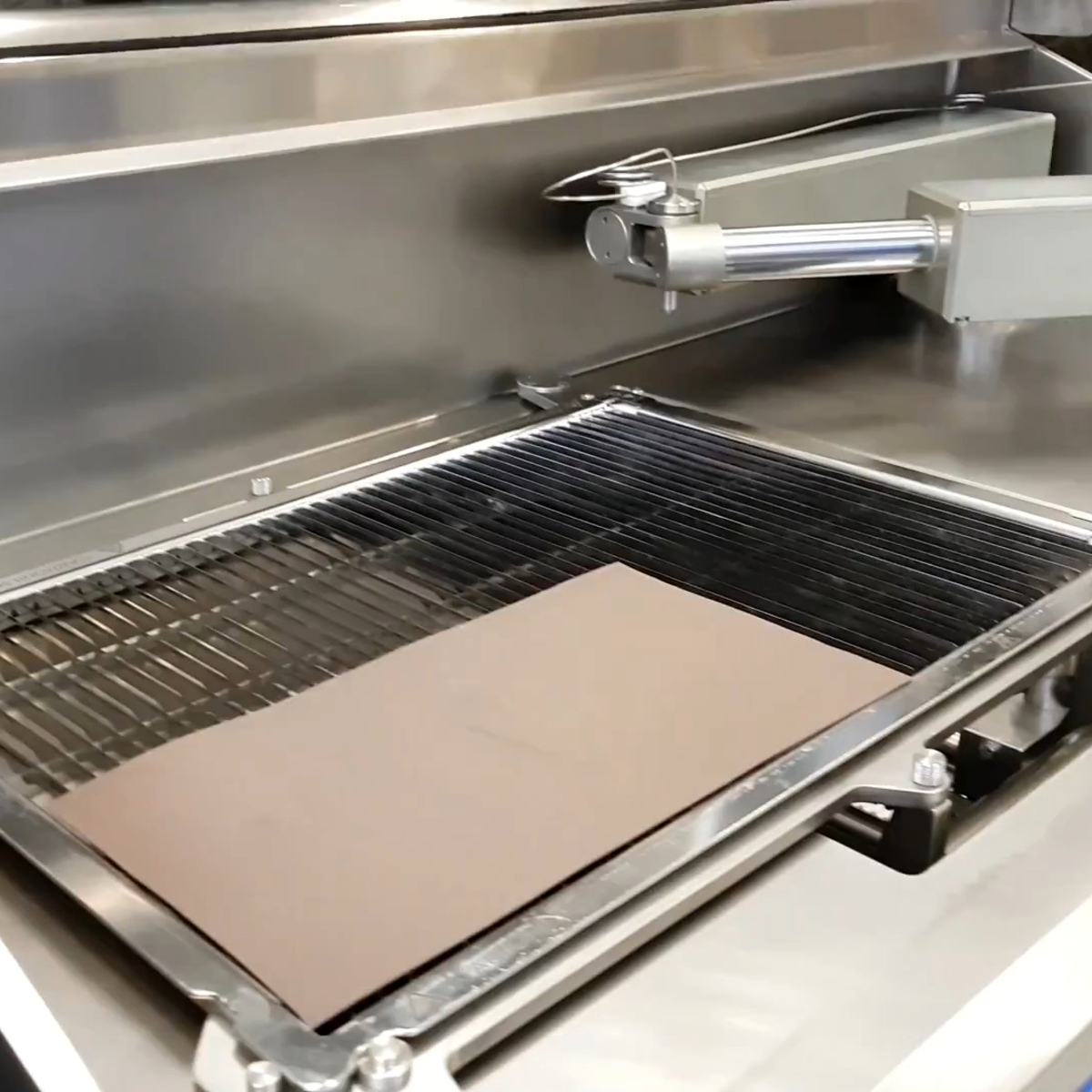
The coolest thing about this machine for us is the drive mechanism. A huge circular gear is trapped between two toothed belts. When the two belts move together the entire thing translates, but when they move in opposite directions, it turns. It seems to be floating on a plastic platform, and because the design allows the water-jet cutting head to remain entirely fixed, only a small hole underneath is necessary, which doubtless simplifies high-pressure water delivery and collection. Rounding the machine out are cake pans make up of vertical slats, like on a laser- or plasma-cutter table, that slip into registration pins and let the water pass through.

The kinematics of this machine are a dream, or perhaps a nightmare. To cut a straight line, it does a cycloid-shaped dance of translation and turning that you simply have to see in motion. Because of this intricate path, the cake-feed speed varies along the way, so this machine won’t be perfect for all applications and relies on a thin kerf. And we can’t help thinking how dizzy the cake must get in the process.

Indeed, the same company put out a relatively pedestrian two-arm motion cutter (another video!) that poses different kinematic problems. It’s essentially a two-arm plotter with a moving table underneath that helps increase the working area. Details are scarce, but it looks like they’re minimizing motion of the moving table, doing the high frequency small stuff with the stiff arms. Presumably someone turned the speed on the previous machine up to 11 and spun a cake off into the room, causing them to rethink the whole move-the-cake-around design.

Of course, watercut pastry isn’t limited to exotic CNC mechanisms. This (third!) video demonstrates that a simple Cartesian XY bot can do the job as well.

If you think about it, using high-pressure pure water to cut foodstuffs is a win on many levels. We’d just miss out on licking the knife. Thanks [Adam G DeMuri] for the awesome comment that lead us to a new world of watercut edibles.

source https://hackaday.com/2021/03/06/waterjet-cut-precision-pastry/

Waterjet-Cut Precision Pastry

We need more high-end, geometric pastry in our lives. This insight is courtesy of a fairly old video, embedded below, demonstrating an extremely clever 2D CNC mechanism that cuts out shapes on a cake pan, opening up a universe of arbitrary cake topologies.

The coolest thing about this machine for us is the drive mechanism. A huge circular gear is trapped between two toothed belts. When the two belts move together the entire thing translates, but when they move in opposite directions, it turns. It seems to be floating on a plastic platform, and because the design allows the water-jet cutting head to remain entirely fixed, only a small hole underneath is necessary, which doubtless simplifies high-pressure water delivery and collection. Rounding the machine out are cake pans make up of vertical slats, like on a laser- or plasma-cutter table, that slip into registration pins and let the water pass through.

The kinematics of this machine are a dream, or perhaps a nightmare. To cut a straight line, it does a cycloid-shaped dance of translation and turning that you simply have to see in motion. Because of this intricate path, the cake-feed speed varies along the way, so this machine won’t be perfect for all applications and relies on a thin kerf. And we can’t help thinking how dizzy the cake must get in the process.

Indeed, the same company put out a relatively pedestrian two-arm motion cutter (another video!) that poses different kinematic problems. It’s essentially a two-arm plotter with a moving table underneath that helps increase the working area. Details are scarce, but it looks like they’re minimizing motion of the moving table, doing the high frequency small stuff with the stiff arms. Presumably someone turned the speed on the previous machine up to 11 and spun a cake off into the room, causing them to rethink the whole move-the-cake-around design.

Of course, watercut pastry isn’t limited to exotic CNC mechanisms. This (third!) video demonstrates that a simple Cartesian XY bot can do the job as well.

If you think about it, using high-pressure pure water to cut foodstuffs is a win on many levels. We’d just miss out on licking the knife. Thanks [Adam G DeMuri] for the awesome comment that lead us to a new world of watercut edibles.

source https://hackaday.com/2021/03/06/waterjet-cut-precision-pastry/

Waterjet-Cut Precision Pastry

We need more high-end, geometric pastry in our lives. This insight is courtesy of a fairly old video, embedded below, demonstrating an extremely clever 2D CNC mechanism that cuts out shapes on a cake pan, opening up a universe of arbitrary cake topologies.

The coolest thing about this machine for us is the drive mechanism. A huge circular gear is trapped between two toothed belts. When the two belts move together the entire thing translates, but when they move in opposite directions, it turns. It seems to be floating on a plastic platform, and because the design allows the water-jet cutting head to remain entirely fixed, only a small hole underneath is necessary, which doubtless simplifies high-pressure water delivery and collection. Rounding the machine out are cake pans make up of vertical slats, like on a laser- or plasma-cutter table, that slip into registration pins and let the water pass through.

The kinematics of this machine are a dream, or perhaps a nightmare. To cut a straight line, it does a cycloid-shaped dance of translation and turning that you simply have to see in motion. Because of this intricate path, the cake-feed speed varies along the way, so this machine won’t be perfect for all applications and relies on a thin kerf. And we can’t help thinking how dizzy the cake must get in the process.

Indeed, the same company put out a relatively pedestrian two-arm motion cutter (another video!) that poses different kinematic problems. It’s essentially a two-arm plotter with a moving table underneath that helps increase the working area. Details are scarce, but it looks like they’re minimizing motion of the moving table, doing the high frequency small stuff with the stiff arms. Presumably someone turned the speed on the previous machine up to 11 and spun a cake off into the room, causing them to rethink the whole move-the-cake-around design.

Of course, watercut pastry isn’t limited to exotic CNC mechanisms. This (third!) video demonstrates that a simple Cartesian XY bot can do the job as well.

If you think about it, using high-pressure pure water to cut foodstuffs is a win on many levels. We’d just miss out on licking the knife. Thanks [Adam G DeMuri] for the awesome comment that lead us to a new world of watercut edibles.

source https://hackaday.com/2021/03/06/waterjet-cut-precision-pastry/

X-Ray Defeats Letterlocking — Unfolds and Reads Letter Sealed Since 1697

Over recent years we’ve been treated to a series of fascinating advances in the world of x-ray imaging, as  researchers have developed their x-ray microtomography techniques and equipment to the point at which they can probe and then computationally reconstruct written material within objects such as letters or scrolls in museum collections whose value or fragility means they can’t be opened and read conventionally. There is more to this challenge than simply extracting the writing though, in addition to detecting the ink the researchers also have to unpick the structure of whatever it was written upon. A particular challenge comes from letterpackets, the art of folding a letter into its own envelope, and a newly-published Nature Communications paper details work from a team of academics in the USA, the UK, and the Netherlands in tackling it.

Letterpackets were more than a practical method of packaging a missive for the mail, they also had a security function often called Letterlocking. A packet would be folded in such a way as to ensure it was impossible to open without tearing or otherwise damaging the paper, and their structure is of especial interest to historians. The researchers had a unique resource with which to work; the Brienne collection is a trunk full of undeliverable mail amassed by a 17th century postmaster couple in Den Haag in the Netherlands, and now in the possession of the Beeld en Geluid museum in that city. In it were a cache of letters including 577 never-opened letterpackets, and the x-ray technique promised a means to analyse these without compromising them.

A letter imaged using the technique.

The researchers have developed an entirely computational technique for the virtual unfolding process. Starting with a 3D volumetric x-ray scan of the unopened packet they then identify the various layers of paper and the bright spots which denote the ink. Their algorithm has to cope with areas in which two or more layers are tightly in contact, for example when multiple levels are folded, and then unpick the resulting 3-dimensional mesh into a 2-dimensional sheet. Their process for mapping the crease pattern involves applying a colour map representing the mean curve radius at a given point. The final section of the paper looks at the multiple different methods of letterlocking, and attempts to categorise them all including a security rating for each. It’s evident that this could be a highly personalised process, indeed they give as an example a letter from Mary Queen of Scots that used an intricate spiral folding technique to identify its sender.

It’s clear that this technique will reveal many more fascinating historical documents as it is both refined and extended across the many more collections of further artefacts that have lain waiting for it. As they say, individual letters do not necessarily contain earth-shattering historical discoveries, but taken together they shed an important light on the social history of past centuries.

One of the names on the paper is [David Mills], whose work has featured here before.

source https://hackaday.com/2021/03/06/x-ray-defeats-letterlocking-unfolds-and-reads-letter-sealed-since-1697/

NASA’s Perseverance Rover Makes Its First Martian Tracks

There’s a special kind of anxiety that comes from trying out a robotic project for the first time. No matter the size, complexity, or how much design and planning has gone into it, the first time a creation moves under its own power can put butterflies in anyone’s stomach. So we can imagine that many people at NASA are breathing a sigh of relief now that the Perseverance rover has completed its first successful test drive on Mars.

To be fair, Perseverance was tested here on Earth before launch. However, this is the first drive since the roving scientific platform was packed into a capsule, set on top of a rocket, and flung hundreds of millions of miles (or kilometers, take your pick) to the surface of another planet. As such, and true to NASA form, the operators are taking things slow.

This joyride certainly won’t be setting speed records. The atomic-powered vehicle traveled a total of just 21.3 feet (6.5 meters) in 33 minutes, including forward, reverse, and a 150 degree turn in-between. That’s enough for the mobility team to check out the drive systems and deem the vehicle worthy of excursions that could range 656 feet (200 meters) or more. Perseverance is packed with new technology, including an autonomous navigation system for avoiding hazards without waiting for round-trip communication with Earth, and everything must be tested before being put into full use.

A couple weeks have passed since the world was captivated by actual video of the rover’s entry, descent, and landing, and milestones like this mark the end of that flashy, rocket-powered skycrane period and the beginning of a more settled-in period, where the team works day-to-day in pursuit of the mission’s science goals. The robotic arm and several on-board sensors and experiments have already completed their initial checks. In the coming months, we can look forward to tons of data coming back from the red planet, along with breathtaking pictures of its alien surface and what will hopefully be the first aircraft flown on another world.

source https://hackaday.com/2021/03/06/nasas-perseverance-rover-makes-its-first-martian-tracks/

99% Inspiration, 99% Perspiration, and 99% Collaboration

I was watching an oldish TEDx talk with Rodney Mullen, probably the most innovative street skater ever, but that’s not the point, and it’s not his best talk either. Along the way, he makes a claim that ideas — in particular the idea that a particular skateboard trick is even possible — are the most important thing.

His experience, travelling around the world on skateboard tours, is that there are millions of kids who are talented enough that when they see a video demonstrating that a particular trick idea is possible, they can replicate it in short order. Not because the video showed them how, but because it expanded their mind’s-eye view of what is possible. They were primed, and so what pushed them over the edge was the inspiration.

On the other side of the street, we’ve got Thomas Edison and his “1% inspiration, 99% perspiration” routine. Edison famously tried a bazillion filament recipes before settling on tungsten, and attributes his success to “putting his time in” or “good old-fashioned hard work” or similar. So who’s right?

The inventor of Casper Slide and the phonograph are both right. Rodney is taking it for granted that these kids have put their time in; they are skaters after all, they skate. He doesn’t see the 99% perspiration because it is the natural background, while the inspiration flashes out in Eureka moments.

Similarly, Thomas E. way underestimates inspiration. He’s already fixated on this novel idea to take an arc lamp and contain it in a glass envelope — that’s what he’s spending all of his perspiration on, after all. But without that key inspiration, all he’d be is sweaty.

And they’re also both wrong! They’re both missing a third ingredient: collaboration. Certainly Mullen, who spent his life hanging out with other skaters, teaching them what he knows, and learning from them in turn, wouldn’t say the community of skaters didn’t shape him. Even in the loner’s sport of skating, nobody is alone. And Edison? His company profited greatly from broader advances in science, and the scientific literature. Menlo Park existed to take bright, well-trained minds and put them all in one place, sharing, teaching, and working together. It embodied the idea of collaborative innovation, and that’s where some of his best work was done.

So I’m with Isaac Newton, “standing on the shoulders of giants“. Success is 99% collaboration. This leaves us with one problem: the percentages don’t add up. But that’s alright by me.

source https://hackaday.com/2021/03/06/99-inspiration-99-perspiration-and-99-collaboration/

99% Inspiration, 99% Perspiration, and 99% Collaboration

I was watching an oldish TEDx talk with Rodney Mullen, probably the most innovative street skater ever, but that’s not the point, and it’s not his best talk either. Along the way, he makes a claim that ideas — in particular the idea that a particular skateboard trick is even possible — are the most important thing.

His experience, travelling around the world on skateboard tours, is that there are millions of kids who are talented enough that when they see a video demonstrating that a particular trick idea is possible, they can replicate it in short order. Not because the video showed them how, but because it expanded their mind’s-eye view of what is possible. They were primed, and so what pushed them over the edge was the inspiration.

On the other side of the street, we’ve got Thomas Edison and his “1% inspiration, 99% perspiration” routine. Edison famously tried a bazillion filament recipes before settling on tungsten, and attributes his success to “putting his time in” or “good old-fashioned hard work” or similar. So who’s right?

The inventor of Casper Slide and the phonograph are both right. Rodney is taking it for granted that these kids have put their time in; they are skaters after all, they skate. He doesn’t see the 99% perspiration because it is the natural background, while the inspiration flashes out in Eureka moments.

Similarly, Thomas E. way underestimates inspiration. He’s already fixated on this novel idea to take an arc lamp and contain it in a glass envelope — that’s what he’s spending all of his perspiration on, after all. But without that key inspiration, all he’d be is sweaty.

And they’re also both wrong! They’re both missing a third ingredient: collaboration. Certainly Mullen, who spent his life hanging out with other skaters, teaching them what he knows, and learning from them in turn, wouldn’t say the community of skaters didn’t shape him. Even in the loner’s sport of skating, nobody is alone. And Edison? His company profited greatly from broader advances in science, and the scientific literature. Menlo Park existed to take bright, well-trained minds and put them all in one place, sharing, teaching, and working together. It embodied the idea of collaborative innovation, and that’s where some of his best work was done.

So I’m with Isaac Newton, “standing on the shoulders of giants“. Success is 99% collaboration. This leaves us with one problem: the percentages don’t add up. But that’s alright by me.

source https://hackaday.com/2021/03/06/99-inspiration-99-perspiration-and-99-collaboration/

Lost a Lightweight Quadcopter? Here Are The Best Ways To Find It

Lost aircraft are harder to find when they are physically small to begin with. Not only are they harder to see, but the smaller units lack features like GPS tracking; it’s not normally possible to add it to a tiny aircraft that can’t handle much more than its own weight in the first place. As a result, little lost quads tend to be trickier to recover in general.

Fluorescent tape adds negligible weight, and will glow brightly at night under a UV light.

The good news is that [Eric Brasseur] has shared some concise tips on how to more easily locate and recover lost aircraft, especially lightweight ones. Recovering aircraft is something every aircraft hobbyist has had to deal with in one way or another, but [Eric] really has gathered an impressive list of tricks and techniques, and some of them go into some really useful additional detail. It occurs to us that a lot of these tips could apply equally well to outdoor robots, or rovers.

Even simple techniques can be refined. For example, using bright colors on an aircraft is an obvious way to increase visibility, but some colors are better choices than others. Bright orange, white, and red are good choices because they are easily detected by the human eye while still being uncommon in nature. Violet, blue, and even cyan on the other hand may seem to be good choices when viewed indoors on a workbench, but if the quad is stuck in dark bushes, those colors will no longer stand out. Another good tip is to consider also adding a few patches of fluorescent tape to the aircraft. If all else fails, return at night with a UV lamp; those patches will glow brightly, and be easily seen from tens of meters.

Some of the tips are used while the device still has power, while others don’t depend on batteries holding out. [Eric] does a great job of summing up those and many more, so take a look. They might come in handy when test flying quadcopters that are little more than an 18650 cell, motors, and a 3D-printable frame.

source https://hackaday.com/2021/03/06/lost-a-lightweight-quadcopter-here-are-the-best-ways-to-find-it/

Print Chess Pieces, then Defeat the Chess-Playing Printer

Chess is undoubtedly a game of the mind. Sadly, some of the nuances are lost when you play on a computer screen. When a game is tactile, it carries a different gravity. Look at a poker player shuffling chips, and you’ll see that when a physical object is on the line, you play for keeps. [Matou], who is no stranger to 3D printing, wanted that tactility, but he didn’t stop at 3D printed pieces. He made parts to transform his Creality Ender 3 Pro into a chess-playing robot.

To convert his printer, [Matou] designed a kit that fits over the print head to turn a hotend into a cool gripper. The extruder motor now pulls a string to close the claw, which is a darn clever way to repurpose the mechanism. A webcam watches the action, while machine vision determines what the player is doing, then queries a chess AI, and sends the next move to OctoPrint on a connected RasPi. If two people had similar setups, it should be no trouble to play tactile chess from opposite ends of the globe.

Physical chess pieces and computers have mixed for a while and probably claimed equal time for design and gameplay. There are a couple of approaches to automating movement from lifting like [Matou], or you can keep them in contact with the board and move them from below.

source https://hackaday.com/2021/03/06/print-chess-pieces-then-defeat-the-chess-playing-printer/

buttonpusher Automates Animal Crossing Tasks

Press button, wait, press button again, repeat. There must be a better way! If that kind of interaction drives you nuts, you’ll probably appreciate [Tommy]’s buttonpusher, which has only one job: automate away some of the more boring parts of Nintendo’s Animal Crossing. On one hand the job the device does is very simple: press a button on the Nintendo joy-con in a preprogrammed pattern. There’s no feedback loop, it just dumbly presses and waits. But there are still quite a few interesting bits to this build.

Rigid mounting combined with interfacing the actuator to the servo horn (instead of to the servo shaft) were the keys to reliable button pushing.

For one thing, [Tommy] discovered that the little 9g RC servo can reliably exert enough force to press the button on the joy-con with the right adapter. He had assumed the servo would be too weak to do the job without a greater mechanical advantage, but a simple hammer-style actuator that attaches to the servo horn easily does the job. Well, it does as long as the servo and joy-con are held rigidly; his first version allowed a little too much wiggle in how well the parts were held, and button presses didn’t quite register. With a 3D-printed fixture to rigidly mount both the servo and the joy-con, things were fine.

In the process of making buttonpusher, which uses CircuitPython, [Tommy] created a tool to automate away another pesky task he was running into: circuitpython_tools was created to automatically watch for code changes, convert the .py files into (smaller) MicroPython bytecode .mpy files, then automatically deploy to the board. This saved [Tommy] a lot of time and hassle during development, but it was only necessary because he quickly ran out of memory on his M0 Metro Express board, and couldn’t fit his code in any other way.

Still, it’s a good example of how one project can sometimes spawn others, and lead to all kinds of lessons learned. You can see buttonpusher automate the crafting process in Animal Crossing in the video, embedded below.

Video game controller automation is a common project, especially for nondestructive hacks. People get pretty creative, and have even come up with ways to automate joystick movements.

source https://hackaday.com/2021/03/05/buttonpusher-automates-animal-crossing-tasks/

buttonpusher Automates Animal Crossing Tasks

Press button, wait, press button again, repeat. There must be a better way! If that kind of interaction drives you nuts, you’ll probably appreciate [Tommy]’s buttonpusher, which has only one job: automate away some of the more boring parts of Nintendo’s Animal Crossing. On one hand the job the device does is very simple: press a button on the Nintendo joy-con in a preprogrammed pattern. There’s no feedback loop, it just dumbly presses and waits. But there are still quite a few interesting bits to this build.

Rigid mounting combined with interfacing the actuator to the servo horn (instead of to the servo shaft) were the keys to reliable button pushing.

For one thing, [Tommy] discovered that the little 9g RC servo can reliably exert enough force to press the button on the joy-con with the right adapter. He had assumed the servo would be too weak to do the job without a greater mechanical advantage, but a simple hammer-style actuator that attaches to the servo horn easily does the job. Well, it does as long as the servo and joy-con are held rigidly; his first version allowed a little too much wiggle in how well the parts were held, and button presses didn’t quite register. With a 3D-printed fixture to rigidly mount both the servo and the joy-con, things were fine.

In the process of making buttonpusher, which uses CircuitPython, [Tommy] created a tool to automate away another pesky task he was running into: circuitpython_tools was created to automatically watch for code changes, convert the .py files into (smaller) MicroPython bytecode .mpy files, then automatically deploy to the board. This saved [Tommy] a lot of time and hassle during development, but it was only necessary because he quickly ran out of memory on his M0 Metro Express board, and couldn’t fit his code in any other way.

Still, it’s a good example of how one project can sometimes spawn others, and lead to all kinds of lessons learned. You can see buttonpusher automate the crafting process in Animal Crossing in the video, embedded below.

Video game controller automation is a common project, especially for nondestructive hacks. People get pretty creative, and have even come up with ways to automate joystick movements.

source https://hackaday.com/2021/03/05/buttonpusher-automates-animal-crossing-tasks/

Explore the Cosmos with this DIY Digital Telescope

Getting a closer look at the Moon isn’t particularly difficult; even an absolute beginner can point a cheap telescope towards our nearest celestial neighbor and get some impressive views. But if you’re looking to explore a bit farther, and especially if you want to photograph what you find out there amongst the black, things can get complicated (and expensive) pretty quick.

While building this 3D printed automated telescope designed [Greg Holloway] isn’t necessarily cheap, especially once you factor in what your time is worth, the final product certainly looks to be considerably streamlined compared to most of what’s available in the commercial space. Rather than having to lug around a separate telescope, tripod, motorized tracker, and camera, you just need this relatively compact all-in-one unit.

It’s taken [Greg] six months to develop his miniature observatory, and it shows. The CAD work is phenomenal, as is the documentation in general. Even if you’re not interested in peering into the heavens, perusing the Instructables page for this project is well worth your time. From his tips on designing for 3D printing to information about selecting the appropriate lens and getting it mated to the Raspberry Pi HQ Camera, there’s a little something for everyone.

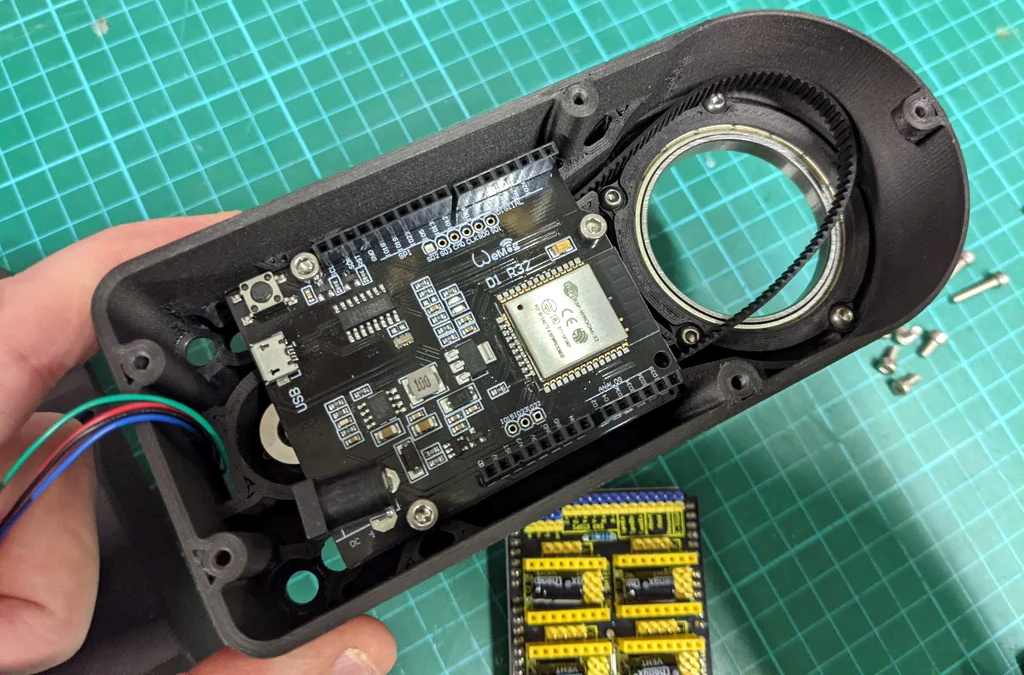
Of course if you are looking to build your own motorized “GOTO” telescope, then this is must-read stuff. [Greg] has really done his homework, and the project is a fantastic source of information about motor controllers, wiring, hand controllers, and the open source firmware you need to tie it all together. Many of the ideas he’s outlined here could be applicable to other telescope projects, or really, anything that needs to be accurately pointed to the sky. If you’d like to get started with night sky photography and aren’t picky about what kind of things you capture, we’ve seen a number of projects that simply point a camera towards the stars and wait for something to happen.

[Thanks to Eugene for the tip.]

source https://hackaday.com/2021/03/05/explore-the-cosmos-with-this-diy-digital-telescope/

Open-DIP Surgery Cuts Retro Chips Down to Size

At least by today’s standards, some of the early chips were really, really big. They may have been revolutionary and they certainly did shrink the size of electronic devices, but integrating a 40-pin DIP into a modern design can be problematic. The solution: cut off all the extra plastic and just work with the die within.

When [Redherring32] alerted us to this innovation, he didn’t include much information — just a couple of photos of the mod and a few brief words about the target chip, an RP2A03 from the glorious NES 8-bit days. Living as it does within the relatively enormous DIP-40 package, it stood to take up far too much space in compact, more modern designs. So the hapless chip fell under the knife, or rather the Dremel tool diamond cutoff wheel. [Redherring32] left a generous boundary around the die. Cutting through the package left the lead frame of the die exposed enough to solder 34AWG (0.02 mm²) magnet wire to bring the leads out for connection. We’d have worried that vibration from the cutting process would have damaged the silicon, but the video in the tweet tells otherwise.

For now, the liberated die is connected to a piece of perfboard, which ironically enough actually makes it larger than the original chip. But this is a proof-of-concept, and given that the operation shrunk the footprint of the chip by about 93%, it should enable some interesting applications. Perhaps a smaller, better version of [Redherring32]’s OpenTendo is in the works.

source https://hackaday.com/2021/03/05/open-dip-surgery-cuts-retro-chips-down-to-size/

Open-DIP Surgery Cuts Retro Chips Down to Size

At least by today’s standards, some of the early chips were really, really big. They may have been revolutionary and they certainly did shrink the size of electronic devices, but integrating a 40-pin DIP into a modern design can be problematic. The solution: cut off all the extra plastic and just work with the die within.

When [Redherring32] alerted us to this innovation, he didn’t include much information — just a couple of photos of the mod and a few brief words about the target chip, an RP2A03 from the glorious NES 8-bit days. Living as it does within the relatively enormous DIP-40 package, it stood to take up far too much space in compact, more modern designs. So the hapless chip fell under the knife, or rather the Dremel tool diamond cutoff wheel. [Redherring32] left a generous boundary around the die. Cutting through the package left the lead frame of the die exposed enough to solder 34AWG (0.02 mm²) magnet wire to bring the leads out for connection. We’d have worried that vibration from the cutting process would have damaged the silicon, but the video in the tweet tells otherwise.

For now, the liberated die is connected to a piece of perfboard, which ironically enough actually makes it larger than the original chip. But this is a proof-of-concept, and given that the operation shrunk the footprint of the chip by about 93%, it should enable some interesting applications. Perhaps a smaller, better version of [Redherring32]’s OpenTendo is in the works.

source https://hackaday.com/2021/03/05/open-dip-surgery-cuts-retro-chips-down-to-size/

Open-DIP Surgery Cuts Retro Chips Down to Size

At least by today’s standards, some of the early chips were really, really big. They may have been revolutionary and they certainly did shrink the size of electronic devices, but integrating a 40-pin DIP into a modern design can be problematic. The solution: cut off all the extra plastic and just work with the die within.

When [Redherring32] alerted us to this innovation, he didn’t include much information — just a couple of photos of the mod and a few brief words about the target chip, an RP2A03 from the glorious NES 8-bit days. Living as it does within the relatively enormous DIP-40 package, it stood to take up far too much space in compact, more modern designs. So the hapless chip fell under the knife, or rather the Dremel tool diamond cutoff wheel. [Redherring32] left a generous boundary around the die. Cutting through the package left the lead frame of the die exposed enough to solder 34AWG (0.02 mm²) magnet wire to bring the leads out for connection. We’d have worried that vibration from the cutting process would have damaged the silicon, but the video in the tweet tells otherwise.

For now, the liberated die is connected to a piece of perfboard, which ironically enough actually makes it larger than the original chip. But this is a proof-of-concept, and given that the operation shrunk the footprint of the chip by about 93%, it should enable some interesting applications. Perhaps a smaller, better version of [Redherring32]’s OpenTendo is in the works.

source https://hackaday.com/2021/03/05/open-dip-surgery-cuts-retro-chips-down-to-size/

Get Apple to Track Your Bluetooth Devices For You

Apple’s “Find My” service allows users to track their missing devices by leveraging a worldwide network of location-aware iGadgets. With millions of iPhones and Macs out in the wild listening for the missing device’s Bluetooth advertisements and relaying their findings to the Cupertino Mothership, it’s a highly effective way of tracking hardware so long as it stays in relatively urban areas. Unfortunately, the system is completely proprietary and non-Apple devices aren’t invited to play.

Or at least, that used to be the case. A project recently released by the [Secure Mobile Networking Lab] called OpenHaystack demonstrates how generic devices can utilize Apple’s Find My network by mimicking the appropriate Bluetooth Low Energy (BLE) broadcasts. Currently they have a firmware image for the BBC micro:bit, as well as a Python script for Linux, that will allow you to spin up an impromptu Find My target. But the team has also published all the information required to implement similar functionality on other BLE-capable devices and microcontrollers, so expect the list of supported hardware to grow shortly.

Diagram showing how the Apple Find My system worksSomewhat ironically, while OpenHaystack allows you to track non-Apple devices on the Find Me tracking network, you will need a Mac computer to actually see where your device is. The team’s software requires a computer running macOS 11 (Big Sur) to run, and judging by the fact it integrates with Apple Mail to pull the tracking data through a private API, we’re going to assume this isn’t something that can easily be recreated in a platform-agnostic way. Beyond the occasional Hackintosh that might sneak in there, it looks like Tim Cook might have the last laugh after all.
It’s not immediately clear how difficult it will be for Apple to close this loophole, but the talk of utilizing a private API makes us think there might be a built-in time limit on how long this project will be viable. After all, Big Tech doesn’t generally approve of us peons poking around inside their machinations for long. Though even if Apple finds a way to block OpenHaystack, it’s expected the company will be releasing “AirTags” sometime this year which will allow users to track whatever objects they like through the system.

source https://hackaday.com/2021/03/05/get-apple-to-track-your-bluetooth-devices-for-you/

Eyesight Guardian Polices Your Poor Pupils

Don’t know about you, but over the last year or so, we have gone from spending ten or twelve hours a day at this computer to upwards of sixteen or eighteen. Fortunately there’s a window behind the monitor for taking those 20/20/20 breaks that are supposed to prevent eye strain, but it’s so hard to remember (and boring) to do it. And nobody needs yet another thing to remember in the name of self-care.

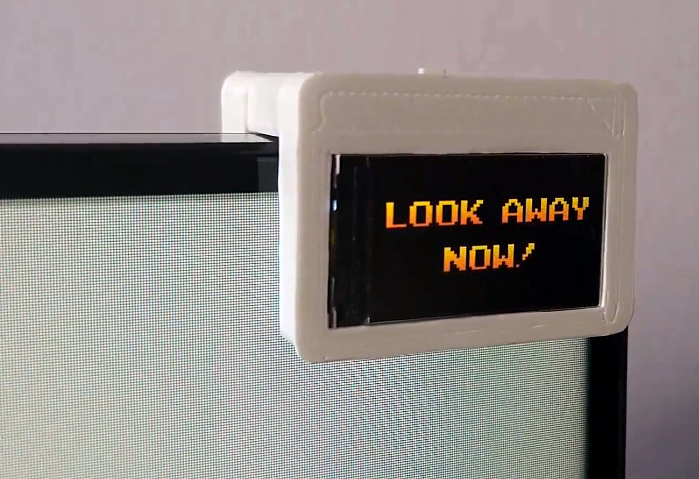
[Daniel Hingston] certainly agrees. As you’ll see in the delightful video after the break, [Daniel] has made a game out of the whole process of stopping every twenty minutes to spend twenty seconds looking at a point that’s at least twenty feet away. Once the break is over, [Daniel] uses the dual-purpose start button to acknowledge having looked away for 20 seconds. The device is meant to clip onto the corner of any monitor, and [Daniel] has provided several sizes of the bridge piece so that everyone can find their fit.

The Guardian’s guts are pretty simple — an Arduino Pro Mini runs the stop watch and a TFT display to show the graphics that live on an SD card. This is a great way to preserve your eyesight by gamifying something we all know we should be doing. It might be nice to add a break timer that counts up to 25 or thereabouts so you have time to stand up and come back. If you press the button too soon, it scolds you and you have to start your eye break over.

Need some more self-care lately? Our own [Jenny List] has your back in these interesting times.

source https://hackaday.com/2021/03/05/eyesight-guardian-polices-your-poor-pupils/

Elegant and Portable DIY Nightlight Becomes a Fixture for Hacker’s Kids

When [itzikdiy]’s kids asked for a night light for their room, he got the bright idea to build something that straddles the line between portable and permanent. This fixture-less fixture plugs directly into a wall socket and is turned on and off with a handsome rocker switch on the bottom.

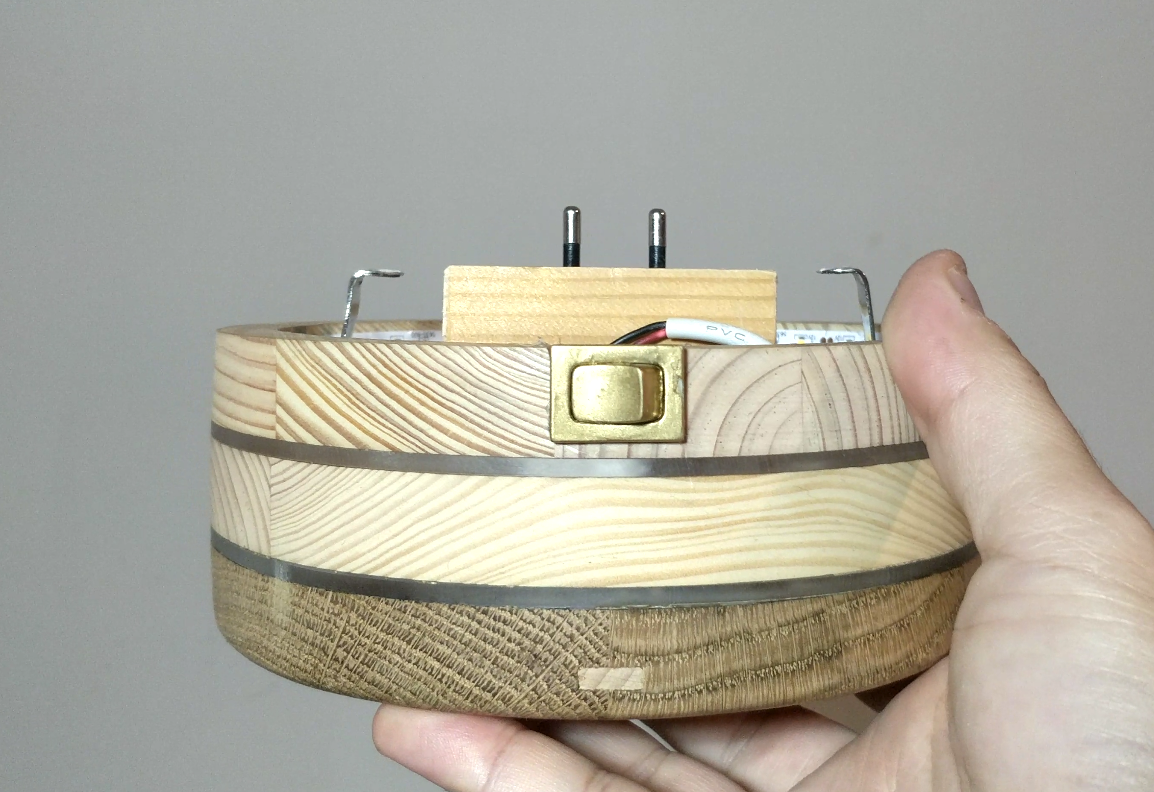
This lovely little lamp is mostly made from scrap — the oak on the front appears to have come from an old cabinet door, and the other two ring-shaped pieces are made from pine. [itzikdiy] even took the acrylic from broken panel lamps. Everything was cut with a Dremel and a circle-cutter attachment except the oak, which required a jigsaw. We think it looks great, especially with the different grain directions — call it art deco woodworking.

When it was all said and done, [itzikdiy] found it was too heavy to hang by the plug alone, so he added an L-shaped support beneath the power supply that holds it more evenly against the wall. [itzikdiy] also made a pair of hooks that snap into a pair of slots on the sides of the outlet itself. The solution is simple, sturdy, and effective without disrupting the lines of the lamp at all. Carve out a little bit of time to watch the build video after the break.

We know that someone of your hulking intelligence has no fear of the dark. But if you think you could use a nightlight in the bathroom for those 2 AM trips, look no further.

source https://hackaday.com/2021/03/05/elegant-and-portable-diy-nightlight-becomes-a-fixture-for-hackers-kids/

Elegant and Portable DIY Nightlight Becomes a Fixture for Hacker’s Kids

When [itzikdiy]’s kids asked for a night light for their room, he got the bright idea to build something that straddles the line between portable and permanent. This fixture-less fixture plugs directly into a wall socket and is turned on and off with a handsome rocker switch on the bottom.

This lovely little lamp is mostly made from scrap — the oak on the front appears to have come from an old cabinet door, and the other two ring-shaped pieces are made from pine. [itzikdiy] even took the acrylic from broken panel lamps. Everything was cut with a Dremel and a circle-cutter attachment except the oak, which required a jigsaw. We think it looks great, especially with the different grain directions — call it art deco woodworking.

When it was all said and done, [itzikdiy] found it was too heavy to hang by the plug alone, so he added an L-shaped support beneath the power supply that holds it more evenly against the wall. [itzikdiy] also made a pair of hooks that snap into a pair of slots on the sides of the outlet itself. The solution is simple, sturdy, and effective without disrupting the lines of the lamp at all. Carve out a little bit of time to watch the build video after the break.

We know that someone of your hulking intelligence has no fear of the dark. But if you think you could use a nightlight in the bathroom for those 2 AM trips, look no further.

source https://hackaday.com/2021/03/05/elegant-and-portable-diy-nightlight-becomes-a-fixture-for-hackers-kids/

Elegant and Portable DIY Nightlight Becomes a Fixture for Hacker’s Kids

When [itzikdiy]’s kids asked for a night light for their room, he got the bright idea to build something that straddles the line between portable and permanent. This fixture-less fixture plugs directly into a wall socket and is turned on and off with a handsome rocker switch on the bottom.

This lovely little lamp is mostly made from scrap — the oak on the front appears to have come from an old cabinet door, and the other two ring-shaped pieces are made from pine. [itzikdiy] even took the acrylic from broken panel lamps. Everything was cut with a Dremel and a circle-cutter attachment except the oak, which required a jigsaw. We think it looks great, especially with the different grain directions — call it art deco woodworking.

When it was all said and done, [itzikdiy] found it was too heavy to hang by the plug alone, so he added an L-shaped support beneath the power supply that holds it more evenly against the wall. [itzikdiy] also made a pair of hooks that snap into a pair of slots on the sides of the outlet itself. The solution is simple, sturdy, and effective without disrupting the lines of the lamp at all. Carve out a little bit of time to watch the build video after the break.

We know that someone of your hulking intelligence has no fear of the dark. But if you think you could use a nightlight in the bathroom for those 2 AM trips, look no further.

source https://hackaday.com/2021/03/05/elegant-and-portable-diy-nightlight-becomes-a-fixture-for-hackers-kids/

This Week in Security: Text Rendering on Windows, GNU Poke, and Bitsquatting

Project Zero just unrestricted the details on CVE-2021-24093, a potentially nasty vulnerability in Windows 10’s DirectWrite, a text rendering library. The flaw got fixed in this month’s patch Tuesday roundup. The flaw is accessible in all the major browsers on Windows 10, as they use DirectWrite for font rendering. The trick here is to use a malicious font that uses some nonsense values. Those values result in a buffer allocation that is too small for complex characters such as Æ.

Because the vulnerability is a Windows library, it’s possible that an exploit would automatically work as a sandbox escape, but I haven’t seen confirmation either way. Let us know if you have some insight there.

Via Bleeping Computer

GNU Poke

The good folks at GNU have minted the 1.0 release of poke, a new binary editing tool. The real killer feature of poke is that it can interpret binary data, decoding it back into readable data structures. If you’re familiar with the way Wireshark can decode packets and give useful, organized output, it seems that poke will provide a similar function, but not limited to network traffic.

It looks like it could become a useful tool for getting a look inside otherwise opaque binaries. What poke brings is a system where you can write pretty-printing templates on the fly, which should be very useful when mapping out an unfamiliar binary. Distros will likely pick up and start packaging poke in the coming weeks, making it even easier to get and play with.

Legitimate Malware Makers?

The chickens may be coming home to roost for The NSO Group. So quick review, NSO makes complex spyware. NSO produced malware targeting Whatsapp users around the world. NSO makes the case that they simply make the tools and sell them legally to governments, and can’t be held liable for what those governments do with those tools. Well, the US Department of Justice isn’t convinced, and has slowly been working on a case against NSO.

The case has the potential to be an important one, as it will set precedent for whether a malware maker is liable for how that malware is used. Some very big names, like Google and Microsoft, have thrown their weight behind the potential prosecution. Their stance is that immunity granted to a spyware maker will result in poorer security for everyone. I do wonder what such a ruling would mean for a security researcher releasing a proof-of-concept for a vulnerability. If a malware campaign went on to adapt and use research code, is that a liability?

Cisco Vulnerabilities

Cisco just recently released a set of patches and vulnerabilities, and a handful of them are really serious. First up is CVE-2021-1393, a bug in the Cisco Application Services Engine. The vulnerability is described as “insufficient access control” on a specific service. An unauthenticated attacker can connect to the service over TCP and make system changes. The description is quite vague, but this could be something like a debug port that was accidentally enabled in production. A very jaded and cynical guess would be that they simply left a telnet port wide open.

Next up is CVE-2021-1388, a similar bug in Cisco’s ACI Multi-Site Orchestrator. In this case, it’s an API that can be fooled into providing a administrator token. Once in possession of this token, one can access the entire API as an administrator, all without having a login at all.

And finally, CVE-2021-1361 is a file system management service that was unintentionally exposed to the outside network on port 9075. A vulnerability in that service means that an attacker can make arbitrary file creation, deletion, or modification.

Exchange 0-days

Microsoft Exchange just got patched for a set of vulnerabilities that were discovered because of active exploitation. Microsoft has attributed attacks to Hafnium, a group believed to be in the employ of the Chinese government.

Volexity seems to have been the firm that first discovered the attack. They have network monitoring services in place for various customers, and that service detected mass data exfiltration on two seperate customer networks. After tracking down the odd traffic, they discovered compromised Exchange servers, and were able to identify the 0-day that was used to compromise the machines.

Xerox

If you happen to discover a vulnerability in something made by Xerox, the appropriate response is apparently to release it anonymously online, as Xerox will send you a cease-and-desist order for anything else. [Raphaël Rigo] was scheduled to give a talk February 18th on a set of Xerox printer vulnerabilities, as part of the Infiltrate security conference. The day the talk was scheduled, Infiltrate announced that it had been canceled due to a legal threat from Xerox. The vulnerabilities were disclosed to Xerox back in 2020, so it’s not as if they didn’t have sufficient time to fix the problems.

Bitsquatting

Cosmic rays get blamed for the occasional computer problem. The theory is that a cosmic ray can hit a memory location and actually cause individual bits to flip. I don’t know whether cosmic rays are always to blame, but I do know that RAM problems are fairly common, and can cause hard-to-troubleshoot problems. We’ve talked about Rowhammer and associated attacks, where manipulating certain ram bits can cause changes in physically nearby bits. One of the security talks about unintentional bit flips suggested that the world’s computers see something like 600,000 mis-flips every day.

Now, bitsquatting is essentially a form of typosquatting. Typosquatting is picking a name a human is likely to accidentally mis-type, like “goggle.com”. Bitsquatting is selecting names likely to be reached through a bit flip. I was introduced to this idea through the work of [remy], who decided to finally test the theory of bitsquatting using the windows.com domain. I’ll use his research to demonstrate how this works. The string “windows” translates into binary as 01110111 01101001 01101110 01100100 01101111 01110111 01110011. A single bit flip can change that second character from 01101001, an “i”, to 01101000, an “h”. Suddenly your computer is looking for “whndows.com” for updates, or to get the current time, etc.

How often do connections intended for the windows domain end up at a bitsquatted domain instead? [remy] calculated that there are 32 such valid domains, and was able to purchase 14 of them — just under half. He set up wildcard DNS so that “*.whndows.com” would also resolve to the IP address where he was listening for traffic. On his 14 domains, in a two week period, he received 199,180 NTP requests. Those came from 626 discrete addresses.

There was one event that was of particular interest. A computer on a Chinese IP address made an HTTP request to time.wiodows.com, which may have been a typo made by a human, as this wasn’t actually an NTP request. The odd thing is that soon after this request came in, a second request arrived from the Baidu search spider, to the same bogus domain. [remy] found it odd, but I believe I know exactly what this is. The “Great Firewall of China” is known to detect HTTP connections to unknown domains, and follow with a connection of its own, scraping the new site’s content. This unexpected connection was almost certainly the GFW’s probing.

An earlier experiment ran for much longer, on a different set of bitsquatting domains. In this case, [Artem Dinaburg] observed the domains for just over seven months, and averaged 59 different IP addresses per day, trying to connect to the bogus domains. He points out that some of these connections are likely typos rather than bit flips. One other observation is that he found mobile devices to be overrepresented in connections to his bitsquatted domains. I can think of two possible explanations for this. First, it’s possible that mobile devices are more susceptible to bit flips, possibly because they are used outside so often. Alternatively, I suspect that mobile on-screen keyboards are just easier to typo on. In any case, bitsquatting is a very clever technique that really does have real-world impact.

source https://hackaday.com/2021/03/05/this-week-in-security-text-rendering-on-windows-gnu-poke-and-bitsquatting/