The world of automated farming may be an unglamorous one to those not invested in its attractions, but like the robots themselves that quietly get on in the background with tending crops, those who follow that path spend many seasons refining their designs. The Acorn is a newly-open-sourced robot from Twisted Fields, a Californian research farm, and it provides a fascinating look at the progress of a farming robot design from germination onwards.
The Acorn is not a CNC gantry for small intensive gardens in the manner of designs such as the Farmbot, instead it’s an autonomous solar-powered rover intended for larger farms which will cruise the fields continuously tending to the plants in its patch. It’s a work in progress, so what we see is the completed rover with the tools and machine vision to follow. It pursues the course of a low-cost lightweight platform, an aluminium chassis surmounted by the solar panel, with mountain bike front fork derived wheels at each corner. It has four wheel drive and four wheel steering, meaning that it can traverse the roughest of farmland. We can see its progress since a 2019 prototype, and while it seems as slow as the seasons themselves to mature, we can see that the final version could be a significantly useful machine on a small farm.
Most of the hacks we see around these parts have to do with taking existing components and cobbling them together in interesting new ways. It’s less often that we see existing components gutted and repurposed, but when it happens, like with this reimagined rotary encoder, it certainly grabs our attention.
You may recall [Chris G] from his recent laser-based Asteroids game. If not you should really check it out — the build was pretty sweet. One small problem with the build was in the controls, where the off-the-shelf rotary encoder he was using didn’t have nearly enough resolution for the job. Rather than choosing a commodity replacement part, [Chris] rolled his own from the mechanical parts of the original encoder, like the shaft and panel bushing, and an AS5048A sensor board. The magnetic angle sensor has 14 bits of resolution, and with a small neodymium ring magnet glued to the bottom of the original shaft, the modified encoder offers far greater resolution than the original contact-based encoder.
The sensor breakout board is just the right size for this job; all that [Chris] needed to do to get the two pieces together was to 3D-print a small adapter. We have to admit that when we first saw this on Hackaday.io, we failed to see what the hack was — the modified part looks pretty much like a run-of-the-mill encoder. The video below shows the design and build process with a little precision rock blasting.
At its core, the RetroArch project exists to make it easier to play classic games on more modern hardware. The streamlined front-end with its tailored collection of emulators helps take the confusion out of getting your favorite game from decades past running on whatever gadget you please, from your smartphone to the venerable Raspberry Pi. But there’s always room for improvement.
In a recent blog post, the folks behind RetroArch took the wraps off of an exciting hardware project that’s been in the works for about a year now. Referred to simply as “RetroArch Open Hardware”, the goal is to develop a fully open source cartridge adapter that will integrate seamlessly with the RetroArch software. Just plug in your original cartridge, and the game fires right up like back in the good old days.
Now to be clear, this isn’t exactly a new idea. But the team at RetroArch explain that previous devices that blurred the line between hardware and emulation have been expensive, hard to find, and worst of all, proprietary. By creating an open hardware project, they hope to truly unleash this capability on the community. Instead of having to deal with one vendor, multiple companies will be free to spin up their own clones and potentially even improve the core design. Should none of the ones on the market fit your particular needs, you’d even be free to build your own version,
What’s more, the gadget will also make it easier to create your own ROMs from cartridges you own. By appearing to the operating system as a USB Mass Storage device, users can literally drag and drop a game ROM to their computer’s desktop. No arcane software fired off from the command line; as much as we might enjoy such things, it’s not exactly intuitive for the gaming community at large. The same technique will also allow users to backup their saved progress before it’s inevitably lost to the ravages of time. The device demonstrated by the team currently only works on Nintendo 64 games, but presumably compatibility with be expanded to other cartridges in the future.
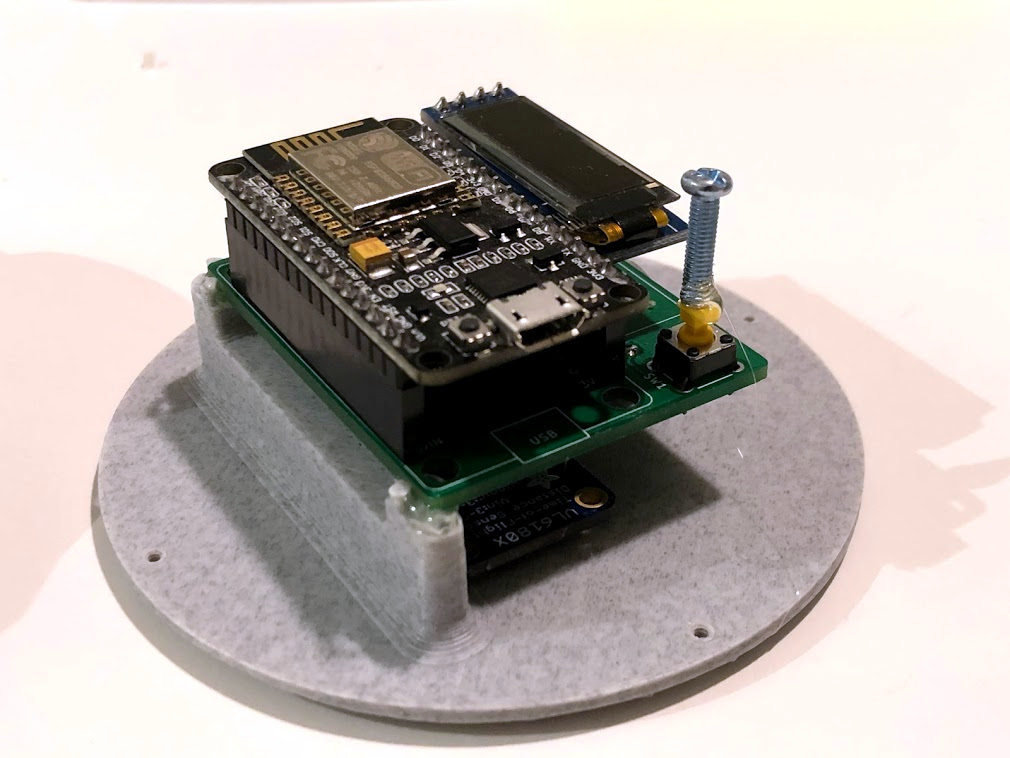
[Justin Lam] created a wonderfully-detailed writeup of his Smart Sourdough Lid project, which was created out of a desire to get better data on the progress and health of his sourdough starters, and to do so more efficiently. The result is a tidy, one-piece lid that constantly measures temperature, humidity, and height of the starter in the jar. Data is sent wirelessly for analysis, but there is also a handy OLED display on the top of the lid that shows immediately useful data like how much the starter has peaked, and how much time has passed since it did so.
The PCB was optimized for size, and not designed with mounting in mind, so a hot-glued machine screw serves as a “button extender”. Issues like this can happen when enclosures are designed after the fact; it’s something to which we can all relate.
We really like how focused the design is, and the level of detail [Justin] goes into to explain his design decisions and describe how well they worked out. This isn’t [Justin]’s first kick at the can when it comes to getting data on his sourdough, after all. We remember his earlier work using computer vision to analyze sourdough starters, and he used what he learned to inform this new design; the smart lid is easier to use and handles data much more efficiently.
The project’s GitHub repository has all the information needed to build your own. The lid is ESP8266-based and integrates a VL6180X time-of-flight (ToF) distance sensor, DHT22 to sense temperature and humidity, and a small SSD1306 OLED display for data. A small custom PCB keeps the modules tidy, and a 3D-printed custom enclosure makes it one tidy package.
[Justin] also analyzes the results he obtained and talks about what they mean in the last part of his writeup, so if you’re into baking and interested in his findings, be sure to give that a look.
This machine will hit a sweet spot between lever-type espresso machines that are like driving a manual without power steering, and those fully automated machines that squeeze all the fun out of playing barista but are easier on the joints.
Here’s how it works so far: a motor drives an electric gear pump that pumps the water through a heater. It’s a closed-loop system, so there’s a 3-way valve after the heater that keeps sending the water back until it’s deemed hot enough. Once that happens, the valve switches functions and begins to pump water through the group head and on to the coffee grounds.
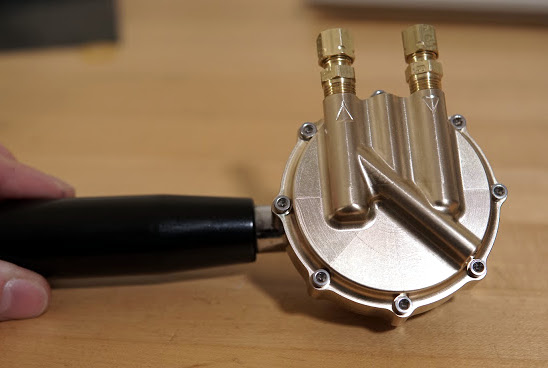
[Ben] designed and milled a beautiful group head that’s designed to fit a La Pavoni portafilter and some other parts he already had on hand. Grab a coffee and watch it pull the first shot after the break, then stick around to see the milling and the drilling.
This machine will hit a sweet spot between lever-type espresso machines that are like driving a manual without power steering, and those fully automated machines that squeeze all the fun out of playing barista but are easier on the joints.
Here’s how it works so far: a motor drives an electric gear pump that pumps the water through a heater. It’s a closed-loop system, so there’s a 3-way valve after the heater that keeps sending the water back until it’s deemed hot enough. Once that happens, the valve switches functions and begins to pump water through the group head and on to the coffee grounds.
[Ben] designed and milled a beautiful group head that’s designed to fit a La Pavoni portafilter and some other parts he already had on hand. Grab a coffee and watch it pull the first shot after the break, then stick around to see the milling and the drilling.
Over the last couple of years, we’ve seen massive price reductions on consumer 3D printers based on masked stereolithography (MSLA) technology. As the name implies, these machines use a standard LCD panel to selectively mask off the ultraviolet light coming from an array of LEDs. Add in a motorized Z stage, and you’ve got a simple and cheap way of coaxing UV resin into three dimensional shapes. These days, $200 USD can get you a turn-key MSLA printer with resolution far beyond the capabilities of filament-based FDM machines.
But [JD] still thinks we can do better. His project aims to produce a fully-functional MSLA printer for $30, and perhaps as low as $15 if manufactured in sufficient quality. He believes that by making high-resolution 3D printing more accessible, it will allow users all over the globe to bring their ideas to life. It’s no wonder he’s calling his machine the Inspire 3D Printer.
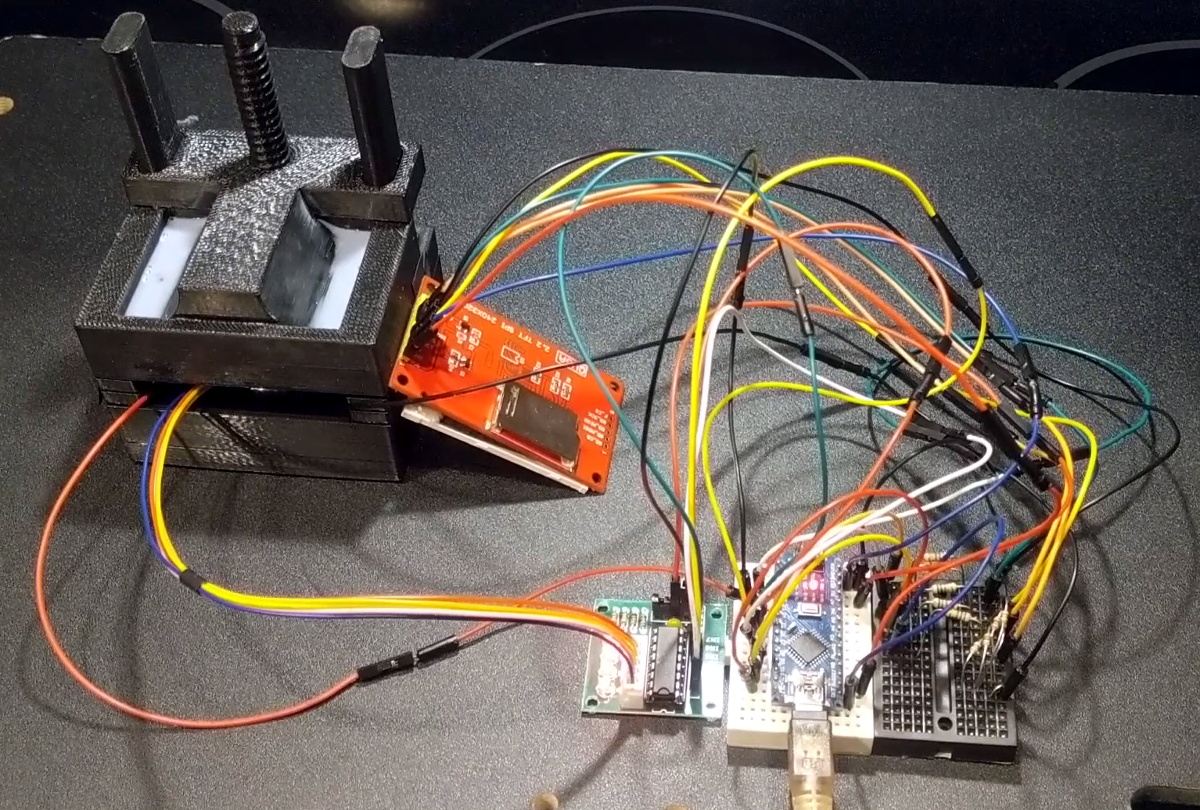
A test fixture for the LCD module.
This isn’t just some pie in the sky concept rolling around in [JD]’s head, either. You can order the Inspire Development Kit right now for just $30, though he makes it clear what you’ll receive isn’t quite a functional MSLA printer. By leveraging a common LCD module, the ESP32, and several 3D printed parts, he’s proven his price point for the kit is achievable; but there’s still plenty of work that needs to be done before the machine is ready for the general public.
For one thing, he’s still working the kinks out of the Z movement. The current design is 3D printed, but [JD] says he’s not quite happy with the amount of slop in the movement and is considering replacing the entire thing with the linear actuator from an optical drive. We’ve already seen these parts reused for accurately positioning lasers, so there’s certainly precedent for it. The firmware for the ESP32 is also in its infancy, and currently only allows the user to print from a selection of simplistic hard-coded shapes as a proof of concept.
It’s no secret that many parts of the United States saw quite a bit of snow that past few weeks. Even snowed in, hackers and engineers continue to do what they do and invent crazy wonderful things. Spurred on by a grand vision of complex polyhedron snowballs, [Jacob] created a clever 3D printed mold that can create Rhombic Dodecahedrons. It has some rather unusual properties as it can be stacked perfectly (no gaps in between the snowdechedrons) and all opposing sides are parallel so it can be held easily in a mitten or glove. Additionally, since the faces are parallel, it unmolds easily and without marring the beautiful snow you just crafted.
Premade STL’s of three different sizes are provided under creative commons with some helpful instructions on how best to print them. Perhaps next time your area gets some good snow, you can be prepared to show off with your high-performance ski-sled as your fly by throwing molded snowballs. That is until you get roped into a friendly debate about whether your snowdechedrons are in fact snow “balls”.
Seed banks are facilities of great value to biodiversity and agriculture around the world. These facilities are used to house stocks of seeds of a wide variety, helping to maintain genetic diversity and avoid the permanent loss of various plant species. While there are some challenges, the basic requirements to run a simple seed bank are to keep a selection of seeds at low temperature and humidity to maximise their viable lifespan.
When it comes to animals, things become more difficult — one can’t simply plant an old seed in the ground and grow a fresh new meerkat, for example. Preservation of animal genetic material poses its own unique set of challenges — ones that the San Diego “Frozen Zoo” don’t shy away from. They’ve recently shown the viability of the program with the healthy birth of a ferret cloned from an animal that died in 1988.
Long-Term Storage
There are less than a dozen frozen zoos around the world, with the first being established at San Diego Zoo by Kurt Benirschke in 1972. While the available biological technology was limited at the time, it was hoped that by cryopreserving samples of animal tissues and reproductive material, they might later be used for research or reproduction purposes. The idea has since spread, with a smattering of other facilities opening up around the world. Such facilities necessarily store a wide variety of material, depending on the species in question. Obviously, viable gametes, or reproductive cells, are of high priority. Eggs and sperm cells from sexually mature animals can readily be secured from both live and deceased specimens, and used to produce embryos for implantation.
Alternatively, fluids such as blood or milk may be saved, as well as muscle tissue, bone, hair or skin samples. With cloning techniques pioneered in the 1990s, DNA extracted from these non-reproductive cells can be inserted into an egg with its nucleus removed. This egg can then be implanted in a surrogate mother like any other embryo, and the pregnancy carried to term. With in vitro fertilization (IVF) techniques in their infancy in the 1970s and cloning a distant blip on the horizon, Dr. Benirschke’s decision to establish the first frozen zoo at the time shows considerable foresight.
With decades of advancements in genetic sequencing and techniques like in vitro fertilization now available, these libraries of genetic material are starting to bear fruit. Although other species have already been successfully cloned, this is the first clone of a US endangered species — a black-footed ferret by the name of Elizabeth Ann. Born to a domestic ferret serving as a foster mother on December 10th of last year, her genes are a duplicate of a ferret named Willa who passed away in 1988 and was frozen at the San Diego facility.
The black-footed ferret has long been a focus of conservationists, who have been working to re-establish the species since it was thought to be extinct in the mid-20th century. When a dead specimen was found on a ranch in the 1980s, breeding work began in earnest, with thousands of ferrets reintroduced into the wild. As for Elizabeth Ann and any potential future clones, however, there aren’t yet plans to release them from captivity.
The Challenge of Genetic Diversity
Both breeding programs and cloning experiments highlight a limitation of this work, however. Genetic diversity is key to maintaining a thriving population over many generations, but the ferrets bred as part of the program all trace their lineage to just 7 individuals. Similarly, a cloning program can produce theoretically unlimited offspring from a single DNA sample, but inbreeding depression will make such a cohort unlikely to thrive in the long term. Thus, any frozen zoo aiming to serve as a potential backup against possible extinctions needs to collect as broad a spectrum of genetic samples as possible.
Kurt is the world’s first Przewalski’s horse clone, born to a domestic horse surrogate mother. It’s hoped that Kurt will grow up to breed with others of his species, increasing the genetic diversity of the herd.
The San Diego facility has had other success stories, too. In partnership with Viagen, a company perhaps best known for offering cloning services for domestic pets, scientists were able to clone Kurt, a Przewalski’s Horse, from forty-year old frozen skin samples. Similarly to the methods used to create Elizabeth Ann, Kurt’s genetic material was used to fertilise an egg which was then implanted into a domestic horse serving as a surrogate mother. Sequencing revealed the donor tissue featured many unique genes not found in the currently-alive population, all of which come from lines of just 12 former individuals. It’s hoped that when Kurt comes of age, breeding with others will significantly increase the genetic diversity of the endangered species.
The need for similar species to carry pregnancies means that it’s unlikely we’ll see frozen zoos churning out wooly mammoths or Tasmanian tigers for some time yet. Having the genetic material alone isn’t enough; a suitably close living relation is key, along with the aforementioned need for genetic diversity if repopulation is the goal. However, the technologies and techniques that have been developed will be crucial to maintaining biodiversity of existing species well into the future, especially given that habitat destruction and other existential threats remain around the world. And, as science continues to progress, it’s likely that frozen zoos will be the first to invite you to see their new dodo exhibit in the future!
Traditionally, a forum full of technical users trying integrate their own hardware into a game system for the purposes of gaining unfettered access to its entire software library was the kind of thing that would keep engineers at Sony and Nintendo up at night. The development and proliferation of so called “mod chips” were an existential threat to companies that made their money selling video games, and as such, sniffing out these console hackers and keeping their findings from going public for as long as possible was a top priority.
But the Arduboy is no traditional game system. Its games are distributed for free, so a chip that allows users to cram hundreds of them onto the handheld at once isn’t some shady attempt to pull a fast one on the developers, it’s a substantial usability improvement over the stock hardware. So when Arduboy creator Kevin Bates found out about the grassroots effort to expand the system’s internal storage on the official forums, he didn’t try to put a stop to it. Instead, he asked how he could help make it a reality for as many Arduboy owners as possible.
Now, a little less than three years after forum member Mr.Blinky posted his initial concept for hanging an external SPI flash chip on the system’s test pads, the official Arduboy FX Mod-Chip has arrived. Whether you go the DIY route and build your own version or buy the ready-to-go module, one thing is for sure: it’s a must-have upgrade for the Arduboy that will completely change how you use the diminutive handheld system.
Freedom of Choice
Originally I was going to roll my own upgrade, which involves dead-bug soldering a SPI flash chip such as the W25Q128 to the Arduboy’s PCB with some thin wires and flashing the system’s ATmega32U4 microcontroller with a new bootloader using an ICSP like the USBasp. While it’s hardly a user-friendly operation, the procedure is well within the capabilities of the average Hackaday reader and potentially even something you can do with parts bin finds.
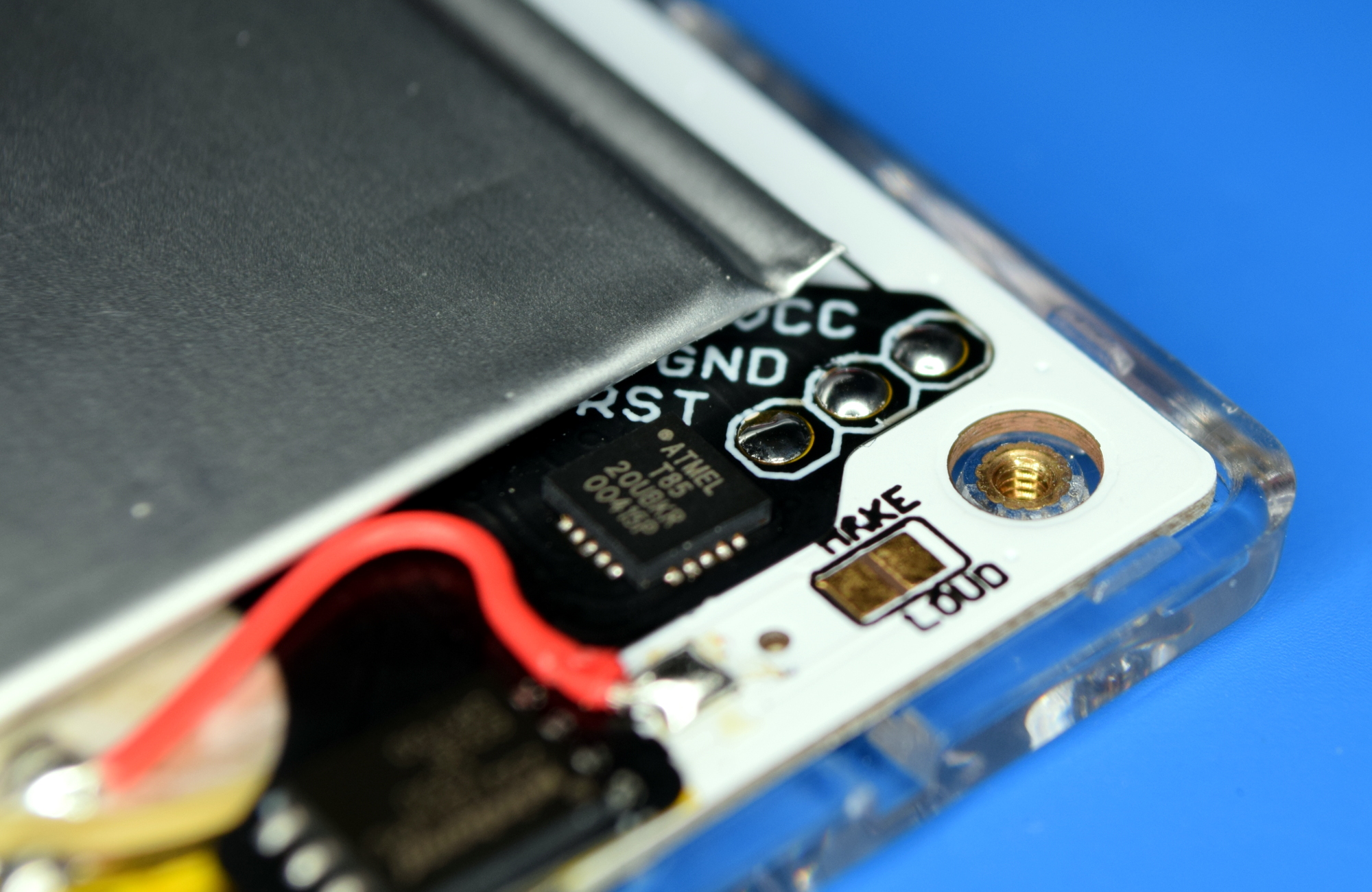
But in the end I decided to go with the pre-programmed FX Mod-Chip directly from Kevin. I’d been curious about the official upgrade since writing about it last year, and wanted to see what the top-of-the-line experience would be like. With a flexible PCB and an onboard ATtiny85 that can flash the system’s bootloader automatically, it’s a considerably more streamlined experience. Plus at just $15 USD, it’s hardly breaking the bank. Though if you want to save a few bucks, you can buy the blank version for $9 and load on your own games onto it.
In either event, the end result is the same. Rather than being stuck with a single game and having to connect your handheld up to the Arduino IDE each time you want to try out a new title, you’ll now have enough flash to store essentially the entire library of completed Arduboy games at once. You can quickly and easily navigate through them by genre using a very slick visual menu, and by holding the Up and Down keys simultaneously, you can even back out of the currently running game and select something else to play without having to power off the system.
As far as the Arduboy goes, this update is nothing short of revolutionary. Frankly, the fact that the device could only hold one game at a time always made it far more of a hassle to use than it should have been. But now that you can quickly skip around and try out all the games without being tethered to a computer, the Arduboy is far more practical for quick gaming sessions.
Installation
As mentioned before, the official upgrade kit has been designed with ease of installation in mind. If you know which way the pointy end of the soldering iron goes, you should be fine. For anyone who needs a little more guidance, there’s a written step-by-step installation guide and even a video you can watch.
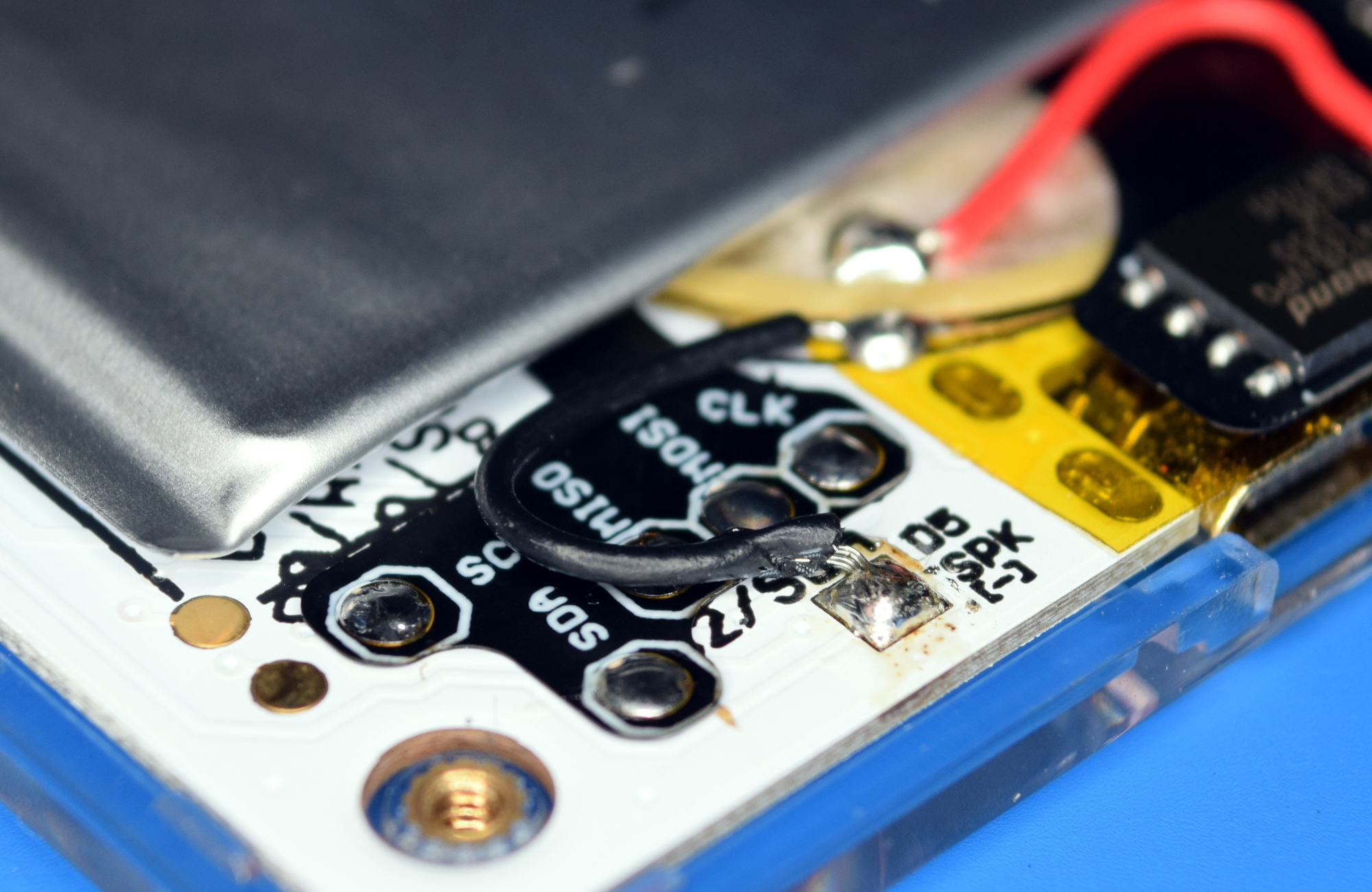
Don’t blame me for that speaker wire.
With the back cover removed, you just need to slip the flex PCB under the battery and tack down the eight points that line up with the test pads on the board. You can remove the piezo speaker temporarily to make the installation a bit easier, but it’s not strictly necessary.
Once the flex PCB is securely attached, you need to turn the Arduboy back on and then short the GND and RST pads for approximately five seconds (a pair of tweezers works well for this). This will trigger the ATtiny85 to begin the bootloader flashing process, and pretty soon you should see the new Arduboy FX startup screen. Once you’ve confirmed the bootloader has been replaced, you can button the system back up.
Library Management
If you buy the pre-programmed FX Mod-Chip, you’ll immediately have access to 233 different Arduboy games and applications which take up roughly 5 MB of the 16 MB available on the W25Q128 chip. While this doesn’t represent all of the software ever written for the platform, it’s a fairly comprehensive collection. Making this sort of prediction is usually a good way to make yourself look like a fool in the future, but in this case, it’s probably safe to say that 16 MB ought to be enough for anybody.
But what about adding future titles? After all, the Arduboy enjoys an active developer scene, and there’s always something new to check out. Well, this is where things get a little tricky. As of this writing, the official tools to actually build a new image for the chip are still in their infancy. The current method relies on a handful of Python scripts and a manually curated CSV file that links nested directories of categories to individual game binaries and banner images. It’s not exactly difficult, but it’s just as unpleasant as it sounds.
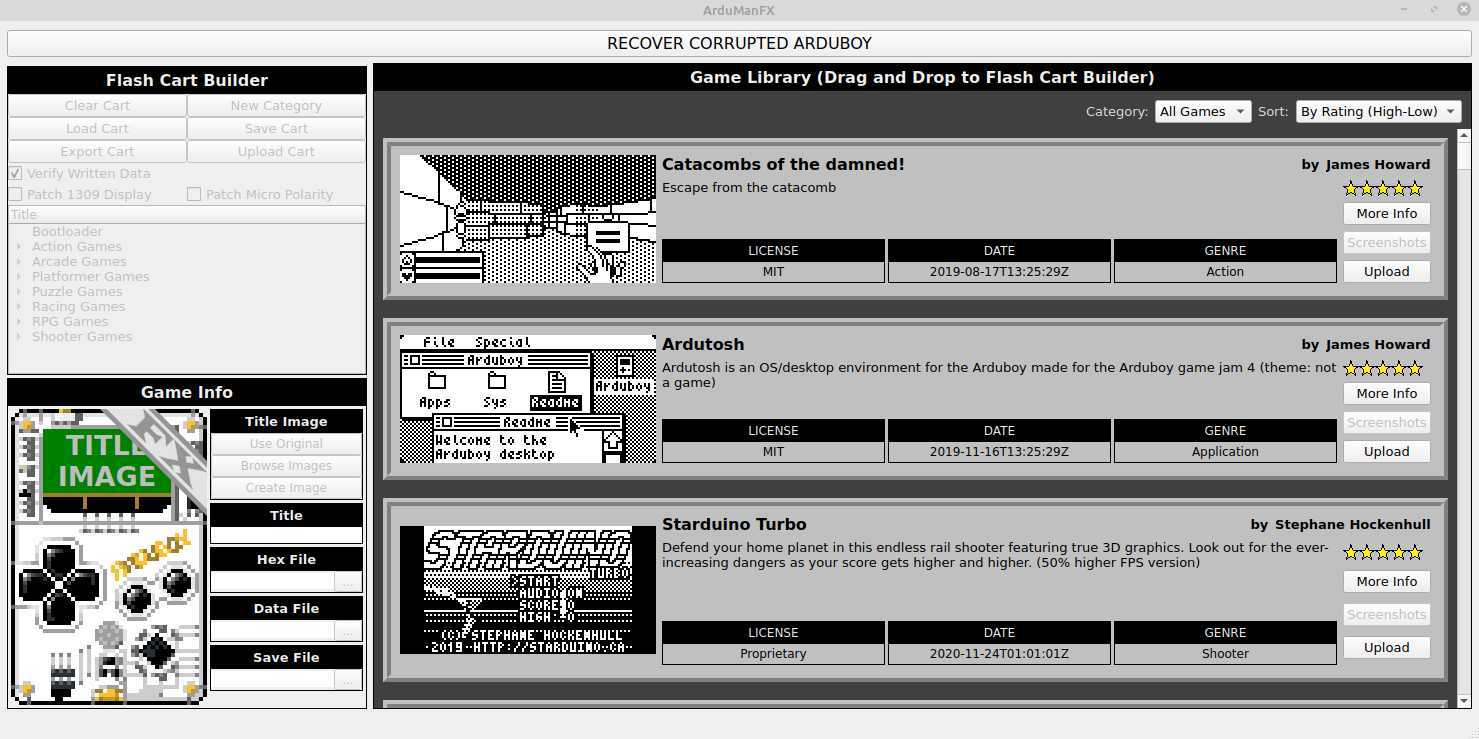
There are some promising projects in the works though, such as ArduManFX by Justin Davis. This multi-platform tool allows the user to search for, download, and ultimately install Arduboy software. As of right now it can only flash single binaries to the system, but the next release is set to include the ability to create chip images from within its drag-and-drop GUI interface.
For now, the flash builder interface is grayed out and can’t be selected.
This is the Way
It’s honestly difficult to overstate just how much this upgrade improves the Arduboy experience, and it’s no surprise that expanded flash storage is slated to be a standard feature going forward. For me personally, the ability to quickly select from between hundreds of games has given new life to a device that was starting to get a bit dustier than I’d like to admit. It’s now a gadget I’ll make sure to toss in my bag before going on a trip, once there’s somewhere to go on a trip to, anyway.
But perhaps more importantly, the Arduboy FX Mod-Chip is a shining example of what can happen when a company doesn’t treat its customers like they’re the enemy. Not only was Kevin Bates supportive of users attempting to modify the hardware they purchased, but he had the forethought to turn their experiments into an official product and even roll the improvements into the next generation of Arduboy. The tech world would be a whole lot nicer if this sort of community collaboration could become the norm and not the exception.
The trick of a volumetric display is the ability to add a third dimension for positioning pixels. Here [Sean] delivered that ability with a stack up of ten screens to add a depth element. This is not such an easy trick. These small OLED displays are all over the place but they share a common element: a dark background over which the pixels appear. [Sean] has gotten his hands on some transparent OLED panels and with some Duck-Duck-Go-Fu we think it’s probably a Crystalfontz 128×56 display. Why is it we don’t see more of these? Anyone know if it’s possible to remove the backing from other OLED displays to get here. (Let us know in the comments.)
The rest of the built is fairly straight-forward with a Feather M4 board driving the ten screens via SPI, and an MPU-6050 IMU for motion input. The form factor lends an aesthetic of an augmented reality device and the production approach for the video puts this in a Bladerunner or Johnny Mneumonic universe. Kudos for expanding the awesome of the build with an implied backstory!
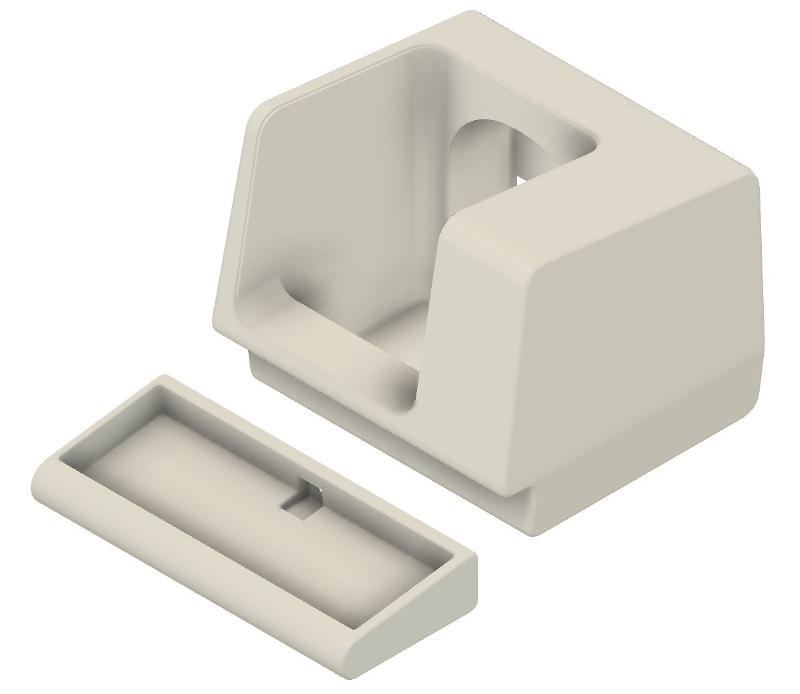
When he went shopping for a vintage serial terminal to go along with his reproduction PDP-8/I computer, [Michael Gardi] came down with a bad case of sticker shock. But rather than be discouraged, he reasoned that if his “retro” computer could stand to have modern components at its heart, so could the terminal he used to talk to it. Leaning on his considerable experience in designing 3D printed replica hardware, he’s built an absolutely gorgeous scaled down DEC VT100 terminal that any classic computer aficionado would be happy to have on their desk.
Now to be clear, [Michael] hasn’t created a true serial terminal. Since the faux PDP-8/I is running on a Raspberry Pi, all he needed to do was come up with something that could connect to its HDMI and USB ports. Put simply, he’s essentially just made a 3D printed enclosure for the Pi’s monitor and keyboard. Oh, but what a gorgeous enclosure it is.
Recreating the VT100 in CAD was made more difficult by the fact that [Michael] couldn’t get his hands on the authentic hardware. But of course, that’s never stopped him before. It turns out DEC provided some very detailed dimensions for the terminal in their original documentation, and while comparing them to photographs of the actual terminal did uncover a few key differences, the overall look is spot on. Once the design was done, he reports it took two rolls of filament and more than 200 hours to print out all the parts for the enclosure.
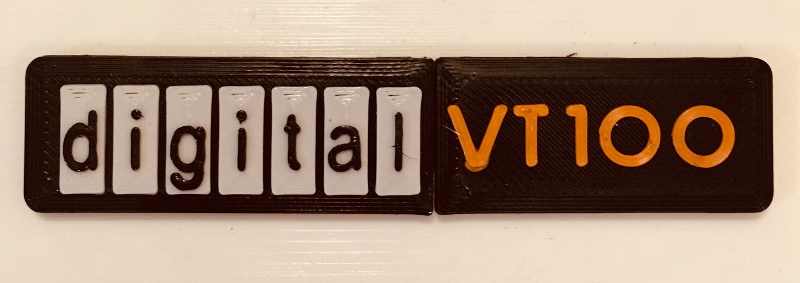
To help sell the authentic look [Michael] tracked down a 4:3 LCD of the appropriate size, and the use of an off-the-shelf portable mechanical keyboard should make text entry a pleasure. For a little fun, he even came up with a themed arcade controller for the VT100 that can be used with RetroPie. The printed logo plate is an especially nice touch, and we’re more than willing to forgive the fact that he had to print it at a larger scale than the rest of the terminal to get all the detail in with his printer’s 0.4 mm nozzle.
On a technical level, this is perhaps the most straightforward replica we’ve ever seen from [Michael]. But even on a relatively simple project like this, his signature attention to detail and craftsmanship is on full display. It’s always a good day when he’s got a new build to show off with, and we’re eager to see what he comes up with next.
The film is presented without narration, but from the Dutch title cards and the fact that it’s Philips, we gather that this factory of gigantic proportions was somewhere in the Netherlands. In any case, it looks like something right out of [Fritz Lang]’s Metropolis and turned the rawest of materials into finished consumer products.
Much of the film focuses on the making of vacuum tubes; the sheer physicality of the job is what really stands out here. The upper body strength that the glassblowers had to have boggles the mind. Check out the chops — and the soon-to-be very unfashionable mustache — on the glassblower at the 12:00 mark. And it wasn’t just the gents who had mad skills — the fine motor control needed for the delicate assembly of the innards of the tubes, which seems to be mostly staffed by women, is just as impressive. We were also surprised by the amount these manual crafts were assisted by automated systems.
Especially interesting is the section where they build the luidspreker. Without narration or captions, it’s a little hard to tell what’s going on, but it appears that they used an enormous press to form chips of Bakelite into sleek covers for the speakers, which themselves are super-chunky affairs made from scratch in the factory. We’re also treated to assembly of the radios, packaging of finished products, and a group of dockworkers who clearly didn’t read the “Fragile” labels pasted on the boxes.
One can’t help but wonder if these people had the slightest inkling of what was about to sweep over them and the rest of the world. And if they did, would they even begin to comprehend how much the very products that they were making would contribute to both the slaughter of the coming war as well as to the sparing of so many lives? Likely not, but the film is still an interesting glimpse into the creation of an industry, one that relied very much on craftsmanship to get it started.
The film is presented without narration, but from the Dutch title cards and the fact that it’s Philips, we gather that this factory of gigantic proportions was somewhere in the Netherlands. In any case, it looks like something right out of [Fritz Lang]’s Metropolis and turned the rawest of materials into finished consumer products.
Much of the film focuses on the making of vacuum tubes; the sheer physicality of the job is what really stands out here. The upper body strength that the glassblowers had to have boggles the mind. Check out the chops — and the soon-to-be very unfashionable mustache — on the glassblower at the 12:00 mark. And it wasn’t just the gents who had mad skills — the fine motor control needed for the delicate assembly of the innards of the tubes, which seems to be mostly staffed by women, is just as impressive. We were also surprised by the amount these manual crafts were assisted by automated systems.
Especially interesting is the section where they build the luidspreker. Without narration or captions, it’s a little hard to tell what’s going on, but it appears that they used an enormous press to form chips of Bakelite into sleek covers for the speakers, which themselves are super-chunky affairs made from scratch in the factory. We’re also treated to assembly of the radios, packaging of finished products, and a group of dockworkers who clearly didn’t read the “Fragile” labels pasted on the boxes.
One can’t help but wonder if these people had the slightest inkling of what was about to sweep over them and the rest of the world. And if they did, would they even begin to comprehend how much the very products that they were making would contribute to both the slaughter of the coming war as well as to the sparing of so many lives? Likely not, but the film is still an interesting glimpse into the creation of an industry, one that relied very much on craftsmanship to get it started.
There’s a major push now to find energy sources with smaller carbon footprints. The maritime shipping industry, according to IEEE Spectrum, is going towards ammonia. Burning ammonia produces no CO2 and it isn’t hard to make. It doesn’t require special storage techniques as hydrogen does and it has ten times the energy density of a modern lithium-ion battery.
You can burn ammonia for internal combustion or use it in a fuel cell. However, there are two problems. First, no ships are currently using the fuel and second most ammonia today is made using a very carbon-intensive process. However it is possible to create “green” ammonia, and projects in Finland, Germany, and Norway are on schedule to start using ammonia-powered ships over the next couple of years.
Switching over, though, will be an infrastructure challenge. Ships consume about 300 million tons of fuel each year, and most of that is diesel which has twice the energy density of ammonia. Ports will need storage and filling equipment to make the switch practical.
To make ammonia takes hydrogen and nitrogen. Most commercial hydrogen is made by reacting methane which releases carbon as a byproduct. However, hydrogen can be split from water using green energy, too, and that will be another key factor in making ammonia fuel work for companies trying to reduce carbon emissions.
You might think this is a new idea, but Germany used ammonia in 1942 to fuel public buses in occupied Belgium. The buses used an internal combustion engine that ran on a combination of ammonia and coal gas. The X-15 aircraft also used ammonia as one component in the fuel that powered its rocket engines.
Storing ammonia is easy, but there are some easy ways to store hydrogen, too. We’ve seen some fuel cell drones, but nothing running on ammonia. At least, not yet.
Many small gasoline engines can be safely modified to run on natural gas or propane with a kit that replaces the carburetor and adds a regulator, providing a reliable alternative fuel source in the event that gasoline is difficult to obtain in an emergency situation. This seat of the pants hack by [HowToLou] is definitively not the safe way to run your generator on natural gas, but if you ever find yourself in a situation where getting the power back on might be a literal matter of life or death, it’s a tip worth keeping in mind.
The basic idea here is that you feed natural gas (though propane should also work) directly into the engine’s intake by way of a hose attached to the air filter box. While cranking the engine, a valve on the gas line is used to manually adjust the air–fuel mixture until it fires up. It’s an extremely simple hack that, in a pinch, you can pull off with the parts on hand. But as you might expect, that simplicity comes at a cost.
There are a few big problems with this approach, but certainly the major one is that there’s nothing to cut off the flow of gas when the engine stops running. So if the generator stalls or you just forget to close the valve after you shut it down, there’s the potential for a very dangerous situation. Additionally, the manual gas valve will be at odds with a generator that automatically throttles up and down based on load. Though to be fair, there are certainly generators out there that simply run the engine flat-out the whole time.
Many small gasoline engines can be safely modified to run on natural gas or propane with a kit that replaces the carburetor and adds a regulator, providing a reliable alternative fuel source in the event that gasoline is difficult to obtain in an emergency situation. This seat of the pants hack by [HowToLou] is definitively not the safe way to run your generator on natural gas, but if you ever find yourself in a situation where getting the power back on might be a literal matter of life or death, it’s a tip worth keeping in mind.
The basic idea here is that you feed natural gas (though propane should also work) directly into the engine’s intake by way of a hose attached to the air filter box. While cranking the engine, a valve on the gas line is used to manually adjust the air–fuel mixture until it fires up. It’s an extremely simple hack that, in a pinch, you can pull off with the parts on hand. But as you might expect, that simplicity comes at a cost.
There are a few big problems with this approach, but certainly the major one is that there’s nothing to cut off the flow of gas when the engine stops running. So if the generator stalls or you just forget to close the valve after you shut it down, there’s the potential for a very dangerous situation. Additionally, the manual gas valve will be at odds with a generator that automatically throttles up and down based on load. Though to be fair, there are certainly generators out there that simply run the engine flat-out the whole time.
As a hacker community, we are no strangers to beautiful and unique musical instruments. A sympathetic nail violin built by [Nicolas Bras] is a welcome addition to the eclectic family. Working up from the simple idea of a nail in a piece of wood and adjusting the pitch by hammering the nail farther into the wood, [Nicolas] expanded the idea. With careful planning and tuning, the nails can have sympathetic properties. These properties mean that when one nail is played via a bow, it causes other nails to sound, creating harmonies and sustains.
With a bit of careful woodworking and a scant touch of metalwork, an instrument was crafted. It offers vast flexibility as it can be played by bow, by plucking with your finger, or by strumming. There are several levels of nails, each level having a paired sympathetic nail. This allows for a diverse and versatile instrument.
Here at Hackaday, we seem to have a thing for tiny violins, whether physical or virtual. While the nail violin may not look like your traditional violin, we can certainly appreciate the wonderful music it creates.
There’s been a constant over the last few weeks’ news, thanks to Elon Musk we’re in another Bitcoin hype cycle. The cryptocurrency soared after the billionaire endorsed it, at one point coming close to $60k, before falling back to its current position at time of writing of around $47k. The usual tide of cryptocurrency enthusiasts high on their Kool-Aid hailed the dawn of their new tomorrow, while a fresh cesspool of cryptocurrency scam emails and social media posts lapped around the recesses of the Internet.
This Time It’s Different!
The worst phrase that anyone can normally say about a financial bubble is the dreaded phrase “This time it’s different“, but there is something different about this Bitcoin hype cycle. It’s usual to hear criticism of Bitcoin for its volatility or its sometime association with shady deals, but what’s different this time is that the primary criticism is of its environmental credentials. The Bitcoin network, we are told, uses more electricity than the Netherlands, more than Argentina, and in an age where global warming has started to exert an uncomfortable influence over our lives, we can’t afford such extravagance and the emissions associated with them.
Here at Hackaday we are more concerned with figures than arguments over the future of currency, so the angle we take away from it all lies with those power stats. How much energy does Argentina use, and is the claim about Bitcoin credible?
The now decommissioned Eggborough power station, Yorkshire, UK. Bitcoin requires eight of these 2GW coal-fired power stations to operate. Deut (Public domain).
We have as good an estimate as possible of the power used by Bitcoin miners, in the form of the Cambridge University Centre for Alternative Finance’s Bitcoin network power tracker. At the time of writing it has an estimate of the network’s annual power consumption at 129.1 TWh. It’s easy enough to find global power consumption data and find that Argentina uses 125 TWh in 2019, so on those metrics the assertion that Bitcoin uses more power than Argentina holds water. A quick back-of-envelope calculation shows the figure to be equivalent to a nearly 15 GW power station running flat-out all year round,and looking up some figures for CO2 emissions per megawatt hour for a further calculations that represents about 130 million tonnes of CO2 from coal-fired power stations.
That’s 10 million tonnes more than the entire UK transport sector emitted in 2019. Arguments that some cryptocurrency may be mined from renewables do not apply, because while those coal fired power stations still exist they are supplying energy which could be supplied by renewable sources that are instead being taken up by the miners. Lest we forget that the Bitcoin algorithm is designed to become more difficult to compute as the blockchain progresses. Cryptocurrency farmers are not unaware of the electricity bills, perpetually seeking out the most efficient mining equipment. This makes for a hazy future, can hardware improvements keep up with increasingly elusive hashes or will the network’s electricity consumption continue to grow?
It’s inevitable that for the time being while our economies are in the transition away from fossil fuels there will continue to be CO2 emissions generated, so if that is the case then those emissions must provide a useful return. If we burn a tonne of fuel oil to move a shipload of freight containers then at least the emissions have done something for us, so is the same true for a cryptocurrency? Does a tonne of CO2 emitted by the miners do anything for us?
A German banknote from the period of hyperinflation. Stadt Plauen, Public domain.
For a currency to be effective it must serve both as a convenient and usable method of conducting transactions, as well as a safe and reliable storage medium for wealth. I can take a pound down to my local Tesco superstore and buy a loaf of bread, or inflation notwithstanding I can put it in my bank account and go to Tesco with it in a year’s time and buy a loaf of bread then.
Putting it in the bank or handing it over at the checkout are both transactions that don’t cost me any extra money and are completed in an instant. That pound (or dollar, or whatever) isn’t just a shiny disc of metal, it’s a tiny statement of confidence in a country’s economy, and jokes about politicians aside, if that country continues to have trade and factories and consumers, it’s a pretty safe bet. A fiat currency such as the pound can lose that effectiveness when the economy goes into crisis, as happened in Germany in the years following the First World War, or in Zimbabwe following the collapse of the country’s agriculture sector after a disastrous land reform programme. When citizens of Germany began needing a literal wheelbarrow full of Marks to pay for break, and a year in the bank saw a Mark reduced to a tiny fraction of its previous value, the Mark had lost its effectiveness as a currency.
The whole point of a cryptocurrency is that it is not a fiat currency backed by a nation state or a real-world asset such as a pile of gold in Fort Knox. A cryptocurrency that is stable and easy to use would be a very effective currency, in that holding it is not risky and it can be taken to a merchant and exchanged for a loaf of bread without problem. Our next question is therefore whether Bitcoin satisfies those criteria and can be considered a useful currency.
The Cost of Bitcoin Transactions
A Bitcoin transaction carries a fee to the miners, it’s a variable rate that at the time of writing is somewhere around $25. There is also a wait for transactions to complete, until they have been placed in the blockchain by the actions of the miners. Therefore Bitcoin is not a convenient currency for transactions; while both of these drawbacks are nothing when buying a Tesla it makes the currency useless as a means to buy a loaf of bread. The Lightning network is an attempt to mitigate this by abstracting micropayments to a peer-to-peer network of participants who conceal their micropayments within a larger paid-for transaction on the main blockchain, but it is not without problems of its own and does not seem to have gained widespread understanding.
The 10000 Bitcoin pizza is famous in the Bitcoin community, but this isn’t it. Perhaps that neither it or Laszlo Hanyecz get more than a passing mention on the whole of Wikipedia should serve as a reminder that the world doesn’t revolve around Bitcoin. Valerio Capello, CC BY-SA 3.0.
So Bitcoin has at least the potential to remain a useful currency for transactions, but does it stack up as a store for wealth? We hear about Elon Musk and institutional investors buying into the cryptocurrency, but what those stories fail to make clear is that those investments are only a small percentage of their much larger portfolios. What about those of us who aren’t multi-billionaires with huge diversified investment portfolios, and who stand to lose our shirts if our one investment goes south? A pile of pounds or dollars in a bank is a safe place to keep our life savings even if it’s not a particularly clever one in an era of low interest rates, so if Bitcoin is a currency we have to evaluate how its safety matches to that of a traditional currency. It’s tempting at this point to cite Bitcoin’s performance over the last decade as evidence of its safety as a store of wealth, and it’s true that had I put even a small percentage of my savings in the currency back when Laszlo Hanyecz bought his famous 10000 BTC pizza I would now be fabulously wealthy instead of a relatively penniless itinerant scribe (I remember reading that news back in 2010 and thinking “That’s cool but it’ll never catch on”, oh well).
But performance and safety of an investment are not the same metrics, so any appraisal of its wealth storage potential should look at it in the here and now: would you advise your grandmother to put her life savings into it? Even the most ardent Bitcoin enthusiast should admit that it is a volatile asset that is prone to sudden falls as well as the occasional stratospheric rise, so it’s difficult to make a case for it as anything other than a speculative investment vehicle and certainly not a safe place for Granny’s hard-earned.
Have We Backed The Wrong Horse?
The above is almost certainly not what most Bitcoin enthusiasts want to hear, that their currency may have the potential to be usable for everyday transactions but elusively remains a volatile wealth store that’s destroying the planet. But they’re awkward questions that have to be asked, otherwise having so far dodged Government financial regulation, the cryptocurrency may succumb instead to Government environmental regulation.
Cryptocurrencies and the blockchains that underpin them are an extremely cool idea, even though the blockchain is not the universal answer to all computing problems that some of its proponents appeared to present it as during the peak of its hype. It’s inevitable that in some form they will be a part of our futures, but perhaps it’s time to ask: In Bitcoin and cryptocurrencies which follow a similar model, have we backed the wrong horse?
There’s been a constant over the last few weeks’ news, thanks to Elon Musk we’re in another Bitcoin hype cycle. The cryptocurrency soared after the billionaire endorsed it, at one point coming close to $60k, before falling back to its current position at time of writing of around $47k. The usual tide of cryptocurrency enthusiasts high on their Kool-Aid hailed the dawn of their new tomorrow, while a fresh cesspool of cryptocurrency scam emails and social media posts lapped around the recesses of the Internet.
This Time It’s Different!
The worst phrase that anyone can normally say about a financial bubble is the dreaded phrase “This time it’s different“, but there is something different about this Bitcoin hype cycle. It’s usual to hear criticism of Bitcoin for its volatility or its sometime association with shady deals, but what’s different this time is that the primary criticism is of its environmental credentials. The Bitcoin network, we are told, uses more electricity than the Netherlands, more than Argentina, and in an age where global warming has started to exert an uncomfortable influence over our lives, we can’t afford such extravagance and the emissions associated with them.
Here at Hackaday we are more concerned with figures than arguments over the future of currency, so the angle we take away from it all lies with those power stats. How much energy does Argentina use, and is the claim about Bitcoin credible?
The now decommissioned Eggborough power station, Yorkshire, UK. Bitcoin requires eight of these 2GW coal-fired power stations to operate. Deut (Public domain).
We have as good an estimate as possible of the power used by Bitcoin miners, in the form of the Cambridge University Centre for Alternative Finance’s Bitcoin network power tracker. At the time of writing it has an estimate of the network’s annual power consumption at 129.1 TWh. It’s easy enough to find global power consumption data and find that Argentina uses 125 TWh in 2019, so on those metrics the assertion that Bitcoin uses more power than Argentina holds water. A quick back-of-envelope calculation shows the figure to be equivalent to a nearly 15 GW power station running flat-out all year round,and looking up some figures for CO2 emissions per megawatt hour for a further calculations that represents about 130 million tonnes of CO2 from coal-fired power stations.
That’s 10 million tonnes more than the entire UK transport sector emitted in 2019. Arguments that some cryptocurrency may be mined from renewables do not apply, because while those coal fired power stations still exist they are supplying energy which could be supplied by renewable sources that are instead being taken up by the miners. Lest we forget that the Bitcoin algorithm is designed to become more difficult to compute as the blockchain progresses. Cryptocurrency farmers are not unaware of the electricity bills, perpetually seeking out the most efficient mining equipment. This makes for a hazy future, can hardware improvements keep up with increasingly elusive hashes or will the network’s electricity consumption continue to grow?
It’s inevitable that for the time being while our economies are in the transition away from fossil fuels there will continue to be CO2 emissions generated, so if that is the case then those emissions must provide a useful return. If we burn a tonne of fuel oil to move a shipload of freight containers then at least the emissions have done something for us, so is the same true for a cryptocurrency? Does a tonne of CO2 emitted by the miners do anything for us?
A German banknote from the period of hyperinflation. Stadt Plauen, Public domain.
For a currency to be effective it must serve both as a convenient and usable method of conducting transactions, as well as a safe and reliable storage medium for wealth. I can take a pound down to my local Tesco superstore and buy a loaf of bread, or inflation notwithstanding I can put it in my bank account and go to Tesco with it in a year’s time and buy a loaf of bread then.
Putting it in the bank or handing it over at the checkout are both transactions that don’t cost me any extra money and are completed in an instant. That pound (or dollar, or whatever) isn’t just a shiny disc of metal, it’s a tiny statement of confidence in a country’s economy, and jokes about politicians aside, if that country continues to have trade and factories and consumers, it’s a pretty safe bet. A fiat currency such as the pound can lose that effectiveness when the economy goes into crisis, as happened in Germany in the years following the First World War, or in Zimbabwe following the collapse of the country’s agriculture sector after a disastrous land reform programme. When citizens of Germany began needing a literal wheelbarrow full of Marks to pay for break, and a year in the bank saw a Mark reduced to a tiny fraction of its previous value, the Mark had lost its effectiveness as a currency.
The whole point of a cryptocurrency is that it is not a fiat currency backed by a nation state or a real-world asset such as a pile of gold in Fort Knox. A cryptocurrency that is stable and easy to use would be a very effective currency, in that holding it is not risky and it can be taken to a merchant and exchanged for a loaf of bread without problem. Our next question is therefore whether Bitcoin satisfies those criteria and can be considered a useful currency.
The Cost of Bitcoin Transactions
A Bitcoin transaction carries a fee to the miners, it’s a variable rate that at the time of writing is somewhere around $25. There is also a wait for transactions to complete, until they have been placed in the blockchain by the actions of the miners. Therefore Bitcoin is not a convenient currency for transactions; while both of these drawbacks are nothing when buying a Tesla it makes the currency useless as a means to buy a loaf of bread. The Lightning network is an attempt to mitigate this by abstracting micropayments to a peer-to-peer network of participants who conceal their micropayments within a larger paid-for transaction on the main blockchain, but it is not without problems of its own and does not seem to have gained widespread understanding.
The 10000 Bitcoin pizza is famous in the Bitcoin community, but this isn’t it. Perhaps that neither it or Laszlo Hanyecz get more than a passing mention on the whole of Wikipedia should serve as a reminder that the world doesn’t revolve around Bitcoin. Valerio Capello, CC BY-SA 3.0.
So Bitcoin has at least the potential to remain a useful currency for transactions, but does it stack up as a store for wealth? We hear about Elon Musk and institutional investors buying into the cryptocurrency, but what those stories fail to make clear is that those investments are only a small percentage of their much larger portfolios. What about those of us who aren’t multi-billionaires with huge diversified investment portfolios, and who stand to lose our shirts if our one investment goes south? A pile of pounds or dollars in a bank is a safe place to keep our life savings even if it’s not a particularly clever one in an era of low interest rates, so if Bitcoin is a currency we have to evaluate how its safety matches to that of a traditional currency. It’s tempting at this point to cite Bitcoin’s performance over the last decade as evidence of its safety as a store of wealth, and it’s true that had I put even a small percentage of my savings in the currency back when Laszlo Hanyecz bought his famous 10000 BTC pizza I would now be fabulously wealthy instead of a relatively penniless itinerant scribe (I remember reading that news back in 2010 and thinking “That’s cool but it’ll never catch on”, oh well).
But performance and safety of an investment are not the same metrics, so any appraisal of its wealth storage potential should look at it in the here and now: would you advise your grandmother to put her life savings into it? Even the most ardent Bitcoin enthusiast should admit that it is a volatile asset that is prone to sudden falls as well as the occasional stratospheric rise, so it’s difficult to make a case for it as anything other than a speculative investment vehicle and certainly not a safe place for Granny’s hard-earned.
Have We Backed The Wrong Horse?
The above is almost certainly not what most Bitcoin enthusiasts want to hear, that their currency may have the potential to be usable for everyday transactions but elusively remains a volatile wealth store that’s destroying the planet. But they’re awkward questions that have to be asked, otherwise having so far dodged Government financial regulation, the cryptocurrency may succumb instead to Government environmental regulation.
Cryptocurrencies and the blockchains that underpin them are an extremely cool idea, even though the blockchain is not the universal answer to all computing problems that some of its proponents appeared to present it as during the peak of its hype. It’s inevitable that in some form they will be a part of our futures, but perhaps it’s time to ask: In Bitcoin and cryptocurrencies which follow a similar model, have we backed the wrong horse?
Liquid handling workstations are commonly used in drug development, and look like small CNC machines with droppers on the ends which can dispense liquid into any container in a grid array. They are also extraordinarily expensive, as is most specialty medical research equipment. This liquid handling workstation doesn’t create novel drugs, though, it creates art, and performs similar functions to its professional counterparts at a much lower cost in exchange for a lot of calibration and math.
The art is created by pumping a small amount of CMYK-colored liquids into a 24×16 grid, with each space in the grid able to hold a small amount of the colored liquid. The result looks similar to a Lite-Brite using liquids instead of small pieces of plastic. The creator [Zach Frew] created the robot essentially from scratch using an array of 3D printers, waterjets, and CNC machines. He was able to use less expensive parts, compared to medical-grade equipment, by using servo-controlled valves and peristaltic pumps, but makes up for their inaccuracies with some detailed math and calibration.
The results of the project are striking, especially when considering that a lot of hurdles needed to be cleared to get this kind of quality, including some physical limitations on the way that the liquids behave in the first place. It’s worth checking out not just for the art but for the amount of detail involved as well. And, for those still looking to scratch the 90s nostalgia itch, there are plenty of other projects using the Lite Brite as inspiration.
Renewable energy sources are becoming increasingly popular. However, such energy can be wasted if an excess is available when it’s not yet needed. A particularly relevant example is solar power; solar panels provide most of their output during the day, while often a household’s greatest energy use is at night.
One way to get around this problem is by storing excess energy so that it can be used later. The most common way this is done is with large batteries, however, it’s not the only game in town. Phase change materials are proving to be a useful tool to store excess energy and recover it later – storing energy not as electricity, but as heat. Let’s take a look at how the technology works, and some of its most useful applications.
It’s All About Heat
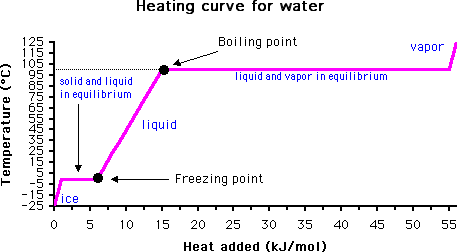
The heating curve of water. Note the flat lines on the curve where the latent heat must be overcome to change phase.
Unlike batteries or capacitors, phase change materials don’t store energy as electricity, but heat. This is done by using the unique physical properties of phase changes – in the case of a material transitioning between solid and liquid phases, or liquid and gas. When heat energy is applied to a material, such as water, the temperature increases. However, when the liquid water reaches temperatures close to boiling point, something strange happens.
As more energy is put in, the temperature begins to flatline. This is because enough energy must be put in to overcome what is called the latent heat of vaporization – the energy required to turn the liquid into a gas. Eventually, once enough heat is put in, the water turns to steam and the temperature is again free to rise. This latent heat can store a significant amount of energy in a material over a relatively small temperature change. This latent heat exists in solid-to-liquid phase changes as well, where it’s known as the latent heat of fusion. By taking advantage of latent heat, large amounts of energy can be stored in a relatively small change in actual temperature, and accessed by manipulating the phase change of a material.
Perhaps the most common form of phase change heat storage on the market is the sodium-acetate handwarmer. These handwarmers contain a sodium-acetate gel in a plastic pouch. When the gel is given a nucleation point by tweaking a metal disk in the gel, it quickly changes phase from a super-saturated liquid to a solid. Suddenly freezing like this releases the latent heat the material was holding in its liquid form, and warms the user’s hands nicely. The material can later be recharged by heating the handwarmer up to melt the sodium acetate once more, before allowing it to gently cool back down to room temperature. The latent heat will then be trapped in the liquid until it is once more disturbed, causing it to freeze again.
A wide variety of materials have been studied for heat storage through the phase change effect. Paraffin wax is perhaps one of the most commonly studied, thanks to its phase change occuring in a useful temperature range. However, its low thermal conductivity limits the rate at which energy can be exchanged, hampering performance. Hydrated salts have been another material of significant interest, though face problems of their own. Often, such materials will undergo subcooling. As heat is extracted from the liquid material, its temperature declines below freezing point without the material actually becoming solid. Without undergoing a change in phase, the latent heat remains trapped in the liquid, and can’t be extracted. Additionally, like many battery chemistries, repeated cycling can cause problems. The phase change material must retain its properties over many cycles, without chemicals falling out of solution or corrosion harming the material or its enclosure over time. Much research into phase change energy storage is centered around refining solutions and using additives and other techniques to engineer around these basic challenges. Often, the specifics of such materials remains a commercial secret as companies attempt to recoup research costs through sales.
Sunamp’s early phase change cells for home heating – note the input and output fluid ports that feed into the internal heat exchanger.
The phase change effect can be used in a variety of ways to functionally store and save energy. Heat can be applied to a phase-change material, melting it and thus storing energy within it as latent heat. Excess electrical energy, such as from renewable sources, can readily be stored in such phase change materials, as it’s possible to turn electrical energy into heat quite efficiently. The reverse is not so easy, however.
Instead, such phase change devices are often instead used to output heat more directly – either by being used as hot water heaters or to supply heat energy to refrigeration processes. This is achieved often by simply passing working fluid, like water or refrigerant, through a heat exchanger in contact with the phase change material. The former has plenty of applicability to households, cutting down on costs for residential heating and hot water. The latter is of more relevance to large commercial and industrial facilities. Particularly in industries such as winemaking and cold storage, refrigeration can be a major bottom-line expense that is essential to operations. Even small percentage gains in efficiency or reduced energy use can have huge payoffs over time.
Different phase change materials freeze at different temperatures, making them suitable for different applications. Lower-temperature materials are useful for refrigeration applications such as in this project by the University of South Australia.
Another interesting use of phase-change materials is as a passive heat management solution for buildings. The idea is to use a phase change material with a melting point around a comfortable room temperature – such as 20-25 degrees Celsius. The material is encapsulated in plastic matting, and can be installed in a building in walls and ceilings along with insulation. The material then acts as a sort of thermal buffer. Heat energy building up in a room can be absorbed by the phase change material, keeping temperatures lower. As the building then cools, the material can release its heat, acting to stabilize temperatures. It can be a lightweight way to increase the thermal mass of a building, and can reduce the reliance on active cooling or heating from HVAC systems.
BioPCM brand phase-change material installed in a ceiling. This is used as a lightweight way to add thermal mass to a building, helping maintain stable comfortable temperatures without the need for continuous heating and cooling.
Looking to the future, it may be that phase change energy storage remains of limited use in the residential space. While it can have benefits, its limited heating-only application makes it less attractive than battery storage that can run an entire home. However, for industrial processes, such as refrigeration and process heating, there’s plenty of scope for phase change technologies to be used as a cheap and effective store of energy. With research ongoing in the field, it’s likely we’ll see greater uptake of this technology in future as energy conservation increases in relevance in future years.
When somebody builds a quadcopter with the express purpose of flying it as fast and aggressively as possible, it’s not exactly a surprise when they eventually run it into an immovable object hard enough to break something. In fact, it’s more like a rite of passage. Which is why many serious fliers will have a 3D printer at home to rapidly run off replacement parts.
Avid first person view (FPV) flier [David Cledon] has taken this concept to its ultimate extreme by designing a 3D printable quadcopter that’s little more than an 18650 cell with some motors attached. Since the two-piece frame can be produced on a standard desktop 3D printer in a little over two hours with less than $1 USD of filament, crashes promise to be far less stressful. Spend a few hours during the week printing out frames, and you’ll have plenty to destroy for the weekend.
While [David] says the overall performance of this diminutive quadcopter isn’t exactly stellar, we think the 10 minutes of flight time he’s reporting on a single 18650 battery is more than respectable. While there’s still considerable expense in the radio and video gear, this design looks like it could be an exceptionally affordable way to get into FPV flying.
Of course, the argument could be made that such a wispy quadcopter is more likely to be obliterated on impact than something larger and commercially produced. There’s also a decent amount of close-quarters soldering involved given the cramped nature of the frame. So while the total cost of building one of these birds might be appealing to the newbie, it’s probably a project best left to those who’ve clocked a few hours in on the sticks.
We’ve seen quite a few 3D printed quadcopter frames over the years, but certainly none as elegant as what [David] has created here. It’s an experiment in minimalism that really embraces the possibilities afforded by low-cost desktop 3D printing, and we wouldn’t be surprised to see it become the standard by which future designs are measured.
Audio and video synthesizers have been around for decades, and are pretty much only limited by one’s willingness to spend money on them. That is, unless you can develop your own FPGA-supercharged synthesizer to really get a leg up on the consumer-grade components. Of course, as [Julian] found out in this four-year project, you tend to pay for it anyway in time spent working on your projects.
[Julian] has actually decided to stop working on the project and open-source it to anyone who wants to continue on. He has already finished the PCB layout on a gargantuan 8-layer print, done all of the routing and parts selection, and really only needed to finish testing it to complete the project. It’s powered by the Xilinx Zynq and is packed with features too: HDMI, DDR3 ram, USB, a handful of sensors, and an Arduino Uno-style header to make interfacing and programming a breeze.
While we’re sympathetic with setting aside a project that we’ve worked so hard on, with most of the work done on this one it should be pretty easy to pick up and adapt for anyone interested in carrying the torch. If you were hoping to wet your whistle with something with fewer PCB layers, though, we’ve seen some interesting (but slightly simpler) video synthesizers made out of other unique hardware as well.
Remember when phones didn’t all look the same? We had a good thing going in the early cell phone days, which seemed like a brief holdover from the Western Electric (et. al) era where you could get a phone that suited your inner minimalist or princess, and choose the color to boot.
[Dubchinsky] found a beautiful phone from this bygone era and saved it from one of two likely fates — the landfill, or else a life languishing as a piece of vintage technology that’s just sitting around for looks. Instead, this phone found a second calling as a lovely desk lamp with secret goose neck flexibility. The lamp itself is an inexpensive LED module from ebay that’s wired up to mains power through a push button switch in the phone’s base.
We absolutely love that [Dubchinsky] wrapped the curly cord around the goose neck, but were a bit disappointed that he didn’t use the hook switch to turn the lamp on and off. In the comments, he says that the plastic felt like it was too brittle to stand up to repeated actuation of such a heavy switch. That’s understandable. [Dubchinsky] also thought about using the rotary dial as a dimmer, and we think that’s a bright idea.
Between the guide, the pictures, and the build process video after the break, this is pretty much a complete how-to. We think that is commendable given that [Dubchinsky] is selling these lamps on etsy.