Game Boy Plays Forever

For those of us old enough to experience it first hand, the original Game Boy was pretty incredible, but did have one major downside: battery consumption. In the 90s rechargeable batteries weren’t common, which led to most of us playing our handhelds beside power outlets. Some modern takes on the classic Game Boy address these concerns with modern hardware, but this group from the Delft University of Technology and Northwestern has created a Game Boy clone that doesn’t need any batteries at all, even though it can play games indefinitely.

This build was a proof-of-concept for something called “intermittent computing” which allows a computer to remain in a state of processing limbo until it gets enough energy to perform the next computation. The Game Boy clone, fully compatible with the original Game Boy hardware, is equipped with many tiny solar panels which can harvest energy and is able to halt itself and store its state in nonvolatile memory if it detects that there isn’t enough energy available to continue. This means that Super Mario Land isn’t exactly playable, but other games that aren’t as action-packed can be enjoyed with very little impact in gameplay.

The researchers note that it’ll be a long time before their energy-aware platform becomes commonplace in devices and replaces batteries, but they do think that internet-connected devices that don’t need to be constantly running or powered up would be a good start. There are already some low-powered options available that can keep their displays active when everything else is off, so hopefully we will see even more energy-efficient options in the near future.

Thanks to [Sascho] for the tip!

source https://hackaday.com/2020/09/11/game-boy-plays-forever/
Arduino Takes Control of Dead Business Card Cutter

It’s a common enough situation, that when an older piece of equipment dies, and nobody wants to spend the money to repair it. Why fix the old one, when the newer version with all the latest bells and whistles isn’t much more expensive? We all understand the decision from a business standpoint, but as hackers, it always feels a bit wrong.

Which is exactly why [tommycoolman] decided to rebuild the office’s recently deceased Duplo CC-330 heavy duty business card cutter. It sounds like nobody really knows what happened to the machine in the first place, but since the majority of the internals were cooked, some kind of power surge seems likely. Whatever the reason, almost none of the original electronics were reused. From the buttons on the front panel to the motor drivers, everything has been implemented from scratch.

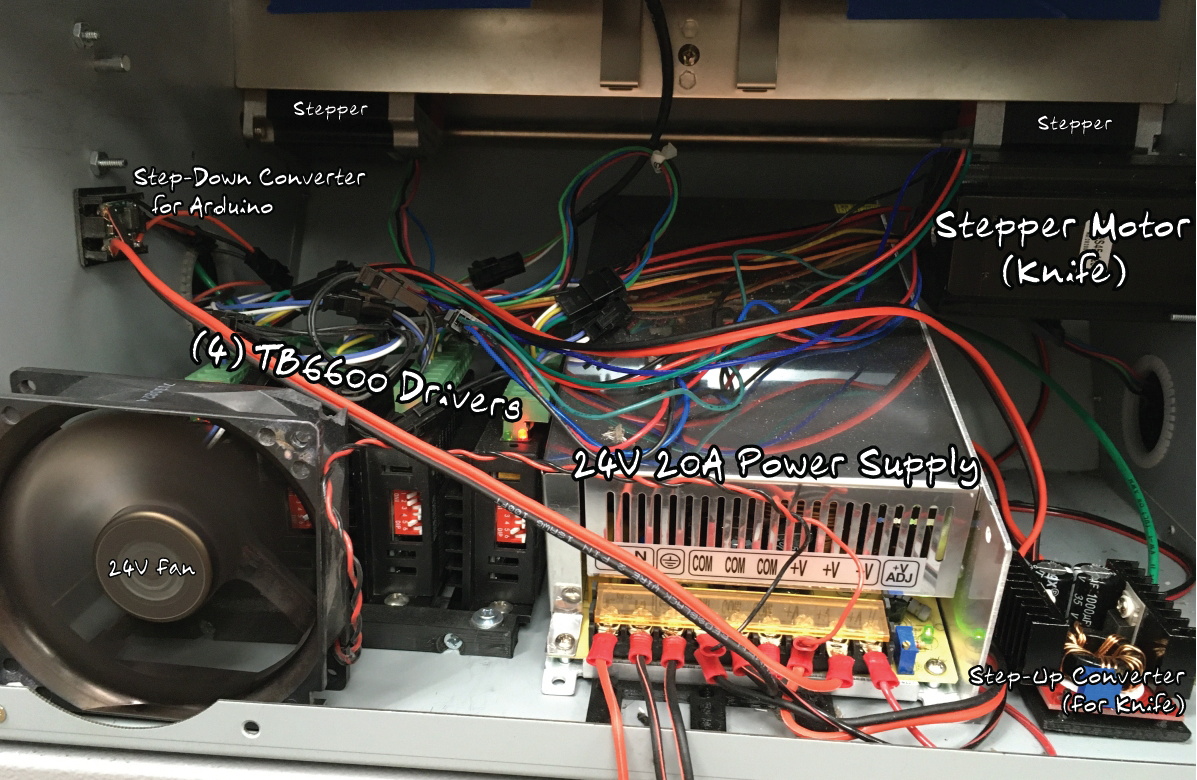
An Arduino Mega 2560 clone is used to control four TB6600 stepper motor drivers, with a common OLED display module installed where the original display went. The keypad next to the screen has been replaced with 10 arcade-style buttons soldered to a scrap of perfboard, though in the end [tommycoolman] covers them with a very professional looking printed vinyl sheet. There’s also a 24 V power supply onboard, with the expected assortment of step up and step down converters necessary to feed the various electronics their intended voltages.

In the end, [tommycoolman] estimates it took about $200 and 30 hours of work to get the card cutter up and running again. The argument could be made that the value of his time needs to be factored into the repair bill as well, but even still, it sounds like a bargain to us; these machines have a four-figure price tag on them when new.

Stories like this one are important reminders of the all wondrous things you can find hiding in the trash. Any time a machine like this can be rescued from the junkyard, it’s an accomplishment worthy of praise in our book.

source https://hackaday.com/2020/09/10/arduino-takes-control-of-dead-business-card-cutter/

Arduino Takes Control of Dead Business Card Cutter

It’s a common enough situation, that when an older piece of equipment dies, and nobody wants to spend the money to repair it. Why fix the old one, when the newer version with all the latest bells and whistles isn’t much more expensive? We all understand the decision from a business standpoint, but as hackers, it always feels a bit wrong.

Which is exactly why [tommycoolman] decided to rebuild the office’s recently deceased Duplo CC-330 heavy duty business card cutter. It sounds like nobody really knows what happened to the machine in the first place, but since the majority of the internals were cooked, some kind of power surge seems likely. Whatever the reason, almost none of the original electronics were reused. From the buttons on the front panel to the motor drivers, everything has been implemented from scratch.

An Arduino Mega 2560 clone is used to control four TB6600 stepper motor drivers, with a common OLED display module installed where the original display went. The keypad next to the screen has been replaced with 10 arcade-style buttons soldered to a scrap of perfboard, though in the end [tommycoolman] covers them with a very professional looking printed vinyl sheet. There’s also a 24 V power supply onboard, with the expected assortment of step up and step down converters necessary to feed the various electronics their intended voltages.

In the end, [tommycoolman] estimates it took about $200 and 30 hours of work to get the card cutter up and running again. The argument could be made that the value of his time needs to be factored into the repair bill as well, but even still, it sounds like a bargain to us; these machines have a four-figure price tag on them when new.

Stories like this one are important reminders of the all wondrous things you can find hiding in the trash. Any time a machine like this can be rescued from the junkyard, it’s an accomplishment worthy of praise in our book.

source https://hackaday.com/2020/09/10/arduino-takes-control-of-dead-business-card-cutter/

ISS Ham Radio Repeater

There is a long history of spacecraft carrying ham radio gear, as the Space Shuttle, Mir, and the ISS have all had hams aboard with gear capable of talking to the Earth. However, this month, the ISS started operating an FM repeater that isn’t too dissimilar from a terrestrial repeater. You can see [TechMinds] video on the repeater, below.

The repeater has a 2 meter uplink and a 70 centimeter downlink. While you can use a garden variety dual-band ham transceiver to use the repeater, you’ll probably need a special antenna along with special operating techniques.

One of the problems you’ll find is that ISS moves fast enough that you will observe doppler shift in the frequencies. The video reproduces a table of frequencies you may have to move through to receive the shifting signal.

You can probably hear the ISS with a good pass with no special equipment, but [TechMinds] wasn’t able to close an actual contact in the video. But [K0LWC] got really close using a pretty standard radio setup, as you can see in the second video.

The ISS has been on the air with digital repeaters and conventional FM radio for some time. The antenna you need doesn’t have to be a huge disk. We’ve seen it done with a handheld beam antenna and a handheld radio.

source https://hackaday.com/2020/09/10/iss-ham-radio-repeater/

Reverse Engineering a Module from a Vacuum Tube Computer

It’s best to admit upfront that vacuum tubes can be baffling to some of the younger generation of engineers. Yes, we get how electron flow from cathode to anode can be controlled with a grid, and how that can be used to amplify and control current. But there are still some things that just don’t always to click when looking at a schematic for a tube circuit. Maybe we just grew up at the wrong time.

Someone who’s clearly not old enough to have ridden the first wave of electronics but still seems to have mastered the concepts of thermionic emission is [Usagi Electric], who has been doing some great work on reverse engineering modules from old vacuum tube computers. The video below focuses on a two-tube pluggable module from an IBM 650, a machine that dates clear back to 1954. The eBay find was nothing more than two tube sockets and a pair of resistors joined to a plug by a hoop of metal. With almost nothing to go on, [Usagi] was still able to figure out what tubes would have gone in the sockets — the nine-pin socket was a big clue — and determine that the module was likely a dual NAND gate. To test his theory, [Usagi] took some liberties with the original voltages used by IBM and built a breakout PCB. It’s an interesting mix of technologies, but he was able to walk through the truth table and confirm that his module is a dual NAND gate.

The video is a bit long but it’s chock full of tidbits that really help clear up how tubes work. Along with some help from this article about how triodes work, this will put you on the path to thermionic enlightenment.

source https://hackaday.com/2020/09/10/reverse-engineering-a-module-from-a-vacuum-tube-computer/

Surfboard LED Strips Light Up The Waves

Surfing is an activity predominantly enjoyed during the day, primarily for reasons of warmth and water safety. Of course, if you prefer to carve the waves at night, you might enjoy the latest project from [Moritz Sivers] – a surfboard kitted out with motion-reactive LEDs.

The build consists of a regular surfboard, with a channel cut around the perimeter into which WS2812B LED strips are glued. Powered by a lithium rechargable battery, commands are given by an Arduino Nano hooked up to a MPU6050 3-axis gyroscope. This allows the Arduino to change the light patterns based on the movement of the board. Left and right turns, pumping the board, and surfing down a wave all come with their own animations.

It’s a fun twist on night surfing, and makes it easier to spot a downed surfer, too. It’s a build we expect to see recreated in a high-end 4K surf film before the year is out. Of course, if you just need to know if the conditions are right before you head out, this surf weather station might be just the build for you. Video after the break.

source https://hackaday.com/2020/09/10/surfboard-led-strips-light-up-the-waves/

Garbage Can Takes Itself Out

Home automation is a fine goal but typically remains confined to lights, blinds, and other things that are relatively stationary and/or electrical in nature. There is a challenge there to be certain, but to really step up your home automation game you’ll need to think outside the box. This automated garbage can that can take itself out, for example, has all the home automation street cred you’d ever need.

The garbage can moves itself by means of a scooter wheel which has a hub motor inside and is powered by a lithium battery, but the real genius of this project is the electronics controlling everything. A Raspberry Pi Zero W is at the center of the build which controls the motor via a driver board and also receives instructions on when to wheel the garbage can out to the curb from an Nvidia Jetson board. That board is needed because the creator, [Ahad Cove], didn’t want to be bothered to tell his garbage can to take itself out or even schedule it. He instead used machine learning to detect when the garbage truck was headed down the street and instruct the garbage can to roll itself out then.

The only other thing to tie this build together was to get the garage door to open automatically for the garbage can. Luckily, [Ahad]’s garage door opener was already equipped with WiFi and had an available app, unbeknownst to him, which made this a surprisingly easy part of the build. If you have a more rudimentary garage door opener, though, there are plenty of options available to get it on the internets.

source https://hackaday.com/2020/09/10/garbage-can-takes-itself-out/

Cell Phone Signal Booster Gets Teardown and Demo

Ever wonder what was inside a cell phone booster, or what it is like to set up or use one? If so, [Kerry Wong]’s got you covered with his teardown of a Cel-Fi Go X Cell Signal Booster by Nextivity. [Kerry] isn’t just ripping apart a cheap unit for laughs; his house has very poor reception and this unit was a carefully-researched, genuine investment in better 4G connectivity.

The whole setup consists of three different pieces: the amplifier unit pictured above, and two antennas. One is an omnidirectional dome antenna for indoors, and the other is a directional log-periodic dipole array (LPDA) antenna for outdoors. Mobile phones connect to the indoor antenna, and the outdoor antenna connects to the distant cell tower. The amplifier unit uses a Bluetooth connection and an app on the mobile phone to manage settings and actively monitor the device, which works well but bizarrely doesn’t seem to employ any kind of password protection or access control whatsoever.

Overall [Kerry] is happy, and reports that his mobile phone enjoys a solid connection throughout his house, something that was simply not possible before. Watch a hands-on of the teardown along with a short demonstration in the video embedded below.

Devices that claim to enhance or boost wireless signals of various kinds seem to attract more than their share of snake oil salesmen, but [Kerry]’s teardown reminds us there are legit hardware offerings (albeit ones with imperfect management app design.) There is also junk out there, like this antenna that was outperformed by a literal rusty nail.

source https://hackaday.com/2020/09/10/cell-phone-signal-booster-gets-teardown-and-demo/

New Zealand to Test Wireless Power Transmission

Nikola Tesla wanted to beam power without wires. NASA talked about building power-generating satellites that would do the same thing. But now New Zealand’s second-largest power utility — Powerco — is working with a start-up company to beam energy to remote locations. There have been several news releases, but possibly the most technical detail is from an interview [Loz Blain] did with the founder of the startup company.

It isn’t really news that you can send radio waves somewhere and convert the signal back into power. Every antenna does that routinely. The question is how efficient is the power transmission and — when the power levels are high — how safe is it? According to [Greg Kushnir], the founder of Emrod, the technology is about 70% efficient and uses ISM frequencies.

According to [Kushnir], the technology relies on metamaterials that are very efficient and a beam that sends all the power to the receiver, possibly through some passive relay stations [Kushnir] claims are like lenses and nearly lossless. Reading between the lines, it sounds like a modern take on the MASER with very good receiving antennas.

The relay antennas allow you to send power beyond your line of sight. Apparently, the power density is not enough to be very harmful if you intersect the beam for brief times, but a laser sensor can stop some part of the energy flow if something obstructs the beam.

Is it real? We don’t doubt it is possible. Their existing prototype sends a few watts about 40 meters, which is not a big deal. The new system will transmit “a few kilowatts” for a longer distance. The real question is can you safely operate at power levels that make economic sense based on actual efficiency. Honestly, 70% isn’t that great and even that sounds like it would be difficult to achieve over a long distance. But Powerco must see some promise in the technology, so we’ll wait and see how it goes.

Based on a tower we saw in Milford, Texas, we think Tesla had a different method in mind. We did recently see a Tesla coil-powered bike, though.

source https://hackaday.com/2020/09/10/new-zealand-to-test-wireless-power-transmission/

A Real Working Lego NES

Lego is an entry into the world of engineering for many a youngster, and an enjoyable pursuit for many more. These days, high quality kits are available to make everything from the Tower of Pisa to Nintendo’s venerated NES console. [TronicsFix] picked up the latter set, and decided it needed to be fully functional.

Consisting of 2646 pieces, the official Lego NES is a faithful recreation of the original, albeit at approximately 80% of the size. After building the kit to spec, [TronicsFix] noted that there was no way a cartridge would fit in the slot.

Given this failing, a ground-up rebuild was in order. Starting with the internals from an original NES, [TronicsFix] set about building an appropriately sized base and working from there. Supports were built to mount the various components, with the controller ports being particularly well done, and the video output and power switches being a little more tricky. The many cosmetic pieces from the official kit came in handy here, giving the final product the aesthetic touches it needed to fit the bill.

The final result is an authentic, functional NES in a LEGO case. [TronicsFix] demonstrates as such, showing the console playing Super Mario 3. Nintendo consoles remain a favorite amongst modders; some going so far as to build fire-breathing creations. Video after the break.

[Thanks to Mark for the tip!]

source https://hackaday.com/2020/09/09/a-real-working-lego-nes/

Digital Pregnancy Tests Use LEDs to Read Between the Lines

[Foone] saw a tweet a few weeks ago alleging that digital pregnancy tests are a rip-off. Regular, cheap tests have an absorbent strip running the length of the plastic, with one end exposed for collecting urine. A few excruciating minutes later, a little plastic window in the middle will show one line, two lines, or a plus or minus sign depending on the presence of human chorionic gonadotropin (HCG) in the urine.

As it turns out, at least two digital tests out there are the exact same thing, but with more steps. Instead of a window, they include circuitry that interprets the lines and publishes the result to a little screen in plain English. It can even tell you if you’re doing it wrong by flashing a little RTFM icon.

[Foone]’s teardown reveals a CR1616 coin cell, an 8-bit microcontroller, and a little phototransistor setup that shines LEDs on the strip and reads the incoming light. Unfortunately, the micro is the mask ROM version, so [Foone] can’t reprogram it to run Doom.

The original tweet’s author is probably not alone in assuming that digital tests are supposed to be more accurate somehow. We think the accuracy claim is more about removing the frazzled and/or incompetent human variable from the equation. If the test interprets the results for you, then there’s no mistaking the results, which is technically a higher degree of accuracy. But if you’re in doubt, you get a test from a doctor.

There’s been some discussion about the e-waste aspect of these all these tests — that it’s a shame to produce a microcontroller just to pee on it and throw it away. Sure, you could look at it that way, but unlike a lot of e-waste, these are tools. It’s unfortunate that this is the industry’s idea of higher accuracy, but what should we expect? It’s just testing for the presence of a hormone in urine. Interpreting the results is up to the viewer. We should probably be astounded that they got the cost down to two for $7.

Many people choose to wait a while to start spreading the news. With a Bluetooth-enabled pregnancy test, everyone can find out together.

Thanks for the tip, [Jay]!

source https://hackaday.com/2020/09/09/digital-pregnancy-tests-use-leds-to-read-between-the-lines/

Digital Pregnancy Tests Use LEDs to Read Between the Lines

[Foone] saw a tweet a few weeks ago alleging that digital pregnancy tests are a rip-off. Regular, cheap tests have an absorbent strip running the length of the plastic, with one end exposed for collecting urine. A few excruciating minutes later, a little plastic window in the middle will show one line, two lines, or a plus or minus sign depending on the presence of human chorionic gonadotropin (HCG) in the urine.

As it turns out, at least two digital tests out there are the exact same thing, but with more steps. Instead of a window, they include circuitry that interprets the lines and publishes the result to a little screen in plain English. It can even tell you if you’re doing it wrong by flashing a little RTFM icon.

[Foone]’s teardown reveals a CR1616 coin cell, an 8-bit microcontroller, and a little phototransistor setup that shines LEDs on the strip and reads the incoming light. Unfortunately, the micro is the mask ROM version, so [Foone] can’t reprogram it to run Doom.

The original tweet’s author is probably not alone in assuming that digital tests are supposed to be more accurate somehow. We think the accuracy claim is more about removing the frazzled and/or incompetent human variable from the equation. If the test interprets the results for you, then there’s no mistaking the results, which is technically a higher degree of accuracy. But if you’re in doubt, you get a test from a doctor.

There’s been some discussion about the e-waste aspect of these all these tests — that it’s a shame to produce a microcontroller just to pee on it and throw it away. Sure, you could look at it that way, but unlike a lot of e-waste, these are tools. It’s unfortunate that this is the industry’s idea of higher accuracy, but what should we expect? It’s just testing for the presence of a hormone in urine. Interpreting the results is up to the viewer. We should probably be astounded that they got the cost down to two for $7.

Many people choose to wait a while to start spreading the news. With a Bluetooth-enabled pregnancy test, everyone can find out together.

Thanks for the tip, [Jay]!

source https://hackaday.com/2020/09/09/digital-pregnancy-tests-use-leds-to-read-between-the-lines/

Third Time’s a Charm for This Basketball-Catching Robot

We all know that version one of a project is usually a stinker, at least in retrospect. Sure, it gets the basic idea into concrete form, but all it really does is set the stage for a version two. That’s better, but still not quite there. Version three is where the magic all comes together.

At least that’s how things transpired on [Shane Wighton]’s quest to build the perfect basketball robot. His first version was a passive backboard that redirected incoming shots based on its paraboloid shape. As cool as the math was that determined the board’s shape, it conspicuously lacked any complicated systems like motors and machine vision — you know, the fun stuff.  Version two had all these elaborations and grabbed off-target shots a lot better, but still, it had a limited working envelope.

Enter version three, seen in action in the video below. Taking a page from [Mark Rober]’s playbook, [Shane] built a wickedly overengineered CoreXY-style robot to cover his shop wall. Everything was built with the lightest possible materials to keep inertia to a minimum and ensure the target ends up in the right place as quickly as possible. [Shane] even figured out how to mount the motor that tilts the backboard on the frame rather than to the carriage. A Kinect does depth-detection duty on the incoming ball — or the builder’s head — and drains pretty much every shot it can reach.

[Shane] has been doing some great work automating away the jobs of pro athletes. In addition to basketball, he has tackled both golf and baseball, bringing explosive power to each. We’re looking forward to versions two and three on both of those builds as well.

source https://hackaday.com/2020/09/09/third-times-a-charm-for-this-basketball-catching-robot/

Wooden Tank’s Movement Hinges on Hinges

When we first looked at this tank, we thought it was pretty cool. The sides are unpainted 1/2″ (12mm) plywood, so it is not flashy. The dimensions came from Google-fu-ing the heck out of the WWII Hetzer and scaling them to 1:6. What knocks our socks off is how much [Bret Tallent] made use of parts you would find in a hardware store or bicycle shop. He uses twin motors from electric bikes, and the wheels look like replacement shopping cart wheels. The best part is the treads, which are dozens of hinges fastened with pairs of bolts and nylon-insert nuts. Something is reassuring about knowing that a repair to your baby is no further than a bike ride.

We don’t know what started [Bret] on his path to sidewalk superiority, but we suspect he is cooped up like the rest of us and looking to express himself. Mini-Hetzer is not licensed by Power Wheels and never will be, so it probably won’t turn into a business anytime soon. There is a complete gallery starting with an empty plywood base, and the pictures tell the story of how this yard Jäger got to this point. There are plans to add a paintball gun and streaming video, so we’d advise that you don’t mess with the jack-o-lanterns on his block this year. Give his gallery a view and see if you don’t become inspired to cobble something clever from the hardware store too. Then, tell us about it.

Another creative hacker used wood for their tank body and the treads as well. If you like your treaded vehicles functional, we have one meant to taxi small planes over the tarmac.

source https://hackaday.com/2020/09/09/wooden-tanks-movement-hinges-on-hinges/

Tesla Coil Electric Bikes is Wireless

Electric bikes, and really all electric vehicles, have one major downside: the weight and cost of batteries. Even with lithium, battery packs for ebikes can easily weigh more than the bike itself and cost almost as much. But having to deal with this shortcoming could be a thing of the past thanks to [LightningOnDemand]’s recent creation. Of course, this would rely on a vast infrastructure of Tesla coils since that’s how this bike receives the power it needs to run its electric motor.

The Tesla coil used for the demonstration is no slouch, either. It’s part of the Nevada Lightning Laboratory and can pack a serious punch (PDF warning). To receive the electrical energy from the coil, the bike (actually a tricycle) uses a metal “umbrella” of sorts which then sends the energy to the electric motor. The bike drags a chain behind itself in order to have a ground point for the electricity to complete its circuit. There is limited range, though, and the Tesla coil will start ionizing paths to the ground if the bike travels too far away.

While we can’t realistically expect Tesla’s idea of worldwide, free, wireless electricity to power our bicycles anytime soon, it is interesting to see his work proven out, even if its on a small scale like this. Of course, it doesn’t take a research laboratory to start working with Tesla coils. This one is built out of common household parts and still gets the voltages required to create the signature effects of a Tesla coil.

Thanks to [Adam] for the tip!

source https://hackaday.com/2020/09/09/tesla-coil-electric-bikes-is-wireless/

Paper Keyboard is Self-Powered

Building a keyboard isn’t a big project these days. Controller chips and boards are readily available, switches are easy to find, and a 3D printer can do a lot of what used to be the hard parts. But engineers at Purdue have printed a self-powered Bluetooth keyboard on an ordinary sheet of paper. You can see videos of the keyboards at work below.

The keyboards work by coating paper with a highly fluorinated coating that repels water, oil, and dust. Special inks print triboelectric circuits so that pressing your finger on a particular part of the paper generates electricity. We were skeptical that the Bluetooth part is self-powered, although maybe it is possible if you have some very low-power electronics or you manage the power generated very carefully.

Conductive nanoparticles are involved and — supposedly — they keyboards cost less than $0.25 to print. We presume that is after the fixed costs of setting everything up.

What would you use this for? It seems like paper isn’t going to be a good choice for long-term durable goods like laptops or cell phones. We can imagine a deli menu with buttons on it, perhaps, but it seems like it will be a while before that’s truly practical.

Still, if it is as robust as it looks, it should be interesting for something. We just aren’t sure what yet. Triboelectricity from key strikes probably isn’t going to run much electronics for very long, but it is fine for energizing some wires for a keypress. This isn’t the first paper generator we’ve seen, oddly enough.

source https://hackaday.com/2020/09/09/paper-keyboard-is-self-powered/

LEGO Delivers Corvette Experience on a Budget

Many dream of tooling around in a high performance sports car, but the cost of owning, maintaining, and insuring one of them make it a difficult proposition. While this LEGO version of the Corvette ZR1 might not be exactly like the real thing, it’s 4-speed manual and electronic gauge cluster can give you a taste of the supercar lifestyle without having to taken out a second mortgage.

Working through the gears.

Built by [HyperBlue], this desktop speedster has more going on under the hood (or more accurately, the roof) than you might expect. While it looks pretty unassuming from the outside, once the top is lifted, you can see all the additional components that have been packed in to motorize it. The functional gearbox takes up almost the entire interior of the car, but it’s not like you were going to be able to fit in there anyway.

But the motorized car is really only half of the project. [HyperBlue] has built a chassis dynamometer for his plastic ride that not only allows you to “start” the engine with realistic sights and sounds (recorded from an actual GM LT1 V8 engine), but put the mini ‘Vette through its paces. With a virtual dashboard powered by the Raspberry Pi, you can see various stats about the vehicle such as throttle position, RPM, and calculated scale speed; providing a real-world demonstration of how the transmission operates.

While a LEGO sports car might not be quite as exciting as getting yourself a real project car, there’s something to be said for being able to rebuild your transmission without getting your hands dirty.

source https://hackaday.com/2020/09/08/lego-delivers-corvette-experience-on-a-budget/

LEGO Delivers Corvette Experience on a Budget

Many dream of tooling around in a high performance sports car, but the cost of owning, maintaining, and insuring one of them make it a difficult proposition. While this LEGO version of the Corvette ZR1 might not be exactly like the real thing, it’s 4-speed manual and electronic gauge cluster can give you a taste of the supercar lifestyle without having to taken out a second mortgage.

Working through the gears.

Built by [HyperBlue], this desktop speedster has more going on under the hood (or more accurately, the roof) than you might expect. While it looks pretty unassuming from the outside, once the top is lifted, you can see all the additional components that have been packed in to motorize it. The functional gearbox takes up almost the entire interior of the car, but it’s not like you were going to be able to fit in there anyway.

But the motorized car is really only half of the project. [HyperBlue] has built a chassis dynamometer for his plastic ride that not only allows you to “start” the engine with realistic sights and sounds (recorded from an actual GM LT1 V8 engine), but put the mini ‘Vette through its paces. With a virtual dashboard powered by the Raspberry Pi, you can see various stats about the vehicle such as throttle position, RPM, and calculated scale speed; providing a real-world demonstration of how the transmission operates.

While a LEGO sports car might not be quite as exciting as getting yourself a real project car, there’s something to be said for being able to rebuild your transmission without getting your hands dirty.

source https://hackaday.com/2020/09/08/lego-delivers-corvette-experience-on-a-budget/

Tutorial for Setting Up Raspberry Pi for Ham Radio Use

There was a time when a ham radio set up sported many dials and switches and probably quite a few boxes as well. Computers have changed all that. Some transceivers now have just a few buttons or are even totally computer-controlled. Where a ham, at one time, might have a TeleType machine, a slow-scan TV monitor, and a fax printer for receiving satellite images, now that can all be on a single computer which can even be a Raspberry Pi. [F4GOH] has a post that takes you from the fundamentals to installing everything from an SDR to many common ham programs for digital modes, APRS, SSTV, and more. You can download the seven-part tutorial as separate PDF files, too.

Even if you aren’t a ham, you might find some of the software interesting. OpenWebRX lets you listen to your software defined radio on the road. You can use other software to pick up weather satellite data.

If you are a seasoned Linux user, you won’t need some of the early material. But you will find some good notes on how to use the ham-specific software and get a good overview of what is possible.

Ham radio has changed a great deal. If you think of it as people with noisy large radios, you might be surprised. The hobby is big enough that you’ll find everything from people talking on tiny radios around the world using a hybrid of radio and Internet connectivity, to people bouncing signals off the moon or using ham radio satellites.

[Dan Maloney] has talked about how to get started in ham radio for under $50. Then again, you might need another $50 for the Raspberry Pi. Of course, there are plenty of opportunities to hack the gear.

source https://hackaday.com/2020/09/08/tutorial-for-setting-up-raspberry-pi-for-ham-radio-use/

Measure 1024 Times, Cut Once

Typically, someone’s first venture into coding doesn’t get a lot of attention. Then again, most people don’t program a CNC table saw right out of the gate. [Jeremy Fielding] wasn’t enticed with “Blink” or “Hello, world,” and took the path less traveled. He tackled I/O, UX, and motion in a single project, which we would equate to climbing K2 as a way to get into hiking. The Python code was over 500 lines, so we feel comfortable calling him an over-achiever.

The project started after he replaced the fence on his saw and wondered if he could automate it, and that was his jumping-on point, but he didn’t stop there. He automated the blade height and angle with stepper motors, so the only feedback is limit switches to keep it from running into itself. The brains are a Raspberry Pi that uses the GPIO for everything. There is a manual mode so he can use the hand cranks to make adjustments like an ordinary saw, but he loses tracking there. His engineering background shines through in his spartan touchscreen application and robust 3D model. The built-in calculator is a nice touch, and pulling the calculations directly to a motion axis field is clever.

We’ve covered [Jeremy]’s DIY dynamometer and look forward to whatever he builds next. Until then, check out a light-duty approach to CNC that cuts foam in two-and-a-half dimensions.

Thank you, [Gabe Eff], for the tip.

source https://hackaday.com/2020/09/08/measure-1024-times-cut-once/

Electric Surfboard Doesn’t Need Waves

Surfing is a majestic sport, but one which relies heavily on the environment to provide suitable waves for the practice. If you don’t live near the right piece of coast, you’re simply out of luck. Of course, you could always build yourself an electric board instead to tear up the local lakes – and that’s precisely what [Simon] did. 

Following on from earlier experiments with 3D printed boats, the board is powered by a pair of jet drives, sourced from [YOUNGSTERS JETS]. Not one to skimp on horsepower, [Simon] selected twin 5000W motors to provide plenty of motive power. Of course, operating at such power levels comes with some headaches, and there’s plenty of blown ESCs and damaged motors along the way. Perseverance and plenty of cash outlay later, and the board is out carving elegant lines in the water at over 45 km/h.

Future updates aim to solve the problem of water ingress into the electronics, particularly the hand controller, of which [Simon] has already ruined two. We look forward to seeing more of these craft out in the water in coming days, particularly as they’re at least 30% less loud and annoying than the common jetski. Video after the break.

source https://hackaday.com/2020/09/08/electric-surfboard-doesnt-need-waves/

Identifying Creatures that go Chirp in the Night

It’s common knowledge that bats navigate and search for their prey using echolocation, but did you know that the ultrasonic chips made by different species of bats are distinct enough that they can be used for identification? [Tegwyn☠Twmffat] did, which is why he came up with this impressive device capable of cataloging the different bats flying around at night.

Now this might seem like an odd gadget to have, but if you’re in the business of wildlife conservation, it’s not hard to imagine how this sort of capability might be useful. This device could be used to easily estimate the size and diversity of bat populations in a particular area. [Tegwyn☠Twmffat] also mentions that, at least in theory, the core concept should work with other types of noisy critters like rodents or dolphins.

Powered by the NVIDIA Jetson Nano, the unit listens with a high-end ultrasonic microphone for the telltale chirps of bats. These are then processed by the software and compared to a database of samples that [Tegwyn☠Twmffat] personally collected in local nature reserves. In the video after the break, you can also see how he uses a set of house keys jingling as a control to make sure the system is running properly.

As winner of the Train All the Things contest back in April, we’re eager to see how the Intelligent Wildlife Species Detector will fare as the competition heats up in the 2020 Hackaday Prize.

source https://hackaday.com/2020/09/08/identifying-creatures-that-go-chirp-in-the-night/

ESP32 Hash Monster Fills Pockets with Packets

Unless you’re reading this from the middle of the ocean or deep in the forest, it’s a pretty safe bet there’s WiFi packets zipping all around you right now. Capturing them is just a matter of having the right hardware and software, and from there, you can get to work on cracking the key used to encrypt them. While such things can obviously have nefarious connotations, there are certainly legitimate reasons for auditing the strength of the wireless networks in the area.

It might not have the computational horsepower to crack any encryption itself, but the ESP32 M5Stack is more than up to the task of capturing WiFi packets if you install the Hash Monster firmware developed by [G4lile0]. Even if you don’t intend on taking things farther, this project makes finding WiFi access points and grabbing their packets a fascinating diversion with the addition of a few graphs and an animated character (the eponymous monster itself) that feeds on all those invisible 1s and 0s in the air.

There’s some excellent documentation floating around that shows you the start to finish process of popping open a WiFi network with the help of Hash Monster, but that’s only the beginning of what’s possible with this gadget. A quick search uncovers a number of software projects that make use of the specific advantages of the M5Stack compared to more traditional ESP32 boards, namely the built-in screen, buttons, and battery. We’ve even seen it used in a few builds here on Hackaday, such as this DIY thermal camera and custom shipboard computer system.

[Thanks to Manuel for the tip.]

source https://hackaday.com/2020/09/08/esp32-hash-monster-fills-pockets-with-packets/

A Gaming Mouse With Recoil Feedback

Rumble first hit the gaming mainstream back in the mid-1990s, and has become de rigeur for console players using gamepads ever since. It’s less prevalent on the PC, because most players rely on keyboards and mice that are rumble-free. However, innovation is possible, and [ilge] put together a modified mouse for shooters that has an excellent recoil feedback device. 

The feedback effect is run by an Arduino, which receives serial data from a Python program running on the host computer. When the mouse is clicked, the Python program notifies the Arduino, which then fires a bank of four solenoids repeatedly back-and-forth to generate the feedback effect. The solenoids are triggered by a relay, which is an easy way to switch such a load, though we suspect it may not hold up well over time due to the rapid fire rate and the likelihood of spark damage over time from high inrush current to the solenoids.

It’s a simple build that nonetheless adds a great haptic feedback effect to the otherwise humble computer mouse. While we don’t expect to see pros using the device anytime soon, it’s a great concept that does add to the shooter experience. Similar hardware could likely be put to great use in a VR context, too. The state of the art of haptic technology continues to move at a rapid pace, and we can’t wait to see what comes next. Video after the break.

source https://hackaday.com/2020/09/08/a-gaming-mouse-with-recoil-feedback/

The Floppy Disk As A Portable Music Format

We remember the floppy disk as the storage medium most of us used two decades or more ago, limited in capacity and susceptible to data loss. It found its way into a few unexpected uses such as Sony’s Mavica line of digital cameras, but outside those who maintain and use older equipment it’s now ancient history.

Seemingly not for [Terence Eden] though, who has made a portable audio player that uses a floppy disk as its storage medium. It came about with the realization that half an hour of extremely compressed audio could be squeezed onto a standard 3.5 inch floppy, and then that the Beatles’ A Hard Day’s Night album comes in at only a shade over that time. With some nifty manipulation of the compression command line and the judicious removal of some unnecessary metadata, the album can fit on a floppy in equivalent quality to the AM radio fans would have heard it over back in 1964.

The player would have been a major undertaking when the floppy was king, but in 2020 it’s simply a USB floppy drive, a Raspberry Pi, and a battery pack. He’s given us the full instructions, and no doubt a more permanent version could be built with a 3D-printed case.

We’re fascinated by the recent trend of storing audio on floppy disks, but despite the hipster vibe, we doubt  the idea will catch on. It’s not the first floppy-based player we’ve seen, but the previous one was more of a fake player.

source https://hackaday.com/2020/09/07/the-floppy-disk-as-a-portable-music-format/