Something’s Brewing Up In The Woods – And It Looks Stunning

Caffeine fuels the hacker, and there are plenty of options to get it into your system, from guzzling energy drinks to chewing instant coffee pellets. But let’s take a nice cup of coffee as input source, which itself can be prepared in many ways using all kinds of techniques. In its simplest form, you won’t need any fancy equipment or even electricity, just heat up some water over a fire and add your ground beans to it. This comes in handy if you’re camping out in the woods or find yourself in a post-apocalyptic world, and in case you still prefer a stylish coffee maker in such a situation — why let an apocalypse ruin having nice things? — you’re in luck, because [Andreas Herz] designed this nifty looking off-the-grid coffee maker.

The design somewhat resembles a certain high-end precision coffee maker that even fictional billionaires approve of, which [Andreas] created in Fusion 360 and is available online. The device base is made from brass, wood, and silicone he cast from a 3D printed mold, while the glass and ceramic parts — i.e. the water tank and coffee pot — are simply store bought. [Andreas] opted for fuel gel as heat source, which burns under a copper coil that acts as heat exchanger and starts the actual brewing process. It took him a few attempts to get it right, and in the end, a coat of black exhaust paint did the trick to get the temperatures high enough.

This may not be the fastest coffee maker, as you will see in the video after the break, but choosing a different fuel source might fix that — [Andreas] just went the safe(r) way by using fuel gel here. But hey, why rush things when you’re camping or having a cozy time in a cabin anyway. Now all you need is the right blend, maybe even your own, made with a camp stove coffee roaster. Of course, in case of an actual apocalypse, you may not have easy access to a CNC router or 3D printer, but then there’s always the option to build an espresso machine from salvaged motorcycle parts.

source https://hackaday.com/2020/08/17/somethings-brewing-up-in-the-woods-and-it-looks-stunning/

Vizy the AI Camera Aims to Ease Machine Vision

Cameras are getting smarter and more capable than ever, able to run embedded machine vision algorithms and pull off tricks far beyond what something like a serial camera and microcontroller board would be capable of, and the upcoming Vizy aims to be even smarter and easier to use yet. Vizy is the work of Charmed Labs, and this isn’t their first foray into accessible machine vision. Charmed Labs are the same folks behind the Pixy and Pixy 2 cameras. Vizy’s main goal is to make object detection and classification easy, with thoughtful hardware features and a browser-based interface.

Vizy can identify common birds with “Birdfeeder”, one of the several built-in applications that uses local processing only.

The usual way to do machine vision is to get a USB camera and run something like OpenCV on a desktop machine to handle the processing. But Vizy leverages a Raspberry Pi 4 to provide a tightly-integrated unit in a small package with a variety of ready-to-run applications. For example, the “Birdfeeder” application comes ready to take snapshots of and identify common species of bird, while also identifying party-crashers like squirrels.

The demonstration video on their page shows off using the built-in high-current I/O header to control a sprinkler, repelling non-bird intruders with a splash of water while uploading pictures and video clips. The hardware design also looks well thought out; not only is there a safe shutdown and low-power mode for the Raspberry Pi-based hardware, but the lens can be swapped and the camera unit itself even contains an electrically-switched IR filter.

Vizy has a Kickstarter campaign planned, but like many others, Charmed Labs is still adjusting to the changes the COVID-19 pandemic has brought. You can sign up to be notified when Vizy launches; we know we’ll be keen for a closer look once it does. Easier machine vision is always a good thing, because it helps free people to focus on clever ideas like machine vision-based tool alignment.

source https://hackaday.com/2020/08/17/vizy-the-ai-camera-aims-to-ease-machine-vision/

Cellerator Wants to Be Your Automated Desktop Biotech Lab

Cellerator really had us at “make designer beers”, but of course this multi-purpose biotech lab has a lot more to offer. It seeks to lower the cost and complexity barriers for automating useful scientific equipment, and wants to pave the way for more innovation in material science based.

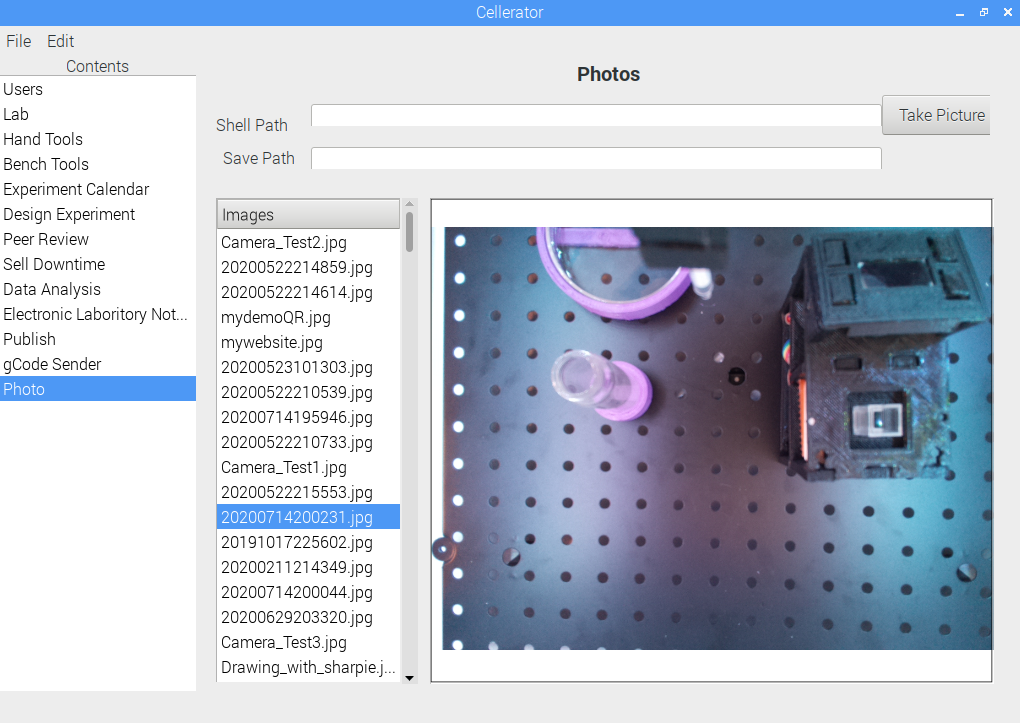
The approach taken by Cellerator is to take existing lab tools and automate common research tasks using components familiar to anyone who’s used a 3D printer. A gantry system with end effectors designed for different tools like pipettes automate the processing of samples. A camera (with or without microscope) can be used for feedback via computer vision, or simply by logging snapshots.

A number of screenshots from the software show the depth of the plans for the system. They include widgets for telling the system where various fixtures such as the hot plate, centrifuge, and bioreactor are located. Sub menus for each tool set parameters for their operation, with a scheduling and instruction system for customizing each experiment as well as recording all of the data along the way.

source https://hackaday.com/2020/08/17/cellerator-wants-to-be-your-automated-desktop-biotech-lab/

Mercurial Light Box Has a Secret Switch

Hit up the lighting aisle of any big box hardware store these days and you’ll probably find a variety of Edison bulbs — modern bulbs meant to evoke the bare, complicated tungsten filament bulbs from the early days of electric candlelight. Edison bulbs use filament LEDs, which resemble skinny candles with wicks at both ends and give off a nice light, especially when diffused by acrylic.

This simple light box uses two filament LEDs that float inside on an internal circuit sculpture. [lonesoulsurfer] likes to use old cell phone batteries and USB charging boards in his builds, and that’s exactly what’s inside this box.

Our favorite part of the build elevates this simple light box into a curiosity for those not in the know. It’s controlled with a mercury tilt switch, so all you’d have to do in a power outage is locate the box and turn it upside down, provided it has a charge.

We love elemental switch design around here, like this light box that switches on with salt water.

source https://hackaday.com/2020/08/17/mercurial-light-box-has-a-secret-switch/

3D on the ZX Spectrum 48K

There are times when a project becomes such a big part of a maker’s life that they find themselves revisiting it even years later. [Thanassis] combined this phenomena with his love for the ZX Spectrum when he ported one of his old 3D rendering projects to the ZX Spectrum 48K. The video below shows the result, and they speak for themselves.

The roots of this project go back around three years, when [Thanassis] posted a similar project for the ATMega328 which employed fixed point math tricks for achieving the graphics. The code needed to be even tighter to run on the Spectrum, eventually getting boiled down to just a handful of calculations. This got the proof of concept working with the z88dk compiler, but it wasn’t quite fast enough.

In the end, hand assembly optimizations nearly doubled the performance to a blistering 10 frames per second. There’s also a version that kicks it all the way up to 40 FPS, but only if you give it a few minutes to do the calculations ahead of time. With a few teaks and the right display, this project could produce some very cool retro visuals.

source https://hackaday.com/2020/08/17/3d-on-the-zx-spectrum-48k/

GridSound – An Audio Workstation In Your Browser

If you’re into creating music, you’ll have a surprisingly large variety of open source options at your disposal, ranging from Audacity as rather simple audio editor to Ardour as a full-blown, studio-worthy DAW — and LMMS, Rosegarden, MusE etc. for anything in between. With [Thomas Tortorini]’s GridSound project, you’ll have one additional choice on your list now, except this one runs in your browser. So if you find yourself in a sudden moment of inspiration, all you’ll need is a browser and off you go.

From the feature set’s point of view, GridSound leans towards LMMS and offers a drum kit, piano roll, and synthesizer. It appears that you won’t be able to record real world instruments at this point, but it’s also a work in progress, so who knows what the future will bring. The code is available on GitHub and you can explore GridSound itself here — no login required, unless you want to save your work. Running in a browser, GridSound is naturally written in JavaScript and uses the Web Audio API to perform the actual audio tasks.

What’s impressive is that [Thomas] opted against any UI framework-of-the-week, but instead implemented everything from scratch in pure vanilla JavaScript. In fact, the entire code base seems to be self-contained without any third party dependencies, and that alone deserves some respect. Sure, JavaScript isn’t everybody’s cup of tea — “real developers use assembly” — so if you prefer something more physical, how about some cardboard music?

source https://hackaday.com/2020/08/17/gridsound-an-audio-workstation-in-your-browser/

Modified Bricks Can House Energy, Too

What if building an emergency battery were as easy as painting conductive plastic onto bricks, stacking them, and charging them up? Researchers at Washington University in St. Louis have done just that — they’ve created supercapacitors by modifying regular old red bricks from various big-box hardware stores.

The bricks are coated in poly(3,4-ethylenedioxythiophene) polystyrene sulfonate (PEDOT:PSS), a conductive polymer that soaks readily into the bricks’ porous surface. When the coated brick is connected to a power source such as a solar panel, the polymer soaks up ions like a sponge. PEDOT:PSS reacts with the iron oxide in the bricks, the rust that gives them their reddish-orange color. Check out the demonstration after the break — it’s a time lapse that shows three PEDOT-coated bricks powering a white LED for ten minutes.

We envision a future where a brick house could double as a battery backup when the power goes out. The researchers thought of that too, or at least had their eye on the outdoors. They waterproofed the PEDOT-coated bricks in epoxy and found they retain 90% of their capacitance and are still efficient after 10,000 charge-discharge cycles. Since this doesn’t take any special kind of brick, it seems to us that any sufficiently porous material would work as long as iron oxide is also present for the reaction. What do you think?

If you can get your hands on the stuff, PEDOT:PSS has all kinds of uses from paper-thin conductors to homebrew organic LEDs.

Thanks for the tip, [Qes]!

source https://hackaday.com/2020/08/16/modified-bricks-can-house-energy-too/

Hydraulic Lifting Workbench To Save Your Back

Working on heavy mechanical machines at awkward heights can be a real back breaker. [Workshop From Scratch] knows this all to well, so he built himself a very clean hydraulic lifting workbench to use around the workshop.

As we’ve come to expect from this aptly named channel, everything on the device has been built from scratch. Though he did use an off-the-shelf manually operated hydraulic piston. The lifting mechanism consists of a parallel bar linkage which allows the benchtop to stay parallel through its entire range of motion. The hand lever of the hydraulic piston was converted to a foot pedal for comfort, and the base has some sturdy trolley wheels to move it around the workshop. Raising the table is admittedly quite slow due to the manual pumping required, but it gets the job done eventually.

Making your own tools and equipment provides a lot of satisfaction, especially if you end up using it a lot. [Workshop From Scratch] builds some excellent tools, like this magnetic drill press, magnetic vice and a workshop crane. We hope to see many more.

source https://hackaday.com/2020/08/16/hydraulic-lifting-workbench-to-save-your-back/