This is it; after a relatively short transit time of eight months, the Mars 2020 mission carrying the Perseverance rover has almost reached the Red Planet. The passage has been pretty calm, but that’s all about to end on Thursday as the Entry Descent and Landing phase begins. The “Seven Minutes of Terror”, which includes a supersonic parachute deployment, machine-vision-assisted landing site navigation, and a “sky-crane” to touch the rover down gently in Jezero crater, will all transpire autonomously 480 million km away. We’ll only learn about how it goes after the eleven-minute propagation delay between Mars and Earth, but we’ll be glued to the NASA YouTube live stream nonetheless. Coverage starts on February 18, 2021 at 11:15 AM Pacific Standard Time (UTC-8). We’ve created a handy time zone converter and countdown so you don’t miss the show.
As amazing as the engineering on display Thursday will be, it looks like the US Navy has plans to unveil technology that will make NASA as relevant as a buggy-whip company was at the turn of the last century. That is, if you believe the “UFO Patents” are for real. The inventor listed on these patents, Dr. Salvatore Pais, apparently really exists; he’s had peer-reviewed papers published in mainstream journals as recently as 2019. Patents listed to Dr. Pais stretch back to 2004, when he invented a laser augmented turbojet propulsion system, which was assigned to defense contractor Northrup Grumman. The rest of the patents are more recent, all seemingly assigned to the US Navy, and cover things like a “high-frequency gravitational wave generator” and a “craft using an inertial mass-reduction device”. There’s also a patent that seems to cover a compact fusion generator. If any of this is remotely true, and we remain highly skeptical, the good news is that maybe we’ll get things like the Epstein Drive. Of course, that didn’t end well for Solomon Epstein. Or for Manéo Jung-Espinoza.
Of course, if you’re going to capitalize on all these alien patents, you’re going to need some funding. If you missed out on the GME short squeeze megabucks, fret not — there’s still plenty of speculative froth to go around. You might want to try your hand at cryptocurrency mining, but with GPUs becoming near-unobtainium, you’ll have to get creative, like throwing together a crypto mining farm with a bunch of laptops. It looks like the Weibo user who posted the photos has laptops propped up on every available surface of their apartment, and there’s also a short video showing a more industrial setup with rack after rack of laptops. These aren’t exactly throw-aways from some grade school, either — they appear to be brand new laptops that retail for like $1,300 a pop. The ironic part is that the miner says this is better than the sweatshop he used to work in. Pretty sure with all that power being dissipated in his house, it’ll still be a sweatshop come summer.
A lot of people have recently learned the hard lesson that when the service is free, you’re the product, and that what Google giveth, Google can taketh away in a heartbeat, and for no discernable reason. Indie game studio Re-Logic and its lead developer Andrew Spinks found that out last week when a vaguely worded terms-of-service violation notice arrived from Google. The developer of the popular game Terraria was at a loss to understand the TOS violation, which resulted in a loss of access to all the company’s Google services. He spent three weeks going down the hell hole of Google’s automated support system, getting nothing but canned messages that were either irrelevant to his case or technically impossible; kinda hard to check your Gmail account when Google has shut it down. The lesson here is that building a business around services that can be taken away on a whim is perhaps not the best business plan.
And finally, we watched with great interest Big Clive’s secrets to getting those crisp, clean macro shots that he uses to reverse-engineer PCBs. We’ve always wondered how he accomplished that, and figured it involved some fancy ring-lights around the camera lens or a specialized lightbox. Either way, we figured Clive had to plow a bunch of that sweet YouTube cash into the setup, but we were surprised to learn that in true hacker fashion, it’s really just a translucent food container ringed with an LED strip, with a hole cut in the top for his cellphone camera. It may be simple, but you can’t argue with the results.
This is it; after a relatively short transit time of eight months, the Mars 2020 mission carrying the Perseverance rover has almost reached the Red Planet. The passage has been pretty calm, but that’s all about to end on Thursday as the Entry Descent and Landing phase begins. The “Seven Minutes of Terror”, which includes a supersonic parachute deployment, machine-vision-assisted landing site navigation, and a “sky-crane” to touch the rover down gently in Jezero crater, will all transpire autonomously 480 million km away. We’ll only learn about how it goes after the eleven-minute propagation delay between Mars and Earth, but we’ll be glued to the NASA YouTube live stream nonetheless. Coverage starts on February 18, 2021 at 11:15 AM Pacific Standard Time (UTC-8). We’ve created a handy time zone converter and countdown so you don’t miss the show.
As amazing as the engineering on display Thursday will be, it looks like the US Navy has plans to unveil technology that will make NASA as relevant as a buggy-whip company was at the turn of the last century. That is, if you believe the “UFO Patents” are for real. The inventor listed on these patents, Dr. Salvatore Pais, apparently really exists; he’s had peer-reviewed papers published in mainstream journals as recently as 2019. Patents listed to Dr. Pais stretch back to 2004, when he invented a laser augmented turbojet propulsion system, which was assigned to defense contractor Northrup Grumman. The rest of the patents are more recent, all seemingly assigned to the US Navy, and cover things like a “high-frequency gravitational wave generator” and a “craft using an inertial mass-reduction device”. There’s also a patent that seems to cover a compact fusion generator. If any of this is remotely true, and we remain highly skeptical, the good news is that maybe we’ll get things like the Epstein Drive. Of course, that didn’t end well for Solomon Epstein. Or for Manéo Jung-Espinoza.
Of course, if you’re going to capitalize on all these alien patents, you’re going to need some funding. If you missed out on the GME short squeeze megabucks, fret not — there’s still plenty of speculative froth to go around. You might want to try your hand at cryptocurrency mining, but with GPUs becoming near-unobtainium, you’ll have to get creative, like throwing together a crypto mining farm with a bunch of laptops. It looks like the Weibo user who posted the photos has laptops propped up on every available surface of their apartment, and there’s also a short video showing a more industrial setup with rack after rack of laptops. These aren’t exactly throw-aways from some grade school, either — they appear to be brand new laptops that retail for like $1,300 a pop. The ironic part is that the miner says this is better than the sweatshop he used to work in. Pretty sure with all that power being dissipated in his house, it’ll still be a sweatshop come summer.
A lot of people have recently learned the hard lesson that when the service is free, you’re the product, and that what Google giveth, Google can taketh away in a heartbeat, and for no discernable reason. Indie game studio Re-Logic and its lead developer Andrew Spinks found that out last week when a vaguely worded terms-of-service violation notice arrived from Google. The developer of the popular game Terraria was at a loss to understand the TOS violation, which resulted in a loss of access to all the company’s Google services. He spent three weeks going down the hell hole of Google’s automated support system, getting nothing but canned messages that were either irrelevant to his case or technically impossible; kinda hard to check your Gmail account when Google has shut it down. The lesson here is that building a business around services that can be taken away on a whim is perhaps not the best business plan.
And finally, we watched with great interest Big Clive’s secrets to getting those crisp, clean macro shots that he uses to reverse-engineer PCBs. We’ve always wondered how he accomplished that, and figured it involved some fancy ring-lights around the camera lens or a specialized lightbox. Either way, we figured Clive had to plow a bunch of that sweet YouTube cash into the setup, but we were surprised to learn that in true hacker fashion, it’s really just a translucent food container ringed with an LED strip, with a hole cut in the top for his cellphone camera. It may be simple, but you can’t argue with the results.
Most of us probably get by with a toothbrush costing a couple dollars at most, made of injection-moulded plastic for delicate, tender mouths. Maybe if you’re a real cleantooth, you have a fancy buzzy electric one. We’d wager few are machining their own bespoke toothbrushes from scratch, but if you want some inspiration, [W&M Levsha] is doing just that.
Much of the work will be familiar to die hard machining enthusiasts. There’s careful crafting of the wood handle, involving a stackup of multiple stained and varnished woods – in this case, hornbeam being the paler of the two, and amaranth providing that rich red color. The stem is a stylish stainless steel piece, elegantly bent to a tasteful curve. Finally, the assembly of the brush head alone is worth the watch. It’s custom made – with a steel backing plate and fishing wire bristles custom cut with an automated jig using stepper motors. We’re suspect fishing wire is not rated for dental use, but the nylon strands are at least in the ballpark of what regular toothbrushes use.
While we probably wouldn’t slide this one betwixt our lips without consulting a dental professional first, it’s a great video for learning about what it takes to make beautiful bespoke objects in the workshop. We’ve seen elegant work from [W&M Levsha] before, too – in the form of a delightfully eclectic cap gun lighter. Video after the break.
Were you to mention Texas to a European, they’d maybe think of cowboys, oil, the hit TV show Dallas, and if they were European Hackaday readers, probably the semiconductor giant Texas Instruments. The only state of the USA with a secession clause also turns out to to have their own power grid independent of neighboring states.
An accurate and contemporary portrait of a typical Texan, as understood by Europeans. Carol M. Highsmith, Public domain.
Surely America is a place of such resourcefulness that this would be impossible, we cry as we watch from afar the red squares proliferating across the outage map. It turns out that for once the independent streak that we’re told defines Texas may be its undoing. We’re used to our European countries being tied into the rest of the continental grid, but because the Texan grid stands alone it’s unable to sip power from its neighbours in times of need.
Let’s dive into the mechanics of maintaining an electricity grid, with the unfortunate Texans for the moment standing in as the test subject.
Combination of Coal, Natural Gas, Nuclear, and Wind Power Generators Knocked Out by Cold
If a power grid was as simple as a collection of generating stations connected full-time to a constant load, its running would be a relatively straightforward affair of shoveling some sort of fuel in at one end and receiving the benefit of the electricity at the other. Sadly the reality of powering a human population is never so predictable, and the grid utility plays a constant game of anticipating variable demand in order to match it with generating capacity. Entire power stations exist with the specific application of providing near instantaneous extra power — you may remember our reporting on UK’s Electric Mountain. Grid strategists make it their business to predict our actions as they relate to power use down to the minute.
Since Texas has blistering hot summers they are used to their periods of peak load happening as Texans turn on their air conditioning en masse, with the relatively mild winters in a state bordering the Gulf of Mexico providing little stress to the system. But here we have a perfect storm of energy facilities closed by the weather being unable to cope with the extra demand has Texas turn to electric heat to keep them warm.
North America, in power grid terms. Fjbfour, Public domain.
In times of need, can you borrow a cup of energy from a neighbor? Continental North America has two large power grids, one on each side of the Rockies, and a few smaller grids of which the Texas Interconnect is one. The reason for its existence is historical, and in part its continuation is because as a single-state entity it is not subject to some Federal or international (with Canada) regulations. It has some relatively modest DC interconnects with its neighbours, but they are not of sufficient capacity to allow generators in warmer states to take up the slack. There is an ambitious plan for a much larger DC interconnect project to link both the Eastern and Western grids with the Texan one, which in turn gives us a chance for a look at how grids are synchronised.
Phase Sync Makes Connecting AC Grids Tricky
Huge thyristors used in the converter plants of the DC link between North and South Islands, New Zwaland. Marshelec, CC BY-SA 3.0.
Connecting two AC electricity grids is not simply a case of wiring them together, as their AC frequency and phase must both match exactly in order for a connection to work. The Texas grid has the same nominal frequency of 60Hz as its neighbours, but in practice there will be a slight difference in frequency and phase that can not be reconciled without the impractical step of powering down the entire state and restarting all its generators in synchronisation. The solution when transferring power between grids is therefore to convert it to DC for the intermediate stage, then back to AC at the correct grid frequency and phase. Many undersea cables such as those linking the UK, Scandinavia, and continental Europe take this approach, meaning that those grids are linked for the purpose of trading power but not synchronised. Thus when in 2018 a political stand-off in Kosovo caused a load imbalance that sent Europe’s grid frequency into a downward spiral, the British grid was unaffected. This is how the ambitious American grid interconnect mentioned earlier is slated to work, with DC links from all three grids meeting in New Mexico with a superconducting cable interconnect for an extra efficiency boost.
Electricity at the scale in which most Hackaday readers encounter it is a cinch to manage with a switching regulator here and there or maybe even a breaker or two in low-power mains circuits. At the scale of a grid, a country, or a continent though it enters an order of magnitude in which a single semiconductor switching device can be the size of a small house, and engineers must concern themselves with not only the matters of power handling but also human behaviours and geopolitics. If you’re a Texan Hackaday reader hunkering down for a cold spell then you have our sympathy and best wishes for a speedy thaw, and meanwhile for the rest of us it’s worth remembering that it could just as easily happen anywhere else.
Header image including USA map, Wapcaplet, CC BY-SA 3.0.
Were you to mention Texas to a European, they’d maybe think of cowboys, oil, the hit TV show Dallas, and if they were European Hackaday readers, probably the semiconductor giant Texas Instruments. The only state of the USA with a secession clause also turns out to to have their own power grid independent of neighboring states.
An accurate and contemporary portrait of a typical Texan, as understood by Europeans. Carol M. Highsmith, Public domain.
Surely America is a place of such resourcefulness that this would be impossible, we cry as we watch from afar the red squares proliferating across the outage map. It turns out that for once the independent streak that we’re told defines Texas may be its undoing. We’re used to our European countries being tied into the rest of the continental grid, but because the Texan grid stands alone it’s unable to sip power from its neighbours in times of need.
Let’s dive into the mechanics of maintaining an electricity grid, with the unfortunate Texans for the moment standing in as the test subject.
Combination of Coal, Natural Gas, Nuclear, and Wind Power Generators Knocked Out by Cold
If a power grid was as simple as a collection of generating stations connected full-time to a constant load, its running would be a relatively straightforward affair of shoveling some sort of fuel in at one end and receiving the benefit of the electricity at the other. Sadly the reality of powering a human population is never so predictable, and the grid utility plays a constant game of anticipating variable demand in order to match it with generating capacity. Entire power stations exist with the specific application of providing near instantaneous extra power — you may remember our reporting on UK’s Electric Mountain. Grid strategists make it their business to predict our actions as they relate to power use down to the minute.
Since Texas has blistering hot summers they are used to their periods of peak load happening as Texans turn on their air conditioning en masse, with the relatively mild winters in a state bordering the Gulf of Mexico providing little stress to the system. But here we have a perfect storm of energy facilities closed by the weather being unable to cope with the extra demand has Texas turn to electric heat to keep them warm.
North America, in power grid terms. Fjbfour, Public domain.
In times of need, can you borrow a cup of energy from a neighbor? Continental North America has two large power grids, one on each side of the Rockies, and a few smaller grids of which the Texas Interconnect is one. The reason for its existence is historical, and in part its continuation is because as a single-state entity it is not subject to some Federal or international (with Canada) regulations. It has some relatively modest DC interconnects with its neighbours, but they are not of sufficient capacity to allow generators in warmer states to take up the slack. There is an ambitious plan for a much larger DC interconnect project to link both the Eastern and Western grids with the Texan one, which in turn gives us a chance for a look at how grids are synchronised.
Phase Sync Makes Connecting AC Grids Tricky
Huge thyristors used in the converter plants of the DC link between North and South Islands, New Zwaland. Marshelec, CC BY-SA 3.0.
Connecting two AC electricity grids is not simply a case of wiring them together, as their AC frequency and phase must both match exactly in order for a connection to work. The Texas grid has the same nominal frequency of 60Hz as its neighbours, but in practice there will be a slight difference in frequency and phase that can not be reconciled without the impractical step of powering down the entire state and restarting all its generators in synchronisation. The solution when transferring power between grids is therefore to convert it to DC for the intermediate stage, then back to AC at the correct grid frequency and phase. Many undersea cables such as those linking the UK, Scandinavia, and continental Europe take this approach, meaning that those grids are linked for the purpose of trading power but not synchronised. Thus when in 2018 a political stand-off in Kosovo caused a load imbalance that sent Europe’s grid frequency into a downward spiral, the British grid was unaffected. This is how the ambitious American grid interconnect mentioned earlier is slated to work, with DC links from all three grids meeting in New Mexico with a superconducting cable interconnect for an extra efficiency boost.
Electricity at the scale in which most Hackaday readers encounter it is a cinch to manage with a switching regulator here and there or maybe even a breaker or two in low-power mains circuits. At the scale of a grid, a country, or a continent though it enters an order of magnitude in which a single semiconductor switching device can be the size of a small house, and engineers must concern themselves with not only the matters of power handling but also human behaviours and geopolitics. If you’re a Texan Hackaday reader hunkering down for a cold spell then you have our sympathy and best wishes for a speedy thaw, and meanwhile for the rest of us it’s worth remembering that it could just as easily happen anywhere else.
Header image including USA map, Wapcaplet, CC BY-SA 3.0.
Were you to mention Texas to a European, they’d maybe think of cowboys, oil, the hit TV show Dallas, and if they were European Hackaday readers, probably the semiconductor giant Texas Instruments. The only state of the USA with a secession clause also turns out to to have their own power grid independent of neighboring states.
An accurate and contemporary portrait of a typical Texan, as understood by Europeans. Carol M. Highsmith, Public domain.
Surely America is a place of such resourcefulness that this would be impossible, we cry as we watch from afar the red squares proliferating across the outage map. It turns out that for once the independent streak that we’re told defines Texas may be its undoing. We’re used to our European countries being tied into the rest of the continental grid, but because the Texan grid stands alone it’s unable to sip power from its neighbours in times of need.
Let’s dive into the mechanics of maintaining an electricity grid, with the unfortunate Texans for the moment standing in as the test subject.
Combination of Coal, Natural Gas, Nuclear, and Wind Power Generators Knocked Out by Cold
If a power grid was as simple as a collection of generating stations connected full-time to a constant load, its running would be a relatively straightforward affair of shoveling some sort of fuel in at one end and receiving the benefit of the electricity at the other. Sadly the reality of powering a human population is never so predictable, and the grid utility plays a constant game of anticipating variable demand in order to match it with generating capacity. Entire power stations exist with the specific application of providing near instantaneous extra power — you may remember our reporting on UK’s Electric Mountain. Grid strategists make it their business to predict our actions as they relate to power use down to the minute.
Since Texas has blistering hot summers they are used to their periods of peak load happening as Texans turn on their air conditioning en masse, with the relatively mild winters in a state bordering the Gulf of Mexico providing little stress to the system. But here we have a perfect storm of energy facilities closed by the weather being unable to cope with the extra demand has Texas turn to electric heat to keep them warm.
North America, in power grid terms. Fjbfour, Public domain.
In times of need, can you borrow a cup of energy from a neighbor? Continental North America has two large power grids, one on each side of the Rockies, and a few smaller grids of which the Texas Interconnect is one. The reason for its existence is historical, and in part its continuation is because as a single-state entity it is not subject to some Federal or international (with Canada) regulations. It has some relatively modest DC interconnects with its neighbours, but they are not of sufficient capacity to allow generators in warmer states to take up the slack. There is an ambitious plan for a much larger DC interconnect project to link both the Eastern and Western grids with the Texan one, which in turn gives us a chance for a look at how grids are synchronised.
Phase Sync Makes Connecting AC Grids Tricky
Huge thyristors used in the converter plants of the DC link between North and South Islands, New Zwaland. Marshelec, CC BY-SA 3.0.
Connecting two AC electricity grids is not simply a case of wiring them together, as their AC frequency and phase must both match exactly in order for a connection to work. The Texas grid has the same nominal frequency of 60Hz as its neighbours, but in practice there will be a slight difference in frequency and phase that can not be reconciled without the impractical step of powering down the entire state and restarting all its generators in synchronisation. The solution when transferring power between grids is therefore to convert it to DC for the intermediate stage, then back to AC at the correct grid frequency and phase. Many undersea cables such as those linking the UK, Scandinavia, and continental Europe take this approach, meaning that those grids are linked for the purpose of trading power but not synchronised. Thus when in 2018 a political stand-off in Kosovo caused a load imbalance that sent Europe’s grid frequency into a downward spiral, the British grid was unaffected. This is how the ambitious American grid interconnect mentioned earlier is slated to work, with DC links from all three grids meeting in New Mexico with a superconducting cable interconnect for an extra efficiency boost.
Electricity at the scale in which most Hackaday readers encounter it is a cinch to manage with a switching regulator here and there or maybe even a breaker or two in low-power mains circuits. At the scale of a grid, a country, or a continent though it enters an order of magnitude in which a single semiconductor switching device can be the size of a small house, and engineers must concern themselves with not only the matters of power handling but also human behaviours and geopolitics. If you’re a Texan Hackaday reader hunkering down for a cold spell then you have our sympathy and best wishes for a speedy thaw, and meanwhile for the rest of us it’s worth remembering that it could just as easily happen anywhere else.
Header image including USA map, Wapcaplet, CC BY-SA 3.0.
The Earth Day Challenge is now under way! Spin up your take on an Earth-Day-themed electronics project and you’ll be in the running for one of the three $200 shopping sprees at Digi-Key, who are sponsoring this contest.
Gutters to Gardens is a great project example; using a rain barrel and solar panel for off-grid automation.
This is all about raising awareness for environmental projection. You might considered something as direct as measuring and plotting air quality data, or as abstract as weighing your home’s recycling bin and garbage bin and making a game out of generating less waste in general, and boosting your recycling-to-landfill ratio. Find an application that can be moved from grid-power to solar power, or build a carbon-savings counter that calculates the impact you have when choosing your bike over a car. The coolest projects are the ones that make us all think in new ways.
In addition to those $200 prizes for the top three projects, there are $50 Tindie gift cards for the twelve most artistically presented projects. Digi-Key is looking for great images to include in a wall calendar for 2022.
Pop over to Hackaday.io to start your entry today. Don’t forget to use the “Submit project to:” drop-down box on the left sidebar of your project page to make sure it’s considered in the contest. You must have your entry in by April 19th!
When we sit down to a build video and see that it’s from [Workshop From Scratch], we know it’ll be a good one, full of plenty of gratuitous metal-wrangling with the promise of an ingenious and useful take on a workshop essential at the end. The home made hydraulic bench vice is the latest from that particular workshop, so settle down with the video below the break for a treat.
Unlike the lead screw we’d expect from a more conventional vice, this one uses a hydraulic pull cylinder and its associated compressor which is powered by compressed air. A substantial vice frame is constructed around the cylinder from thick steel plate, with some careful welding and grinding to ensure a smooth finish. The result is substantial clamping force with a very smooth and quick action, which doesn’t overhang the edge of the bench in the way a more traditional one does. The hydraulic tube is tucked away through a hole in the bench, and the foot-operated pump lies out of sight on the floor.
Looking at this vice with blacksmith-trained eyes, it raises the question of how it might perform were something in it to be hammered. Overhanging vices are vulnerable to splitting when hammered, so there’s the possibility that this one with its flat mounting might fare a little better. Either way it would be an asset to any workshop.
Surely BASIC is properly obsolete by now, right? Perhaps not. In addition to inspiring a large part of home computing today, BASIC is still very much alive today, even outside of retro computing.
There was a time, not even that long ago, when the lingua franca of the home computer world was BASIC. This wasn’t necessarily always the exact same BASIC; the commands and syntax differed between whatever BASIC dialect came with any given model of home computer (Commodore, Atari, Texas Instruments, Sinclair or any of the countless others). Fortunately most of these licensed or were derived from the most popular microcomputer implementation of BASIC: Microsoft BASIC.
BASIC has its roots in academics, where it was intended to be an easy to use programming language for every student, even those outside the traditional STEM fields. Taking its cues from popular 1960s languages like FORTRAN and ALGOL, it saw widespread use on time-sharing systems at schools, with even IBM joining the party in 1973 with VS-BASIC. When the 1970s saw the arrival of microcomputers, small and cheap enough to be bought by anyone and used at home, it seemed only natural that they too would run BASIC.
The advantage of having BASIC integrated into these systems was obvious: not only were most people who bought such a home computer already familiar with BASIC, it allows programs to be run without first being compiled. This was good, because compiling a program takes a lot of RAM and storage, neither of which were plentiful in microcomputers. Instead of compiling BASIC source code, BASIC interpreters would interpret and run the code one line at a time, trading execution speed for flexibility and low resource use.
After turning on one’s microcomputer, the BASIC interpreter would usually be loaded straight from an onboard ROM in lieu of a full-blown operating system. In this interpreter shell, one could use the hardware, write and load BASIC programs and save them to tape or disk. Running existing BASIC code as well as compiled programs on one’s computer, or even typing them in from a listing in a magazine all belonged to the options. As BASIC implementations between different home computers were relatively consistent, this provided for a lot of portability.
That was then, and this is now. Are people actually still using the Basic language?
BASIC Joystick Fun
To start off with, let’s see a bit of what BASIC is about. For an extremely simple but fun example of how BASIC can be used, let’s take a look at an application for the Commodore 64 (courtesy of C64-Wiki) that moves an arrow around the screen while printing its screen coordinates using a joystick connected to the second joystick port. The C64 runs Commodore BASIC 2.0, which is based on Microsoft BASIC.
 10 S=2: X=150: Y=150: V=53248: GOTO 100
 15 J=PEEK(56320): IF J=127 THEN 15
 20 IF J=111 THEN POKE 56322,255:END
 25 IF J=123 THEN X=X-S
 30 IF J=119 THEN X=X+S
 35 IF J=125 THEN Y=Y+S
 40 IF J=126 THEN Y=Y-S
 45 IF J=122 THEN Y=Y-S
 50 IF J=118 THEN Y=Y-S
 55 IF J=117 THEN Y=Y-S
 60 IF J=121 THEN Y=Y-S
 65 IF X=>252 THEN X=10
 70 IF X=<10 THEN X=252 75 IF Y>254 THEN Y=44
 80 IF Y<44 THEN Y=254
 85 PRINT CHR$(147);CHR$(158);CHR$(17);"X-POS:";X;" Y-POS";Y
 90 POKE V,X:POKE V+1,Y: GOTO 15
100 FOR Z=832 TO 853 : POKE Z,0: NEXT Z
105 FOR Z=832 TO 853 STEP 3: READ J: POKE Z,J: NEXT Z
110 POKE V+21,1: POKE  V+39,7: POKE V+33,0: POKE V+29,1
115 POKE 56322,224: POKE 2040,13: GOTO 85
120 DATA 240, 224, 224, 144, 8, 4, 2, 1
Each of the lines above are entered as-is, including the line number. On the next line after the code we enter RUN and hit ‘Return’ (or ‘Enter’, depending on one’s keyboard). Assuming we didn’t mistype anything, the code will now execute to show the following screen:
In this exciting game, we move the arrow around the screen using the joystick.
So what does this code do? As with any BASIC program, it starts at the first line which here is 10. It defines a few variables here, before jumping to line 100 (using GOTO). In a FOR loop, we POKE (i.e. write a hardware register) and repeat this in a few more addresses, which updates the display to its initial configuration. Here the READ command is used to read constants which are defined by DATA.
Many of these memory addresses directly address the video adapter (VIC-II in the C64). When we use PEEK at line 15, it reads the contents of the memory address 56322, which corresponds to the current input values on the second joystick port. After that we can check the state of each input using the bit values and adjust our on-screen arrow accordingly (line 90), along with the coordinates (line 85).
The C64 Wiki page for this program includes a bitwise comparison version. That should run marginally faster, as it has fewer lines of code. For moving an arrow around the screen, the difference would be unlikely to be noticed, however.
Important to note here is that BASIC implementations on different microcomputers would have to POKE and PEEK different memory addresses to get the same effect due to the different system layout of each computer. Some implementations would also provide commands tailored specifically to that microcomputer system, which became more relevant as graphics and audio capabilities grew.
Interpreted Versus Compiled
A familiar sight for some people: the QuickBasic IDE.
The interpreted nature of BASIC on most microcomputers was both a benefit and a disadvantage. On one hand, it’s very flexible, and you can simply run your latest program and quickly modify it without having to deal with lengthy compile cycles (on a <10 MHz Z80 or 6502 MPU, no less). On the other hand, because any errors in the code will not become apparent until the program is run by the interpreter, this leads to the same joyful experience as with modern-day JavaScript and Python scripts, where the code will run fine until the interpreter suddenly keels over with an error message (if one is lucky).
With BASIC this usually comes in the form of a ‘Syntax error on line <line>’ error. Running the same code through a compiler would however have found those errors. This feature of interpreted code means that the easy distribution method of code as listings in computer magazines and reference books would only be as good as the quality of the printed code and one’s own typing skills. Fortunately, on the C64 and similar systems, fixing a mistyped line would be as easy as retyping it, hitting ‘Return’ and the interpreter shell would update the line in question.
BASIC Today
The PureBasic Visual Designer.
All good and well, you may say at this point, but nobody is dragging out that C64 to do some BASIC programming today. Aside from folks who like to play with old computers, of course. Here it should be noted that BASIC didn’t live and die with Commodore and Atari. Over at Microsoft, BASIC spawned Visual Basic, Visual Basic for Applications (VBA) and VB .NET. The latter allows writing VB code for the .NET runtime.
Microsoft also released Small Basic in 2008, which it says targets novice programmers, for example students who used a visual programming language like Scratch previously. This is not to be confused with SmallBASIC, which is an open source (GPL) BASIC dialect with accompanying interpreters for modern platforms.
BASIC dialects can also be found in many graphing and programmable calculators from Ti, HP, Casio and others, although many of these dialects are not directly compatible with the original BASIC standard (ISO/IEC 10279:1991). Since the 1980s, BASIC evolved to no longer require line numbers, instead using labels which it can jump to, along with adopting new programming paradigms. This was introduced with QuickBasic in 1985 and is a common sight today.
Also on the commercial side of the fence is PureBasic by Fantaisie Software, which provides an IDE and compiler for a number of target platforms. True BASIC is a modern BASIC toolchain and IDE which moves closer to FORTRAN in its syntax, and is developed by the original developers of BASIC (Darthmouth BASIC).
Clearly, BASIC is not dead then. It sees daily use in its commercial forms, the myriad of open source projects and in the vibrant retrocomputing community. Aside from still being a (arguably) good language to teach programming with, it’s also a nice option for embedded applications, especially where many use MicroPython or kin today, as the system requirements are much lower. We reported on an ARM MCU which came with a BASIC interpreter a number of years ago, for example.
There are also projects like UBASIC PLUS on GitHub, targeting STM32F0 MCUs and requiring as little as 8 kB of RAM and 64 kB of Flash. Another project for ARM and PIC32 (as well as DOS and Windows) is MMBasic, which lists its requirements as 94 kB of Flash and at least 16 kB of RAM.
With BASIC having evolved in an era when home computers had less memory and storage than a $5 microcontroller has today, it makes for an excellent, low-resource language for situations which call for the use of interpreted scripts rather than precompiled binaries, without having to shell out for MCUs with more Flash and RAM.
Are any of our readers regular users of BASIC in some form today? If so, be sure to leave a comment with your experiences and tips for those who might be interested in giving BASIC a shot, whether on desktop, retro systems or embedded 🙂
[Header Image: The HP 2000 system, mainly used for running time-shared BASIC, CC-BY 3.0]
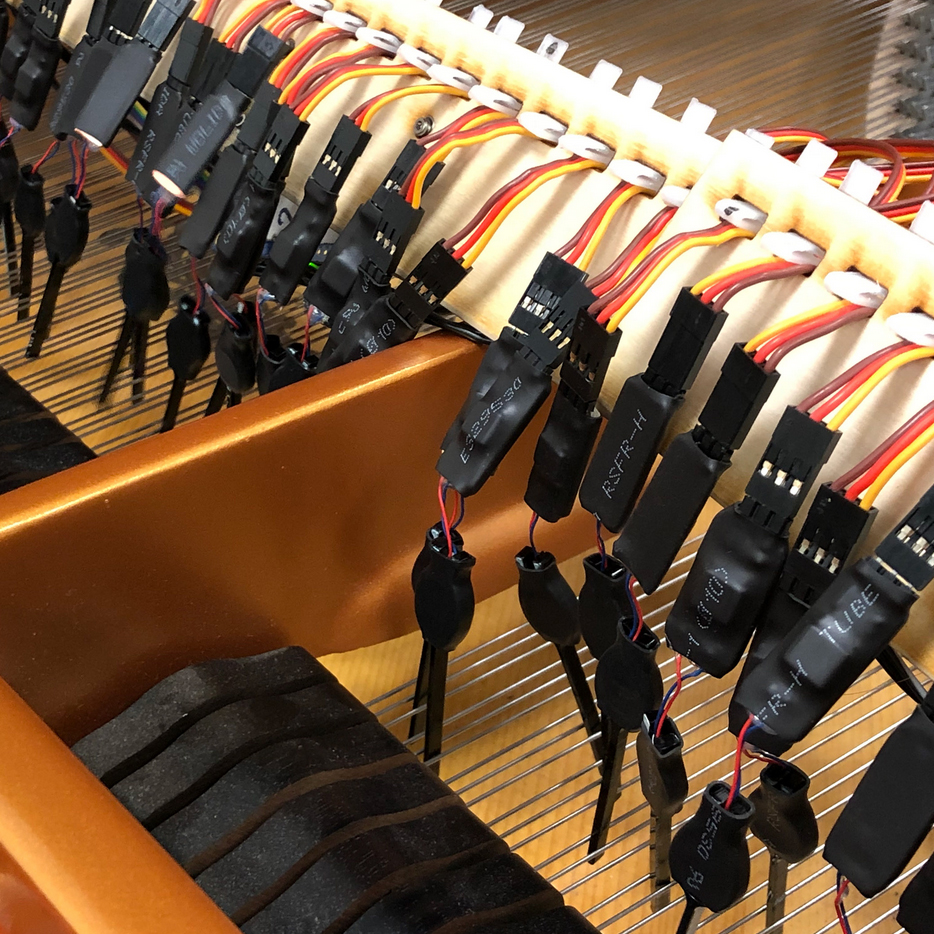
It’s not every day we see a grand piano with a Raspberry Pi inside, let alone one with 96 motors, but sometimes we get lucky. The contraption in question is one developed by [Konstantin Leonenko], as part of a collaboration with composer [Patricia Alessandrini] for a piece she created inspired by Ada Lovelace. Specifically, [Patricia] was inspired by Ada’s idea that an “analytical machine” would, someday, be able to create music on its own. [Konstantin] and [Patricia] worked together to make a machine that would learn from it’s human co-performers and create music with them.
Their creation, rather than just one tricked-out keyboard, is actually a portable attachment that can be easily fitted to any grand piano. Each of the device’s 96 motors drives a plastic “finger” that excites the piano’s strings. The result is a sound unlike any other — and you really need to experience it so click through that link at the top for the demo video.
Rather cleverly, the fingers are designed such that their dynamics help to mask the sound of the motor (a must for performances) while simultaneously enhancing the string’s timbre. Like any project, this one went through a number of iterations over the two-year design process, and even spun off into an entirely new, glove-based version.
We’ve seen some awesome music tech hacks, and this one fits right in with the rest. It’s always exciting to see an instrument as ubiquitous as the piano be used in new and refreshing ways. Be sure to check out the link at the top for a video of this incredible instrument in action!
It’s not every day we see a grand piano with a Raspberry Pi inside, let alone one with 96 motors, but sometimes we get lucky. The contraption in question is one developed by [Konstantin Leonenko], as part of a collaboration with composer [Patricia Alessandrini] for a piece she created inspired by Ada Lovelace. Specifically, [Patricia] was inspired by Ada’s idea that an “analytical machine” would, someday, be able to create music on its own. [Konstantin] and [Patricia] worked together to make a machine that would learn from it’s human co-performers and create music with them.
Their creation, rather than just one tricked-out keyboard, is actually a portable attachment that can be easily fitted to any grand piano. Each of the device’s 96 motors drives a plastic “finger” that excites the piano’s strings. The result is a sound unlike any other — and you really need to experience it so click through that link at the top for the demo video.
Rather cleverly, the fingers are designed such that their dynamics help to mask the sound of the motor (a must for performances) while simultaneously enhancing the string’s timbre. Like any project, this one went through a number of iterations over the two-year design process, and even spun off into an entirely new, glove-based version.
We’ve seen some awesome music tech hacks, and this one fits right in with the rest. It’s always exciting to see an instrument as ubiquitous as the piano be used in new and refreshing ways. Be sure to check out the link at the top for a video of this incredible instrument in action!
One of the best things to come from the growing drone industry is the development of compact and powerful brushless motors. We’ve seen several multi-rotors capable of carrying a human, but electric helicopters are rare. [OskarRDA] decided to experiment with this, converting his single-seat ultralight helicopter to electric power and giving it seven tail rotors in the process. Flight footage after the break.
The helicopter in question started life as a Mosquito Air, a bare-bones kit helicopter originally powered by a two-stroke engine. The engine and gearbox were replaced with an EMRAX 228 109 kW brushless motor. Initially, he used the conventional drive-shaft powered tail rotor but wanted to experiment with multiple smaller rotors powered by separate motors, which has several advantages. He only really needed four of the 5008 or 5010 size motors with 18″ props to get comparable thrust, but he added more for redundancy. The new setup was also lighter, even with its independent batteries, at 7.5 kg compared to the 8.1 kg of the old tail rotor assembly.
One of the major advantages of a conventional helicopter over a multirotor is the ability to autorotate safely to the ground if the engine fails. A coupled tail rotor bleeds some energy from the main rotor while autorotating, but since the tail rotor has independent power in this case, it allows all the energy to be used by the main rotor, theoretically decreasing decent speed by 120 feet per second. [OskarRDA] did some engine failure and autorotation test flights, and the results were positive. He likes his new tail rotors enough that he doesn’t plan on going back to a single large rotor.
Power for the main motor is provided by a 7.8 kW, 40 kg LiPo battery pack mounted beneath the seat. Theoretically, this would allow flight times of up to 27 minutes, but [OskarRDA] has kept most of his flights to 10 minutes or less. He didn’t add any electronic gyro for stabilization, but he did add some electronic coupling between the main motor and tail motors, to reduce the torque correction required by the pilot. Even so, it is clear from the flight footage that [OskarRDA] is a skilled helicopter pilot.
Ever felt like what your MCU of choice misses is a way to read the electrical signals from your muscles? In that case [Deepak Khatri] over at Upside Down Labs has got your back with the BioAmp EMG Pill. Described as an affordable, open source electromyography (EMG) module, based around a TL074 quad low-noise JFET-input opamp. At just over 32×10 millimeters, it’s pretty compact as well.
The onboard opamp ensures that the weak electrical signals captured from the muscles when they move are amplified sufficiently that the ADC of any microcontroller or similar can capture the signal for further processing. Some knowledge of how to set up an EMG is required to use the module, of course, and the TL074 opamp prefers an input voltage between 7-30 V. Even so, it has all the basics onboard, and the KiCad project is freely available via the above linked GitHub project.
In addition, [Deepak] also tweeted about working on an affordable, open source active prosthetics controller (and human augmentation device), which has us very much interested in what other projects may come out of Upside Down Labs before long. After, all we’re no strangers to hacking with biosignals.
Ever felt like what your MCU of choice misses is a way to read the electrical signals from your muscles? In that case [Deepak Khatri] over at Upside Down Labs has got your back with the BioAmp EMG Pill. Described as an affordable, open source electromyography (EMG) module, based around a TL074 quad low-noise JFET-input opamp. At just over 32×10 millimeters, it’s pretty compact as well.
The onboard opamp ensures that the weak electrical signals captured from the muscles when they move are amplified sufficiently that the ADC of any microcontroller or similar can capture the signal for further processing. Some knowledge of how to set up an EMG is required to use the module, of course, and the TL074 opamp prefers an input voltage between 7-30 V. Even so, it has all the basics onboard, and the KiCad project is freely available via the above linked GitHub project.
In addition, [Deepak] also tweeted about working on an affordable, open source active prosthetics controller (and human augmentation device), which has us very much interested in what other projects may come out of Upside Down Labs before long. After, all we’re no strangers to hacking with biosignals.
Ever felt like what your MCU of choice misses is a way to read the electrical signals from your muscles? In that case [Deepak Khatri] over at Upside Down Labs has got your back with the BioAmp EMG Pill. Described as an affordable, open source electromyography (EMG) module, based around a TL074 quad low-noise JFET-input opamp. At just over 32×10 millimeters, it’s pretty compact as well.
The onboard opamp ensures that the weak electrical signals captured from the muscles when they move are amplified sufficiently that the ADC of any microcontroller or similar can capture the signal for further processing. Some knowledge of how to set up an EMG is required to use the module, of course, and the TL074 opamp prefers an input voltage between 7-30 V. Even so, it has all the basics onboard, and the KiCad project is freely available via the above linked GitHub project.
In addition, [Deepak] also tweeted about working on an affordable, open source active prosthetics controller (and human augmentation device), which has us very much interested in what other projects may come out of Upside Down Labs before long. After, all we’re no strangers to hacking with biosignals.
There was a time when visitors to London would carry an A to Z map to navigate the city’s Undergound railway system, referring to the iconic London Transport map printed on its back as they did so. Now it’s likely they’ll do the same with their smartphones, with apps ranging from simple analogues of the printed version through to fully annotated route planners with up to the minute train information. Is this a new technology, something only possible in the last decade? Serial British rail YouTuber [Geoff Marshall] thinks otherwise, and has programmed a Tube map on a vintage BBC Micro.
We don’t expect anyone to heft a pile of vintage hardware onto the Central Line at rush hour even though in reality he’s running it on an emulator due to his real BBC Micro being kaput. Perhaps someone should drop him a line about capacitor replacement in that power supply. But it does provide an entertaining jaunt back into afternoons in a 1980s school computer lab, with MOVE, DRAW, and PLOT commands as he wrestles with the limited colour palette of MODE 2. The result only covers Tube Zone 1, or the very centre of London, so to visit London Hackspace you’ll have to remember to take the Bakerloo line northbound out to Zone 4 and disembark at Wembley Central.
Happily as you can see in the video below the break he enlists the help of a friend to run it on real hardware. He posted the code as a comment to the video but it’s really hard to find. Try this direct link and scroll down, it should be the first comment but you need to click “Read more” to unfold the code. We think the Tube Map would make a great test for any retrocomputer, so we look forward to this feat being repeated.
The availability of cheap and powerful RC motors and electronics has made it possible for almost anyone to build an RC flying machine. Software is usually the bigger challenge, which has led to the development of open-source packages like BetaFlight and Ardupilot. These packages are very powerful, but not easy to modify if you have unconventional requirements. [Nichola Rehm] faced this challenge while doing his master’s degree, so he created dRehmFlight, a customizable flight controller for VTOL aircraft. Overview video after the break.
dRehmFlight runs on Teensy 4.0 with a MPU6050 or MPU9250 IMU
[Nichola] has been building unique VTOL aircraft for close to a decade, and he specifically wanted flight stabilization software that is easy to modify and experiment with. Looking at the dRehmFlight code, we think he was successful. The main flight controller package is a single file of fewer than 1600 lines. It’s well commented and easy to figure out, even for an inexperienced programmer. A detailed PDF manual is also available, with full descriptions for all the functions and important variables, and a couple of tutorials to get you started. Libraries for interfacing with accelerometers and RC gear is also included. It runs on a 600 Mhz Teensy 4.0, and all the programming can be done from the Arduino IDE.
[Nichalo] has repeatedly demonstrated the capabilities of dRehmFlight with several unique aircraft, like the belly flopping RC Starship we covered a while ago, a VTOL quad rotor biplane, VTOL F35, and the cyclocopter seen in the header image. dRehmFlight might not have the racing drone performance of BetaFlight, or advanced autopilot features of Ardupilot, but it’s perfect for getting unconventional aircraft off the ground.
The VHS VCR has now passed from widespread use, and can thus be found as a ready supply of interesting parts for the curious hardware hacker. [Clewsy] has a novel use for a VCR head scanning drum, the part that is supposed to be tasked with reading information off of magnetic tape. Instead, it’s reading information from fingers as the knob for a USB volume control. Underneath the drum is an optical encoder disk which is read by an ATmega32U4 for USB interfacing with a host computer.
The helical-scan video recorder was a mechanically complex solution to the problem of recording a high-bandwidth video signal onto a tape that could be made slow-moving enough to be practical. By recording the video in diagonal stripes across the tape from a fast-moving spinning head they avoided the need for huge reels of tape, enabling hours of video to be fitted into a roughly book-size cassette.
While over time the mechanics of a VCR mechanism were simplified and cheapened to a great extent, the heads and drum were the one area that could not be compromised. Thus the VCR head was for a time the most high-precision mechanical device owned by most consumers, and the drums usually have exceptionally nice bearings. All of this makes one a particularly good choice for a volume knob or indeed any other large rotational control, so much so that we’re surprised it hasn’t become a more frequent occurrence. So scour the electronic junk, and you might just find the ultimate in free high quality control hardware.
Of course, this isn’t the only thing a VCR head drum can do. How about a centrifuge?
One thing some of us here in the United States have always been jealous of is the WAGO connectors that seem so common in electrical wiring everywhere else in the world. We often wonder why the electrical trades here haven’t adopted them more widely — after all, they’re faster to use than traditional wire nuts, and time is money on the job site.
This print-in-place electrical connector is inspired by the WAGO connectors, specifically their Lever Nut series. We’ll be clear right up front that [Tomáš “Harvie” Mudruňka’s] connector is more of an homage to the commercially available units, and should not be used for critical applications. Plus, as a 3D-printed part, it would be hard to compete with something optimized to be manufactured in the millions. But the idea is pretty slick. The print-in-place part has a vaguely heart-shaped cage with a lever arm trapped inside it.
After printing and freeing the lever arm, a small piece of 1.3-mm (16 AWG) solid copper wire is inserted into a groove. The wire acts as a busbar against which the lever arm squeezes conductors. The lever cams into a groove on the opposite wall of the cage, making a strong physical and electrical connection. The video below shows the connectors being built and tested.
Even though most of the world population couldn’t tell you what room or body temperature is in Fahrenheit, there are some places on this globe where this unit is still in common use. For people in those areas, it’s therefore a real hassle when, say, a cheap Chinese air quality measurement systems only reports in degrees Celsius. Fortunately, [BSilverEagle] managed to patch such a unit to make it display temperature in Fahrenheit.
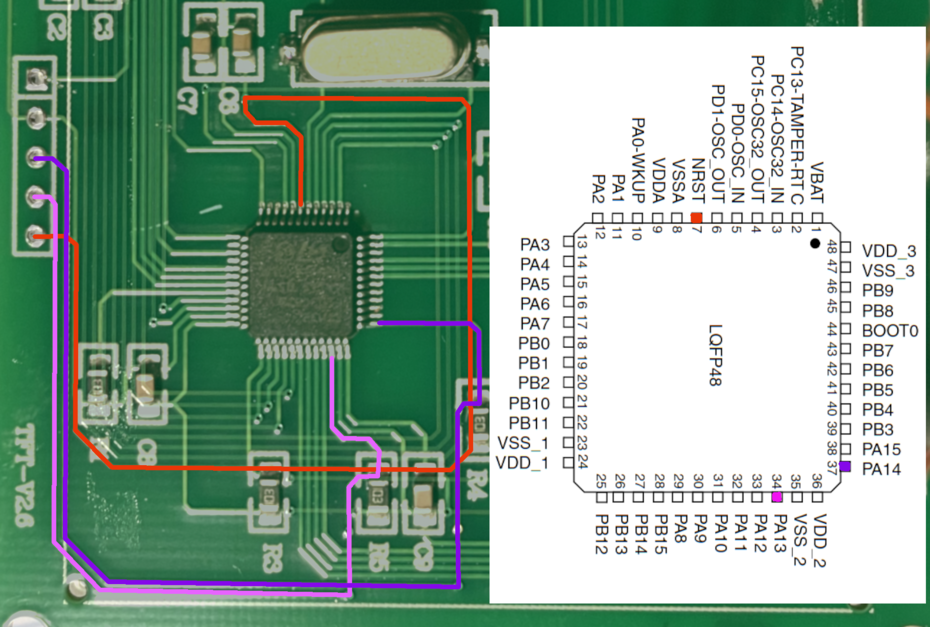
The reverse engineering begins by finding a way to dump the firmware. It’s nice to hear that [BSilverEagle] used some the skills demonstrated in [Eric Shlaepfer’s] PCB reverse engineering workshop from Hackaday Remoticon last November to trace out the debug header and the SWD pins of STM32F103C8 MCU. After that, OpenOCD could be used to dump the firmware image, with no read protection encountered. The firmware was then reverse-engineered using Ghidra, so that [BSilverEagle] could figure out where the temperature was being calculated and where the glyph for the Celsius symbol was stored. From there this it was a straight-forward rewrite of those two parts of the original firmware to calculate the temperature value in Fahrenheit, change the glyph and reflash the MCU.
So why buy this thing in the first place if it didn’t spit out units useful for your current locale? Cost. Buying this consumer(ish) device was about the same cost as buying the individual parts, designing and manufacturing the PCB, and writing the firmware for it. The only downside for their use case was the lack of Fahrenheit. Not a problem for those who demand full control of the hardware they own.
Even though most of the world population couldn’t tell you what room or body temperature is in Fahrenheit, there are some places on this globe where this unit is still in common use. For people in those areas, it’s therefore a real hassle when, say, a cheap Chinese air quality measurement systems only reports in degrees Celsius. Fortunately, [BSilverEagle] managed to patch such a unit to make it display temperature in Fahrenheit.
The reverse engineering begins by finding a way to dump the firmware. It’s nice to hear that [BSilverEagle] used some the skills demonstrated in [Eric Shlaepfer’s] PCB reverse engineering workshop from Hackaday Remoticon last November to trace out the debug header and the SWD pins of STM32F103C8 MCU. After that, OpenOCD could be used to dump the firmware image, with no read protection encountered. The firmware was then reverse-engineered using Ghidra, so that [BSilverEagle] could figure out where the temperature was being calculated and where the glyph for the Celsius symbol was stored. From there this it was a straight-forward rewrite of those two parts of the original firmware to calculate the temperature value in Fahrenheit, change the glyph and reflash the MCU.
So why buy this thing in the first place if it didn’t spit out units useful for your current locale? Cost. Buying this consumer(ish) device was about the same cost as buying the individual parts, designing and manufacturing the PCB, and writing the firmware for it. The only downside for their use case was the lack of Fahrenheit. Not a problem for those who demand full control of the hardware they own.
We all seem to intuitively know that a lot of what we do online is not great for our mental health. Hang out on enough social media platforms and you can practically feel the changes your mind inflicts on your body as a result of what you see — the racing heart, the tight facial expression, the clenched fists raised in seething rage. Not on Hackaday, of course — nothing but sweetness and light here.
That’s all highly subjective, of course. If you’d like to quantify your online misery more objectively, take a look at the aptly named BrowZen, a machine learning application by [Nick Bild]. Built around an NVIDIA Jetson Xavier NX and a web camera, BrowZen captures images of the user’s face periodically. The expression on the user’s face is classified using a facial recognition model that has been trained to recognize facial postures related to emotions like anger, surprise, fear, and happiness. The app captures your mood and which website you’re currently looking at and stores the results in a database. Handy charts let you know which sites are best for your state of mind; it’s not much of a surprise that Twitter induces rage while Hackaday pushes [Nick]’s happiness button. See? Sweetness and light.
Our summer gatherings at hacker camps are fleeting and ephemeral, anticipated for months but over far too quickly. Afterwards we have only our memories, and perhaps the occasional Hackaday write-up. We think BornHack 2020 in Denmark was the only hacker camp that wasn’t forced to go online-only by the pandemic last year, and now as far as we know it has also become the only one ever that has left its mark for the wider world by being captured for posterity by Google Earth.
Visible in the forest is the sparsely populated and socially distanced main field of what was a considerably smaller camp than normal, as well as in separate clearings the speakers tent and the loud field. Perhaps it doesn’t help as much in explaining to outsiders what a hacker camp is as might a picture of one of the larger ones, but it does at least serve as a visible reminder that we weren’t quite snuffed out last year.
It’s a moment of nostalgia to see BornHack 2020 on Google Maps for those of us who were there, but perhaps the point of all this is to take a moment to consider the likely prospects for similar events in 2021 given the pandemic. Both the British EMF Camp and American Toorcamp had to cancel their events last year and should return in 2022, there’s no word as yet about 2021 from the Serbian BalCCon or the Italian IHC, our latest update on Luxembourg’s HaxoGreen is that it’s still slated to go ahead with its move to 2021, and currently both BornHack and the Dutch MCH are expecting to run as normal this summer.
In the grip of a savage third wave of the pandemic where this is being written, it’s by no means a foregone conclusion that 2020’s cancellations may not repeat themselves. International borders remain difficult to cross without exacting quarantine requirements. If you make it to a camp this year you may be one of the lucky few, and in the increasingly likely event that we don’t, we’ll be suitably envious. Don’t loose hope, we shall all meet again… eventually.
With many folks continuing to work from home for far longer than they ever thought, it’s no surprise that we’re seeing the rise of small DIY devices to make that video call or virtual presentation a little easier. [Dustin Watts] was interested in the functionality of the Elgato Stream Deck — a macro keyboard where each key is its own screen. But that kind of fancy hardware comes with a formidable price tag. So he built his own, and made it open source!
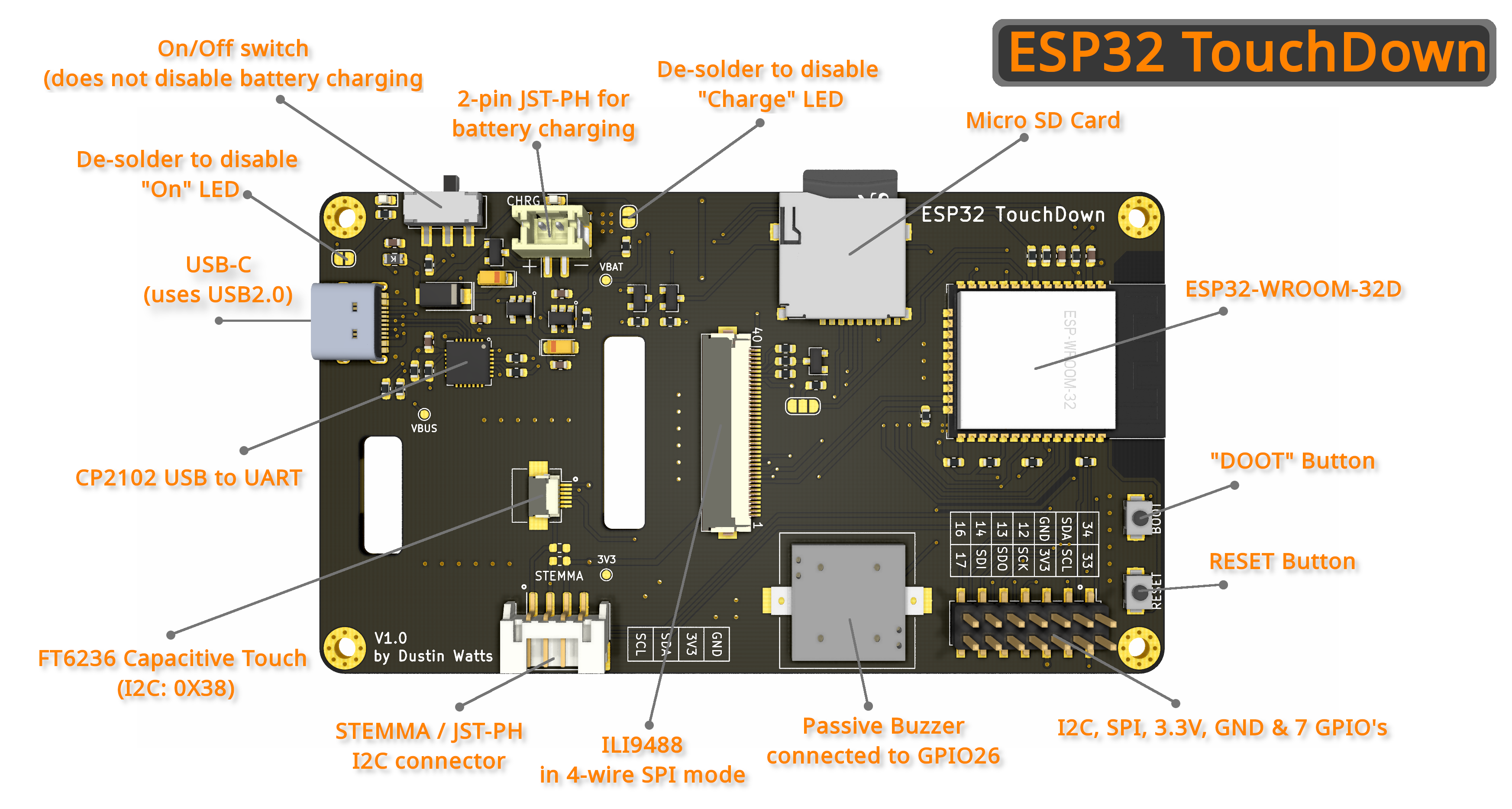
His first iteration — FreeTouchDeck — was built using commonly available modules but has since evolved into the ESP32 Touchdown which does it all with a single PCB. It’s a highly-customizable touchscreen macro keyboard which provide easy access shortcuts and macros for quick actions. Need a quick mute button, want to switch camera views on OBS, or maybe you want smarter shortcut keys for your CAD of choice. This will can get you there.
There a few key differences from the first version (FreeTouchDeck). The ESP32 dev board was ditched for a tidy PCB the directly integrates the module. This one has a capacitive touch controller (FT6236) rather than a resistive one as the capacitive screens deliver a far nicer user experience. A built-in battery and charger circuit (which the FreeTouchDesk didn’t have) allows for the extra bit of flexibility to stream from anywhere (within wireless range of course). Multiple case designs are available in STL form that allows it to be placed on a wall or desk with ease.
Datasheets, gerbers, kicad files, BOMs, and example firmware is provided on GitHub. The software is easily configurable so it can be set up to do any sort of macro, key combination, or action. This isn’t just limited to emulating a Bluetooth keyboard as there are examples showing how to connect to Home Assistant. All in all, this is a wonderful example of continued iteration on a project.
With many folks continuing to work from home for far longer than they ever thought, it’s no surprise that we’re seeing the rise of small DIY devices to make that video call or virtual presentation a little easier. [Dustin Watts] was interested in the functionality of the Elgato Stream Deck — a macro keyboard where each key is its own screen. But that kind of fancy hardware comes with a formidable price tag. So he built his own, and made it open source!
His first iteration — FreeTouchDeck — was built using commonly available modules but has since evolved into the ESP32 Touchdown which does it all with a single PCB. It’s a highly-customizable touchscreen macro keyboard which provide easy access shortcuts and macros for quick actions. Need a quick mute button, want to switch camera views on OBS, or maybe you want smarter shortcut keys for your CAD of choice. This will can get you there.
There a few key differences from the first version (FreeTouchDeck). The ESP32 dev board was ditched for a tidy PCB the directly integrates the module. This one has a capacitive touch controller (FT6236) rather than a resistive one as the capacitive screens deliver a far nicer user experience. A built-in battery and charger circuit (which the FreeTouchDesk didn’t have) allows for the extra bit of flexibility to stream from anywhere (within wireless range of course). Multiple case designs are available in STL form that allows it to be placed on a wall or desk with ease.
Datasheets, gerbers, kicad files, BOMs, and example firmware is provided on GitHub. The software is easily configurable so it can be set up to do any sort of macro, key combination, or action. This isn’t just limited to emulating a Bluetooth keyboard as there are examples showing how to connect to Home Assistant. All in all, this is a wonderful example of continued iteration on a project.