Sea Level: How Do We Measure Global Ocean Levels and Do Rising Oceans Change that Benchmark?

Every summer you go down the shore, but lately you’ve begun to notice that the beach seems narrower each time you visit. Is that the sea level rising, or is the sand just being swept away? Speaking of sea levels, you keep hearing that they rise higher every year — but how exactly is that measured? After all, you can’t exactly use a ruler. As it turns out, there are a number of clever systems in place that can accurately measure the global sea level down to less than an inch and a half.

Not only are waves always rippling across the ocean’s surface, but tides periodically roll in and out, making any single instantaneous measurement of sea level hopelessly inaccurate. Even if you plan to take hundreds or thousands of measurements over the course of weeks or months, taking the individual measurements is still difficult. Pick a nice, stable rock in the surf, mark a line on it, and return every hour for two weeks to hold a tape measure up to it. At best you’ll get within six inches on each reading, no matter what you’ll get wet, and at worst the rock will move and you’ll get a damp notebook full of useless numbers. So let’s take a look at how the pros do it.

Expensive Rulers

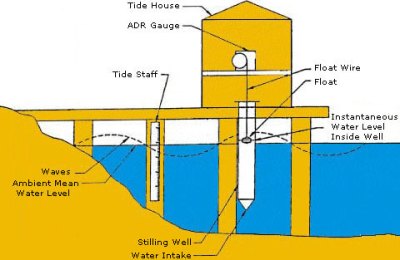
As it turns out, measuring sea level with a ruler isn’t that far off — but professional oceanographers have really nice ones called tide gauges, which live in aptly-named tide houses. The simplest tide gauge is a long tube sitting in the water, anchored in place. The tube has small openings below the water level that allow water to flow in and out. Also referred to as a stilling well, this device averages out small movements and waves, allowing for a much more calm and accurate measurement against a series of graduations inside the tube.
An old-fashioned tide house, courtesy of NOAA

Of course, manually making all these measurements is tedious work, and today there are computerized methods for recording tide levels. Even so, some tide houses had automated recording systems as early as 1830. These systems consisted of a float in the stilling well, which moved a “pen” by way of rope and pulley. Every six minutes, the pen would mark the tide level on paper, much in the way an old seismometer works.

Over the years, the stilling well has evolved into the sounding tube — rather than a float on a rope, the sounding tube sends an audio pulse down the tube and measures the time it takes for the pulse to bounce off the water surface and return to a sensor. Recently, NOAA has developed a new system that uses microwave radar to measure the water level. Microwave sensors don’t need a stilling well- they can be mounted to a structure that sits above the water. This is a massive advantage, because servicing the sensor is much easier if you don’t need to don a wetsuit and air tank. In the coming years, NOAA is planning to transition it’s acoustic measurement stations to this new microwave technology.

So, if you can measure sea level without ever touching the water, from how far away can you measure, exactly?

Send In The Satellites

As it turns out, you can take measurements from pretty far away — about 830 miles away, to be exact.

Courtesy of NASA/JPL

In 1992, an Ariane 4 rocket hurdled up from the Guiana Space Center to deliver the TOPEX/Poseidon satellite into orbit. The satellite carried an impressive array of instruments including two radar altimeters, a microwave radiometer, GPS receivers, and a laser retroreflector array. The GPS system was able to pinpoint the satellite’s location to within an inch, and was the first system to demonstrate that GPS satellites could be used to locate another spacecraft rather than only terrestrial targets.

The TOPEX/Poseidon system was groundbreaking for a number of reasons. Not only was it able to measure sea level to an incredible degree of accuracy (1.5 inches), but it was the first mission to map the earth’s tides. It mapped currents across the ocean, and gathered valuable data that improved our understanding of climate change, weather, and even the Earth’s gravitational field.

Although the satellite was shut down in 2006 after malfunctioning, its mission was taken over by Jason-1, which was launched in 2001 to supplement TOPEX/Poseidon’s measurements. Jason-2 followed, and in 2016 the mantle was taken up by Jason-3.

We know that these satellites do a great job of measuring the sea level, but what exactly are they measuring it against?

So Is Sea Level Zero?

The "reference ellipsoid" is the first-order definition of the non-spherical shape of the Earth as an ellipsoid of revolution with equatorial radius of 6378.1363 kilometers and a flattening coefficient of 1/298.257. Well yes… and no. It depends on your reference point. If you look on any topographical map, you’ll notice that elevations are reported in height above (or occasionally, below) sea level. Pilots often report altitudes in AMSL, or Above Mean Sea Level. Mean sea level is obtained by time-averaging the still water level (SWL) to remove cyclical effect of daily tides. SWL is simply what can be measured with a tide gauge, the water level with sea motions such as wind waves smoothed out. This works well enough for measuring the elevation of things that aren’t, well, the ocean, but we run into a problem if we try to measure the ocean in terms of itself. This is where we need other references to measure against.

The satellite-based instruments report sea level with respect to the WGS-84 Reference Ellipsoid, defined by the TOPEX/Poseidon Data User’s Handbook as the “the first-order definition of the non-spherical shape of the Earth as an ellipsoid.” This is also the baseline GPS receivers use to convey elevation data. Another helpful reference surface is the geoid — the theoretical shape that the Earth’s ocean would make if it were free from the external influences of the Sun and other celestial bodies, only acted upon by the gravity and rotation of the Earth itself.

Does Mars Have a “Sea Level”?

This is all well and good for Earth with it’s vast oceans, but how is elevation measured on Mars (or other planets, for that matter) where there is no sea to reference?

If you want to measure a mountain on Mars, you better bring a barometer and a calculator. Zero elevation is defined as the isobar where the atmospheric pressure is equal to 610.5 Pa (for reference, “sea level” on earth has an atmospheric pressure of 101.5 kPa). Though seemingly selected at random, 610.5 Pa is the triple point of water on the red planet — that is, the pressure at which water can exist in its solid, liquid, and gaseous states simultaneously. From that, and a reference ellipsoid similar to the one we use for the Earth, the elevation of various geographic features is measured by laser altimeters affixed to an orbiting satellite such as the Mars Global Surveyor.

Let’s take a look at the Moon now, where the “atmospheric” pressure is effectively zero (okay, there’s some gas there but the pressure is around 3\times 10^{-10} Pa). The Mars method won’t work here, since there’s no atmosphere to speak of. To establish the Moon’s reference ellipsoid, scientists determined its average diameter and set that as the zero. The Lunar Reconnaissance Orbiter then can measure the relative altitude of the lunar surface with respect to that datum.

Back To The Beach

So, back to our initial quandary — what exactly is causing that receding shoreline you notice year after year? On average, the global sea level rises annually by about 0.14 inches, so while global warming is a very real concern you probably aren’t noticing its effects on the shoreline one year to the next. That leaves coastal erosion — the gradual removal of sand, rocks, and soil by the ocean. It’s a good thing then, if much of the coastline is so unstable, that we have tide houses and satellites to accurately track changes in the global sea level. That rock you tried to measure against is all but guaranteed to move.
source https://hackaday.com/2021/03/08/sea-level-how-do-we-measure-global-ocean-levels-and-do-rising-oceans-change-that-benchmark/

3D Printing 90° Overhangs With Non-Planar Slicing

When slicing a model for 3D printing, the part is divided into a stack of flat, 2D layers. But there’s an alternative in the form of non-planar slicing, where the layers can follow 3D curves. [Rene K. Mueller] took this a step further and successfully used non-planar slicing to print 90° overhangs on a normal Cartesian FDM printer.

Non-planar layers have been around for a while, but were generally limited to creating smooth curves without layer lines. The idea of using the technique for overhangs had been floating around in [Rene]’s head for a while, and he was spurred to action after seeing the rotating tilted nozzle printer featured here on Hackaday. The idea is only to have the outer edge of each layer overhang, by making each layer slope downward toward the overhang. [Rene] programmed a conic slicer algorithm for this purpose, which splits the model into dome-shaped layers, like an onion.

He did a lot of testing and documented the results in detail. Conical slices were compared with tilted slices, which are also used for belt 3D printers. Both have some geometric limitations. Tilted slices can only print the overhang in one direction, but conical slices can do this in all directions, allowing it to create a mushroom-like shape without any support. The limitation is that it can only print inward or outward from a central point. More complex geometry must be segmented, and each sub-volume sliced separately. The slicing angle is also limited by the shape of the print head, to avoid it crashing into the print.

We think this technique has a lot of potential for widespread use, especially since it is compatible with most existing FDM printers. It is still a work in progress, but support has already been added for Slic3r and Prusa Slicer. We look forward to seeing how it develops and gets adopted.

source https://hackaday.com/2021/03/08/3d-printing-90-deg-overhangs-with-non-planar-slicing/

AVR Configurable Custom Logic as a Frequency Divider at 4x Chip’s Clock Speed

What a time to be alive when you can find inexpensive microcontrollers that come with programmable(ish) logic that can operate independently of the system clock. [David Johnson-Davies] recently built a proof of concept using the Configurable Custom Logic (CCL) that is available in some of the newer AVR microcontroller designs. It’s a simple implementation, a set of frequency dividers that blink three LEDs with up to a 90 MHz input signal. But the simplicity is the reason to love his write-up — you can wrap your head around it right away.

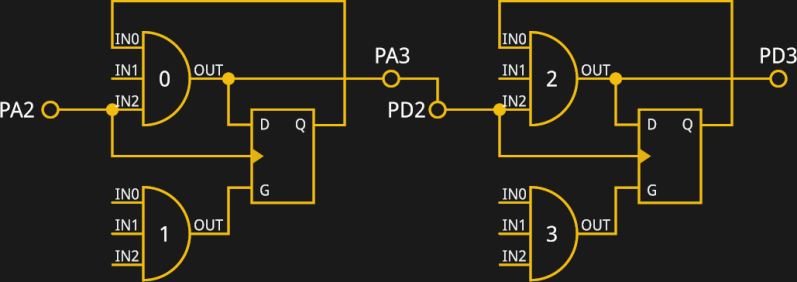
There are four lookup table (LUTs) used to form the frequency divider. Think of these like a NAND or XOR gate, but you get to decide how the output truth tables will perform. The output is fed into a sequencer which can be configured as a D/JK flip-flop or a D/RS latch, plus you can specify the signal edge, and of course define the clock source. An interesting trick here is to hold the G input of both D flip-flops high by feeding them LUTs set to all ones. Note that the output of the first divider (PA3) is feeding the external input (PD2) of the second divider.

While the CCL is configured using the C code you flash to the microcontroller, it’s a hardware peripheral capable of operating independent of the chip’s system clock. The AVR128DA28 that’s used here tops out at 24 MHz (double that if you use the PLL) but [David] got reliable results from his clock divider feeding a signal as high as 90 MHz to the input pin. Of course you have the option of feeding internal clock signals to the CCL, but that wouldn’t seem nearly as interesting here. For the demo, [David] is actually toggling an IO pin which is connected to PA2 as the external input for the logic. Make sure you click through to his write-up linked above as he does an excellent job of walking through the sample code (just a couple-dozen lines to set this all up). Here’s the datasheet for this chip (PDF, page 447 for pertinent registers) and for a deeper dive the appnote on CCL (PDF).

So what is this all good for? We already saw an answer to that question back in January when [SM6VFZ] used the CCL peripheral to build a software-defined switch-mode converter. How awesome is that?

source https://hackaday.com/2021/03/08/avr-configurable-custom-logic-as-a-frequency-divider-at-4x-chips-clock-speed/

Head Lamp Gives Glowing Creature Comforts

What can we say? It’s 2021, and we could probably all use a psychotic glow worm lamp in our lives about now to lighten the mood and/or provide a new focal point for sitting and staring. Tired of dragging out that creepy little Elf on the Shelf every holiday season? [LiabilityLabs]’ Head Lamp is slightly less terrifying and far more functional. Really, the options are limitless.

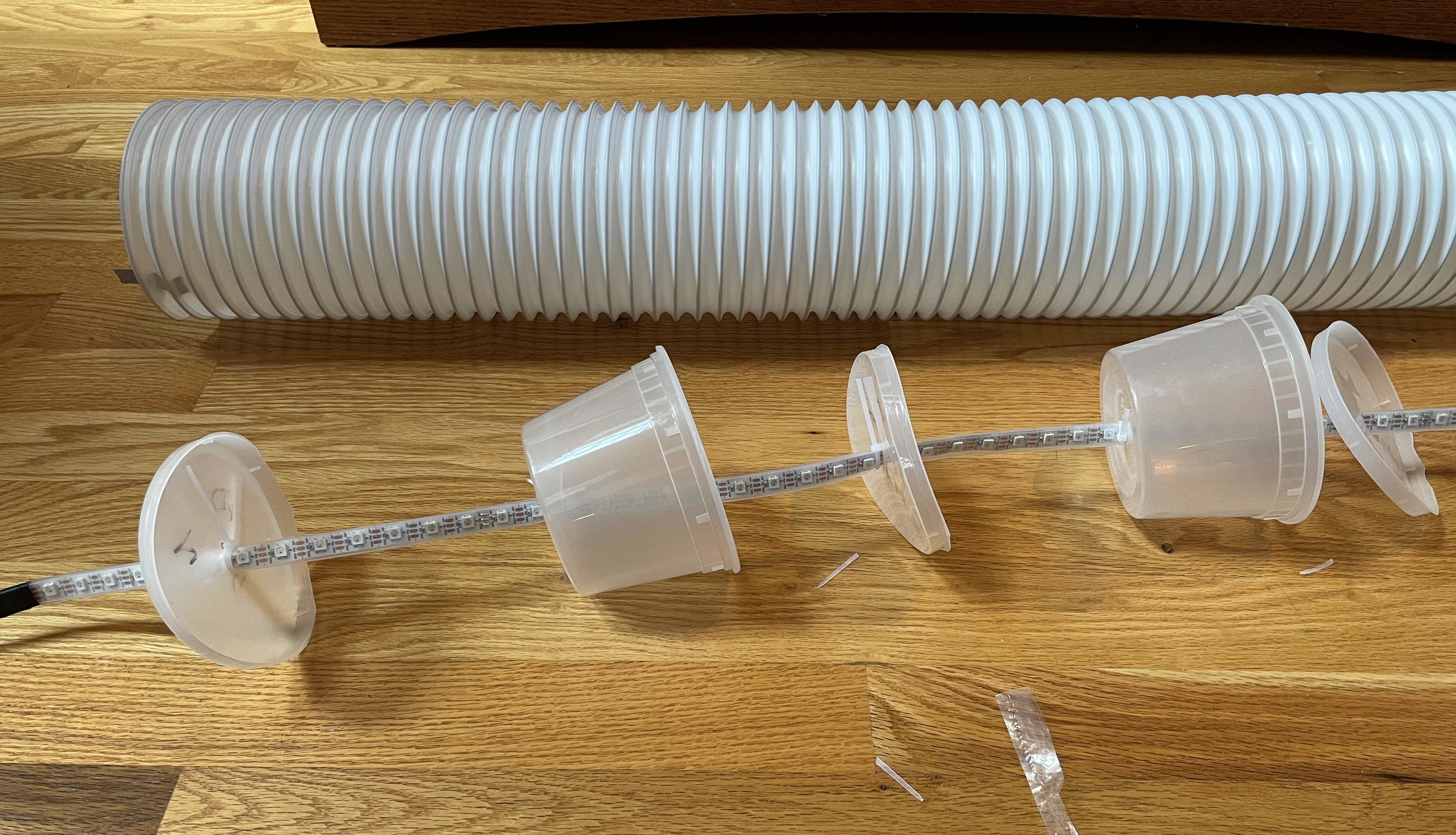
The brain of this scare snake is an Electromage Pixelblaze LED controller, a powerful Wi-Fi enabled little board with a live web editor. [LiabilityLabs] recycled 20 milky plastic containers and their lids to help diffuse the light and avoid hot spots by holding the LED strip in the center of the tube. There’s a momentary button on the glowy guy’s tail that lets [LiabilityLabs] cycle through different color patterns with ease.

Whether you need a mascot for your stream channel, a confidant, or a refreshing rainbow rubber ducky of problem solving, Head Lamp is flexible. Feast your eyes on some brief animations after the break.

Want the glowies without the willies? This mesmerizing fiber optic lamp is an easy build.


source https://hackaday.com/2021/03/07/head-lamp-gives-glowing-creature-comforts/

Head Lamp Gives Glowing Creature Comforts

What can we say? It’s 2021, and we could probably all use a psychotic glow worm lamp in our lives about now to lighten the mood and/or provide a new focal point for sitting and staring. Tired of dragging out that creepy little Elf on the Shelf every holiday season? [LiabilityLabs]’ Head Lamp is slightly less terrifying and far more functional. Really, the options are limitless.

The brain of this scare snake is an Electromage Pixelblaze LED controller, a powerful Wi-Fi enabled little board with a live web editor. [LiabilityLabs] recycled 20 milky plastic containers and their lids to help diffuse the light and avoid hot spots by holding the LED strip in the center of the tube. There’s a momentary button on the glowy guy’s tail that lets [LiabilityLabs] cycle through different color patterns with ease.

Whether you need a mascot for your stream channel, a confidant, or a refreshing rainbow rubber ducky of problem solving, Head Lamp is flexible. Feast your eyes on some brief animations after the break.

Want the glowies without the willies? This mesmerizing fiber optic lamp is an easy build.


source https://hackaday.com/2021/03/07/head-lamp-gives-glowing-creature-comforts/

Hackaday Links: March 7, 2021

It’s March, which means Keysight is back in the business of giving away a ton of test gear. Keysight University Live starts on March 15, with daily events the first week followed by a string of weekly live events through April. We always enjoy these Keysight events; sure, they’re clearly intended to sell more gear, but the demos and tutorials are great, and we always learn a lot. There’s also a feeling of community that feels similar to the Hackaday community; just a bunch of electronics nerds getting together to learn and share. If you’re interested in that community, or even if you’re just looking for a chance to win something from the $300,000 pile of goodies, you’ll need to register.

There’s another event coming up that you’ll want to know about: the 2021 Open Hardware Summit. Because 2021 is the new 2020, the summit is being held virtually again, this year on April 9. Tickets are on sale now, and we’re told there are still plenty of Ada Lovelace Fellowships available to those who consider themselves to be a minority in tech. The Fellowship covers the full cost of a ticket; it usually covers travels costs too, but sadly we’re still not there yet.

Once we do start traveling again, you might need to plan more carefully if cities start following the lead of Petaluma, California and start banning the construction of gas stations. The city, about 40 miles (64 km) north of San Francisco, is believed to be the first city in the United States to ban new gas station construction. The city council’s decision also prevents gas station owners from expanding, reconstructing, or relocating existing gas stations. The idea is to create incentives to move toward non-fossil fuel stations, like electric vehicle charging stations and hydrogen fueling. Time will tell how well that works out.

Go home Roomba — you’re drunk. That could be what Roomba owners are saying after an update semi-bricked certain models of the robotic vacuum cleaners. Owners noted a variety of behaviors, like wandering around in circles, bumping into furniture, and inability to make its way back to base for charging. There’s even a timelapse on reddit of a Roomba flailing about pathetically in a suspiciously large and empty room. The drunken analogy only goes so far, though, since we haven’t seen any reports of a Roomba barfing up the contents of its dust bin. But we’re still holding out hope.

And finally, if you’re not exactly astronaut material but still covet a trip to space, you might luck out courtesy of Japanese billionaire Yusaku Maezawa. He’s offering to pay the way for eight people from around the world on a planned flight to the Moon and back in 2023. Apparently, Maezawa bought up all the seats for the flight back in 2018 with the intention of flying a group of artists to space. His thinking has changed, though, and now he’s opening up the chance to serve as ballast join the crew to pretty much any rando on the planet. Giving away rides on Starship might be a harder sell after this week’s test, but we’re sure he’ll find plenty of takers. And to be honest, we wish the effort well — the age of routine civilian space travel can’t come soon enough for us.

source https://hackaday.com/2021/03/07/hackaday-links-march-7-2021/

The B-2 Bomber: Those Who Forget History Are Doomed To Reverse Engineer It

The Drive had an interesting post recently, about someone noticed a procurement from the U. S. Air Force to reverse engineer the B-2 bomber’s Load Heat Exchanger (whatever that is). You’d think if the Air Force wanted to reverse engineer something, they’d be looking at another country’s aircraft. What can this mean?

Presumably, the original plans for the system have been lost, or maybe the company who made them is long gone and the tooling to create new ones along with it. Then again, maybe the assembly needs parts that you can no longer get. The Drive has another interesting speculation: perhaps the plans were so secret that were accidentally destroyed.

You don’t hear much about the B-2. There are only 20 left of the 21 built, at least that we know about. Original plans in the 1980s called for 132, but the end of the Cold War spelled the end for the stealth bomber. They get an overhaul every nine years. The Drive also speculates that this may be part of the Air Force’s desire to digitize spare parts and use 3D printing, but — honestly — it doesn’t sound that way to us. Especially since the fleet will retire no later than 2032, so whatever is replaced is only needed for a decade.

If you think you want to have a go, here’s the help wanted ad from the Air Force. If you read the text, it’s pretty clear they have some defective units that need replacement and it sounds like no one knows how to do it with existing materials. Not many of us get to design things that are still working nearly three decades later. Keeping a supply of parts and even know-how for something built in the 1990s isn’t trivial. Something to think about if you design something with a long service life.

The B-2 is a stealth bomber and while one did crash, it wasn’t shot down. The F-117A — the stealth fighter — was shot down against all odds, though. While the B-2 appears to be quite a plane, we prefer our bombers a little bit older. Still, you might enjoy the video below about the B-2’s chief engineer, although he doesn’t mention the Load Heat Exchanger.

source https://hackaday.com/2021/03/07/the-b-2-bomber-those-who-forget-history-are-doomed-to-reverse-engineer-it/

Give Your Smart Home a Green Thumb with MQTT

We have all been stuck inside for too long, and maybe that’s why we have recently seen a number of projects attempting to help humans take better care of their housemates from Kingdom Plantae. To survive, plants need nutrients, light, and water. That last one seems tricky to get right; not too dry and not drowning them either, so [rbaron’s] green solder-masked w-parasite wireless soil monitor turns this responsibility over to your existing home automation system.

w-parasite MQTT diagram

Like this low-power soil sensor project and the custom controller for six soil sensors, [rbaron’s] w-parasite uses a “parasitic capacitive” moisture sensor to determine if it’s time to water plants. This means that unlike resistive soil moisture sensors, here the copper traces are protected from corrosion by the solder mask. For those wondering how they work, [rbaron]’s Twitter thread has a great explanation.

The “w” in the name is for WiFi as the built-in ESP-32 module then takes the moisture reading and sends an update wirelessly via MQTT. Depending on the IQ of your smart-home setup, you could log the data, route an alert to a cellphone, light up a smart-bulb, or even switch on an irrigation system.

w-parasite circuit board in a potted plant[rbaron] has shared a string of wireless hacks, controlling the A/C over Slack and a BLE Fitness Tracker that inspired more soldering than jogging. We like how streamlined this solution is, with the sensor, ESP-32 module, and battery all in a compact single board design. Are you asking yourself, “but how is a power-hungry ESP-32 going to last longer than it takes for my geraniums to dry out?” [rbaron] is using deep sleep that only consumes 15uA between very quick 500ms check-ins. The rechargeable LIR2450 Li-Ion coin cell shown here can transmit a reading every half hour for 90 days. If you need something that lasts longer than that, use [rbaron]’s handy spreadsheet to choose larger batteries that last a whole year. Though, let’s hope we don’t have to spend another whole year inside with our plant friends.
We may never know why the weeds in the cracks of city streets do better than our houseplants, but hopefully, we can keep our green roommates alive (slightly longer) with a little digital nudge.


source https://hackaday.com/2021/03/07/give-your-smart-home-a-green-thumb-with-mqtt/

Give Your Smart Home a Green Thumb with MQTT

We have all been stuck inside for too long, and maybe that’s why we have recently seen a number of projects attempting to help humans take better care of their housemates from Kingdom Plantae. To survive, plants need nutrients, light, and water. That last one seems tricky to get right; not too dry and not drowning them either, so [rbaron’s] green solder-masked w-parasite wireless soil monitor turns this responsibility over to your existing home automation system.

w-parasite MQTT diagram

Like this low-power soil sensor project and the custom controller for six soil sensors, [rbaron’s] w-parasite uses a “parasitic capacitive” moisture sensor to determine if it’s time to water plants. This means that unlike resistive soil moisture sensors, here the copper traces are protected from corrosion by the solder mask. For those wondering how they work, [rbaron]’s Twitter thread has a great explanation.

The “w” in the name is for WiFi as the built-in ESP-32 module then takes the moisture reading and sends an update wirelessly via MQTT. Depending on the IQ of your smart-home setup, you could log the data, route an alert to a cellphone, light up a smart-bulb, or even switch on an irrigation system.

w-parasite circuit board in a potted plant[rbaron] has shared a string of wireless hacks, controlling the A/C over Slack and a BLE Fitness Tracker that inspired more soldering than jogging. We like how streamlined this solution is, with the sensor, ESP-32 module, and battery all in a compact single board design. Are you asking yourself, “but how is a power-hungry ESP-32 going to last longer than it takes for my geraniums to dry out?” [rbaron] is using deep sleep that only consumes 15uA between very quick 500ms check-ins. The rechargeable LIR2450 Li-Ion coin cell shown here can transmit a reading every half hour for 90 days. If you need something that lasts longer than that, use [rbaron]’s handy spreadsheet to choose larger batteries that last a whole year. Though, let’s hope we don’t have to spend another whole year inside with our plant friends.

We may never know why the weeds in the cracks of city streets do better than our houseplants, but hopefully, we can keep our green roommates alive (slightly longer) with a little digital nudge.


source https://hackaday.com/2021/03/07/give-your-smart-home-a-green-thumb-with-mqtt/

This Dual Extrusion System Rocks

Dual extrusion systems for 3D printers have been around for quite a few years, but the additional cost, complexity, and hassle of printing with them have kept them off the workbenches of most hackers. [Jón Schone] from Proper Printing has now thrown his own hat in the ring, with a custom dual extrusion rocker system that can swap extruders without any additional actuators.

The two extruders are mounted on a spring-loaded rocker mechanism, which holds the inactive extruder up and away from the printing surface. Extruders are swapped by moving the carriage to either end of the x-axis, where the v-wheel rolls a ramp and pops the rocker over, putting the new extruder in the center line of the carriage. There are 3 wheels at the top of the carriage, but only two are in contact with the rail at any time. While this system is more complex than simply mounting two extruders side-by-side, it reduces the chances of the inactive nozzle oozing onto the parts or scraping across the surface. The height of each extruder can be adjusted with a screw,  and any horizontal offset between the nozzles is checked with a calibration procedure and corrected in the firmware. See the full video after the break.

[Jón] is offering the design files and modified firmware to perform this mod on your own Ender 3 Pro (though he notes other Creality printers should be compatible), but you’ll still need to source a control board with the additional stepper driver and heater output for the second extruder. This is yet another in a long list of hacks he’s performed on this popular entry-level printer, such as a modification that allows you to fold the machine up and take it on the go.

Thanks for the tip [BaldPower]!

source https://hackaday.com/2021/03/07/this-dual-extrusion-system-rocks/

The Digital Radio Era (Partially) Ends In Ireland

It’s commonly agreed that the future of broadcast radio lies in the eventual replacement of AM and FM analogue transmissions with digital services. A wide range of technologies exist to service this change-over, and for much of the world the most visible of them has been Digital Audio Broadcasting, or DAB. This VHF service has slowly increased in popularity to the extent that in some countries the FM or AM switch-off process has already happened or is well under way. It’s thus a surprise to hear a piece of news from a country that’s going the other way, as the Irish broadcaster RTÉ is about to turn off its national DAB multiplex.

The reason cited is cost-effectiveness, the take up of DAB in the Republic by listeners is low (Northern Ireland having the UK multiplexes instead), and that the broadcaster is the only one maintaining a national multiplex. Our Irish friends tell us that as in other parts of the world the rural coverage can be patchy, and with only RTÉ and no commercial stations on offer it’s easy to see why the allure of a DAB set is lacking.

In case anyone is tempted to prophecy the demise of digital broadcasting from this news, that’s not the real story. This is simply an abandonment of DAB. Plenty of Irish people listen to the radio through digital media just as anywhere else, this is simply an indication that they’re choosing not to do so via DAB. The Irish DVB television multiplexes carry the same stations and more, and meanwhile, the inexorable rise of online listening through smart speakers and mobile phones has eaten DAB’s lunch. But it does raise the point for other places: when your mobile phone delivers any radio station or streaming service you desire and is always in your pocket, why would you want a radio?

For more on DAB including some of its shortcomings, a few years ago we took an in-depth look at the system.

Thanks [Laura] for the header image.

source https://hackaday.com/2021/03/07/the-digital-radio-era-partially-ends-in-ireland/

Tetris on Split-Flap Go Brrr

It hardly seems possible, but engineer collective and split-flap display purveyors [Oat Foundry] were able to build a working implementation of Tetris on a 10 x 40 split-flap display in the span of a single day. Check it out in the video after the break.

This project is a bit understaffed in the details department, but we do know that [Oat Foundry] started with [Timur Bakibayev]’s open-source implementation of Tetris in Python and modified the draw function to work on a split-flap display. As you may have guessed, the biggest obstacle is the refresh rate and how it affects playability — particularly during those tense moments when a player rotates a piece before dropping it. Split-flaps flip quickly from on to off, but flipping back to on requires a full trip around through all the other characters.

We think this is nice work for a one-day build. Should they go further, we’d like to see the same things implemented as [Oat Foundry] does: a high score tracker and a preview of the next piece.

Don’t have a split-flap display? Yeah, us either, but we do have televisions. Turn on the tube and check out this Nano-scale Tetris.

Via reddit

source https://hackaday.com/2021/03/07/tetris-on-split-flap-go-brrr/

Is That A Cat Or Not?

Pandemic induced boredom takes people in many different ways. Some of us go for long walks, others learn to speak a new language, while yet more unleash their inner gaming streamer. [Niklas Fauth] has taken a break from his other projects by creating a very special project indeed. A cat detector! No longer shall you ponder whether or not the object or creature before you is a cat, now that existential question can be answered by a gadget.

This is more of a novelty project than one of special new tech, he’s taken what looks to be the shell from a cheap infra-red thermometer and put a Raspberry Pi Zero with camera and a small screen into it. This in turn runs Tensorflow with the COCO-SSD object identification model. The device has a trigger, and when it’s pressed to photograph an image it applies the model to detect whether the subject is a cat or not. The video posted to Twitter is below the break, and we can’t dispute its usefulness in the feline-spotting department.

[Niklas] has featured here more than once in the past. This is not his only pandemic project, either.

source https://hackaday.com/2021/03/06/is-that-a-cat-or-not/

The IEEE Builds a Smart Watch

It used to be that building your own watch was either a big project or it meant that you didn’t really care about how something looked on your wrist. But now with modern parts and construction techniques, a good-looking smart watch isn’t out of reach of the home shop. But if you don’t want to totally do it yourself, you can turn to a kit and that’s what [Stephen Cass] did. Writing in IEEE Spectrum, he took a kit called a Watchy and put it through its paces for you.

Watchy is an open source product that uses an ESP32, an E-ink display, and costs about $50. The display is 1.5 inches — good enough for a watch — and it has a real time clock, a vibration motor, an accelerometer, and four buttons. The whole thing runs on a 200 mAh lithium polymer battery. The charger is microUSB and you can also upload software to it using the usual Arduino tools.

However, [Stephen] found that none of the examples he tried would work at first. He found problems with the Mac software, but he also had problems under Windows. The answer? Switching to a Raspberry Pi seemed to work and once the watch was wiped clean, the Mac tools would work, too. It sounds like this isn’t a common problem, but he has to erase the watch with the Pi before each programming cycle.

Unlike a normal Arduino program, all the work in a typical Watchy program happens in setup() so the watch can mostly sleep and it updates the 200×200 typically just once a minute. As an example, [Stephan] wrote a watch face that uses an old Irish alphabet to tell time. He plans to add code to grab online data, too, and the phone has support for connecting wirelessly and parsing JSON to make tasks like that easier.

We always thought the EZ430-Chronos was a good-looking watch, but its screen is dated now. You can also pick up a lot of cheap import watches that can be hacked.

source https://hackaday.com/2021/03/06/the-ieee-builds-a-smart-watch/

Waterjet-Cut Precision Pastry

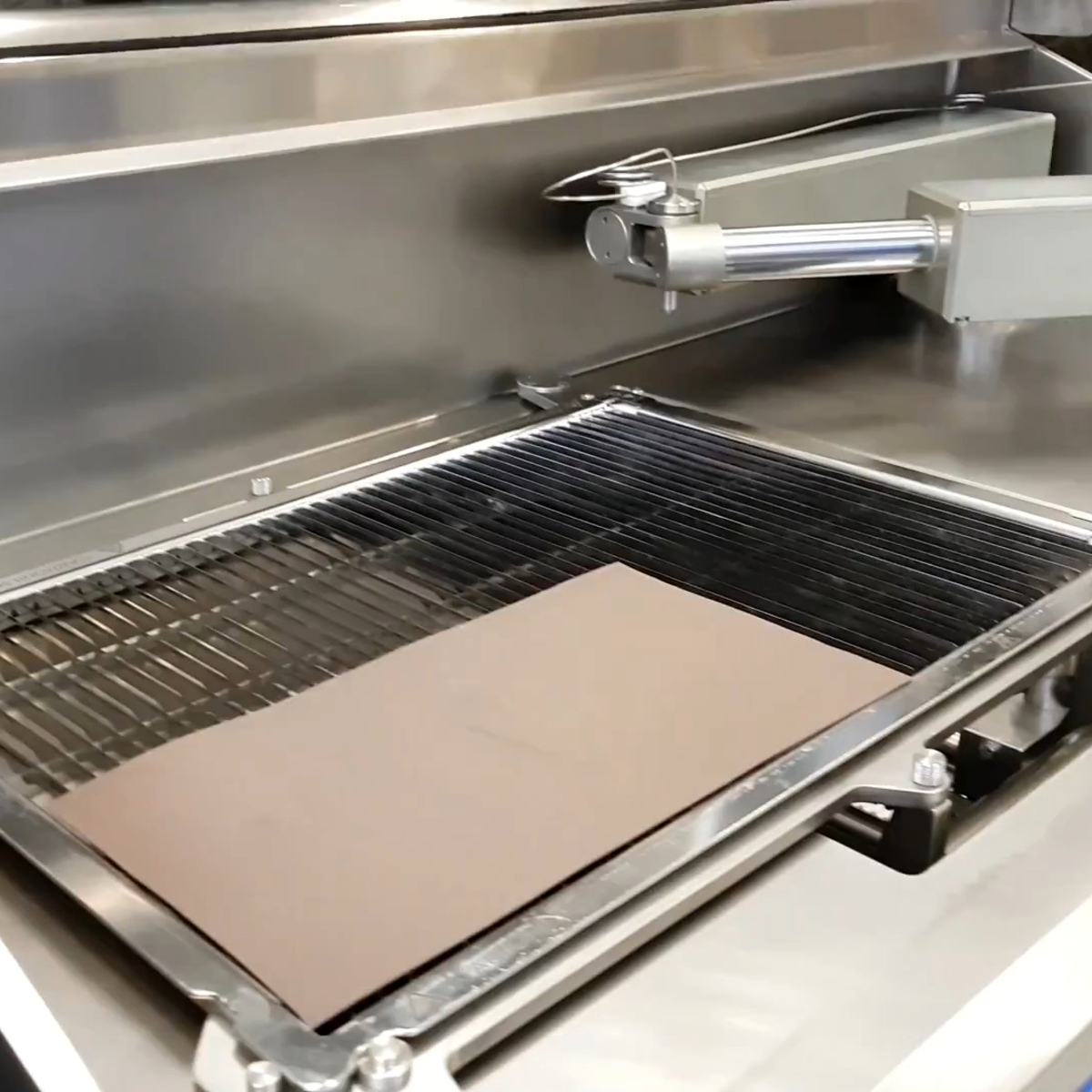
We need more high-end, geometric pastry in our lives. This insight is courtesy of a fairly old video, embedded below, demonstrating an extremely clever 2D CNC mechanism that cuts out shapes on a cake pan, opening up a universe of arbitrary cake topologies.

The coolest thing about this machine for us is the drive mechanism. A huge circular gear is trapped between two toothed belts. When the two belts move together the entire thing translates, but when they move in opposite directions, it turns. It seems to be floating on a plastic platform, and because the design allows the water-jet cutting head to remain entirely fixed, only a small hole underneath is necessary, which doubtless simplifies high-pressure water delivery and collection. Rounding the machine out are cake pans make up of vertical slats, like on a laser- or plasma-cutter table, that slip into registration pins and let the water pass through.

The kinematics of this machine are a dream, or perhaps a nightmare. To cut a straight line, it does a cycloid-shaped dance of translation and turning that you simply have to see in motion. Because of this intricate path, the cake-feed speed varies along the way, so this machine won’t be perfect for all applications and relies on a thin kerf. And we can’t help thinking how dizzy the cake must get in the process.

Indeed, the same company put out a relatively pedestrian two-arm motion cutter (another video!) that poses different kinematic problems. It’s essentially a two-arm plotter with a moving table underneath that helps increase the working area. Details are scarce, but it looks like they’re minimizing motion of the moving table, doing the high frequency small stuff with the stiff arms. Presumably someone turned the speed on the previous machine up to 11 and spun a cake off into the room, causing them to rethink the whole move-the-cake-around design.

Of course, watercut pastry isn’t limited to exotic CNC mechanisms. This (third!) video demonstrates that a simple Cartesian XY bot can do the job as well.

If you think about it, using high-pressure pure water to cut foodstuffs is a win on many levels. We’d just miss out on licking the knife. Thanks [Adam G DeMuri] for the awesome comment that lead us to a new world of watercut edibles.

source https://hackaday.com/2021/03/06/waterjet-cut-precision-pastry/

Waterjet-Cut Precision Pastry

We need more high-end, geometric pastry in our lives. This insight is courtesy of a fairly old video, embedded below, demonstrating an extremely clever 2D CNC mechanism that cuts out shapes on a cake pan, opening up a universe of arbitrary cake topologies.

The coolest thing about this machine for us is the drive mechanism. A huge circular gear is trapped between two toothed belts. When the two belts move together the entire thing translates, but when they move in opposite directions, it turns. It seems to be floating on a plastic platform, and because the design allows the water-jet cutting head to remain entirely fixed, only a small hole underneath is necessary, which doubtless simplifies high-pressure water delivery and collection. Rounding the machine out are cake pans make up of vertical slats, like on a laser- or plasma-cutter table, that slip into registration pins and let the water pass through.

The kinematics of this machine are a dream, or perhaps a nightmare. To cut a straight line, it does a cycloid-shaped dance of translation and turning that you simply have to see in motion. Because of this intricate path, the cake-feed speed varies along the way, so this machine won’t be perfect for all applications and relies on a thin kerf. And we can’t help thinking how dizzy the cake must get in the process.

Indeed, the same company put out a relatively pedestrian two-arm motion cutter (another video!) that poses different kinematic problems. It’s essentially a two-arm plotter with a moving table underneath that helps increase the working area. Details are scarce, but it looks like they’re minimizing motion of the moving table, doing the high frequency small stuff with the stiff arms. Presumably someone turned the speed on the previous machine up to 11 and spun a cake off into the room, causing them to rethink the whole move-the-cake-around design.

Of course, watercut pastry isn’t limited to exotic CNC mechanisms. This (third!) video demonstrates that a simple Cartesian XY bot can do the job as well.

If you think about it, using high-pressure pure water to cut foodstuffs is a win on many levels. We’d just miss out on licking the knife. Thanks [Adam G DeMuri] for the awesome comment that lead us to a new world of watercut edibles.

source https://hackaday.com/2021/03/06/waterjet-cut-precision-pastry/

Waterjet-Cut Precision Pastry

We need more high-end, geometric pastry in our lives. This insight is courtesy of a fairly old video, embedded below, demonstrating an extremely clever 2D CNC mechanism that cuts out shapes on a cake pan, opening up a universe of arbitrary cake topologies.

The coolest thing about this machine for us is the drive mechanism. A huge circular gear is trapped between two toothed belts. When the two belts move together the entire thing translates, but when they move in opposite directions, it turns. It seems to be floating on a plastic platform, and because the design allows the water-jet cutting head to remain entirely fixed, only a small hole underneath is necessary, which doubtless simplifies high-pressure water delivery and collection. Rounding the machine out are cake pans make up of vertical slats, like on a laser- or plasma-cutter table, that slip into registration pins and let the water pass through.

The kinematics of this machine are a dream, or perhaps a nightmare. To cut a straight line, it does a cycloid-shaped dance of translation and turning that you simply have to see in motion. Because of this intricate path, the cake-feed speed varies along the way, so this machine won’t be perfect for all applications and relies on a thin kerf. And we can’t help thinking how dizzy the cake must get in the process.

Indeed, the same company put out a relatively pedestrian two-arm motion cutter (another video!) that poses different kinematic problems. It’s essentially a two-arm plotter with a moving table underneath that helps increase the working area. Details are scarce, but it looks like they’re minimizing motion of the moving table, doing the high frequency small stuff with the stiff arms. Presumably someone turned the speed on the previous machine up to 11 and spun a cake off into the room, causing them to rethink the whole move-the-cake-around design.

Of course, watercut pastry isn’t limited to exotic CNC mechanisms. This (third!) video demonstrates that a simple Cartesian XY bot can do the job as well.

If you think about it, using high-pressure pure water to cut foodstuffs is a win on many levels. We’d just miss out on licking the knife. Thanks [Adam G DeMuri] for the awesome comment that lead us to a new world of watercut edibles.

source https://hackaday.com/2021/03/06/waterjet-cut-precision-pastry/

X-Ray Defeats Letterlocking — Unfolds and Reads Letter Sealed Since 1697

Over recent years we’ve been treated to a series of fascinating advances in the world of x-ray imaging, as  researchers have developed their x-ray microtomography techniques and equipment to the point at which they can probe and then computationally reconstruct written material within objects such as letters or scrolls in museum collections whose value or fragility means they can’t be opened and read conventionally. There is more to this challenge than simply extracting the writing though, in addition to detecting the ink the researchers also have to unpick the structure of whatever it was written upon. A particular challenge comes from letterpackets, the art of folding a letter into its own envelope, and a newly-published Nature Communications paper details work from a team of academics in the USA, the UK, and the Netherlands in tackling it.

Letterpackets were more than a practical method of packaging a missive for the mail, they also had a security function often called Letterlocking. A packet would be folded in such a way as to ensure it was impossible to open without tearing or otherwise damaging the paper, and their structure is of especial interest to historians. The researchers had a unique resource with which to work; the Brienne collection is a trunk full of undeliverable mail amassed by a 17th century postmaster couple in Den Haag in the Netherlands, and now in the possession of the Beeld en Geluid museum in that city. In it were a cache of letters including 577 never-opened letterpackets, and the x-ray technique promised a means to analyse these without compromising them.

A letter imaged using the technique.

The researchers have developed an entirely computational technique for the virtual unfolding process. Starting with a 3D volumetric x-ray scan of the unopened packet they then identify the various layers of paper and the bright spots which denote the ink. Their algorithm has to cope with areas in which two or more layers are tightly in contact, for example when multiple levels are folded, and then unpick the resulting 3-dimensional mesh into a 2-dimensional sheet. Their process for mapping the crease pattern involves applying a colour map representing the mean curve radius at a given point. The final section of the paper looks at the multiple different methods of letterlocking, and attempts to categorise them all including a security rating for each. It’s evident that this could be a highly personalised process, indeed they give as an example a letter from Mary Queen of Scots that used an intricate spiral folding technique to identify its sender.

It’s clear that this technique will reveal many more fascinating historical documents as it is both refined and extended across the many more collections of further artefacts that have lain waiting for it. As they say, individual letters do not necessarily contain earth-shattering historical discoveries, but taken together they shed an important light on the social history of past centuries.

One of the names on the paper is [David Mills], whose work has featured here before.

source https://hackaday.com/2021/03/06/x-ray-defeats-letterlocking-unfolds-and-reads-letter-sealed-since-1697/

NASA’s Perseverance Rover Makes Its First Martian Tracks

There’s a special kind of anxiety that comes from trying out a robotic project for the first time. No matter the size, complexity, or how much design and planning has gone into it, the first time a creation moves under its own power can put butterflies in anyone’s stomach. So we can imagine that many people at NASA are breathing a sigh of relief now that the Perseverance rover has completed its first successful test drive on Mars.

To be fair, Perseverance was tested here on Earth before launch. However, this is the first drive since the roving scientific platform was packed into a capsule, set on top of a rocket, and flung hundreds of millions of miles (or kilometers, take your pick) to the surface of another planet. As such, and true to NASA form, the operators are taking things slow.

This joyride certainly won’t be setting speed records. The atomic-powered vehicle traveled a total of just 21.3 feet (6.5 meters) in 33 minutes, including forward, reverse, and a 150 degree turn in-between. That’s enough for the mobility team to check out the drive systems and deem the vehicle worthy of excursions that could range 656 feet (200 meters) or more. Perseverance is packed with new technology, including an autonomous navigation system for avoiding hazards without waiting for round-trip communication with Earth, and everything must be tested before being put into full use.

A couple weeks have passed since the world was captivated by actual video of the rover’s entry, descent, and landing, and milestones like this mark the end of that flashy, rocket-powered skycrane period and the beginning of a more settled-in period, where the team works day-to-day in pursuit of the mission’s science goals. The robotic arm and several on-board sensors and experiments have already completed their initial checks. In the coming months, we can look forward to tons of data coming back from the red planet, along with breathtaking pictures of its alien surface and what will hopefully be the first aircraft flown on another world.

source https://hackaday.com/2021/03/06/nasas-perseverance-rover-makes-its-first-martian-tracks/

99% Inspiration, 99% Perspiration, and 99% Collaboration

I was watching an oldish TEDx talk with Rodney Mullen, probably the most innovative street skater ever, but that’s not the point, and it’s not his best talk either. Along the way, he makes a claim that ideas — in particular the idea that a particular skateboard trick is even possible — are the most important thing.

His experience, travelling around the world on skateboard tours, is that there are millions of kids who are talented enough that when they see a video demonstrating that a particular trick idea is possible, they can replicate it in short order. Not because the video showed them how, but because it expanded their mind’s-eye view of what is possible. They were primed, and so what pushed them over the edge was the inspiration.

On the other side of the street, we’ve got Thomas Edison and his “1% inspiration, 99% perspiration” routine. Edison famously tried a bazillion filament recipes before settling on tungsten, and attributes his success to “putting his time in” or “good old-fashioned hard work” or similar. So who’s right?

The inventor of Casper Slide and the phonograph are both right. Rodney is taking it for granted that these kids have put their time in; they are skaters after all, they skate. He doesn’t see the 99% perspiration because it is the natural background, while the inspiration flashes out in Eureka moments.

Similarly, Thomas E. way underestimates inspiration. He’s already fixated on this novel idea to take an arc lamp and contain it in a glass envelope — that’s what he’s spending all of his perspiration on, after all. But without that key inspiration, all he’d be is sweaty.

And they’re also both wrong! They’re both missing a third ingredient: collaboration. Certainly Mullen, who spent his life hanging out with other skaters, teaching them what he knows, and learning from them in turn, wouldn’t say the community of skaters didn’t shape him. Even in the loner’s sport of skating, nobody is alone. And Edison? His company profited greatly from broader advances in science, and the scientific literature. Menlo Park existed to take bright, well-trained minds and put them all in one place, sharing, teaching, and working together. It embodied the idea of collaborative innovation, and that’s where some of his best work was done.

So I’m with Isaac Newton, “standing on the shoulders of giants“. Success is 99% collaboration. This leaves us with one problem: the percentages don’t add up. But that’s alright by me.

source https://hackaday.com/2021/03/06/99-inspiration-99-perspiration-and-99-collaboration/

99% Inspiration, 99% Perspiration, and 99% Collaboration

I was watching an oldish TEDx talk with Rodney Mullen, probably the most innovative street skater ever, but that’s not the point, and it’s not his best talk either. Along the way, he makes a claim that ideas — in particular the idea that a particular skateboard trick is even possible — are the most important thing.

His experience, travelling around the world on skateboard tours, is that there are millions of kids who are talented enough that when they see a video demonstrating that a particular trick idea is possible, they can replicate it in short order. Not because the video showed them how, but because it expanded their mind’s-eye view of what is possible. They were primed, and so what pushed them over the edge was the inspiration.

On the other side of the street, we’ve got Thomas Edison and his “1% inspiration, 99% perspiration” routine. Edison famously tried a bazillion filament recipes before settling on tungsten, and attributes his success to “putting his time in” or “good old-fashioned hard work” or similar. So who’s right?

The inventor of Casper Slide and the phonograph are both right. Rodney is taking it for granted that these kids have put their time in; they are skaters after all, they skate. He doesn’t see the 99% perspiration because it is the natural background, while the inspiration flashes out in Eureka moments.

Similarly, Thomas E. way underestimates inspiration. He’s already fixated on this novel idea to take an arc lamp and contain it in a glass envelope — that’s what he’s spending all of his perspiration on, after all. But without that key inspiration, all he’d be is sweaty.

And they’re also both wrong! They’re both missing a third ingredient: collaboration. Certainly Mullen, who spent his life hanging out with other skaters, teaching them what he knows, and learning from them in turn, wouldn’t say the community of skaters didn’t shape him. Even in the loner’s sport of skating, nobody is alone. And Edison? His company profited greatly from broader advances in science, and the scientific literature. Menlo Park existed to take bright, well-trained minds and put them all in one place, sharing, teaching, and working together. It embodied the idea of collaborative innovation, and that’s where some of his best work was done.

So I’m with Isaac Newton, “standing on the shoulders of giants“. Success is 99% collaboration. This leaves us with one problem: the percentages don’t add up. But that’s alright by me.

source https://hackaday.com/2021/03/06/99-inspiration-99-perspiration-and-99-collaboration/

Lost a Lightweight Quadcopter? Here Are The Best Ways To Find It

Lost aircraft are harder to find when they are physically small to begin with. Not only are they harder to see, but the smaller units lack features like GPS tracking; it’s not normally possible to add it to a tiny aircraft that can’t handle much more than its own weight in the first place. As a result, little lost quads tend to be trickier to recover in general.

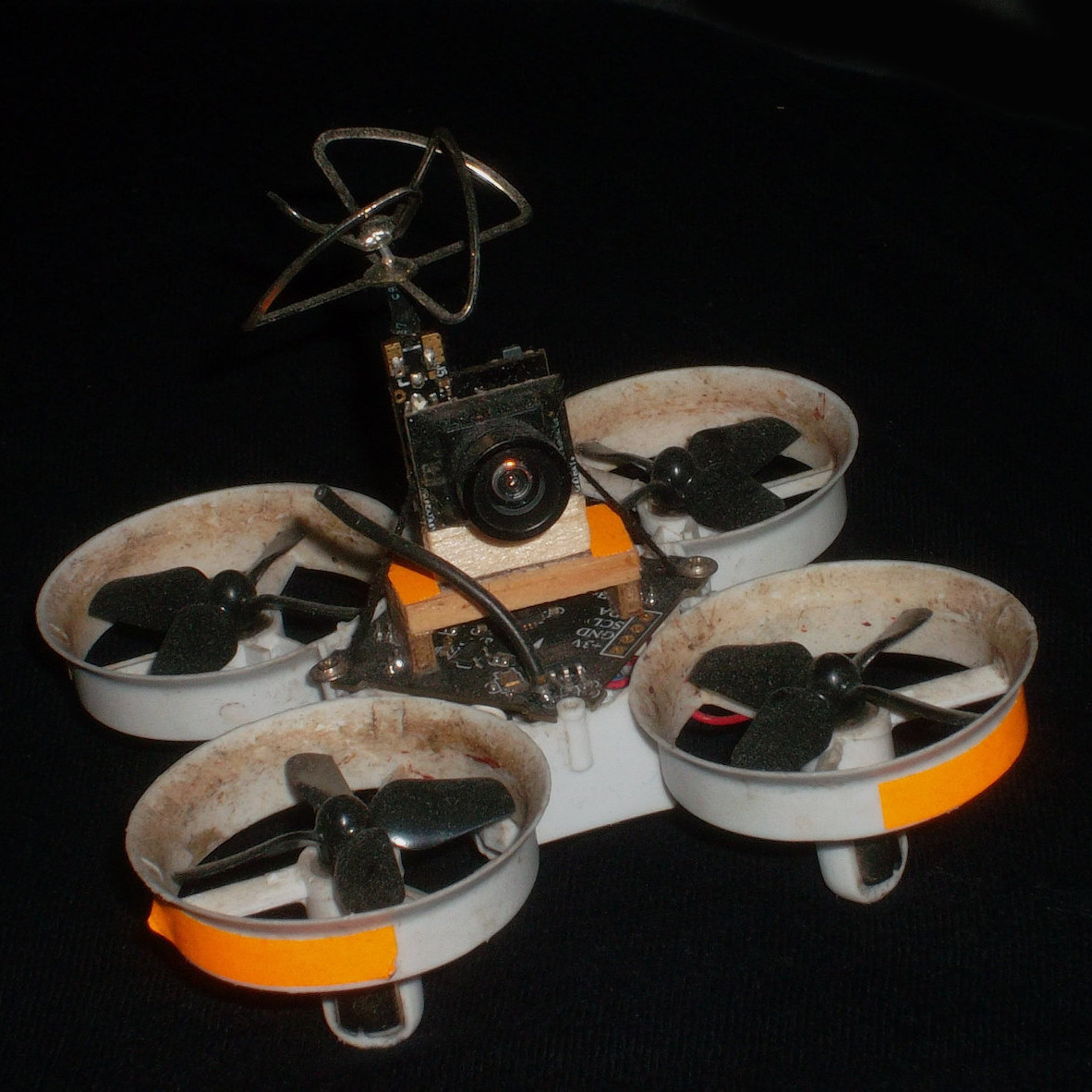
Fluorescent tape adds negligible weight, and will glow brightly at night under a UV light.

The good news is that [Eric Brasseur] has shared some concise tips on how to more easily locate and recover lost aircraft, especially lightweight ones. Recovering aircraft is something every aircraft hobbyist has had to deal with in one way or another, but [Eric] really has gathered an impressive list of tricks and techniques, and some of them go into some really useful additional detail. It occurs to us that a lot of these tips could apply equally well to outdoor robots, or rovers.

Even simple techniques can be refined. For example, using bright colors on an aircraft is an obvious way to increase visibility, but some colors are better choices than others. Bright orange, white, and red are good choices because they are easily detected by the human eye while still being uncommon in nature. Violet, blue, and even cyan on the other hand may seem to be good choices when viewed indoors on a workbench, but if the quad is stuck in dark bushes, those colors will no longer stand out. Another good tip is to consider also adding a few patches of fluorescent tape to the aircraft. If all else fails, return at night with a UV lamp; those patches will glow brightly, and be easily seen from tens of meters.

Some of the tips are used while the device still has power, while others don’t depend on batteries holding out. [Eric] does a great job of summing up those and many more, so take a look. They might come in handy when test flying quadcopters that are little more than an 18650 cell, motors, and a 3D-printable frame.

source https://hackaday.com/2021/03/06/lost-a-lightweight-quadcopter-here-are-the-best-ways-to-find-it/

Print Chess Pieces, then Defeat the Chess-Playing Printer

Chess is undoubtedly a game of the mind. Sadly, some of the nuances are lost when you play on a computer screen. When a game is tactile, it carries a different gravity. Look at a poker player shuffling chips, and you’ll see that when a physical object is on the line, you play for keeps. [Matou], who is no stranger to 3D printing, wanted that tactility, but he didn’t stop at 3D printed pieces. He made parts to transform his Creality Ender 3 Pro into a chess-playing robot.

To convert his printer, [Matou] designed a kit that fits over the print head to turn a hotend into a cool gripper. The extruder motor now pulls a string to close the claw, which is a darn clever way to repurpose the mechanism. A webcam watches the action, while machine vision determines what the player is doing, then queries a chess AI, and sends the next move to OctoPrint on a connected RasPi. If two people had similar setups, it should be no trouble to play tactile chess from opposite ends of the globe.

Physical chess pieces and computers have mixed for a while and probably claimed equal time for design and gameplay. There are a couple of approaches to automating movement from lifting like [Matou], or you can keep them in contact with the board and move them from below.

source https://hackaday.com/2021/03/06/print-chess-pieces-then-defeat-the-chess-playing-printer/

buttonpusher Automates Animal Crossing Tasks

Press button, wait, press button again, repeat. There must be a better way! If that kind of interaction drives you nuts, you’ll probably appreciate [Tommy]’s buttonpusher, which has only one job: automate away some of the more boring parts of Nintendo’s Animal Crossing. On one hand the job the device does is very simple: press a button on the Nintendo joy-con in a preprogrammed pattern. There’s no feedback loop, it just dumbly presses and waits. But there are still quite a few interesting bits to this build.

Rigid mounting combined with interfacing the actuator to the servo horn (instead of to the servo shaft) were the keys to reliable button pushing.

For one thing, [Tommy] discovered that the little 9g RC servo can reliably exert enough force to press the button on the joy-con with the right adapter. He had assumed the servo would be too weak to do the job without a greater mechanical advantage, but a simple hammer-style actuator that attaches to the servo horn easily does the job. Well, it does as long as the servo and joy-con are held rigidly; his first version allowed a little too much wiggle in how well the parts were held, and button presses didn’t quite register. With a 3D-printed fixture to rigidly mount both the servo and the joy-con, things were fine.

In the process of making buttonpusher, which uses CircuitPython, [Tommy] created a tool to automate away another pesky task he was running into: circuitpython_tools was created to automatically watch for code changes, convert the .py files into (smaller) MicroPython bytecode .mpy files, then automatically deploy to the board. This saved [Tommy] a lot of time and hassle during development, but it was only necessary because he quickly ran out of memory on his M0 Metro Express board, and couldn’t fit his code in any other way.

Still, it’s a good example of how one project can sometimes spawn others, and lead to all kinds of lessons learned. You can see buttonpusher automate the crafting process in Animal Crossing in the video, embedded below.

Video game controller automation is a common project, especially for nondestructive hacks. People get pretty creative, and have even come up with ways to automate joystick movements.

source https://hackaday.com/2021/03/05/buttonpusher-automates-animal-crossing-tasks/

buttonpusher Automates Animal Crossing Tasks

Press button, wait, press button again, repeat. There must be a better way! If that kind of interaction drives you nuts, you’ll probably appreciate [Tommy]’s buttonpusher, which has only one job: automate away some of the more boring parts of Nintendo’s Animal Crossing. On one hand the job the device does is very simple: press a button on the Nintendo joy-con in a preprogrammed pattern. There’s no feedback loop, it just dumbly presses and waits. But there are still quite a few interesting bits to this build.

Rigid mounting combined with interfacing the actuator to the servo horn (instead of to the servo shaft) were the keys to reliable button pushing.

For one thing, [Tommy] discovered that the little 9g RC servo can reliably exert enough force to press the button on the joy-con with the right adapter. He had assumed the servo would be too weak to do the job without a greater mechanical advantage, but a simple hammer-style actuator that attaches to the servo horn easily does the job. Well, it does as long as the servo and joy-con are held rigidly; his first version allowed a little too much wiggle in how well the parts were held, and button presses didn’t quite register. With a 3D-printed fixture to rigidly mount both the servo and the joy-con, things were fine.

In the process of making buttonpusher, which uses CircuitPython, [Tommy] created a tool to automate away another pesky task he was running into: circuitpython_tools was created to automatically watch for code changes, convert the .py files into (smaller) MicroPython bytecode .mpy files, then automatically deploy to the board. This saved [Tommy] a lot of time and hassle during development, but it was only necessary because he quickly ran out of memory on his M0 Metro Express board, and couldn’t fit his code in any other way.

Still, it’s a good example of how one project can sometimes spawn others, and lead to all kinds of lessons learned. You can see buttonpusher automate the crafting process in Animal Crossing in the video, embedded below.

Video game controller automation is a common project, especially for nondestructive hacks. People get pretty creative, and have even come up with ways to automate joystick movements.

source https://hackaday.com/2021/03/05/buttonpusher-automates-animal-crossing-tasks/