When [MisterM]’s MIL gave him a rad 80s portable cassette player, he jumped for joy. Once he figured out the window was exactly the same size as the standard for Raspberry Pi HATs, the possibilities left him reeling. A flurry of ideas later, he settled on a weather display featuring a Pimoroni Unicorn HAT HD.
The 1984 Weatherman Pi pulls data from the Dark Sky API every 1.5 seconds using a Zero W. [MisterM] chose to highlight the current temperature, conditions, and rain probability, though there are heaps of other API goodies still on the table. It shows the current weather conditions as animations, scrolls the temperature, and gives a nice graph of rainfall probability.
Surprisingly, the dazzling display isn’t our favorite part. See those spongy headphones up top? They’re not just for decoration, though they go a long way in helping the cassette player keep its identity. Whenever there’s a change in the weather, they shimmy back and forth on a 9g servo. If the servo were continuous, it might be neat to use them as a weather vane.
Be sure to check out [MisterM]’s comprehensive demo/build video waiting for you on the B-side. We love a good weather display around here, and the more colorful and literal, the better.
Dealzer has some interesting items for sale that focuses on hydroponics and indoor plant growing.
As I have the scenario set up from many years of reading castaway type stories I have been on the lookout for plant growing systems that would work underground or in space. Mars here I come…
VOLKANO·THURSDAY, 19 APRIL 2018· Create, play, listen, relax or work with the confidence that your Volkano Product will perform as you need it to when you need it to. Get ready to explore our range of top quality consumer electronics and experience raw power, through sheer simplicity.Volkano is the fastest growing personal electronics brand in the world with an ever increasing global footprint. We are committed to the ideal that price should never discount quality and with this in mind have introduced more than 100 different audio products, personal user electronics, computer peripherals and electronic accessories to the market. We firmly believe that for every electronic challenge you face, there is a Volkano Solution.
Roberts House is an important example of the middle class British Colonial Style villa built in the late nineteenth century. It is a National Monument and an exotic immigrant to the Last Outpost of the British Empire nestled in a green oasis of indigenous trees.
The Roberts family’s daughter Esther was born here and grew up to be the first female social anthropologists of the then Colony of Natal. She was well known as a librarian, author of research papers and books dealing with the indigenous population, and as a confidant and friend of Killie Campbell one of the doyens of Africana collectors in the country. Her large collection and library is now linked to the University of KwaZulu-Natal. Most importantly Esther stood many-a-day silently outside the city hall with her solidarity group called the Black Sash,lamenting injustices endured by the non-white population.
She died here more than ten years before South Africa was liberated. In the new democratic South Africa, the road was named after her.
THE YARD
On the perimeter of the property are the offices of Architects and Planners who all subscribe and contribute to the museum. Shared spaces are used for talks, lectures and exhibitions.
There’s a certain charm to old technologies that have been supplanted by newer versions. And we’re not just talking about aesthetic nostalgia this time. With older versions of current technology, you are still connected to the underlying process, and that’s a nice feeling.
Part of the typewriter’s charm is in its instant permanence. These days, its so easy to backspace, delete, and otherwise banish thoughts to the void without giving them a fair trial, though it’s nice not to have to pound the keys to make an impression. At the typewriter, your words are immediately committed to paper, for better or worse. You can usually see them pretty well, although maybe not on the current line, and that is good for letting the words flow without judgment.
[Murtaza Tunio] recently used a thermal POS printer in an art project, but it had since grown cold with disuse. Why not turn it into a typewriter? All it took was a Raspberry Pi, a USB keyboard, and an existing Python library for communicating with these parallel printers. Typing is a bit challenging for a few reasons. For one thing, [Murtaza] has to type five lines before the words become visible. The enter key doesn’t come across for some reason, so a different one had to be assigned. On the upside, [Murtaza] can trigger the paper cutter with a keystroke.
[Mile] put together this stunning LED matrix watch, on which the stars of this show are the 256 monochrome 0603 LEDs arranged in a grid on its face. The matrix is only 1.4in in the diagonal and is driven by a combination of an LED driver and some shift registers. The brain is an ATmega328p. We appreciate the extra effort taken to add a USB to UART adapter so the mega can be programmed over USB. It also contains all the necessary circuitry to charge and maintain the lithium battery inside safely.
Input into the device is done with a hall effect sensor which keeps the build from having any moving parts. The body is a combination of 3D printed parts and really fetching brass details connecting to the band.
If it weren’t over the top enough the build even has an ambient light sensor so the display can dim or brighten depending. We bet [Mile] is pretty proud to wear this on their wrist.
In a report published by Science Advances, a research team from the United States and Korea revealed a strain-sensitive, stretchable, and autonomous self-healing semiconductor film. In other words, they’ve created an electronic skin that’s capable of self-regulation. Time to cue the ending track from Ex Machina? Not quite.
Apart from the inevitable long timeline it will take to see the material in production, there are still challenges to improve sensing for active semiconductors. The methods used by the team – notably using a dynamically cross-linked blend of polymer semiconductor and self-healing elastomer – have created a film with a gauge factor of 5.75×10^5 at full strain. At room temperature, even with fracture strains, the material demonstrated self healing.
The technique mimics the self healing properties of human skin, accelerating the development of biomedical devices and soft robots. While active-matrix transistor array-based sensors can provide signals that reduce crosstalk between individual pixels in electronic skin, embedding these rigid sensors and transistors into stretchable systems causes mechanical mismatch between rigid and soft components. A strain-sensing transistor simplifies the process of fabrication, while also improving mechanical conformability and the lifetime of the electronic skin.
The synthetic skin was also shown to operate within a medically safe voltage and to be waterproof, which will prevent malfunctions when placed in contact with ionic human sweat.
Air conditioning compressors aren’t exactly a mainstay of the average hacker’s junk box. Typically, they’re either fitted to a car to do their original job, or they’re on the bench getting refurbished. However, with the right mods, it’s possible to turn one into a functioning internal combustion engine.
The build starts by disassembling the compressor, which contains three double-sided pistons. The housing is drilled with ports to allow gas to flow into and out of the cylinders, as well as to transfer from one side of the piston to the other. Acrylic end plates are fitted to the assembly. One end acts as an intake manifold, delivering air and fuel to the cylinders. The other side acts as the cylinder head, mounting the sparkplugs. Everything is then connected with acrylic tubing and a small square section of acrylic is turned into a carburetor to supply the air-fuel mix. Ignition is handled by coils triggered by the movement of the flywheel.
After an initial failure due to the acrylic manifold cracking, a stronger part is fabricated, and the engine bursts into life. The acrylic end caps give a great view of the combustion process in action. We’d love to see the a dyno graph on how much power and torque the unit puts out, or to see it hooked up to a bicycle or cart.
Like many of us, [Zach Archer] enjoys the comfort of his darkened room so much that he has trouble getting up and facing the day. To make things a little easier for himself, he decided to put together a custom alarm clock that would fill his mornings with the glorious glow of LEDs; and since he finds the mountains an inspirational sight he decided to wrap the whole thing up in a 3D printed enclosure that resembles snow capped peaks.
But even Bob Ross himself couldn’t have imagined a snowy mountain range that featured an integrated e-ink screen. The big 4.2″ panel is connected to a custom designed PCB by [romkey], which was graciously donated for this project. An ESP32 runs the show, providing a convenient web interface to control not only the clock, but various aspects of the mountain’s internal LEDs such as fade in time and total duration.
[Zach] says he originally printed the mountains in PLA, but the heat generated by the LEDs eventually started to cause things to warp. Switching over to translucent PETG not only solved the heat problem, but made for a very effective LED diffuser. Rather than complex animation patterns, he’s found that smoothly transitioning between different shades of blue and green seems to work best for him in the mornings.
Asking machines to make music by themselves is kind of a strange notion. They’re machines, after all. They don’t feel happy or hurt, and as far as we know, they don’t long for the affections of other machines. Humans like to think of music as being a strictly human thing, a passionate undertaking so nuanced and emotion-based that a machine could never begin to understand the feeling that goes into the process of making music, or even the simple enjoyment of it.
The idea of humans and machines having a jam session together is even stranger. But oddly enough, the principles of the jam session may be exactly what machines need to begin to understand musical expression. As Sara Adkins explains in her enlightening 2019 Hackaday Superconference talk, Creating with the Machine, humans and machines have a lot to learn from each other.
To a human musician, a machine’s speed and accuracy are enviable. So is its ability to make instant transitions between notes and chords. Humans are slow to learn these transitions and have to practice going back and forth repeatedly to build muscle memory. If the machine were capable, it would likely envy the human in terms of passionate performance and musical expression.
The jam session is an ideal venue for two (or more) humans to play around in the same musical sandbox. Once they agree on a key, the door to improvisation is unlocked. They can play back and forth, riffing on each other’s ideas. Machines may not feel, but they can definitely learn aspects of musical composition by algorithmically interpreting the musical data from a performer and regurgitating it back through different methods. Sara’s talk takes us through a few of the ways that humans and machines can jam out together.
The Jamming Algorithm
Sara wrote a series of compositions that are meant to be played by humans and machines together through interactive algorithms. She starts with a composition called “Breathe” that uses a rule-based algorithm to interpret solo electric guitar input and feed it through a granular synthesizer. The guitar player uses a foot pedal to take FFT snapshots of their performance, which gives the machine information about the pitch and duration of the notes they played.
Once the algorithm determines the prevailing harmonics, it plays them back as ethereal, droning sine waves that sound like an ocean. The algorithm also takes input from a lapel mic taped under the player’s nose to create an amplitude envelope that affects the rate of granular synthesis. This adds a nice staccato counterpoint to the lapping sine waves.
Bach Has Entered the Session
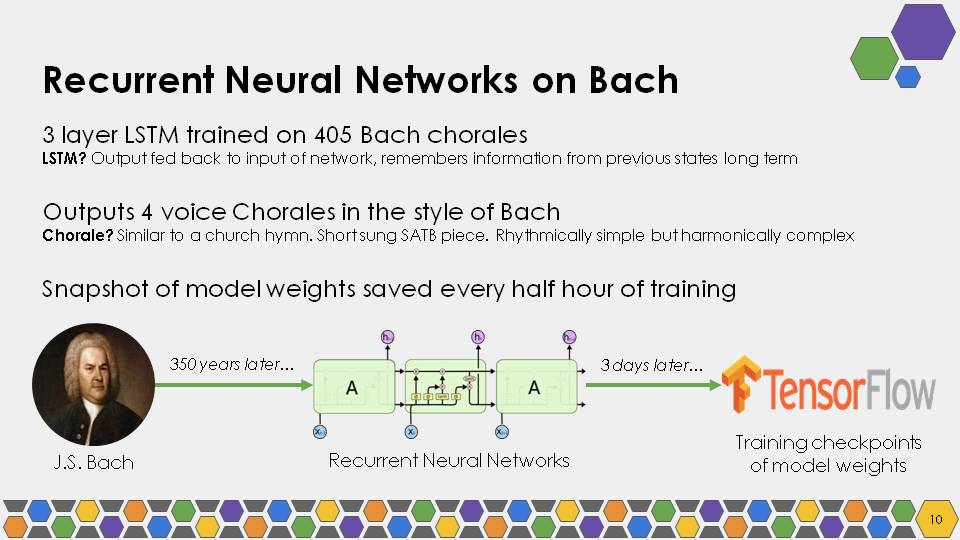
For another composition using recurrent neural networks, Sara used TensorFlow to train a 3-layer long short-term memory (LSTM) on a diet of 405 Bach chorales. A chorale is a short hymn-like piece that’s usually written for four-voice harmony — a soprano, an alto, a tenor, and a bass. The algorithm for this piece is a two-part process. Once the content is there and the network has been trained, the performer uses a MIDI interface to control movement through the neural network checkpoints, sustain or skip selected notes, and adjust the tempo. Sara trained the neural network for three days, and the difference between day one and day two is amazing.
The last composition Sara shares in her talk is called Machine Cycle, which she composed for an ensemble with a MIDI keyboard soloist, a guitarist, and some harmonic sine wave drones. As the keyboardist plays, the machine snatches phrases at random and creates a Markov chain of possible embellishments like grace notes and slight changes in rhythm, before the algorithm plays back the result. While this is happening, another human acting as conductor can control parameters like the output tempo, and whether any notes are skipped.
The idea of humans and machines jamming together is an interesting one for sure. We’d like to feed the sounds of industrial machinery into these algorithms just to see what kind of new metal comes back.
Deep in the heart of Paris, a series of underground tunnels snakes across the city. They cross into unkept public spaces from centuries ago that have since vanished from collective memory – abandoned basements, catacombs, and subways hundreds of miles apart.
Only a few groups still traverse these subterranean streets. One that came into public view a few years ago, Les UX (Urban eXperiment), has since claimed several refurbished developments, including restoring the long neglected Pantheon clock and building an underground cinema, complete with a bar and restaurant.
While the streets of Paris are tame during the day, at night is when Les UX really comes alive. A typical night might involve hiding in the shadows away from potential authorities roaming the streets, descending into the tunnels through a grate in the road, and carrying materials to an agreed upon drop off location. Other nights might involve wedging and climbing over pipes and ladders, following the routes into the basements of buildings left unguarded.
[via Will Cowan]
Members have claimed to be able to access every last government building and telecom tunnel in the city. Even members of the Parisian police force can’t help but admire the knowledge and skills of the underground hackers. One of the members, [Lazar Kunstmann], was able to describe the process of stealing a Picasso – apparently an easy enough task for anyone who has the time to observe the lax security within the Museum of Modern Art of the City of Paris.
Granted, sneaking around the tunnels and under secured buildings isn’t as easy as some members may make it sound. Accessing the tunnels – an illegal but rarely enforced act – is already quite difficult. Finding an unlocked entrance can be an exceptionally long trek from the nearest subway, and knowing the secret entrances can require connections with other urban explorers. Even crawling around in the tunnels is a filthy and exhausting activity for the uninitiated.
Shadowy Beginnings, Professional Present
The organization had its start some time in 1981, beginning with the stolen plans for many of Paris’s underground tunnels and passageways. They have since grown into an enclave of anonymous artists and concerned citizens who have come together to restore medieval crypts and celebrate the forgotten sites of Parisian past. Few have ever come forward about their existence apart from [Kunstmann], who has since spokentomagazines and published a book based on his experiences.
According to his account, the organization is divided into several subunits – one that specializes in infiltration (an all-female team known as the Mouse House), one that couriers internal messages and communicates over a coded radio network, one that keeps a database of organization activities, one that organizes the staged shows and readings, one that specializes in photography, and one that works on restorations (known as Untergunther).
[via UX]
The latter team is made up of more experienced professionals – architects and historians, often with a personal interest in the object of restoration, as in the case of the Pantheon clock. Professional clockmakers such as [Jean-Baptiste Viot] assisted in the multiyear project, painstakingly recreating gears that were too rusted or worn to be restored and refurbishing other parts of the clock that had been corroded or weathered from years of neglect. When the newly restored clock was revealed in October 2007, however, they were met with attention from the Paris police force.
While the group may have begun as a clan of rebellious teenagers, it eventually grew into something far more sophisticated. The entire operation for the Pantheon required special care taken to understand the mechanisms behind the clock tower and the techniques used by its original architects. [Viot] especially wanted to undergo the project since oxidation had so ruined the original works that they would soon be impossible to repair without replacing every part. As a professional horologist, he had the skills required for the job, and Les UX had been looking to undergo the restoration for years. The team built a workshop outfitted with armchairs, a table, bookshelves, a minibar, and red velvet drapes concealed into wooden crates to blend into the paraphernalia stored within the monument. Only at the dead of night was the clock repair equipment brought out. The group did everything from updating the workshop’s electrical wiring to growing their own vegetable garden on the terrace. Even if members were caught at night, a fake badge was enough to get past the security guards.
The autopsy of the clock revealed that someone appeared to have sabotaged the clock, possibly a Pantheon employee tired of winding the monument once a week. They cleaned the parts in a hot bath of soap, ammonia, and oxalic acid, scrubbing and polishing every surface. Then they replaced or recreated pulleys, cables, the broken escape wheel, and missing parts like the pendulum bob. By the time the project had finished, the team felt that it would be a good idea to notify the authorities about their work in order to ensure proper future maintenance of the public monument. They offered to meet the director of the monument in person, but were startled to find that the authorities refused to believe their story, instead suing UX at 48,300 euros and up to a year of jail time. The then-deputy of the monument even hired a clockmaker to re-sabotage the work. (The clockmaker refused other than disengaging the escape wheel, the same part that had been sabotaged the first time.)
Authorities Barge In
The Pantheon wasn’t the first time the police were brought face-to-face with a Les UX project. Back in 2004, a widely covered story emerged of a police force discovering an underground movie theater run by the group, containing a movie screen, bar, and kitchen. The space was equipped with telephones and electricity, with movies ranging from 1950s classics to modern thrillers. The police were less than happy with their discovery, but when they returned for a formal investigation, the space had been entirely vacated.
[via UX]
In fact, the authorities so opposed the group’s activities that they began a new unit to track the group through the city’s sewers and catacombs in an effort to identify members of the group and charge them for their actions. The Centre of National Monuments similarly replaced their administrator after their embarrassment over not noticing how the group had entered the Pantheon building so easily. Over the course of the scheme, large planks were even carried up the clock tower in order to construct a small workshop inside the space.
As for the trial against the restorers, the judge ruled in favor of the Untergunther members. It may have been seen as a relief, but it was definitely not the expected culmination of the project – the main reason the project was revealed in the first place was to provide authorities with the information they needed to wind up the clock so that it would work again.
[via UX]
Some members of Les UX certainly felt that they had to do something to help save the lost public works of Paris, especially if the local government wasn’t going to take action. Others were simply excited to continue celebrating the Parisian underground world. Many had been students in the Latin Quarter in the 80s and 90s, when secret parties were common to find in the tunnels.
While the Pantheon remains the group’s proudest feat, there are still active events going on and restorations in the works. Past exploits have included rock concerts for up to 4000 people in the quarries, projections off a locked film theater (showing subtly subversive programming by international filmmakers), and an art exhibition in a supposedly seal-off underground gallery. Members were even known to travel through a series of interconnected caves beneath the Palais de Chaillot, across the Seine from the Eiffel tower, every Bastille day to watch the fireworks from the roof of the building.
While it’s not affiliated with Les UX, there are a number of videos online that show some parts of the Paris underground scene and the artists affiliated with the tunnels.

 The 1984 Weatherman Pi pulls data from the Dark Sky API every 1.5 seconds using a Zero W. [MisterM] chose to highlight the current temperature, conditions, and rain probability, though there are heaps of other API goodies still on the table. It shows the current weather conditions as animations, scrolls the temperature, and gives a nice graph of rainfall probability.