The frame is built out of the same brackets and aluminum tubing used to add handrails to stairwells on buildings. Not only is this a fast way to do it, the set-up can be guaranteed to be sturdy since hand rails are often literally standing between life and death. The high ground clearance allows for all sorts of sensors and devices to be mounted while still being able to clear the plants below.
For motion hub motors driven by an ODrive were re-purposed for the task. He explored turning the wheels as well, but it seems like differential steer and casters works well for this set-up. ROS on an Nividia Jetson runs the show and deals with the various sensors such as a stereoscopic camera and IMU.
We’re excited to see what hacks people come up with as research in this area grows. (Tee-hee!) For example, [Junglist] wants to see the effect of simply running a UV light over a field rather than spraying with pesticides or fungicides would have.
Sometimes when you are browsing randomly through the tech feeds, up pops an article that just crystallizes a nascent thought that had been simmering below the surface for a long time, and is enough to make you sit up and say “Yes! I agree completely with that!”. Such a moment came with [Cheapscatesguide]’s post: “My Fantasy: A Cellphone I can Use as a DesktopComputer“, in which the pertinent question is asked that if smartphones are so powerful, why are they not much better at being more than, well, smartphones?
Readers with long memories may recall that the cellphone-as-computer idea is one that has been tried at least once before. The Motorola Atrix appeared in the early years of this decade, and was a high-end smartphone that could be slotted into both desktop replacement and netbook-style base stations and used as a Linux-based personal computer. Unfortunately it was both eye-wateringly expensive and disappointingly slow due to a hobbled operating system, so it failed to set the market alight. There was a brief moment when unsold Atrix netbook docks were available on the surplus market and became popular platforms as a Raspberry Pi desktop interface, but this experiment seems to have put paid to the idea of one device to truly rule them all.
If we had to hazard a guess as to why this has failed to happen, we’d finger both the manufacturer’s desire not to undermine their lucrative sales in other sectors, and both their and the carriers’ desire to lock down the devices as much as possible. A manufacturer such as Apple will for example never produce an iPhone that can replace a desktop, because it would affect their MacBook sales. Oddly in another form we’re nearly there, this piece is being worked on with a Chromebook, a device that has a useful browser, a functional Android layer, and (because it’s a 64-bit model) an officially supported and useful Debian layer. We don’t expect this to translate into a phone any time soon though.
Have you made an infinity mirror yet? They’re pretty much a rite of passage project at this point. But unlike that DIY power supply, most of them serve no function beyond looking cool (not that there’s anything wrong with that). Might as well make it do something, right?
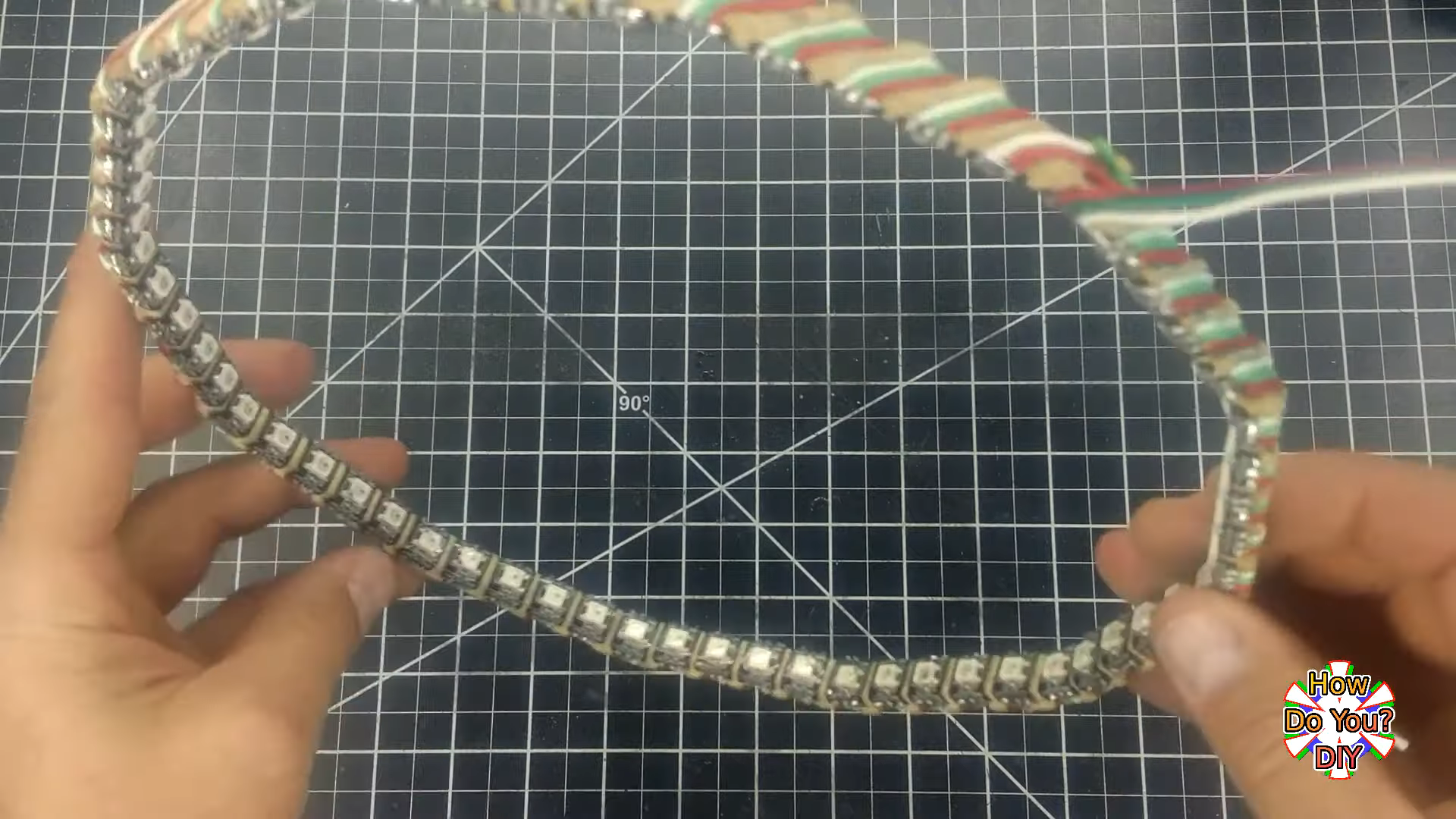
[How Do You – DIY] has a built a few mirrors because he likes experimenting with the effects of different reflective surfaces in various positions. This time, he’s built a clock from the ground up. Basic infinity mirror rules apply here, though he used semi-transparent reflective film on both sides for greater effect and put an adjustable warping bar in the back so the trail curves toward the center. The actual timekeeping is done by an Arduino Nano.
The RGB LEDs on his strip were a few millimeters too far apart for his liking, so he added a few dozen hours to the build by cutting it apart and painstakingly placing them all around the wood frame. Then he Dremeled a groove for each set of three wires that link the LEDs so that they sit flush. The final product is beautiful, and it’s a shame that this LED-holding frame is hidden away inside the equally well-crafted aluminium frame.
Don’t waste another minute — sweep past the break to check out the build video. If it’s a portable and functional conversation piece you want, make a set of infinity mirror coasters.
Oh, and did we mention that we’re running a clock contest? Hint, hint.
Way back in 1984, the Ghostbusters defended New York City from an onslaught of supernatural phenomena. In their honor, [BALES] created this costume for Halloween, replete with an amazing replica proton pack.
(We know, this is a little late for Halloween 2019, but just think about how early you’re going to be for Halloween 2020!)
While not actually capable of trapping and harnessing entities from the spirit realm, the replica pack nonetheless is impressive. Constructed primarily from EVA foam and PVC pipe, it’s built on a custom built Alice pack frame to make it easy to carry. The cyclotron scores some LEDs, and EL wire completes the neutrino wand. A rough-and-ready paintjob make the gear look well used, and the laser-printed labels go a long way to completing the look.
[BALES] didn’t skimp on the clothing side either. The olive drab overalls, an embroidered patch, and belt were sourced from Amazon, and a custom name badge was produced to complete the ensemble. We’re sure the costume was an absolute hit at Halloween, and gives us plenty ideas of our own. It would pair well with this PKE meter that actually detects radiation, too!
[George] and his coworkers like to blow off a little lunchtime steam on the company ping pong table. We might do the same, except it’d just be us versus the wall, and most of the exercise would consist of bending over to pick the ball up off the floor. When he found a scrap piece of acrylic out in their shop, [George] got the bright idea to make an edge-lit paddle featuring the company’s logo.
Not only does the paddle look cool, it works pretty well, too, even though it’s heavier and has smooth surfaces compared to a standard paddle. To begin, [George] found a regulation-size paddle outline and imported it into SolidWorks, then designed all the necessary cuts for the LEDs and other electronics. He also designed and printed ergonomic grips to protect the goods.
Continuing the stuff-on-hand theme, [George] used through-hole LEDs and dug into the abundance of battery clips and springs they have lying around for designing prototypes, instead of making it all fancy with SMT LEDs and a rechargeable battery pack. Slip on those sweatbands, because we’re serving up the build video after the break.
We see more ping pong balls than paddles around here, and that’s probably because they make great LED diffusers.
We always marvel at how open-source tools can often outstrip their commercial counterparts. Yosys, the open-source tool for Verilog synthesis, is a good example. Although the Xilinx ISE design suite is something close to abandonware, a lot of people still use it because it supports older FPGAs the newer tools don’t. Its Verilog parser is somewhat slow to catch up to new standards, and according to a recent GitHub update, Yosys can now provide files for ISE that target Spartan 6, Virtex 7, and Series 7 FPGAs. In addition, there is some support for Spartan 3, Virtex 2, 4, and 5, although those are not ready yet.
According to the post, you’ll want to use the synth_xilinx command along with the -ise option and a -family option that matches your target (that is, xc6s for Spartan 6). On the output side, you’ll write an EDIF file using the write_edif command.
This is not to say that the Xilinx XST parser that processes Verilog for ISE is terrible. However it does lag behind on some features, and if it doesn’t work… too bad. Xilinx has a lower focus on ISE and its variants in favor of Vivado which doesn’t support many older chips. With Yosys, there’s an active community around the program and, if you must, you can dig in and fix any problems yourself. You can at least use the source code to answer what if questions.
When you hear the name “Tesla”, chances are good that thoughts turn instantly to the company that’s trying to reinvent the motor vehicle and every industry that makes it possible. While we applaud the effort, it’s a shame that they chose to appropriate the surname of a Serbian polymath as their corporate brand, because old [Nikola] did so many interesting things in his time, and deserves to be remembered in his own right.
Take the Tesla valve. In essence a diode for fluids, the Tesla valve uses a tortuous path to allow flow in one direction but severely restrict it in the other. Understanding how it works isn’t necessarily intuitive, though, which is why [NightHawkInLight] chose to demonstrate the Tesla valve principle with exploding propane. It’s not new territory to him; we’ve covered his propane-powered rifle in the past.
The swirling blue and green flame front in those experiments make burning propane the perfect working fluid to demonstrate how the Tesla valve works. The video below tells the tale, with high-speed footage showing the turbulence that restricts the reverse flow. The surprise discovery is that in the forward direction, the burning gas actually seems to accelerate as it moves down the valve; hypersonic Tesla plasma cannon, anyone?
We’ve seen Tesla valves before, including one made from a “Shrinky Dink”. That did a pretty good job of visualizing the flow patterns that make the valve work, but there’s a huge showmanship gap between tiny channels filled with colored water and the explosive decomposition of a fuel-air mix. It’s a bit riskier, and standard “don’t try this at home” disclaimers apply, but luckily [NightHawkInLight] still has his eyebrows, so he must be doing something right.
With 18650 cells as cheap and plentiful as they are, you’d think building your own custom battery packs would be simple. Unfortunately, soldering the cells is tricky, and not everyone is willing to invest in a spot welding setup just to put the tabs on them. Of course that’s only half the battle, you’ll still want some battery protection and management onboard to protect the cells.
The lack of a good open source system for pulling all this together is why [Timothy Economu] created DKblock. Developed over the last three years, his open source system allows users to assemble large 18650 battery packs for electric vehicles or home energy storage, complete with integrated intelligent management and protection systems. Perhaps best of all there’s no welding required, the packs simply get bolted together.
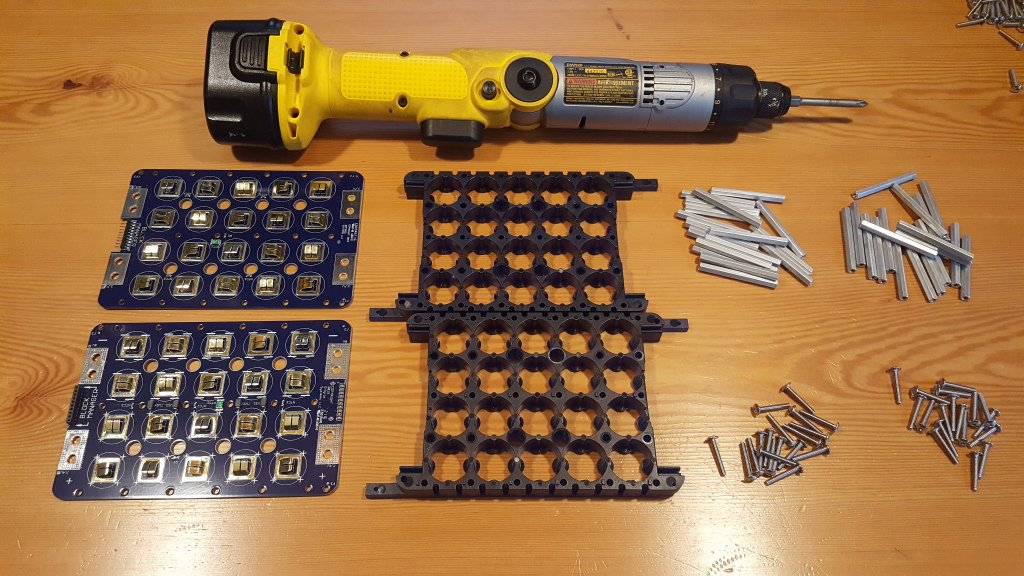
Each block of batteries is assembled using screws and standoffs in conjunction with ABS plastic cell holders. A PCB is placed on each side of the stack, and with tabs not unlike what you’d see in a traditional battery compartment, all the cells get connected without having to solder or weld anything to them. This allows for the rapid assembly of battery packs from 7.2 VDC all the way up to 150 VDC , and means individual cells can easily be checked and replaced in the future should the need arise.
For monitoring the cells, a “Block Manager” board is installed on each block, which communicates wirelessly to a “Pack Supervisor” board that monitors the overall health of the system. Obviously, such a robust system is probably a bit overkill if you’re just looking to build a pack for your quadcopter, but if you’re looking to build a DIY Powerwall or juice up a custom electric vehicle, this could be the battery management system you’ve been looking for.
We caught up with Shah Selbe and Jacob Lewallen the morning after their project, FieldKit, won the Hackaday Prize. FieldKit is an open-source field-based research data collection platform. Which is basically a lot of fancy words for saying it’s a system for collecting sensor data in the field without being snagged by the myriad of problems associated with putting electronics in remote locations. It’s a core project of Conservify, a non-profit organization that seeks to empower conservation research.
As grand prize winner the FieldKit project was awarded a $125,000 cash prize, which Shah and Jacob say is transformative for a non-profit pursuing technology research and development. It seems the grant process has not evolved to embrace developing electronics, while opportunities for research projects have begun to involve recording large data sets in order to test a hypothesis. This is where FieldKit truly shines. Their vision is to provide a low-cost and extensible system that other researchers can use to collect data while making their own grant dollar go much further.
FieldKit is modular in nature. At the center is the core board that hosts the microcontroller, radio, GPS, and power circuits. Headers connectors allow for a range of sensors and expansion modules to easily be swapped in and out depending on the user’s needs. Currently the team has proven modules for measuring water quality, water level, and weather data. The collected data is stored locally until the user comes around and downloads it to their smartphone by way of the WiFi access point built into the station, but the team is working on a LoRa radio module for long-distance access. The project also includes plans for a data sharing and visualization web interface for scientists who wish to make their data sets available.
The hardware has been refined thanks to the team’s first-hand experience setting up numerous large sensor networks in the field. The knowledge gained in each of those endeavors has been rolled into FieldKit so that other researchers can benefit.
The FieldKit design includes a ruggedized enclosure, sensor modules to the left attaching to the core board on the right which hosts microcontroller, radio, GPS, and power management
A reliable, well-tested platform has the potential to greatly reduce the cost of at-scale sensing by moving away from the traditional paradigm of building a custom device for each research project. At the very least, it reduces the cost and complexity of custom hardware, as the majority of the system — the enclosure, power supply, data storage and transfer — can be standardized, and the only custom work is the sensor itself if a suitable module doesn’t already exist. Even the enclosure has been designed to minimize the amount of work necessary when adapting it for different sensor payloads.
The information age has put amazing data processing power at our fingertips. But the scientific method still demands a high bar in carefully collected observations before we can put that processing power to good use. A scientist shouldn’t also have to be an electronics engineer to carry out their studies. FieldKit seeks to bridge the divide and boost the effectiveness of every researcher and every dollar spent setting up a research project. We hope that taking the top spot in the Hackaday Prize has energized the team as they continue their quest to make conservation research available to all.
There were five other top winners named and five honorable mentions in this year’s Hackaday Prize. You can see the excitement and hear from those project designers during the Hackaday Prize Ceremony:
A few days ago I was invited to a party. Party invites are always good, and if I can make it to this one I’ll definitely go. It’s from a continental European hackerspace, and it’s for their tenth birthday party. As I spent a while checking ferries and flights it struck me, a lot of the spaces in my sphere are about a decade old. I went to London Hackspace’s 10th earlier in the year, and a host of other British hackerspaces aren’t far behind. Something tells me I’ll be knocking back the Club Mate and listening to EDM of some form at more than one such party in the coming year.
For most of the decade since I found the then-recently-established mailing list of my local hackerspace I’ve spent a lot of my time involved in more than one space. I’ve been a hackerspace director, a member, and many roles in between and I’ve seen them in both good times and bad ones. Perhaps it’s time to sit back and take stock of that decade and ask a few questions about hackerspaces. How have they fared, what state are they in now, and where are they going?
Has It Really Been That Long?
Some spaces such as the legendary c-base in Berlin have of course been around for much longer than a decade. RalfR [CC BY-SA 3.0]
There was a time when hackerspaces were very few and far between, almost legendary entities that you’d heard about but never visited. If you were lucky enough to be a member of a hackerspace twenty or thirty years ago then I am envious of you, for aside from a brief taste of the required atmosphere during my Robot Wars days my hardware work was pursued mostly in the wilderness. As they spread out from those trailblazers your part of the world may have had its first hackerspace on a different timescale from mine, but they edged into the UK in about 2009 and 2010. First a few larger cities had them, then they spread inexorably to smaller ones so that now it’s a fair certainty that any European settlement from a large town upwards will have one. We’ve seen a few wither on the vine while others have burned brightly and faltered, but have they matured? Can a hackerspace director at last get their hands dirty in the workshop without constantly fighting for their space’s existence?
Different people find their own benefits from the hackerspace community, whether it be in the workshop, the politics, the running or simply the community itself. For me they have provided a stimulating community of like-minded tinkerers through a difficult period in life, and by my observation they provide a similar refuge for many others. Unfortunately though they do not serve everyone in the same fashion, and I find it disturbing how many people I have encountered along the way for whom the community has not been kind. Individual members fade away from their space when they are treated badly, but in particular those involved in the running of a space proceed to inevitable burnout. I shouldn’t have a host of friends in the community who have been damaged by running a hackerspace, yet I do, and I believe the cause of this is reflected in the way the movement has evolved.
What Happens When a Small Group Becomes a Large One?
The current home of Hack42 in Arnhem, Netherlands, a space that makes me envious every time I visit it. Mitch Altman [CC BY-SA 2.0]
Hackerspaces arrived here not just in the form of rooms full of tools and machines, but as organisational copies of some of the places that inspired them. For many this meant a model based around consensus and an almost Athenian approach to democracy, in which all voices had a say and for which the idea was that all members would contribute to the running. The phrase “Do-ocracy” appeared, in which tasks and functions could be done at will by anyone, with the idea that they would be done by those most suited for them. These models and concepts can work, indeed there are spaces in which they work well. However they are invariably the smaller spaces, and as the membership grows their flaws become rapidly apparent.
When a space first emerges, it is usually at the hands of a small and well-motivated group of individuals with a common purpose. They become a well-oiled machine, and a space in this phase of its existence can be an exciting place to be a member of. Spaces that stay at this size with somewhere around twenty members are fortunate, because the problems that face larger ones under a consensus model never have a chance to appear. If they can cover their rent and no calamity befalls them such as their landlord wanting the building emptied, they can have a happy future.
As their membership grows though, the percentage of members who share the ideals and work ethic of that original crew becomes ever smaller, and the deficiencies of the model begin to show. Despite the do-ocracy the members expect there to be Someone In Charge, so there will be some sort of board of directors. An uneasy divergence emerges between the three competing influences of directors, do-ocracy, and consensus, as the percentage of members prepared to perform the do-ocracy declines and the directors are left to pick up the slack.
Meanwhile the membership believe themselves to have a say in everything because of the consensus model. The beleaguered directors are under attack from all sides as they try to keep up with the space-running tasks that nobody else will do while simultaneously weathering the onslaught from the inactive members to whom consensus has given a sense of entitlement. Meetings become hours-long nightmares of endless waffle as members with Something To Say exercise their opportunity to drone on for hours that they could be spending taking on some of that do-ocracy work of getting stuff done.
This is a rite of passage for every growing hackerspace. The jump from a few handfuls of people to a large, self-sustaining membership hinges on successfully navigating this in-between time without alienating the people who make up the community of the space. The most successful spaces by my observation have been those that have modified or even moved away entirely from consensus and do-ocracy, and that now sport a more executive model in which a board of directors is left to run the space with accountability in a much more periodic form akin to the shareholders meetings faced by directors of large companies.
Would You Invest In A Home For A Hackerspace?
Finding one of these can sometimes be a challenge. Mtaylor848 [CC BY-SA 4.0]
Having adapted the governance model to fit the growing hackerspace, what remains a threat to it? From where I am sitting I worry chiefly about the insecurity of so many hackerspace venues. It seems everywhere you turn there’s a story of a hackerspace whose lease wasn’t renewed, or whose walls simply can no longer hold all of the goings-on. Whatever the reason, the common problem for the mature hackerspace seems to be location, location, location.
Our advantage is that we are prepared to take on odd spaces that might otherwise be unrentable, but on the other hand those spaces have a tendency to be in locations whose owners have an eye towards redevelopment. I have lost count of the number of times that successful and financially viable spaces of my acquaintance have needed to move for this reason, and I wish that there were some way to be put on a more stable footing.
Some spaces go in with other organisations to occupy a larger space, as the ability to pay more in rent grants additional bargaining power with the landlord. For example my hackerspace in Milton Keynes shares a building with the local Men In Sheds that is rented from the local Community Foundation, but that is an extremely lucky situation. Though the relationship between space and Shed is a largely harmonious one in MK this can be a dangerous path. Other spaces have tried the route of going under the wing of a sponsor, only to hit the buffers when the sponsor loses interest in them.
There are times when I wonder whether there is a viable business model in a community-owned property investment company with the aim of providing accommodation for hackerspaces with the ability to pay a sustainable rent, but I am sadly not an accountant nor an expert in property investment companies so it remains only an idle thought.
…And What Does The Future Hold?
So the spaces around me have not only survived the decade since the movement arrived in my part of the world, but have become the centers of hacker culture. What are the challenges that will face them in the next decade, and how should they cope? I’ve touched upon the lack of security of tenure with respect to physical space, so beyond that I think the chief threat comes from a proliferation of competitors. Whether you call it a hackspace, a hackerspace, or a makerspace, it can sometimes seem as though there are a plethora of spaces springing up, and we can be lost in the crowd.
The answer of course is that very few of them are hackerspaces as we know them. Aside from the FabLabs that many people will be familiar with there is a trend for all sorts of organisations to put a 3D printer and maybe a laser cutter in a room and call it a hackspace. They want to appear innovative and on-trend, but they also want complete control over their resource. Thus they never replicate the secret sauce that makes our hackerspaces special, which is the community and its ability to generate ideas and cool stuff. They do however present a threat, because among them are so-called hackspaces that compete with our hackerspaces for funding and other resources. When a community group is competing with a space run by a much larger entity with professional staff dedicated to fundraising, they will always be at a disadvantage. I can think of more than one British city that has reached saturation point with these spaces, with consequent problems for the community space. Our best hope with respect to these spaces is I think to recognise them as a fad, and trust that they will largely be a thing of the past in a few years time as the Next Big Thing takes their place.
It’s been a bit of a shock to realise that the spaces I’m involved with are all around ten years old, but despite some of the teething troubles and ongoing challenges I’ve noted above, I think the movement remains in good shape. If you’re from a space that has escaped any problems I envy you. If you’re a diehard fan of consensus and do-ocracy then I hope it never goes wrong for you as I have seen it go. Meanwhile, if you have a view on any of this we’d love to hear from you in the comments. Keep supporting your local space, so it is still going in a decade’s time.
Difference of two Vikram moon images, contrast tweaked.
Hackaday editors Elliot Williams and Mike Szczys highlight the most delightful hacks of the past week. Need a random-number showpiece for your office? Look no further than that fish tank. Maybe the showpiece you actually need is to complete your band’s stage act? You want one of Tristan Shone’s many industrial-chic audio controllers or maybe just a hacked turntable sitting between your guitar and amp.
Plus citizen science is alive and well in the astronomy realm, and piezo elements are just never going to charge your electric vehicle.
Take a look at the links below if you want to follow along, and as always tell us what you think about this episode in the comments!