
Games
All games I found out about
[4K] Cyberpunk Project – Minecraft Timelapse by Elysium Fire #youtubevids
CRAZY RAFT BUILDING GLITCH! Stranded Deep S4 Episode 34 #youtubevids
DEADLY ACID PARKOUR! Raft Survival S2 Episode 6 #youtubevids
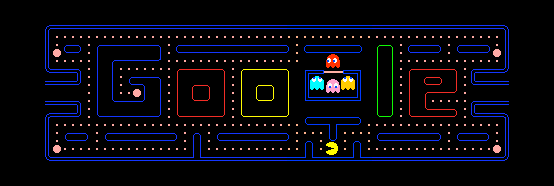
Pacman on Google
Did you know that if you search for “google pacman” you get a playable in-browser pacman game for desktop pc?
Give it a try
- May 21, 2010
- 30th Anniversary of PAC-MAN
- When I was growing up, my dad had the best job I could possibly imagine: he was an arcade game and pinball technician. For me, that meant summer trips through Poland’s coastal cities with their seasonal arcade parlors; peeking inside cabinets to learn programming and engineering secrets; and—of course—free games!
One of my favorites was PAC-MAN, whose popularity transcended the geopolitical barriers of that time. During the heyday of space shooters, Tōru Iwatani’s creation stood out as one of the first video games aimed at a broader audience, with a cute story of pizza-shaped character gobbling dots in a maze, colorful (literally!) characters, friendly design, very little violence and everlasting fun.
Today, on PAC-MAN’s 30th birthday, you can rediscover some of your 8-bit memories—or meet PAC-MAN for the first time—through our first-ever playable Google doodle. To play the game, go to google.com during the next 48 hours (because it’s too cool to keep for just one day) and either press the “Insert Coin” button or just wait for a few seconds.
Google doodler Ryan Germick and I made sure to include PAC-MAN’s original game logic, graphics and sounds, bring back ghosts’ individual personalities, and even recreate original bugs from this 1980’s masterpiece. We also added a little easter egg: if you throw in another coin, Ms. PAC-MAN joins the party and you can play together with someone else (PAC-MAN is controlled with arrow keys or by clicking on the maze, Ms. PAC-MAN using the WASD keys).
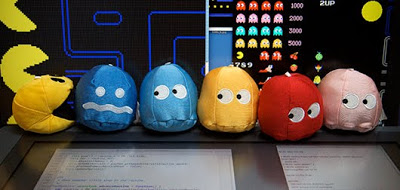
- PAC-MAN™ & ©1980 NAMCO BANDAI Games Inc.
PAC-MAN seems like a natural fit for the Google homepage. They’re both deceptively straightforward, carefully hiding their complexity under the hood. There’s a light-hearted, human touch to both of them. And we can only hope you find using Google at least a quarter as enjoyable as eating dots and chasing ghosts. You know, without actually needing any quarters.
Posted by Marcin Wichary, senior UX designer and developer

Dwarf Fortress
Dwarf Fortress (officially called Slaves to Armok: God of Blood Chapter II: Dwarf Fortress) is a part construction and management simulation, part roguelike, indie video game created by Tarn and Zach Adams. Freeware and in development since 2002, its first alpha version was released in 2006 and it received attention for being a two-member project surviving solely on donations. The primary game mode is set in a procedurally generated fantasy world in which the player indirectly controls a group of dwarves, and attempts to construct a successful and wealthy underground fortress. Critics praised its complex, emergent gameplay but had mixed reactions to its difficulty. The game influenced Minecraft and was selected among other games to be featured in the Museum of Modern Art to show the history of video gaming in 2012.
The game has text-based graphics and is open-ended with no main objectives. Before playing, the player has to set in motion a process which generates worlds with continents, oceans and histories documenting civilizations. The main game mode, Dwarf Fortress, consists of selecting a suitable site from the generated-world, establishing a successful colony or fortress, combating threats like goblin invasions, generating wealth and taking care of the dwarves. Each dwarf is modeled down to its individual personality, has likes or dislikes and possesses specific trainable skills in various labors. The second main game mode, Adventurer, is a turn-based, open-ended roguelike mode where the player starts off as an adventurer in the world and is free to explore, complete quests, or even visit old abandoned fortresses. The combat system is anatomically detailed with combat logs describing events like organs getting pierced, fat getting bruised and limbs getting severed.
Prior to Dwarf Fortress, Tarn Adams was working on a project called Slaves to Armok: God of Blood which was a role-playing game. By 2004, Adams decided to shift from the original Armok to Dwarf Fortress after the former became difficult to maintain. Adams calls it his life’s work and said in 2011 that version 1.0 will not be ready for at least another 20 years, and even after that he would continue to work on it. The game has a cult following and an active online community. As there is no way to win, every fortress, no matter how successful, is usually destroyed somehow. This prompts the official community motto: “Losing is Fun!”

Doni Bobes
https://www.youtube.com/user/DoniBobesMC/featured
Doni Bobes is me. Minecraft Video I make. The video you like. The subscribe button you will hit. pls

Avomance
https://www.youtube.com/channel/UCeprnLp3l8oZPAig8XjVLnA
Avomance is a leading Minecraft Tutorial, Lets Play and Lets Build creator with an easy to follow style and really interactive channel. I especially enjoy creating a Minecraft tutorial for people with specific requirements A BIT ABOUT ME I am actually a London boy, born and bred and although I no longer live there, the accent can’t help slipping out. For all those people out there who comment I sound like Gordon Ramsey….. that’s why! The interaction I get with my ‘Avomaniacs’ is one of the best things about being on YouTube. Many ideas I have are because of people like you commenting in my videos and pushing me on. I really look forward to creating new and entertaining content for a long time to come and hope you continue to join me for the ride! Don’t forget to follow me on Social Media Twitter: @AvoMinecraft Insta: AvoMinecraft Focussing on Minecraft with Lets Play, Lets Build Tutorials, Redstone, SMP and more
I Built a City Where The Lower Class is Taxed to Death This Happened – Citystate #youtubevids
r/IDOWorkHereLady – But I DO WORK Here Lady! Best Stories! #youtubevids
Yes, this is absolutely why I purchase my Snapmaker 3D printer!!😂😂
Posted by Snapmaker on Thursday, 24 October 2019
Automatic Fire 🔥 Extinguisher Ball
Automatic Fire 🔥 Extinguisher BallInfo or Buy @ https://electricalmag.com/automatic-fire-extinguisher-ball/Must use for #Safety#electrical #electricalengineering
Posted by Electrical Engineering on Tuesday, 19 November 2019
Try this out guys
Https://Liddy.no/8bwt
Ebikes if you’re interested.