HAWT Wind Turbine Is Mostly 3D Printed

Wind turbines are a great source of renewable energy, and a great DIY project, too. They can be built with all kinds of materials and the barrier for entry is low for the beginner. [Fab] has built just such a device, taking advantage of modern construction techniques, and dubbed it the WinDIY.

The WinDIY design is mostly 3D printed, with a familiar three-bladed design. The diameter of the rotor is 1.2 m, meaning that braking and regulating the turbine is required for safety in high winds. [Fab] is aiming to achieve this control with a combination of mechanical and electronic braking, as well as variable-pitch blades. The benefit of 3D printing the design is it allows iterations to be made quickly, particularly of parts with complex geometries that would be too time-consuming or expensive to machine otherwise.

[Fab]’s writeup goes into great detail on topics like the design of the pitch control systems and other minutae, which should serve as a great reference for anyone else working on a similar project. If you’re looking for something with more of a sci-fi future vibe, consider attempting a vertical-axis build instead.

source https://hackaday.com/2020/08/07/hawt-wind-turbine-is-mostly-3d-printed/

Separation Between WiFi and Bluetooth Broken by the Spectra Co-Existence Attack

This year, at DEF CON 28 DEF CON Safe Mode, security researchers [Jiska Classen] and [Francesco Gringoli] gave a talk about inter-chip privilege escalation using wireless coexistence mechanisms. The title is catchy, sure, but what exactly is this about?

To understand this security flaw, or group of security flaws, we first need to know what wireless coexistence mechanisms are. Modern devices can support cellular and non-cellular wireless communications standards at the same time (LTE, WiFi, Bluetooth). Given the desired miniaturization of our devices, the different subsystems that support these communication technologies must reside in very close physical proximity within the device (in-device coexistence). The resulting high level of reciprocal leakage can at times cause considerable interference.

There are several scenarios where interference can occur, the main ones are:

  • Two radio systems occupy neighboring frequencies and carrier leakage occurs
  • The harmonics of one transmitter fall on frequencies used by another system
  • Two radio systems share the same frequencies

To tackle these kind of problems, manufacturers had to implement strategies so that the devices wireless chips can coexist (sometimes even sharing the same antenna) and reduce interference to a minimum. They are called coexistence mechanisms and enable high-performance communication on intersecting frequency bands and thus, they are essential to any modern mobile device. Despite open solutions exist, such as the Mobile Wireless Standards, the manufacturers usually implement proprietary solutions.

Spectra

Spectra is a new attack class demonstrated in this DEF CON talk, which is focused on Broadcom and Cypress WiFi/Bluetooth combo chips. On a combo chip, WiFi and Bluetooth run on separate processing cores and coexistence information is directly exchanged between cores using the Serial Enhanced Coexistence Interface (SECI) and does not go through the underlying operating system.

Spectra class attacks exploit flaws in the interfaces between wireless cores in which one core can achieve denial of service (DoS), information disclosure and even code execution on another core. The reasoning here is, from an attacker perspective, to leverage a Bluetooth subsystem remote code execution (RCE) to perform WiFi RCE and maybe even LTE RCE. Keep in mind that this remote code execution is happening in these CPU core subsystems, and so can be completely invisible to the main device CPU and OS.

Join me below where the talk is embedded and where I will also dig into the denial of service, information disclosure, and code execution topics of the Spectra attack.

Denial of Service

This happens when one wireless core denies transmission to the other core. DoS attacks are possible if one core is able to claim spectrum resources of the other core. As this is the basic working principle of any coexistence interface, all of them are vulnerable by definition, as long as one core keeps constantly claiming the resource for himself. Other DoS opportunities arise from one wireless core being able to crash another via shared RAM abuse.

Information Disclosure

One wireless core can infer data or actions of the other core. One example is when connecting an HID device like a keyboard. Timings and contents of keypresses can be observed on the host that receives those keystrokes. However, an attacker who has only code execution on a WiFi chip should not be able to make such observations. While the content of the keypresses are missing, it is possible for code running on the WiFi chip to infer timing statistics about the keys pressed in the Bluetooth side. This becomes interesting for inferring passwords and password lengths.

Code Execution

One wireless core can execute code within the other core. The security researchers demonstrate that it is possible to execute an arbitrary WiFi address with controlled contents via Bluetooth. This happens because when both cores are running, they share a RAM region which contain, among other information, a large function table. By overwriting a specific address, it is possible to control the WiFi core program counter. This means that a Bluetooth subsystem exploit can turn into a WiFi exploit. In addition, writing to the WiFi buffer and executing addresses produces various kernel panics on Android and iOS, indicating that further escalations into the host are possible and probably it’s just a matter of time until someone pops calc.

Conclusion

Although the research was centered on Broadcom and Cypress combo chips (which cover, by the way, all iPhones, MacBooks, iMacs, older Apple Watches, Samsung S and Note series, some Google Nexus, Raspberry Pi and so forth…) advisories were sent to Intel, MediaTek, Qualcomm, Texas Instruments, Marvell, NXP and they all mention similar coexistence interfaces in their devices. So, mutatis mutandis, and because of its very nature, some Spectra class vulnerabilities probably exist in other vendors too.

And since [Jiska] has a history breaking wireless stuff, we can probably expect a follow-up on this research and this class of inter-chip privilege escalation vulnerabilities. Can’t wait!

source https://hackaday.com/2020/08/07/separation-between-wifi-and-bluetooth-broken-by-the-spectra-co-existence-attack/

This Week in Security: Garmin Ransomware, KeePass , and Twitter Warnings

On July 23, multiple services related to Garmin were taken offline, including their call center and aviation related services. Thanks to information leaked by Garmin employees, we know that this multi-day outage was caused by the Wastedlocker ransomware campaign. After four days, Garmin was able to start the process of restoring the services.

It’s reported that the requested ransom was an eye-watering $10 million. It’s suspected that Garmin actually paid the ransom. A leaked decryptor program confirms that they received the decryption key. The attack was apparently very widespread through Garmin’s network, as it seems that both workstations and public facing servers were impacted. Let’s hope Garmin learned their lesson, and are shoring up their security practices.

KeePass

KeePass released an update this week addressing a couple flaws in the KeePassRPC service. The update announcement is light on the details, but thankfully we have the full story directly from [Philipp Danzinger], the student that discovered the vulnerabilities. Both vulnerabilities are in the implementation of the SRP-6(a) key exchange protocol.

The vulnerable component is the RPC. KeyPass is essentially a simple database containing passwords. That database is encrypted using the user’s password, so the contained passwords cannot be retrieved without that master password. When a user launches KeePass, he or she is first prompted for this master password, and the database is decrypted using that password. The KeePassRPC service allows other processes, like a browser plugin, to access the now-decrypted database. The first time a new client attemps to access the RPC service, a keypair is generated, and the user is prompted whether to allow the new connection. The public key is stored and marked as trusted, allowing that client to request passwords again in the future, so long as the database had been unlocked.

The authentication protocol is similar to a DH key exchange. A shared value is raised to the power of the secret key resulting in a value called A. This is sent as part of the key exchange, and the formal specification states that it is never allowed to be 0. The problem is that KeePassRPC doesn’t properly check that A != 0. When A is set to 0, the entire key exchange breaks down, as all the values end up equaling 0, as 0^x is always 0. This means that any client can spoof an already authorized client.

The second vulnerability is a weak random number generator used on the server side to generate the secret key b. That key is based on the current date and time, run through a pseudo-random function. Because that function is known, if an attacker can guess the exact time value used, then the secret key is easily calculated. It’s not quite as simple as it seems, as the time value is measured in “ticks”, each tick being 100 nanoseconds. It would take a bit of guesswork and a few thousand guesses to land on the right value, but without any rate limiting, that process would just take a few seconds.

What makes this attack very serious is the fact that modern web browsers allow Javascript running on a webpage to attempt to connect to localhost. If your KeePass database is unlocked, and you load a page running malicious JS, it could access the RPC port and spoof the authorized KeePass browser plugin and download your entire KeePass database. Thankfully this bug was disclosed privately and KeePassRPC has been updated to 1.12.1, which closes both vulnerabilities. Additionally, 1.13 has since been released with additional safeguards against this and similar attacks.

Twitter

Twitter has started displaying a security warning for some users. The details are extremely scarce, but lets see what details we can tease out. First, the warning specifies that the issue in question was a vulnerability in the Twitter Android app, but that it was related to an Android vulnerability, and then links to the October 2018 Android security update. Looking through the vulnerabilities disclosed, there doesn’t seem to be an obvious candidate for the related vulnerability.

KDE Ark

We’ve seen a very simple technique show up in countless security stories: path transversal. It’s simple, you can include a “..” as part of a file path to move up a directory. Often times this can be included in unexpected places to bypass security restrictions, or do other unintended things. Archive files are no exception, and there is nothing preventing a zip archive from having such paths. Most archive programs catch this behavior and don’t allow the archive to extract as it’s written. The venerable unzip command complains like this:

# unzip relative2.zip 
Archive:  relative2.zip
warning:  skipped "../" path component(s) in tmp/../../moo
 extracting: tmp/moo

KDE Ark, until recently, didn’t treat those paths as special, and would happily extract files to whatever path it was instructed to. The update doesn’t seem to be officially released at the time of writing, so be wary of blindly extracting archives until that update is available. There is a useful repository of archives that can be used to test for various transversal issues, and I’ve confirmed that one in particular (harmless zip file containing tmp/../../moo) does demonstrate the issue in Ark.

And Finally…

Remember Boothole? Multiple vendors pushed fixes to this Linux secure boot vulnerability, and a handful of unbootable systems was the result. For the case of RHEL and CentOS, another round of updated packages have been released, fixing the problem and making for bootable systems again.

And what does a criminal do with a database breach? Apparently after selling them, they release them for free. If it wasn’t stolen data, I’d call it a win. Once a breach has made as much money as the seller thinks it’s likely to make, it’s not uncommon for the data to be released for free. These aren’t very popular sites or services, but it might be worth a check to see if your data was included in the release.

source https://hackaday.com/2020/08/07/this-week-in-security-garmin-ransomware-keepass-and-twitter-warnings/


This Week in Security: Garmin Ransomware, KeePass , and Twitter Warnings

On July 23, multiple services related to Garmin were taken offline, including their call center and aviation related services. Thanks to information leaked by Garmin employees, we know that this multi-day outage was caused by the Wastedlocker ransomware campaign. After four days, Garmin was able to start the process of restoring the services.

It’s reported that the requested ransom was an eye-watering $10 million. It’s suspected that Garmin actually paid the ransom. A leaked decryptor program confirms that they received the decryption key. The attack was apparently very widespread through Garmin’s network, as it seems that both workstations and public facing servers were impacted. Let’s hope Garmin learned their lesson, and are shoring up their security practices.

KeePass

KeePass released an update this week addressing a couple flaws in the KeePassRPC service. The update announcement is light on the details, but thankfully we have the full story directly from [Philipp Danzinger], the student that discovered the vulnerabilities. Both vulnerabilities are in the implementation of the SRP-6(a) key exchange protocol.

The vulnerable component is the RPC. KeyPass is essentially a simple database containing passwords. That database is encrypted using the user’s password, so the contained passwords cannot be retrieved without that master password. When a user launches KeePass, he or she is first prompted for this master password, and the database is decrypted using that password. The KeePassRPC service allows other processes, like a browser plugin, to access the now-decrypted database. The first time a new client attemps to access the RPC service, a keypair is generated, and the user is prompted whether to allow the new connection. The public key is stored and marked as trusted, allowing that client to request passwords again in the future, so long as the database had been unlocked.

The authentication protocol is similar to a DH key exchange. A shared value is raised to the power of the secret key resulting in a value called A. This is sent as part of the key exchange, and the formal specification states that it is never allowed to be 0. The problem is that KeePassRPC doesn’t properly check that A != 0. When A is set to 0, the entire key exchange breaks down, as all the values end up equaling 0, as 0^x is always 0. This means that any client can spoof an already authorized client.

The second vulnerability is a weak random number generator used on the server side to generate the secret key b. That key is based on the current date and time, run through a pseudo-random function. Because that function is known, if an attacker can guess the exact time value used, then the secret key is easily calculated. It’s not quite as simple as it seems, as the time value is measured in “ticks”, each tick being 100 nanoseconds. It would take a bit of guesswork and a few thousand guesses to land on the right value, but without any rate limiting, that process would just take a few seconds.

What makes this attack very serious is the fact that modern web browsers allow Javascript running on a webpage to attempt to connect to localhost. If your KeePass database is unlocked, and you load a page running malicious JS, it could access the RPC port and spoof the authorized KeePass browser plugin and download your entire KeePass database. Thankfully this bug was disclosed privately and KeePassRPC has been updated to 1.12.1, which closes both vulnerabilities. Additionally, 1.13 has since been released with additional safeguards against this and similar attacks.

Twitter

Twitter has started displaying a security warning for some users. The details are extremely scarce, but lets see what details we can tease out. First, the warning specifies that the issue in question was a vulnerability in the Twitter Android app, but that it was related to an Android vulnerability, and then links to the October 2018 Android security update. Looking through the vulnerabilities disclosed, there doesn’t seem to be an obvious candidate for the related vulnerability.

KDE Ark

We’ve seen a very simple technique show up in countless security stories: path transversal. It’s simple, you can include a “..” as part of a file path to move up a directory. Often times this can be included in unexpected places to bypass security restrictions, or do other unintended things. Archive files are no exception, and there is nothing preventing a zip archive from having such paths. Most archive programs catch this behavior and don’t allow the archive to extract as it’s written. The venerable unzip command complains like this:

# unzip relative2.zip 
Archive:  relative2.zip
warning:  skipped "../" path component(s) in tmp/../../moo
 extracting: tmp/moo

KDE Ark, until recently, didn’t treat those paths as special, and would happily extract files to whatever path it was instructed to. The update doesn’t seem to be officially released at the time of writing, so be wary of blindly extracting archives until that update is available. There is a useful repository of archives that can be used to test for various transversal issues, and I’ve confirmed that one in particular (harmless zip file containing tmp/../../moo) does demonstrate the issue in Ark.

And Finally…

Remember Boothole? Multiple vendors pushed fixes to this Linux secure boot vulnerability, and a handful of unbootable systems was the result. For the case of RHEL and CentOS, another round of updated packages have been released, fixing the problem and making for bootable systems again.

And what does a criminal do with a database breach? Apparently after selling them, they release them for free. If it wasn’t stolen data, I’d call it a win. Once a breach has made as much money as the seller thinks it’s likely to make, it’s not uncommon for the data to be released for free. These aren’t very popular sites or services, but it might be worth a check to see if your data was included in the release.

source https://hackaday.com/2020/08/07/this-week-in-security-garmin-ransomware-keepass-and-twitter-warnings/

Odyssey Is A x86 Computer Packing An Arduino Along For The Trip

We love the simplicity of Arduino for focused tasks, we love how Raspberry Pi GPIO pins open a doorway to a wide world of peripherals, and we love the software ecosystem of Intel’s x86 instruction set. It’s great that some products manage to combine all of them together into a single compact package, and we welcome the recent addition of Seeed Studio’s Odyssey X86J4105.

[Ars Technica] recently looked one over and found it impressive from the perspective of a small networked computer, but they didn’t dig too deeply into the maker-friendly side of the product. We can look at the product documentation to see some interesting details. This board is larger than a Raspberry Pi, but its GPIO pins were laid out in exactly the same order as that on a Pi. Some HATs could plug right in, eliminating all the electrical integration leaving just the software issue of ARM vs x86. Tasks that are not suitable for CPU-controlled GPIO (such as generating reliable PWM) can be offloaded to an on-board Arduino-compatible microcontroller. It is built around the SAMD21 chip, similar to the Arduino MKR and Arduino Zero but the pinout does not appear to match any of the popular Arduino form factors.

The Odyssey is not the first x86 single board computer (SBC) to have GPIO pins and an onboard Arduino assistant. LattePanda for example has been executing that game plan (minus the Raspberry Pi pin layout) for the past few years. We’ve followed them since their Kickstarter origins and we’ve featured creative uses here and there. LattePanda’s current offerings are built around Intel CPUs ranging from Atom to Core m3. The Odyssey’s Celeron is roughly in the middle of that range, and the SAMD21 is more capable than the ATmega32U4 (Arduino Leonardo) on board a LattePanda. We always love seeing more options in a market for us to find the right tradeoff to match a given project, and we look forward to the epic journeys yet to come.

source https://hackaday.com/2020/08/07/odyssey-is-a-x86-computer-packing-an-arduino-along-for-the-trip/

Lightning Analysis With Your SDR

Perhaps it’s just one of those things adults dream up to entertain their children, but were you ever told to count slowly the time between seeing a lightning flash and hearing the rumble of thunder? The idea was that the count would tell you how far away the storm was, but from a grown-up perspective the calibration accuracy of a child saying “one… two…three…” in miles seems highly suspect. It’s a valid technique though, and it can be used to monitor thunderstorms by the radio emissions created through the electrical discharge. It’s an area the SAGE project has been working in, and they’ve posted some details including a fascinating run-down of the software techniques , on how lightning can be detected with an RTL-SDR.

A lightning strike produces a characteristic wideband burst that shows up in the time domain as a maximum point that can easily be detected but could also be confused with radio interference from another source. Thus after identifying maxima they zoom in and perform a Fourier transform to spot the wideband burst. It’s all done in Python, and the pleasant surprise is how straightforward to understand it all is.

SAGE are working on a distributed sensor network, so we hope this work might one day give us real-time open lightning data. The FFT approach should ensure that it won’t be fooled by false positives as a traditional detector might be.

Via RTL-SDR.com.

source https://hackaday.com/2020/08/07/lightning-analysis-with-your-sdr/

The Google Chrome Dinosaur Game, in Real Life

[Ryan] wanted to hack the Google Chrome Dinosaur Game so he could control the dinosaur with his own movements. The game only requires two keyboard presses (up and down arrow keys), so controlling the game with the Arduino Keyboard library only requires a few simple function calls.

He uses the Arduino MKR board in his build, but notes any number of other boards would work as well. A force sensor detects his jumps and a stretch sensor detects him ducking. Both the stretch and force sensors are resistive transducers, so two simple voltage divider circuits (one for each sensor) are needed to convert changes in force to a voltage. You may need to adjust the sensor threshold to ensure the code responds to your movements, but [Ryan] makes that pretty easy to do in software as both thresholds are stored as global variables.

It’s a pretty simple hack, but could make for some good socially-distanced fun. What other hackable Google Chrome extensions do you like?

source https://hackaday.com/2020/08/06/google-chrome-dinosaur-game-in-real-life/

iRobot Makes Learning Robot More Affordable

When you think of iRobot, you probably think of floor cleaning or military robots. But they also have a set of robots aimed at education. The Root robot — an acquisition the company made in 2019 — originally targeted classrooms and cost about $200 each. A new version costs about $130 and is a better fit for home users.

The original version  — Root rt1 — is still available, but the rt0 version has several missing features to hit the desired price. What’s missing? Apparently, the rt1 can stick to a whiteboard using magnets, but that feature is missing on the rt0. There are also no “cliff” sensors or color scanner.

On the plus side, there is a new $20 option that allows either version of the robot to mount Lego creations. Usually, the robots can draw with a marker underneath and retract it on command. The rt1 can also erase the marker. With the Lego base, though, you can use that same mechanism to actuate something like the catapult in the video.

The robots can be coded using something that looks like Scratch or using text-based coding. The editor — you can even simulate it online for free– has three levels, depending on the student’s ability to read and code. In addition, there are many free exercises and activities.

For $130, these seem as though they’d be easily hackable as a robot platform. Of course, you want this for your kids and we wouldn’t say otherwise.

Educational robots are not a new idea. If you want to stick with iRobot for the big league stuff, you can also get a Roomba that doesn’t suck.

source https://hackaday.com/2020/08/06/irobot-makes-learning-robot-more-affordable/

A Tongue Operated Human Machine Interface

For interfacing with machines, most of us use our hands and fingers. When you don’t have use of your hands (permanently or temporarily), there are limited alternatives. [Dorothee Clasen] has added one more option, [In]Brace, which is basically a small slide switch that you can operate with your tongue.

[In]Brace consists of a custom moulded retainer for the roof of your mouth, on which is a small ball with an embedded magnet, that slides long wire tracks. Above the track is a set of three magnetic sensors, that can detect the position of the ball. On the prototype, a wire from the three sensors run out of the corner of the users mouth, to a wireless microcontroller (Which looks to us like a ESP8266) hooked behind the user’s ear. In a final product, it would obviously be preferable if everything were sealed in the retainer. We think there is even more potential if one of the many 3-axis hall effect sensors are used, with a small joystick of rolling ball. The device could be used by disabled persons, for physical therapy, or just for cases where a person’s hands are otherwise occupied. [Dorothy] created a simple demonstration, where she plays Pong, or Tong in this case, using only the [In]Brace. Hygiene and making sure that it doesn’t somehow become a choke hazard will be very important if this ever became a product, but we think there is some potential.

[Kristina Panos] did a very interesting deep dive into the tongue as an HMI device a while ago, so this isn’t a new idea, but the actual implementations differ quite a lot. Apparently it’s also possible to use your ear muscles as an interface!

Thanks for the tip [Itay]!

source https://hackaday.com/2020/08/06/a-tongue-operated-human-machine-interface/

Telepresence Robot Navigates Upgrades

As time marches on and a good percentage of us are still isolating from society at large, the progress of technology isn’t kept as stagnant. Earlier this year we featured a project about a much-needed small telepresence robot with an exceptionally low barrier for entry, and with the progress of time it has received several upgrades and some crowdfunding, all while preserving its original intent of a simple and easily-operated way of keeping in contact with others.

The new robot is still based on the cardboard design that holds a smartphone and drives it around using a microcontroller platform, but thanks to its small size and low power requirement this seems to suit it nicely. Improvements over the original design include a more robust one-size-fits-all phone mount and a more refined cardboard body. Also, since the small size is a little bit of a downside when navigating anywhere that isn’t a desk or counter, the new version makes it easier to make modifications such as adding a pedestal which can elevate the phone and improve the experience of the remote driver. A number of other optional modifications are possible as well, including a grabbing arm.

While telepresence robots unfortunately are needed now more than ever, we are happy to see people like [Ross] take on projects like this which will hopefully help improve our shared situation by allowing us to have a more involved level of contact with people we would otherwise prefer to see in person. If you’d like to build your own without waiting on the crowdfunding, be sure to check out the original project we featured back in April.

source https://hackaday.com/2020/08/06/telepresence-robot-navigates-upgrades/

Generate Positivity with Machine Learning

Gesture recognition and machine learning are getting a lot of air time these days, as people understand them more and begin to develop methods to implement them on many different platforms. Of course this allows easier access to people who can make use of the new tools beyond strictly academic or business environments. For example, rollerblading down the streets of Atlanta with a gesture-recognizing, streaming TV that [nate.damen] wears over his head.

He’s known as [atltvhead] and the TV he wears has a functional LED screen on the front. The whole setup reminds us a little of Deep Thought. The screen can display various animations which are controlled through Twitch chat as he streams his journeys around town. He wanted to add a little more interaction to the animations though and simplify his user interface, so he set up a gesture-sensing sleeve which can augment the animations based on how he’s moving his arm. He uses an Arduino in the arm sensor as well as a Raspberry Pi in the backpack to tie it all together, and he goes deep in the weeds explaining how to use Tensorflow to recognize the gestures. The video linked below shows a lot of his training runs for the machine learning system he used as well.

[nate.damen] didn’t stop at the cheerful TV head either. He also wears a backpack that displays uplifting messages to people as he passes them by on his rollerblades, not wanting to leave out those who don’t get to see him coming. We think this is a great uplifting project, and the amount of work that went into getting the gesture recognition machine learning algorithm right is impressive on its own. If you’re new to Tensorflow, though, we have featured some projects that can do reliable object recognition using little more than a Raspberry Pi and a camera.

source https://hackaday.com/2020/08/06/generate-positivity-with-machine-learning/

The Redesigned CNC Scroll Saw Rides Again

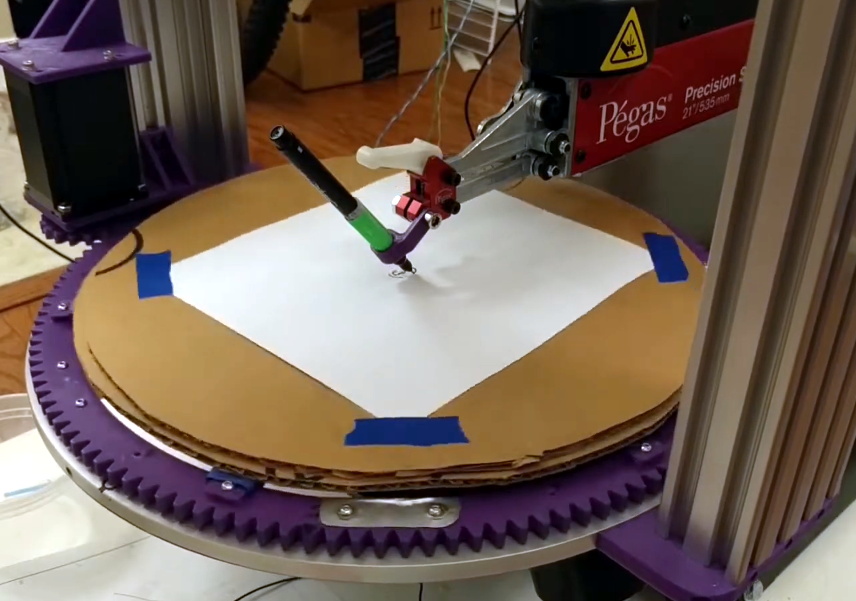
When [Andrew Consroe] tried to build a CNC scroll saw, he quickly learned how tricky of a design problem it is. With a blade that only cuts in one direction, you can’t simply move the tool in the X and Y dimensions like you can with a laser or router; either the work piece or the blade itself needs to continuously rotate towards the direction of the cut.

He’s recently shown off the third version of the machine, and while it’s still not exactly a practical tool, there’s no question it’s a brilliantly designed one, or that it works, slowly. Earlier attempts used a rotating table to spin the work piece, but [Andrew] found this to be an imperfect solution. Building a mechanism heavy duty enough to spin the material being cut while remaining accurate enough not to break the blade was a tall order, though he did get pretty close.

The earlier version used a rotating table.

This time around he’s decided to simply rotate the blade itself. This can be accomplished with a single stepper motor and some suitably sized pulleys, while maintaining an exceptionally high degree of accuracy. The whole blade assembly moves up and down on an aluminum extrusion rail with a motor and crank arrangement. By synchronizing the rotation of the blade with the vertical movement of the saw, the software can be sure that everything is where it needs to be before the cutting stroke actually happens.

Judging by the video after the break, the system works quite well. The complex rounded shapes he cuts out of the piece of plywood look essentially perfect, and it sounds like this new version of the machine isn’t breaking blades due to positional errors like the previous one did. Unfortunately, it’s also very slow. There’s so many moving parts and careful positioning required that even when the video is sped up 10x, the saw still appears to only be creeping its way through the  material.

On the back half of the video, [Andrew] details another approach to rotating the blade that would reduce the amount of moving mass in the saw. This would give the machine a considerable speed boost, and we’d love to see him implement it. By the way, before anyone says it: using a spiral blade is cheating.

source https://hackaday.com/2020/08/06/the-redesigned-cnc-scroll-saw-rides-again/

Scratch Built Subnautica Sub Explores the Pool

In Subnautica, players explore an alien underwater landscape with the help of a number of futuristic tools and vehicles. [Robert Cook] found himself particularly enamored with the large submarine you unlock towards the later parts of the game, so much so that he decided to build his own real-life version.

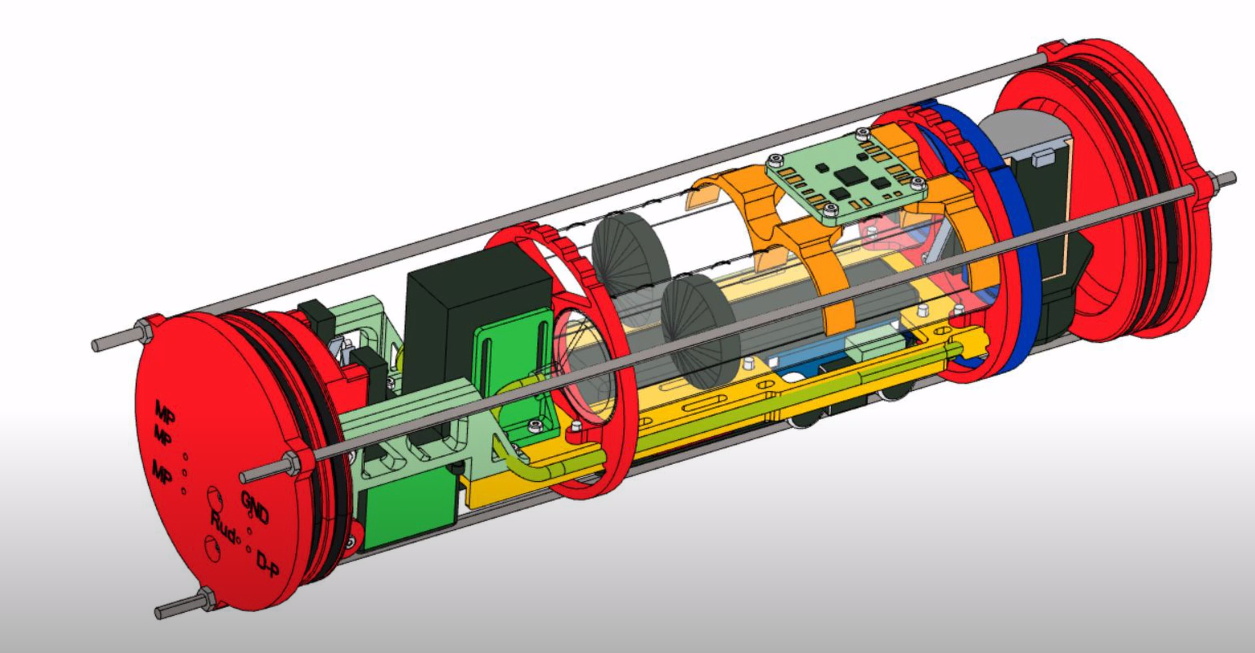
Even though the RC version of the Cyclops [Robert] has designed is only big enough to explore swimming pool sized alien landscapes, it’s by no means a simple build. In fact, the sub’s internal watertight compartment holds an impressive array of electronics and systems that are arguably overkill for what’s essentially a toy. Not that we’re complaining, of course.

Beyond the electronics and a few key components, almost every part of the RC Cyclops has been 3D printed. From the bulkheads that cap off the internal watertight acrylic tube to the hull itself, there’s a lot of plastic aboard this ship. Which might explain why it takes nearly two kilograms of lead weight to get the sub close to neutral buoyancy. From there, a clever ballast tank arrangement made from a syringe and peristaltic pump allow the vehicle to dive and surface on command.

[Robert] is in the process of releasing the STL files for all the submarine’s 3D printed components, and has done an excellent job of documenting the roughly four months he’s spent working on the project in a series of videos on his YouTube channel. The videos contain a wealth of fascinating tips and tricks regarding DIY submersible vehicles, such as selecting the proper radio frequencies for maximum penetration through water and counteracting the permeability of 3D printed parts with a generous coating of epoxy.

Modern RC hardware makes it easier than ever to cobble together a “submarine”, but there’s still something to be said for a project that takes the long way around and actually implements features like a functioning ballast system.

[Thanks to kemfic for the tip.]

source https://hackaday.com/2020/08/06/scratch-built-subnautica-sub-explores-the-pool/

Miles the Spider Robot

Who doesn’t love robotic spiders? Today’s biomimetic robot comes in the form of Miles, the quadruped spider robot from [_Robox].

Miles uses twelve servos to control its motion, three on each of its legs, and also includes a standard HC-SR04 ultrasonic distance sensor for some obstacle avoidance capabilities. Twelve servos can use quite a bit of power, so [_Robox_] had to power Miles with six LM7805 ICs to get sufficient current. [_Robox_] laser cut acrylic sheets for Miles’s body but mentions that 3D printing would work as well.

Miles uses inverse kinematics to get around, which we’ve seen in a previous project and is a pretty popular technique for controlling robotic motion. The Instructable is a little light on the details, but the source code is something to take a look at. In addition to simply moving around [_Robox_] developed code to make Miles dance, wave, and take a bow. That’s sure to be a hit at your next virtual show-and-tell.

By now you’re saying “wait, spiders have eight legs”, and of course you’re right. But that’s an awful lot of servos. Anyway, if you’d rather 3D print your four-legged spider, we have a suggestion.

source https://hackaday.com/2020/08/06/miles-the-spider-robot/

Mold-Making Masterclass in Minutes

Making silicone molds seems easy, but there are a lot of missteps to be made along the way that can mean the difference between a great, reusable mold, and one that’s a sad waste of silicone. If you’re helpless to know the difference, then check out [Eric Strebel]’s 9-minute masterclass teaser video on making a two-part mold for resin casting, which is also embedded below.

Even if you already know how to do this, there’s probably a good tip in here somewhere. One of them being that you should always pour your silicone from one place and let it coat the piece being copied. Otherwise, there might be lines on the mold. Another tip is for DIY mold release made from petroleum jelly thinned with naphtha.

Our favorite tip has to do with the way [Eric] makes this a reusable two-part mold, which is more akin to injection molding. To pour silicone for the second part and get it to separately nicely, [Eric] uses sprues made out of resin rods that were cast inside of drinking straw molds. These he chamfers against a belt sander to minimize the contact with the cast part, which makes them a snap to break off. [Eric] says this is just the beginning, and there are more videos to come that will break down the steps.

There’s more than one way to make a mold, especially for casting in metal. We’ve seen everything from 3D-printed molds to kinetic sand.

source https://hackaday.com/2020/08/05/mold-making-masterclass-in-minutes/

A Wood Gas Powered Lawn Mower

When mowing the lawn, you generally have a choice of pushing power, electric or gasoline. Thanks to the nutty inventor [Colin Furze], you can now add wood gas to the list, as long as you don’t mind some inconvenience. He built a wood gas generator on top of a formerly gasoline powered lawn mower, so he can now run his lawn mower on wood chips.

Wood gas generators have been used with internal combustion engines for a very long time, reaching their peak in the later parts of WW2 when fuel shortages plagued Europe. When wood is burned at high temperature but with limited oxygen, it produces a combustible gas mix that can be fed into an internal combustion engine. [Colin]’s generator went through a number of iterations, and the problem-solving that goes into a project like this is always interesting to watch. We would not recommend running tests like these indoors, but we suppose no [Colin Furze] video would be complete without a bit of danger.

On his first version he had an extraction fan that was too close to the outlet of the burn chamber, so it melted very quickly. The combustion temperature was also not high enough, which required some changes to the chamber geometry. The main problem that plagued the project was filtering out the moisture and tar. [Colin] did eventually get the lawn mower to run on wood gas, but tar was still getting into the engine, which prevented it from starting the second time. The filtering system will need some refinement, which [Colin] will address in his next video, which he also hints will involve some sort of diabolical swing set.

How [Colin] has escaped serious injury up to this point is beyond us, but his projects have undeniable entertainment value, ranging from a giant hydraulic exoskeleton, to a hoverbike. We’ve also seen a number of other wood gas projects, including a wood gas powered bicycle, and gasometer storage tank.

source https://hackaday.com/2020/08/05/a-wood-gas-powered-lawn-mower/

Illegal Blast Fishing Detector is All Ears

Blast fishing — the act of using explosives underwater to kill entire schools of fish with shock waves — has been a widespread problem in the Philippines for decades. Although a few fishermen get rich from the first blast at a fresh site, it isn’t good for anyone in the long term, especially the coral and other sea life. Many blast fisherman use homemade explosives, often at the risk of losing fingers and limbs.

The local authorities have tried many tactics to deter the activity. Where education about the diminishing returns of blast fishing has failed, appeals to religion with strategically placed statuary of the Virgin Mary have been somewhat successful. [Ifthekar ahammad] has another idea, and it involves detecting the explosion, triangulating the position of the blast, and reporting it to the authorities as soon as possible.

The CBobby system works by analyzing the audio spectrum. It looks for transient changes from the ambient background noise levels, and analyzes duration and the frequencies it heard to decide whether there was an explosion or not. Plans to field test this in the Philippines have been dashed by the pandemic, but [ifthekar] has been hard at work testing in Germany with underwater speakers blasting out explosion noises. Already, the system can differentiate the blasts from various environmental sounds like ships, the bellows of large sea creatures, earthquakes, rain, and thunder.

Although the test rig is encased in neon orange acrylic, the actual blast fishing tattler will be disguised as a venomous stonefish, making it as appealing to mess with as fire ants or wasps.

Destructive blast fishing is all-around terrible, even though it’s done for survival. But what do we think of using drones to fish for sport?

source https://hackaday.com/2020/08/05/illegal-blast-fishing-detector-is-all-ears/

The Smell Of Space

In space, so the Alien tagline goes, nobody can hear you scream. One of the most memorable pieces of movie promotion ever, it refers to the effect of the vacuum of space on the things human senses require an atmosphere to experience. It’s a lesson that Joss Whedon used to great effect with the Serenity‘s silent engine light-ups in Firefly, while Star Wars ignored it completely to give us improbable weapon noises in space battles.

Sound may not pass through the vacuum of space, but that’s not to say there are not things other than light for the senses. The Apollo astronauts reported that moon dust released a smell they described as akin to burnt gunpowder once it was exposed to the atmosphere inside their lander, and by now you may have heard that there is a Kickstarter that aims to recreate the smell as a fragrance. Will it replace the cloying wall of Axe or Lynx Africa body spray that pervades high-school boys’ changing rooms, or is it a mere novelty?

The Apollo astronaut Gene Cernan, liberally coated with moon dust after returning to the Lunar module
The Apollo astronaut Gene Cernan, liberally coated with moon dust after returning to the Lunar module. NASA / Public Domain

Smells Like Moon Dust

The gunpowder smell experienced by the Apollo crews is likely to have been caused by oxygen-sensitive compounds in the moon dust being oxidised by their first exposure to an atmosphere after having accumulated through billions of years of our satellite’s buffeting by solar winds. By the time the samples reached Earth-based scientists this process was long over, so no smell remains for analysis. Even the vacuum containers in which the astronauts were to catch a sample for return to earth without being compromised by a vacuum failed to stop it, it’s thought that their seals were compromised by the unexpectedly pervasive nature of the dust. Thus the “Eau de Luna” perfume will be a creation based only on the astronauts’ recollections rather than an analysis of the smell they experienced.

Like a Locker Room in Orbit

Moon dust may so far be our species’ only encounter with another heavenly body, but that isn’t to say that space is not without other smells. The NASA astronaut Jerry Linenger described “a distinct, burnt-dry smell“in the airlocks of the Soviet/Russian Mir space station after returning from space, which is probably analogous to the Moon smell. But numerous accounts from the residents of Mir and other stations talk of smells from a completely different source; the astronauts themselves.

In a space station it is impossible to open a window for a bit of extra ventilation, so as the early stations gave way to continuously-crewed modular outposts that stayed aloft for many years their atmospheres reflected the accumulated biome of all that had been brought to them by their crews. Mir was said to be infested with mould and fungus towards the end of its life, and in 2019 there was concern that the same fate was befalling the ISS. It’s said that the fluid displacement effect of weightlessness adversely affects the human sense of smell, which is perhaps fortunate for those who have to live with it.

So the space fragrance probably remains the closest that most of us will ever come to leaving the atmosphere, thus it could smell of anything at all and none of us would ever smell the real thing and be able to ask for a refund if it didn’t match. Does it matter though, for the hacker who doesn’t quite have everything? No doubt we’ll catch that open-airlock scent at one or other of next year’s events.

source https://hackaday.com/2020/08/05/the-smell-of-space/

Pour Yourself a Glass of 100,000 Volts

You’d be hard pressed to find a hacker or maker who doesn’t have a soft spot for the tantalizing buzz and snap of a high voltage spark gap, but it remains the sort of project that most of us don’t take on personally. There’s a perceived complexity in building a device capable of shooting a proper spark through several inches of open air, with connotations of exotic components and massive hand-wound coils. Plus, nobody wants to inadvertently singe off their eyebrows.

While the latest video from [Jay Bowles] might not assuage anyone’s fear of performing impromptu electrolysis, it does at least prove that you don’t need to have a laboratory full of gear to produce six figure voltages. In fact, you don’t even need much in the way of electronics: the key components of this DIY Marx generator are made with little more than water and some household items.

This is made possible by the fact that the conductivity of water can be changed depending on what’s been dissolved into it. Straight tap water is a poor enough conductor that tubes of it can be used in place of high voltage resistors, while the addition of some salt and a plastic insulating layer makes for a rudimentary capacitor. You’ll still need wires to connect everything together and some bits of metal to serve as spark gaps, but nothing you won’t find lurking in the parts bin.

Of course, water and a smattering of nails won’t spontaneously generate electricity. You need to give it a bit of a kick start, and for that [Jay] is using a 15,000 volt DC flyback power supply that looks like it may have been built with components salvaged from an old CRT television. While the flyback transformer alone could certainly generate some impressive sparks, this largely liquid Marx generator multiplies the input voltage to produce a serious light show.

We’re always glad to see a new video from the perennially jovial [Jay] come our way. While his projects might not always be practical in the strictest sense, they never fail to inspire a lively discussion about the fascinating applications of high voltage.

source https://hackaday.com/2020/08/05/pour-yourself-a-glass-of-100000-volts/

The Game Boy as a Midi Synthesiser

In the world of chiptune music there are many platforms to choose from, each with their own special flavour tot heir sound. The Game Boy has a particular following, but it differs from some of its contemporary platforms in having a custom sound chip built into the same silicon as its processor. You can’t crank open a Game Boy and lift out the sound chip for your own synth project, instead you must talk to it through the Game Boy’s Z80 processor. This is something [Adil Soubki] knows well, as he’s completed a project that turns the handheld console into a MIDI synthesiser.

A Game Boy was designed to play games and not as a developer’s toy, so it doesn’t exactly roll out the red carpet for the hacker. He’s got under the console’s skin by mapping a section of its memory address map to the pins on a Teensy microcontroller board, and running some Game Boy code that reads the vaues there and uses them to configure the sound hardware. The Teensy handles the translation between MIDI and these byte values, turning the whole into a MIDI synthesiser. It’s a succesful technique, as can be seen in the video below the break. Best of all, the code is available, so you can have a go for yourself.

We’ve featured Game Boy synths before here at Hackaday, but usually they have been of the more conventional variety.

source https://hackaday.com/2020/08/05/the-game-boy-as-a-midi-synthesiser/

Retro Game Bow Tie

[Greg] loves hacking his bow ties. Back in high school, he added some bright RGB LEDs to the bow tie he wore to prom and even won the male best-dressed award. Recently he decided to try another bow tie hack, this time giving his tie some retro arcade game feels.

He decided to use an ATtiny85 and to experiment doing some more lower-level programming to refresh his skills. He wrote all his libraries from scratch which really helped him learn a lot about the ATtiny in the process. This also helped him make sure his code was as efficient as possible since he had quite a bit of memory constraints using the ATtiny85 (only 512 bytes of RAM).

He designed the body of the bow tie with wood. He fit all the electronics inside the body while allowing the ATtiny to protrude out of the body giving his bow tie some wanted hacker aesthetic. Of course, he needed to access the toggle switch to play the game, so he made a slot for that as well.

Nice addition to the electronics bow tie collection on Hackaday. Really aesthetic design if you ask us. And you know how much we love retro games.

source https://hackaday.com/2020/08/04/retro-game-bow-tie/

A Hybrid Helical Antenna for the Es’hail-2 Geosynchronous Repeater

Amateur radio operators like to say that working a contact in space can be done with a simple handheld transceiver and a homemade antenna. And while that’s true, it’s true only for low Earth orbit satellites such as the ISS. If you want to reach a satellite in geosynchronous orbit it’ll take a little more effort, and this dual-feed helical “ice cream cone” antenna could really help.

Until recently, the dream of an amateur radio repeater in geosynchronous orbit remained out of reach, but that changed with the launch of the Qatari satellite Es’hail-2 last year. Since then, hams from Brazil to Thailand have been using the repeater, and UK-based [Tech Minds] has been in the thick of the action. The antenna he presents is a hybrid design, needed because of the 2.4-GHz band uplink and 10-GHz downlink on the satellite, also known as QO-100. Both require a largish dish antenna, with the downlink requiring a low-noise block downconverter (LNB) and feed horn. The uplink side of [Tech Minds]’ antenna is a helical design, with three-and-a-half turns of heavy copper wire and a tuning section of copper strapping that attaches directly to an N-type connector. The helix is just the right size for the feed horn of an LNB for the downlink side, nestled in a hole in the helical antenna’s aluminum reflector disc. There are 3D-printed parts to support everything, plus a cone-shaped radome to keep it all safe from the elements.

It looks like a great design, but sadly, North American and East Asian hams can only dream about building one, since QO-100 is below the horizon for us. We’re jealous, but we’re still glad the repeater is up there. Check out this article for more on how Es’hail-2 got the first geosynchronous ham repeater.

source https://hackaday.com/2020/08/04/a-hybrid-helical-antenna-for-the-eshail-2-geosynchronous-repeater/