Many small gasoline engines can be safely modified to run on natural gas or propane with a kit that replaces the carburetor and adds a regulator, providing a reliable alternative fuel source in the event that gasoline is difficult to obtain in an emergency situation. This seat of the pants hack by [HowToLou] is definitively not the safe way to run your generator on natural gas, but if you ever find yourself in a situation where getting the power back on might be a literal matter of life or death, it’s a tip worth keeping in mind.
The basic idea here is that you feed natural gas (though propane should also work) directly into the engine’s intake by way of a hose attached to the air filter box. While cranking the engine, a valve on the gas line is used to manually adjust the air–fuel mixture until it fires up. It’s an extremely simple hack that, in a pinch, you can pull off with the parts on hand. But as you might expect, that simplicity comes at a cost.
There are a few big problems with this approach, but certainly the major one is that there’s nothing to cut off the flow of gas when the engine stops running. So if the generator stalls or you just forget to close the valve after you shut it down, there’s the potential for a very dangerous situation. Additionally, the manual gas valve will be at odds with a generator that automatically throttles up and down based on load. Though to be fair, there are certainly generators out there that simply run the engine flat-out the whole time.
Many small gasoline engines can be safely modified to run on natural gas or propane with a kit that replaces the carburetor and adds a regulator, providing a reliable alternative fuel source in the event that gasoline is difficult to obtain in an emergency situation. This seat of the pants hack by [HowToLou] is definitively not the safe way to run your generator on natural gas, but if you ever find yourself in a situation where getting the power back on might be a literal matter of life or death, it’s a tip worth keeping in mind.
The basic idea here is that you feed natural gas (though propane should also work) directly into the engine’s intake by way of a hose attached to the air filter box. While cranking the engine, a valve on the gas line is used to manually adjust the air–fuel mixture until it fires up. It’s an extremely simple hack that, in a pinch, you can pull off with the parts on hand. But as you might expect, that simplicity comes at a cost.
There are a few big problems with this approach, but certainly the major one is that there’s nothing to cut off the flow of gas when the engine stops running. So if the generator stalls or you just forget to close the valve after you shut it down, there’s the potential for a very dangerous situation. Additionally, the manual gas valve will be at odds with a generator that automatically throttles up and down based on load. Though to be fair, there are certainly generators out there that simply run the engine flat-out the whole time.
As a hacker community, we are no strangers to beautiful and unique musical instruments. A sympathetic nail violin built by [Nicolas Bras] is a welcome addition to the eclectic family. Working up from the simple idea of a nail in a piece of wood and adjusting the pitch by hammering the nail farther into the wood, [Nicolas] expanded the idea. With careful planning and tuning, the nails can have sympathetic properties. These properties mean that when one nail is played via a bow, it causes other nails to sound, creating harmonies and sustains.
With a bit of careful woodworking and a scant touch of metalwork, an instrument was crafted. It offers vast flexibility as it can be played by bow, by plucking with your finger, or by strumming. There are several levels of nails, each level having a paired sympathetic nail. This allows for a diverse and versatile instrument.
Here at Hackaday, we seem to have a thing for tiny violins, whether physical or virtual. While the nail violin may not look like your traditional violin, we can certainly appreciate the wonderful music it creates.
There’s been a constant over the last few weeks’ news, thanks to Elon Musk we’re in another Bitcoin hype cycle. The cryptocurrency soared after the billionaire endorsed it, at one point coming close to $60k, before falling back to its current position at time of writing of around $47k. The usual tide of cryptocurrency enthusiasts high on their Kool-Aid hailed the dawn of their new tomorrow, while a fresh cesspool of cryptocurrency scam emails and social media posts lapped around the recesses of the Internet.
This Time It’s Different!
The worst phrase that anyone can normally say about a financial bubble is the dreaded phrase “This time it’s different“, but there is something different about this Bitcoin hype cycle. It’s usual to hear criticism of Bitcoin for its volatility or its sometime association with shady deals, but what’s different this time is that the primary criticism is of its environmental credentials. The Bitcoin network, we are told, uses more electricity than the Netherlands, more than Argentina, and in an age where global warming has started to exert an uncomfortable influence over our lives, we can’t afford such extravagance and the emissions associated with them.
Here at Hackaday we are more concerned with figures than arguments over the future of currency, so the angle we take away from it all lies with those power stats. How much energy does Argentina use, and is the claim about Bitcoin credible?
The now decommissioned Eggborough power station, Yorkshire, UK. Bitcoin requires eight of these 2GW coal-fired power stations to operate. Deut (Public domain).
We have as good an estimate as possible of the power used by Bitcoin miners, in the form of the Cambridge University Centre for Alternative Finance’s Bitcoin network power tracker. At the time of writing it has an estimate of the network’s annual power consumption at 129.1 TWh. It’s easy enough to find global power consumption data and find that Argentina uses 125 TWh in 2019, so on those metrics the assertion that Bitcoin uses more power than Argentina holds water. A quick back-of-envelope calculation shows the figure to be equivalent to a nearly 15 GW power station running flat-out all year round,and looking up some figures for CO2 emissions per megawatt hour for a further calculations that represents about 130 million tonnes of CO2 from coal-fired power stations.
That’s 10 million tonnes more than the entire UK transport sector emitted in 2019. Arguments that some cryptocurrency may be mined from renewables do not apply, because while those coal fired power stations still exist they are supplying energy which could be supplied by renewable sources that are instead being taken up by the miners. Lest we forget that the Bitcoin algorithm is designed to become more difficult to compute as the blockchain progresses. Cryptocurrency farmers are not unaware of the electricity bills, perpetually seeking out the most efficient mining equipment. This makes for a hazy future, can hardware improvements keep up with increasingly elusive hashes or will the network’s electricity consumption continue to grow?
It’s inevitable that for the time being while our economies are in the transition away from fossil fuels there will continue to be CO2 emissions generated, so if that is the case then those emissions must provide a useful return. If we burn a tonne of fuel oil to move a shipload of freight containers then at least the emissions have done something for us, so is the same true for a cryptocurrency? Does a tonne of CO2 emitted by the miners do anything for us?
A German banknote from the period of hyperinflation. Stadt Plauen, Public domain.
For a currency to be effective it must serve both as a convenient and usable method of conducting transactions, as well as a safe and reliable storage medium for wealth. I can take a pound down to my local Tesco superstore and buy a loaf of bread, or inflation notwithstanding I can put it in my bank account and go to Tesco with it in a year’s time and buy a loaf of bread then.
Putting it in the bank or handing it over at the checkout are both transactions that don’t cost me any extra money and are completed in an instant. That pound (or dollar, or whatever) isn’t just a shiny disc of metal, it’s a tiny statement of confidence in a country’s economy, and jokes about politicians aside, if that country continues to have trade and factories and consumers, it’s a pretty safe bet. A fiat currency such as the pound can lose that effectiveness when the economy goes into crisis, as happened in Germany in the years following the First World War, or in Zimbabwe following the collapse of the country’s agriculture sector after a disastrous land reform programme. When citizens of Germany began needing a literal wheelbarrow full of Marks to pay for break, and a year in the bank saw a Mark reduced to a tiny fraction of its previous value, the Mark had lost its effectiveness as a currency.
The whole point of a cryptocurrency is that it is not a fiat currency backed by a nation state or a real-world asset such as a pile of gold in Fort Knox. A cryptocurrency that is stable and easy to use would be a very effective currency, in that holding it is not risky and it can be taken to a merchant and exchanged for a loaf of bread without problem. Our next question is therefore whether Bitcoin satisfies those criteria and can be considered a useful currency.
The Cost of Bitcoin Transactions
A Bitcoin transaction carries a fee to the miners, it’s a variable rate that at the time of writing is somewhere around $25. There is also a wait for transactions to complete, until they have been placed in the blockchain by the actions of the miners. Therefore Bitcoin is not a convenient currency for transactions; while both of these drawbacks are nothing when buying a Tesla it makes the currency useless as a means to buy a loaf of bread. The Lightning network is an attempt to mitigate this by abstracting micropayments to a peer-to-peer network of participants who conceal their micropayments within a larger paid-for transaction on the main blockchain, but it is not without problems of its own and does not seem to have gained widespread understanding.
The 10000 Bitcoin pizza is famous in the Bitcoin community, but this isn’t it. Perhaps that neither it or Laszlo Hanyecz get more than a passing mention on the whole of Wikipedia should serve as a reminder that the world doesn’t revolve around Bitcoin. Valerio Capello, CC BY-SA 3.0.
So Bitcoin has at least the potential to remain a useful currency for transactions, but does it stack up as a store for wealth? We hear about Elon Musk and institutional investors buying into the cryptocurrency, but what those stories fail to make clear is that those investments are only a small percentage of their much larger portfolios. What about those of us who aren’t multi-billionaires with huge diversified investment portfolios, and who stand to lose our shirts if our one investment goes south? A pile of pounds or dollars in a bank is a safe place to keep our life savings even if it’s not a particularly clever one in an era of low interest rates, so if Bitcoin is a currency we have to evaluate how its safety matches to that of a traditional currency. It’s tempting at this point to cite Bitcoin’s performance over the last decade as evidence of its safety as a store of wealth, and it’s true that had I put even a small percentage of my savings in the currency back when Laszlo Hanyecz bought his famous 10000 BTC pizza I would now be fabulously wealthy instead of a relatively penniless itinerant scribe (I remember reading that news back in 2010 and thinking “That’s cool but it’ll never catch on”, oh well).
But performance and safety of an investment are not the same metrics, so any appraisal of its wealth storage potential should look at it in the here and now: would you advise your grandmother to put her life savings into it? Even the most ardent Bitcoin enthusiast should admit that it is a volatile asset that is prone to sudden falls as well as the occasional stratospheric rise, so it’s difficult to make a case for it as anything other than a speculative investment vehicle and certainly not a safe place for Granny’s hard-earned.
Have We Backed The Wrong Horse?
The above is almost certainly not what most Bitcoin enthusiasts want to hear, that their currency may have the potential to be usable for everyday transactions but elusively remains a volatile wealth store that’s destroying the planet. But they’re awkward questions that have to be asked, otherwise having so far dodged Government financial regulation, the cryptocurrency may succumb instead to Government environmental regulation.
Cryptocurrencies and the blockchains that underpin them are an extremely cool idea, even though the blockchain is not the universal answer to all computing problems that some of its proponents appeared to present it as during the peak of its hype. It’s inevitable that in some form they will be a part of our futures, but perhaps it’s time to ask: In Bitcoin and cryptocurrencies which follow a similar model, have we backed the wrong horse?
There’s been a constant over the last few weeks’ news, thanks to Elon Musk we’re in another Bitcoin hype cycle. The cryptocurrency soared after the billionaire endorsed it, at one point coming close to $60k, before falling back to its current position at time of writing of around $47k. The usual tide of cryptocurrency enthusiasts high on their Kool-Aid hailed the dawn of their new tomorrow, while a fresh cesspool of cryptocurrency scam emails and social media posts lapped around the recesses of the Internet.
This Time It’s Different!
The worst phrase that anyone can normally say about a financial bubble is the dreaded phrase “This time it’s different“, but there is something different about this Bitcoin hype cycle. It’s usual to hear criticism of Bitcoin for its volatility or its sometime association with shady deals, but what’s different this time is that the primary criticism is of its environmental credentials. The Bitcoin network, we are told, uses more electricity than the Netherlands, more than Argentina, and in an age where global warming has started to exert an uncomfortable influence over our lives, we can’t afford such extravagance and the emissions associated with them.
Here at Hackaday we are more concerned with figures than arguments over the future of currency, so the angle we take away from it all lies with those power stats. How much energy does Argentina use, and is the claim about Bitcoin credible?
The now decommissioned Eggborough power station, Yorkshire, UK. Bitcoin requires eight of these 2GW coal-fired power stations to operate. Deut (Public domain).
We have as good an estimate as possible of the power used by Bitcoin miners, in the form of the Cambridge University Centre for Alternative Finance’s Bitcoin network power tracker. At the time of writing it has an estimate of the network’s annual power consumption at 129.1 TWh. It’s easy enough to find global power consumption data and find that Argentina uses 125 TWh in 2019, so on those metrics the assertion that Bitcoin uses more power than Argentina holds water. A quick back-of-envelope calculation shows the figure to be equivalent to a nearly 15 GW power station running flat-out all year round,and looking up some figures for CO2 emissions per megawatt hour for a further calculations that represents about 130 million tonnes of CO2 from coal-fired power stations.
That’s 10 million tonnes more than the entire UK transport sector emitted in 2019. Arguments that some cryptocurrency may be mined from renewables do not apply, because while those coal fired power stations still exist they are supplying energy which could be supplied by renewable sources that are instead being taken up by the miners. Lest we forget that the Bitcoin algorithm is designed to become more difficult to compute as the blockchain progresses. Cryptocurrency farmers are not unaware of the electricity bills, perpetually seeking out the most efficient mining equipment. This makes for a hazy future, can hardware improvements keep up with increasingly elusive hashes or will the network’s electricity consumption continue to grow?
It’s inevitable that for the time being while our economies are in the transition away from fossil fuels there will continue to be CO2 emissions generated, so if that is the case then those emissions must provide a useful return. If we burn a tonne of fuel oil to move a shipload of freight containers then at least the emissions have done something for us, so is the same true for a cryptocurrency? Does a tonne of CO2 emitted by the miners do anything for us?
A German banknote from the period of hyperinflation. Stadt Plauen, Public domain.
For a currency to be effective it must serve both as a convenient and usable method of conducting transactions, as well as a safe and reliable storage medium for wealth. I can take a pound down to my local Tesco superstore and buy a loaf of bread, or inflation notwithstanding I can put it in my bank account and go to Tesco with it in a year’s time and buy a loaf of bread then.
Putting it in the bank or handing it over at the checkout are both transactions that don’t cost me any extra money and are completed in an instant. That pound (or dollar, or whatever) isn’t just a shiny disc of metal, it’s a tiny statement of confidence in a country’s economy, and jokes about politicians aside, if that country continues to have trade and factories and consumers, it’s a pretty safe bet. A fiat currency such as the pound can lose that effectiveness when the economy goes into crisis, as happened in Germany in the years following the First World War, or in Zimbabwe following the collapse of the country’s agriculture sector after a disastrous land reform programme. When citizens of Germany began needing a literal wheelbarrow full of Marks to pay for break, and a year in the bank saw a Mark reduced to a tiny fraction of its previous value, the Mark had lost its effectiveness as a currency.
The whole point of a cryptocurrency is that it is not a fiat currency backed by a nation state or a real-world asset such as a pile of gold in Fort Knox. A cryptocurrency that is stable and easy to use would be a very effective currency, in that holding it is not risky and it can be taken to a merchant and exchanged for a loaf of bread without problem. Our next question is therefore whether Bitcoin satisfies those criteria and can be considered a useful currency.
The Cost of Bitcoin Transactions
A Bitcoin transaction carries a fee to the miners, it’s a variable rate that at the time of writing is somewhere around $25. There is also a wait for transactions to complete, until they have been placed in the blockchain by the actions of the miners. Therefore Bitcoin is not a convenient currency for transactions; while both of these drawbacks are nothing when buying a Tesla it makes the currency useless as a means to buy a loaf of bread. The Lightning network is an attempt to mitigate this by abstracting micropayments to a peer-to-peer network of participants who conceal their micropayments within a larger paid-for transaction on the main blockchain, but it is not without problems of its own and does not seem to have gained widespread understanding.
The 10000 Bitcoin pizza is famous in the Bitcoin community, but this isn’t it. Perhaps that neither it or Laszlo Hanyecz get more than a passing mention on the whole of Wikipedia should serve as a reminder that the world doesn’t revolve around Bitcoin. Valerio Capello, CC BY-SA 3.0.
So Bitcoin has at least the potential to remain a useful currency for transactions, but does it stack up as a store for wealth? We hear about Elon Musk and institutional investors buying into the cryptocurrency, but what those stories fail to make clear is that those investments are only a small percentage of their much larger portfolios. What about those of us who aren’t multi-billionaires with huge diversified investment portfolios, and who stand to lose our shirts if our one investment goes south? A pile of pounds or dollars in a bank is a safe place to keep our life savings even if it’s not a particularly clever one in an era of low interest rates, so if Bitcoin is a currency we have to evaluate how its safety matches to that of a traditional currency. It’s tempting at this point to cite Bitcoin’s performance over the last decade as evidence of its safety as a store of wealth, and it’s true that had I put even a small percentage of my savings in the currency back when Laszlo Hanyecz bought his famous 10000 BTC pizza I would now be fabulously wealthy instead of a relatively penniless itinerant scribe (I remember reading that news back in 2010 and thinking “That’s cool but it’ll never catch on”, oh well).
But performance and safety of an investment are not the same metrics, so any appraisal of its wealth storage potential should look at it in the here and now: would you advise your grandmother to put her life savings into it? Even the most ardent Bitcoin enthusiast should admit that it is a volatile asset that is prone to sudden falls as well as the occasional stratospheric rise, so it’s difficult to make a case for it as anything other than a speculative investment vehicle and certainly not a safe place for Granny’s hard-earned.
Have We Backed The Wrong Horse?
The above is almost certainly not what most Bitcoin enthusiasts want to hear, that their currency may have the potential to be usable for everyday transactions but elusively remains a volatile wealth store that’s destroying the planet. But they’re awkward questions that have to be asked, otherwise having so far dodged Government financial regulation, the cryptocurrency may succumb instead to Government environmental regulation.
Cryptocurrencies and the blockchains that underpin them are an extremely cool idea, even though the blockchain is not the universal answer to all computing problems that some of its proponents appeared to present it as during the peak of its hype. It’s inevitable that in some form they will be a part of our futures, but perhaps it’s time to ask: In Bitcoin and cryptocurrencies which follow a similar model, have we backed the wrong horse?
Liquid handling workstations are commonly used in drug development, and look like small CNC machines with droppers on the ends which can dispense liquid into any container in a grid array. They are also extraordinarily expensive, as is most specialty medical research equipment. This liquid handling workstation doesn’t create novel drugs, though, it creates art, and performs similar functions to its professional counterparts at a much lower cost in exchange for a lot of calibration and math.
The art is created by pumping a small amount of CMYK-colored liquids into a 24×16 grid, with each space in the grid able to hold a small amount of the colored liquid. The result looks similar to a Lite-Brite using liquids instead of small pieces of plastic. The creator [Zach Frew] created the robot essentially from scratch using an array of 3D printers, waterjets, and CNC machines. He was able to use less expensive parts, compared to medical-grade equipment, by using servo-controlled valves and peristaltic pumps, but makes up for their inaccuracies with some detailed math and calibration.
The results of the project are striking, especially when considering that a lot of hurdles needed to be cleared to get this kind of quality, including some physical limitations on the way that the liquids behave in the first place. It’s worth checking out not just for the art but for the amount of detail involved as well. And, for those still looking to scratch the 90s nostalgia itch, there are plenty of other projects using the Lite Brite as inspiration.
Renewable energy sources are becoming increasingly popular. However, such energy can be wasted if an excess is available when it’s not yet needed. A particularly relevant example is solar power; solar panels provide most of their output during the day, while often a household’s greatest energy use is at night.
One way to get around this problem is by storing excess energy so that it can be used later. The most common way this is done is with large batteries, however, it’s not the only game in town. Phase change materials are proving to be a useful tool to store excess energy and recover it later – storing energy not as electricity, but as heat. Let’s take a look at how the technology works, and some of its most useful applications.
It’s All About Heat
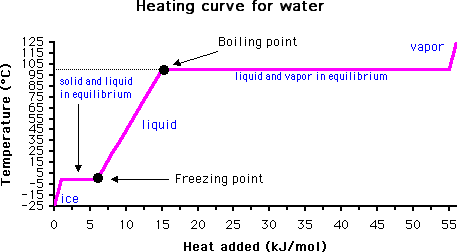
The heating curve of water. Note the flat lines on the curve where the latent heat must be overcome to change phase.
Unlike batteries or capacitors, phase change materials don’t store energy as electricity, but heat. This is done by using the unique physical properties of phase changes – in the case of a material transitioning between solid and liquid phases, or liquid and gas. When heat energy is applied to a material, such as water, the temperature increases. However, when the liquid water reaches temperatures close to boiling point, something strange happens.
As more energy is put in, the temperature begins to flatline. This is because enough energy must be put in to overcome what is called the latent heat of vaporization – the energy required to turn the liquid into a gas. Eventually, once enough heat is put in, the water turns to steam and the temperature is again free to rise. This latent heat can store a significant amount of energy in a material over a relatively small temperature change. This latent heat exists in solid-to-liquid phase changes as well, where it’s known as the latent heat of fusion. By taking advantage of latent heat, large amounts of energy can be stored in a relatively small change in actual temperature, and accessed by manipulating the phase change of a material.
Perhaps the most common form of phase change heat storage on the market is the sodium-acetate handwarmer. These handwarmers contain a sodium-acetate gel in a plastic pouch. When the gel is given a nucleation point by tweaking a metal disk in the gel, it quickly changes phase from a super-saturated liquid to a solid. Suddenly freezing like this releases the latent heat the material was holding in its liquid form, and warms the user’s hands nicely. The material can later be recharged by heating the handwarmer up to melt the sodium acetate once more, before allowing it to gently cool back down to room temperature. The latent heat will then be trapped in the liquid until it is once more disturbed, causing it to freeze again.
A wide variety of materials have been studied for heat storage through the phase change effect. Paraffin wax is perhaps one of the most commonly studied, thanks to its phase change occuring in a useful temperature range. However, its low thermal conductivity limits the rate at which energy can be exchanged, hampering performance. Hydrated salts have been another material of significant interest, though face problems of their own. Often, such materials will undergo subcooling. As heat is extracted from the liquid material, its temperature declines below freezing point without the material actually becoming solid. Without undergoing a change in phase, the latent heat remains trapped in the liquid, and can’t be extracted. Additionally, like many battery chemistries, repeated cycling can cause problems. The phase change material must retain its properties over many cycles, without chemicals falling out of solution or corrosion harming the material or its enclosure over time. Much research into phase change energy storage is centered around refining solutions and using additives and other techniques to engineer around these basic challenges. Often, the specifics of such materials remains a commercial secret as companies attempt to recoup research costs through sales.
Sunamp’s early phase change cells for home heating – note the input and output fluid ports that feed into the internal heat exchanger.
The phase change effect can be used in a variety of ways to functionally store and save energy. Heat can be applied to a phase-change material, melting it and thus storing energy within it as latent heat. Excess electrical energy, such as from renewable sources, can readily be stored in such phase change materials, as it’s possible to turn electrical energy into heat quite efficiently. The reverse is not so easy, however.
Instead, such phase change devices are often instead used to output heat more directly – either by being used as hot water heaters or to supply heat energy to refrigeration processes. This is achieved often by simply passing working fluid, like water or refrigerant, through a heat exchanger in contact with the phase change material. The former has plenty of applicability to households, cutting down on costs for residential heating and hot water. The latter is of more relevance to large commercial and industrial facilities. Particularly in industries such as winemaking and cold storage, refrigeration can be a major bottom-line expense that is essential to operations. Even small percentage gains in efficiency or reduced energy use can have huge payoffs over time.
Different phase change materials freeze at different temperatures, making them suitable for different applications. Lower-temperature materials are useful for refrigeration applications such as in this project by the University of South Australia.
Another interesting use of phase-change materials is as a passive heat management solution for buildings. The idea is to use a phase change material with a melting point around a comfortable room temperature – such as 20-25 degrees Celsius. The material is encapsulated in plastic matting, and can be installed in a building in walls and ceilings along with insulation. The material then acts as a sort of thermal buffer. Heat energy building up in a room can be absorbed by the phase change material, keeping temperatures lower. As the building then cools, the material can release its heat, acting to stabilize temperatures. It can be a lightweight way to increase the thermal mass of a building, and can reduce the reliance on active cooling or heating from HVAC systems.
BioPCM brand phase-change material installed in a ceiling. This is used as a lightweight way to add thermal mass to a building, helping maintain stable comfortable temperatures without the need for continuous heating and cooling.
Looking to the future, it may be that phase change energy storage remains of limited use in the residential space. While it can have benefits, its limited heating-only application makes it less attractive than battery storage that can run an entire home. However, for industrial processes, such as refrigeration and process heating, there’s plenty of scope for phase change technologies to be used as a cheap and effective store of energy. With research ongoing in the field, it’s likely we’ll see greater uptake of this technology in future as energy conservation increases in relevance in future years.
When somebody builds a quadcopter with the express purpose of flying it as fast and aggressively as possible, it’s not exactly a surprise when they eventually run it into an immovable object hard enough to break something. In fact, it’s more like a rite of passage. Which is why many serious fliers will have a 3D printer at home to rapidly run off replacement parts.
Avid first person view (FPV) flier [David Cledon] has taken this concept to its ultimate extreme by designing a 3D printable quadcopter that’s little more than an 18650 cell with some motors attached. Since the two-piece frame can be produced on a standard desktop 3D printer in a little over two hours with less than $1 USD of filament, crashes promise to be far less stressful. Spend a few hours during the week printing out frames, and you’ll have plenty to destroy for the weekend.
While [David] says the overall performance of this diminutive quadcopter isn’t exactly stellar, we think the 10 minutes of flight time he’s reporting on a single 18650 battery is more than respectable. While there’s still considerable expense in the radio and video gear, this design looks like it could be an exceptionally affordable way to get into FPV flying.
Of course, the argument could be made that such a wispy quadcopter is more likely to be obliterated on impact than something larger and commercially produced. There’s also a decent amount of close-quarters soldering involved given the cramped nature of the frame. So while the total cost of building one of these birds might be appealing to the newbie, it’s probably a project best left to those who’ve clocked a few hours in on the sticks.
We’ve seen quite a few 3D printed quadcopter frames over the years, but certainly none as elegant as what [David] has created here. It’s an experiment in minimalism that really embraces the possibilities afforded by low-cost desktop 3D printing, and we wouldn’t be surprised to see it become the standard by which future designs are measured.
Audio and video synthesizers have been around for decades, and are pretty much only limited by one’s willingness to spend money on them. That is, unless you can develop your own FPGA-supercharged synthesizer to really get a leg up on the consumer-grade components. Of course, as [Julian] found out in this four-year project, you tend to pay for it anyway in time spent working on your projects.
[Julian] has actually decided to stop working on the project and open-source it to anyone who wants to continue on. He has already finished the PCB layout on a gargantuan 8-layer print, done all of the routing and parts selection, and really only needed to finish testing it to complete the project. It’s powered by the Xilinx Zynq and is packed with features too: HDMI, DDR3 ram, USB, a handful of sensors, and an Arduino Uno-style header to make interfacing and programming a breeze.
While we’re sympathetic with setting aside a project that we’ve worked so hard on, with most of the work done on this one it should be pretty easy to pick up and adapt for anyone interested in carrying the torch. If you were hoping to wet your whistle with something with fewer PCB layers, though, we’ve seen some interesting (but slightly simpler) video synthesizers made out of other unique hardware as well.
Remember when phones didn’t all look the same? We had a good thing going in the early cell phone days, which seemed like a brief holdover from the Western Electric (et. al) era where you could get a phone that suited your inner minimalist or princess, and choose the color to boot.
[Dubchinsky] found a beautiful phone from this bygone era and saved it from one of two likely fates — the landfill, or else a life languishing as a piece of vintage technology that’s just sitting around for looks. Instead, this phone found a second calling as a lovely desk lamp with secret goose neck flexibility. The lamp itself is an inexpensive LED module from ebay that’s wired up to mains power through a push button switch in the phone’s base.
We absolutely love that [Dubchinsky] wrapped the curly cord around the goose neck, but were a bit disappointed that he didn’t use the hook switch to turn the lamp on and off. In the comments, he says that the plastic felt like it was too brittle to stand up to repeated actuation of such a heavy switch. That’s understandable. [Dubchinsky] also thought about using the rotary dial as a dimmer, and we think that’s a bright idea.
Between the guide, the pictures, and the build process video after the break, this is pretty much a complete how-to. We think that is commendable given that [Dubchinsky] is selling these lamps on etsy.
Using circuit simulating software like SPICE can be a powerful tool for modeling the behavior of a circuit in the real world. On the other hand, it’s not always necessary to have all of the features of SPICE available all the time, and these programs tend to be quite expensive as well. To that end, [Wes Hileman] noticed an opportunity for a specific, quick method for performing impedance calculations using python without bulky, expensive software and came up with a program which he calls fastZ.
The software works on any network of passive components (resistors, capacitors, and inductors) and the user can specify parallel and series connections using special operators. Not only can the program calculate the combined impedance but it can perform frequency analysis at a specified frequency or graph the frequency response over a wide range of frequencies. It’s also running in python which makes it as simple as importing any other python package, and is also easy to implement in any other python program compared to building a simulation and hoping for the best.
If you find yourself regularly drawing Bode plots or trying to cobble together a circuit simulation to work with your python code, this sort of solution is a great way to save a lot of headache. It is possible to get the a piece of software like SPICE to to work together with other python programs though, often with some pretty interesting results.
Using circuit simulating software like SPICE can be a powerful tool for modeling the behavior of a circuit in the real world. On the other hand, it’s not always necessary to have all of the features of SPICE available all the time, and these programs tend to be quite expensive as well. To that end, [Wes Hileman] noticed an opportunity for a specific, quick method for performing impedance calculations using python without bulky, expensive software and came up with a program which he calls fastZ.
The software works on any network of passive components (resistors, capacitors, and inductors) and the user can specify parallel and series connections using special operators. Not only can the program calculate the combined impedance but it can perform frequency analysis at a specified frequency or graph the frequency response over a wide range of frequencies. It’s also running in python which makes it as simple as importing any other python package, and is also easy to implement in any other python program compared to building a simulation and hoping for the best.
If you find yourself regularly drawing Bode plots or trying to cobble together a circuit simulation to work with your python code, this sort of solution is a great way to save a lot of headache. It is possible to get the a piece of software like SPICE to to work together with other python programs though, often with some pretty interesting results.
Using circuit simulating software like SPICE can be a powerful tool for modeling the behavior of a circuit in the real world. On the other hand, it’s not always necessary to have all of the features of SPICE available all the time, and these programs tend to be quite expensive as well. To that end, [Wes Hileman] noticed an opportunity for a specific, quick method for performing impedance calculations using python without bulky, expensive software and came up with a program which he calls fastZ.
The software works on any network of passive components (resistors, capacitors, and inductors) and the user can specify parallel and series connections using special operators. Not only can the program calculate the combined impedance but it can perform frequency analysis at a specified frequency or graph the frequency response over a wide range of frequencies. It’s also running in python which makes it as simple as importing any other python package, and is also easy to implement in any other python program compared to building a simulation and hoping for the best.
If you find yourself regularly drawing Bode plots or trying to cobble together a circuit simulation to work with your python code, this sort of solution is a great way to save a lot of headache. It is possible to get the a piece of software like SPICE to to work together with other python programs though, often with some pretty interesting results.
Terry Pratchett once said “Wisdom comes from experience. Experience is often a result of lack of wisdom.” This is as true with technical skills as it is with the rest of life, and you won’t truly understand a specific topic unless you’ve struggled with it a bit. [publidave] wanted a simple wireless display for a bluetooth cycling cadence sensor, and soon found himself deep down the rabbit hole of Micropython and Bluetooth Low Energy on the ESP32.
[publidave] had converted his bicycle for indoor training during lockdown and winter, and realized he can’t use the guided training app and view his cadence simultaneously, so he needed a dedicated cadence display. Since [publidave] was comfortable with Python, he decided to give Micropython on the ESP32 ago. Bluetooth Low Energy can be rather confusing if you haven’t implemented it before, especially if good examples are hard to come by. In short, the ESP32 needs to find the sensor, connect to it, select the right service, and listen for the notifications containing the data. The data is then converted to RPM and displayed on a small OLED display. [publidave] does an excellent job of describing what exactly he did, highlighting the problems he encountered, and how he solved them.
In the end, he had a functional display, a good idea of what he would do differently next time, and a lot of additional knowledge and understanding. In our book that’s a successful project.
Since so much of the health related devices work with Bluetooth Low Energy, it could be handy to know the technology and how to interface with it. It would allow you to do things like unbrick a $2000 exercise bike,
Reddit user [duzitbetter] showed off their design for a 3D-printed programmable macro keyboard that offers a different take on what can be thought of as a sort of 3D-printed PCB. The design is called the Bloko 9 and uses the Raspberry Pi PICO and some Cherry MX-style switches, which are popular in DIY keyboards.
The enclosure and keycaps are all 3D printed, and what’s interesting is the way that the enclosure both holds the components in place as well as providing a kind of wire guide for all the electrical connections. The result is such that bare copper wire can be routed and soldered between leads in a layout that closely resembles the way a PCB would be routed. The pictures say it all, so take a look.
The name Rube Goldberg has long been synonymous with any overly-built contraption played for laughs that solves a simple problem through complicated means. But it might surprise you to learn that the man himself was not an engineer or inventor by trade — at least, not for long. Rube’s father was adamant that he become an engineer and so he got himself an engineering degree and a job with the city. Rube lasted six months engineering San Francisco’s sewer systems before quitting to pursue his true passion: cartooning.
Rube’s most famous cartoons — the contraptions that quickly became his legacy — were a tongue-in-cheek critique meant to satirize the tendency of technology to complicate our lives in its quest to simplify them. Interestingly, a few other countries have their own version of Rube Goldberg. In the UK it’s Heath Robinson, and in Denmark it’s Robert Storm Petersen, aka Storm P.
Rube Goldberg was a living legend who loved to poke fun at everything happening in the world around him. He became a household name early in his cartooning career, and was soon famous enough to endorse everything from cough drops to cigarettes. By 1931, Rube’s name was in the Merriam-Webster dictionary, his legacy forever cemented as the inventor of complicated machinery designed to perform simple tasks. As one historian put it, Rube’s influence on culture is hard to overstate.
Rube’s alma mater Berkeley calls him an engineer’s engineer. Image via Berkeley Engineering
Engineer of His Own Future
Reuben Garrett Lucius Goldberg was born July 4th, 1883 to Max and Hannah Goldberg in San Francisco, California. He started tracing cartoons in the newspaper at the age of four and kept drawing throughout his childhood. Rube never had any formal drawing lessons, though he did take a few lessons from a sign painter around age 11.
When Rube announced his intent to become a famous cartoonist, his family was horrified. Rube’s father, a policeman and fire commissioner, had worked hard to to provide a good life for his family after emigrating from Germany. He equated artists with beggars, and wanted Rube to be an engineer.
Though Rube still dreamed of becoming a famous cartoonist, he got a mining engineering degree from UC Berkeley in 1904. He then took a job with the city of San Francisco as a water and sewers engineer. Rube hated the job so much that he quit after six months, and took a job at the San Francisco Chronicle for one third the pay. Rube started out at the bottom, emptying wastebaskets, sweeping the floors, and filing photographs. But he still drew every chance he got, and was eventually hired by the San Francisco Bulletin to be their sports cartoonist.
Okay, so this doesn’t really use a taser — that’s just click bait and we apologize. An actual taser would be a terrible way to train yourself to be a better typist, because depending on where you choose to deliver the shock, you could damage your typing nerves pretty quickly with a few milliamps at 50,000 volts.
The main brain of this pain trainer is a Particle Argon board which has I/O pins that can be controlled from the web. When the website detects a typo, it sends a signal to the Argon, which turns on a relay that activates the shock mechanism. What’s most impressive is that [nobody6502] doesn’t have a full-blown computer and programmed everything on an iPad. Check out the build video after the break.
Okay, so this doesn’t really use a taser — that’s just click bait and we apologize. An actual taser would be a terrible way to train yourself to be a better typist, because depending on where you choose to deliver the shock, you could damage your typing nerves pretty quickly with a few milliamps at 50,000 volts.
The main brain of this pain trainer is a Particle Argon board which has I/O pins that can be controlled from the web. When the website detects a typo, it sends a signal to the Argon, which turns on a relay that activates the shock mechanism. What’s most impressive is that [nobody6502] doesn’t have a full-blown computer and programmed everything on an iPad. Check out the build video after the break.
The Flir One Pro is a thermal camera that attaches to a mobile phone with a USB-C plug. [Gigawatts] has one, and unfortunately managed to drop it, breaking the USB-C plug and rendering the device useless. The plug is separate from the main PCB, an assembly of its own with a flexible cable, but FLIR are not interested in supplying spares. What was the answer? Wire data lines into the device’s charging port, of course!
The One Pro has its own battery, and to avoid draining the phone it is charged through another USB connection, this time a socket. The data lines aren’t connected, which necessitated some very careful soldering of wire-wrap wire to an SMD package to fix. When completed and secured with glue the resulting camera works with a USB-C cable, and there are plans to mount a tripod thread receptacle in the space left by the USB-C plug.
It’s disappointing that Flir choose not to supply replacements for the USB-C plug assembly, seemingly they see the device as a throwaway piece of consumer electronics rather than the expensive instrument that it is. This modification should at lease allow some unfortunate One Pro owners to revive their dead cameras.
Wherever you are in the world, the chances are that a large portion of your utility bill is for heating. This was certainly the case for [Christian Haschek], who realized he can use a cryptocurrency mining rig to offset some of his heating costs.
[Christian]’s central ventilation and water heating is handled by a heat pump, which uses a lot of electricity, especially in the Austrian winter. When it draws in cool air, it first needs to heat it to the thermostat temperature before venting it to the house. Cryptocurrency mining rigs are also heavy electricity users, but they also produce a lot of heat, which can be used to preheat the air going to the heat pump. [Christian] had four older AMD R9 390 GPUs (equivalent to the Nvidia GeForce GTX 970) lying around, so he mounted them in a server case and piped the heat pump’s air intake through the case.
At the time he did the tests, earnings from mining were enough to cover half of his heating bill, even after paying for the mining rig’s electricity. That is not taking into account the electricity savings from the preheated air. He only shows the results of one evening, where it dropped his electricity usage from around 500Wh to below 250Wh. We would like to see the long-term results, and it would be an interesting challenge to build a model to calculate the true costs or savings, taking into account all the factors. For instance, it could be possible to save costs even if the mining rig itself is running at a slight loss.
Of course, this is not a new idea. A quick internet search yields several similar projects and even some commercial crypto mining space heaters. We do like the fact that [Christian] reused some hardware he already had and integrated it into his central heating rather than using it as a mobile unit.
3D printers, desktop CNC mills/routers, and laser cutters have made a massive difference in the level of projects the average hacker can tackle. Of course, these machines would never have seen this level of adoption if you had to manually write G-code, so CAM software had a big part to play. Recently we found out about an open-source browser-based CAM pack created by [Stewert Allen] named Kiri:Moto, which can generate G-code for all your desktop CNC platforms.
To get it out of the way, Kiri:Moto does not run in the cloud. Everything happens client-side, in your browser. There are performance trade-offs with this approach, but it does have the inherent advantages of being cross-platform and not requiring any installation. You can click the link above and start generating tool paths within seconds, which is great for trying it out. In the machine setup section you can choose CNC mill, laser cutter, FDM printer, or SLA printer. The features for CNC should be perfect for 90% of your desktop CNC needs. The interface is intuitive, even if you don’t have any previous CAM experience. See the video after the break for a complete breakdown of the features, complete with timestamp for the different sections.
All the required features for laser cutting are present, and it supports a drag knife. If you want to build an assembly from layers of laser-cut parts, Kiri:Moto can automatically slice the 3D model and nest the 2D parts on the platform. The slicer for 3D printing is functional, but probably won’t be replacing our regular slicer soon. It places heavy emphasis on manually adding supports, and belt printers like the Ender CR30 are already supported.
Kiri:Moto is being actively improved, and it looks as though [Stewart] is very responsive to community inputs. The complete source code is available on GitHub, and you can run an instance on your local machine if you prefer to do so.
We like what we’re seeing with Kiri:Moto, and honestly surprised we didn’t find out about it sooner. After Autodesk neuted the free version of Fusion 360, some CAM users might still be looking for alternatives. We think this is a good option, and you might want to consider the Path workbench in FreeCAD as well.
[Amy Makes Stuff] has long used a pair of diamond honing blocks to freehand sharpen planes, chisels, and all the other dull things around the shop. Although this method works fairly well, the results are often inconsistent without some kind of jig to hold the blade securely as it’s being sharpened. These types of devices are abundant and cheap to buy, but as [Amy] says in the video after the break, then she doesn’t get to machine anything. Boy, do we know that feeling.
[Amy] was able to make this completely out of stuff she had lying around, starting with a block of scrap aluminium that eventually gets cut into the two halves of the jig. The video is full of tips and tricks and it’s really interesting to see [Amy]’s processes up close. Our favorite part has to be that grippy knob that expands and contracts the jig. [Amy] made it by drilling a bunch of holes close to the outside edge of a circle, and then milled away the edge until she had a fully fluted knob. Once she had the jig finished, she upgraded her honing blocks by milling a new home for them out of milky-white high-density polyethylene.
The availability of small and powerful brushless motors has been instrumental in the development of so-called micro-mobility vehicles. But if your commute involves crossing a frozen lake, you might find the options a bit lacking. Fortunately [Simon] from [RCLifeOn] now has a solution for you in the form of motorized ice skates.
[Simon] used 3D printed brackets to mount outrunner brushless motors to the back of a pair of ice-skates. The spinning outer housing of the motor is used as the wheel, with a bunch of studs threaded in it to dig into the ice and provide traction. At first [Simon] tried to use a pair of RC car springs to keep the motor in contact with the ice, but spring force was insufficient for the task, so he ended up rigidly mounting the motors. Getting proper traction on the ice from a standstill was still tricky, so he ended up leaning back to push the motor down, which also had the effect of putting him off balance, limiting the practical acceleration. The most obvious solution for the tracking problem seems to be stronger springs, but we assume he didn’t have any on hand. The batteries are held in a backpack, with cables running down to the skates, and a wireless electric skateboard controller is used for throttle control.
The obvious risk of these skates is of the studded motors inadvertently becoming meat grinders if you fall. It still looks like a fun project, and we wouldn’t mind having a go on those skates.
Getting into e-biking is a great hobby. It can get people on bikes who might otherwise not be physically able to ride, it can speed up commute times, and it can even make hauling lots of stuff possible and easy, not to mention it’s also fun and rewarding. That being said, there are a wide array of conflicting laws around what your e-bike can and can’t do on the road and if you don’t want to run afoul of the rules you may need a programmable device that ensures your e-bike is restricted in the appropriate way.
This build is specifically for Bafang mid drives, which can be up to 1000 W and easily power a bike beyond the speed limit where [Tomblarom] lives. A small microcontroller is housed in a waterproof box on the bike and wired between the motor’s display and controller. A small hall effect sensor and magnet sit by this microcontroller, and if the magnet is removed then the microcontroller reprograms the bike’s controller to limit the speed and also to disable the throttle, another feature that is illegal in some jurisdictions but not others. As an added bonus, the microcontroller also handles brake lights, turn signals, and automatic headlights for the bike as well.
While the project page mentions removing the magnet while getting pulled over to avoid fines and other punishments, that’s on you. We imagine this could still be useful for someone who wants to comply with local laws when riding on the road, but still wants to remove the restrictions when riding on private property or off-road where the wattage and speed restrictions might not apply.
Wind turbines are incredible pieces of technology, able to harvest wind energy and deliver it to the power grid without carbon emissions. Their constant development since the first one came online in 1939 mean that the number of megawatts produced per turbine continues to rise as price per megawatt-hour of wind energy continues to fall. Additionally, they can operate in almost any climate to reliably generate energy almost anywhere in the world from Canada to the North Atlantic to parts beyond. While the cold snap that plowed through the American South recently might seem to contradict this fact, in reality the loss of wind power during this weather event is partially a result of tradeoffs made during the design of these specific wind farms (and, of course, the specifics of how Texas operates its power grid, but that’s outside the scope of this article) rather than a failure of the technology itself.
First, building wind turbines on the scale of megawatts isn’t a one-size-fits-all solution. Purchasing a large turbine from a company like GE, Siemens, or Vestas is a lot like buying a car. A make and model are selected first, and then options are selected for these base models. For example, low but consistent wind speeds demand a larger blade that will rotate at a lower speed whereas areas with higher average wind speeds may be able to get by with smaller and less expensive blades for the same amount of energy production. Another common option for turbines is cold weather packages, which include things like heaters for the control systems, hydraulics, and power electronics, additional insulation in certain areas, and de-icing solutions especially for the turbine blades.
In a location like Texas that rarely sees cold temperatures for very long, it’s understandable that the cold weather packages might be omitted to save money during construction (although some smaller heaters are often included in critical areas to reduce condensation or humidity) but also to save on maintenance as well: every part in a wind turbine has to be maintained. Continuing the car analogy, it’s comparable to someone purchasing a vehicle in a cold climate that didn’t come equipped with air conditioning to save money up front, but also to avoid repair costs when the air conditioning eventually breaks. However, there are other side effects beyond cost to be considered when installing equipment that’s designed to improve a turbine’s operation in cold weather.
Let’s dig into the specifics of how wind turbine equipment is selected for a given wind farm.
Good Design Involves Tradeoffs
Improving a turbine’s ability to operate in cold weather may actually decrease its ability to operate in hot weather, which Texas at least is guaranteed to see during large portions of the year. Everything in a turbine generates heat when operating, from the blade pitching equipment to the gearbox and generator to the power electronics which tie them electrically to the grid. Expelling the waste heat in summer is much more important in these places than preparing them for a few days of cold weather that might not even happen in any given year. Typically this waste heat is expelled by means of radiators and cooling fans, whether they are installed on the gearbox, generator, power converter, or other heat-sensitive equipment, and the settings at which the cooling systems activate (if they exist at all) may not be easy or possible to change.
This brings up another consideration with wind energy in Texas specifically. Wind is plentiful in Texas, so it was among the first places in the US to adopt early versions of grid-scale wind turbines, some of which are still in operation. These turbines are much less configurable than modern versions, and it may not be easy or possible to change the various temperature settings in a turbine. That means that in some cases, cooling fans are active all the time, or the turbines are otherwise permanently configured in a way that makes them ideal for use in hot climates but quickly trip offline in cold weather. Even modern turbines will go offline if the internal temperatures reach a set point well below freezing (typically -30 °C/-22 °F) in order to prevent damage (note that if grid operators are aware of the weather they’ll be able to predict the loss of generation and plan for it), but if cooling systems aren’t configured for the cold, vents are still open, or insulation is lacking, these turbines will not be immune to the effects of the cold either.
Fighiting Ice: Electric Heat and Special Paint; But Not Helicopters
Other aspects of wind turbines that impact their abilities to operate in extreme cold is how they deal with ice, specifically on the turbine blades. Carbon-based electrical heaters on the blades are common way to control ice buildup. 2014 images of the helicopter deicing tests in Sweden shown in the video below went viral during the Texas outage, but this technique is not used in Texas and doesn’t seem to have seen much adoption anywhere due to the expenses involved. (Also considering the need to have a pilot and at least two other workers on-site during icy conditions.) Installing blade heaters caries its own cost and, at least for the time being, may only make economic sense in areas that are expected to deal with cold during a significant portion of the year.
Other options include using thermal cameras to sense ice buildup and shut the turbine down if the ice becomes severe. While all of these methods so far require energy inputs in order to de-ice blades, an innovative product from a wind turbine company called Gamesa is producing paint that naturally prevents ice formation, eliminating the need for expensive energy-intensive deicing solutions.
Another example of a company using paint to try to prevent ice buildup on blades is at a wind farm in Canada where the site has painted some blades black in order to increase the amount of UV light absorbed from the sun, hoping to naturally increase the temperature of the blades without any novel technology or energy-intensive solutions. While this method is not as widespread as other methods, it demonstrates an example of a tradeoff between hot and cold climates: painting blades black in Texas, while there is some evidence that it may reduce bird fatalities, presumably would have major downsides when the long summers rolled around and the blades heated up beyond design tolerances.
Human Resources in Cold Weather
While all of these technological solutions to extreme climates are the subject of any news cycle focused on the downsides of wind energy, one of the most important things about the operation of wind turbines is often glossed over when considering operation outside of their intended climate: the people who maintain them have to also be prepared to live and work in that climate as well. If a turbine trips offline for a routine reason during a snow or ice event, most wind technicians at sites in places like Texas don’t have access to snowplows, snowblowers, or snowmobiles to access the turbines like they might if they were working in northern Quebec. They may not live in areas that regularly plow or salt the roads, making it difficult or unsafe to get to the site or turbines at all. Even if the technicians are doing something simple to improve the turbine’s performance in cold weather, like shutting hatch vents or adding insulation, they still need to get to the turbines.
Ice buildup on turbine blades can be thrown or fall on people and equipment if left unchecked. Via windpowerengineering.com
Further, there are some safety issues with ice buildup on turbines as well, namely that it has to go somewhere when it falls off of the turbines. For that reason, most technicians have strict rules on approaching turbines during ice events to prevent any ice from shedding off of the turbine and onto them or their vehicles. In a cold climate that has de-icing systems, however, this issue can be more controlled and predictable, but in a place like Texas this means that an otherwise fixable turbine might be left offline for a much longer time while technicians wait for safer conditions.
In conclusion, we’d like to note that the recent disaster in Texas was not related to any fundamentals of wind energy itself, but rather to other issues with their isolated power grid and the trend of American infrastructure to be in a general state of disrepair. Wind turbines are perfectly capable of producing energy in some of the most extreme cold environments on the planet, provided they (and their operators) are designed and equipped to handle the climate. In fact, since air density is inversely proportional to temperature, turbines in cold climates can produce more energy for a given wind speed than those in hot climates. We should also give Texas a pat on the back for investing so heavily in wind energy. As of 2019 the state had just shy of 25 GW of wind power capacity, the most by far of any other state, and installed capacity continues to rise rapidly. They have an incredible amount of wind energy available and they have not let it go to waste. But winterizing turbines in hot climates, especially older turbines that aren’t as configurable, is often infeasible both from an economic point-of-view and also because the process of designing any product, whether it’s a small toy or a giant wind farm, requires tradeoffs.

 There are a few big problems with this approach, but certainly the major one is that there’s nothing to cut off the flow of gas when the engine stops running. So if the generator stalls or you just forget to close the valve after you shut it down, there’s the potential for a very dangerous situation. Additionally, the manual gas valve will be at odds with a generator that automatically throttles up and down based on load. Though to be fair, there are certainly generators out there that simply run the engine flat-out the whole time.