Intel’s Forgotten 1970s Dual Core Processor

Can you remember when you received your first computer or device containing a CPU with more than one main processing core on the die? We’re guessing for many of you it was probably some time around 2005, and it’s likely that processor would have been in the Intel Core Duo family of chips. With a dual-core ESP32 now costing relative pennies it may be difficult to grasp in 2020, but there was a time when a multi-core processor was a very big deal indeed.

What if we were to tell you that there was another Intel dual-core processor back in the 1970s, and that some of you may even have owned one without ever realizing it? It’s a tale related to us by [Chris Evans], about how a team of reverse engineering enthusiasts came together to unlock the secrets of the Intel 8271.

If you’ve never heard of the 8271 you can be forgiven, for far from being part of the chip giant’s processor line it was instead a high-performance floppy disk controller that appeared in relatively few machines. An unexpected use of it came in the Acorn BBC Micro which is where [Chris] first encountered it. There’s very little documentation of its internal features, so an impressive combination of decapping and research was needed by the team before they could understand its secrets.

As you will no doubt have guessed, what they found is no general purpose application processor but a mask-programmed dual-core microcontroller optimized for data throughput and containing substantial programmable logic arrays (PLAs). It’s a relatively large chip for its day, and with 22,000 transistors it dwarfs the relatively svelte 6502 that does the BBC Micro’s heavy lifting. Some very hard work at decoding the RMO and PLAs arrives at the conclusion that the main core has some similarity to their 8048 architecture, and the dual-core design is revealed as a solution to the problem of calculating cyclic redundancy checks on the fly at disk transfer speed. There is even another chip using the same silicon in the contemporary Intel range, the 8273 synchronous data link controller simply has a different ROM. All in all the article provides a fascinating insight into this very unusual corner of 1970s microcomputer technology.

As long-time readers will know, we have an interest in chip reverse engineering.

source https://hackaday.com/2020/11/22/intels-forgotten-1970s-dual-core-processor/

Beer Pong Difficulty Level: 10

Beer pong is a fun enough game for those of a certain age, but one thing that it lacks is a way of cranking up the difficulty setting independent of the amount of beer one has consumed. At least, that was the idea [Ty] had when he came up with this automated beer pong table which allows the players to increase the challenge of this game by sliding the cups around the top of the table.

The build uses a belt-driven platform under a clear cover with a set of magnets attached. Each of the cups on the table has a corresponding magnet, which allows them to slide fairly easily back and forth on the table. The contraption is controlled by an Arudino Nano with a small screen and dial that allows the players to select a difficulty level from 1 to 10. The difficulty levels increase the speed that the cups oscillate on the table, which certainly adds another layer of complexity to this already challenging game.

While we hope to eventually see a beer pong table that can automatically arrange the cups as the game is played, we do appreciate the effort to make an already difficult game even more difficult. Of course, if you have problems with the difficulty level you might want to pick up a PongMate CyberCannon Mark III to help with those clutch beer pong shots.

source https://hackaday.com/2020/11/21/beer-pong-difficulty-level-10/

Beer Pong Difficulty Level: 10

Beer pong is a fun enough game for those of a certain age, but one thing that it lacks is a way of cranking up the difficulty setting independent of the amount of beer one has consumed. At least, that was the idea [Ty] had when he came up with this automated beer pong table which allows the players to increase the challenge of this game by sliding the cups around the top of the table.

The build uses a belt-driven platform under a clear cover with a set of magnets attached. Each of the cups on the table has a corresponding magnet, which allows them to slide fairly easily back and forth on the table. The contraption is controlled by an Arudino Nano with a small screen and dial that allows the players to select a difficulty level from 1 to 10. The difficulty levels increase the speed that the cups oscillate on the table, which certainly adds another layer of complexity to this already challenging game.

While we hope to eventually see a beer pong table that can automatically arrange the cups as the game is played, we do appreciate the effort to make an already difficult game even more difficult. Of course, if you have problems with the difficulty level you might want to pick up a PongMate CyberCannon Mark III to help with those clutch beer pong shots.

source https://hackaday.com/2020/11/21/beer-pong-difficulty-level-10/

A Computer In The Game Of Life

We often hear the term “Turing-complete” without giving much thought as to what the implications might be. Technically Microsoft PowerPoint, Portal 2, and Magic: the Gathering all are Turing-complete, what of it? Yet, each time someone embarks on an incredible quest of perseverance and creates a computer in one of these mediums, we stand back in awe.

[Nicolas Loizeau] is one such individual who has created a computer in Conway’s Game of Life. Unlike electricity, the Game of Life uses gliders as signals. Because two orthogonal gliders can cancel each other out or form a glider eater if they intersect with a good phase shift, the basic logic gates can be formed from these interactions. This means the space between gates is crucial as signals need to be in phase alignment. The basic building blocks are a period-60 gun, a 90-degree glider reflector, a glider duplicator, and a glider eater.

All the Python code that generates these structures is on GitHub as the sheer size of the machine couldn’t possibly be placed by hand. The Python includes scripts to assemble the basic programs as a bank of selectable glider generators. It’s all based on Golly, which is an excellent program for simulating Conway’s Game of Life, among other things. While this isn’t the first computer in the Game of Life as [Paul Rendell] published a design in 2000 and [Adam Goucher] published a Spartan universal computer constructor in 2009, we think this is a particularly beautiful one.

The actual architecture has an 8-bit data bus, a 64-byte memory with two read ports, a ROM with 21 bits per line, and a one-hot encoded ALU supporting 8 different operations. Instructions have a 4-bit opcode which is decoding in a few different instructions. The clock is four loops, formed by the glider reflectors as the glider beams rotate. This gives the computer four stages: execution, writing, increment PC, and write PC to memory.

The Game of Life is an excellent example of Cellular Automaton (CA). There are several other types of CA’s and the history behind them is fascinating. We’ve covered this field before and delved into this beautiful fringe of computer science. Check out the video below to truly get a sense of the scale of the machine that [Nicolas] has devised.

source https://hackaday.com/2020/11/21/a-computer-in-the-game-of-life/

A Rocket Powered Ejection Seat For Model Aircraft

As radio control planes don’t typically have human pilots onboard, the idea of installing an ejection seat in one is somewhat frivolous. But that doesn’t mean it wouldn’t be a lot of fun, and [James Whomsley] has set his mind to achieving the task.

The build process is an iterative one, with [James] solving problems step-by-step and testing along the way. The first task was to successfully launch a small action figure and his flight seat vertically in a controlled fashion. After a few attempts, a combination of rocket motors and guide rails were settled upon that could achieve the goal. Next up, a drogue parachute system was designed and tested to stabilize the seat at the height of its trajectory. Further work to come involves handling seat separation and getting the action figure safely back to the ground.

While action figures aren’t alive and the ejection seat serves no real emergency purpose, we can imagine it would be a hit at the local flying field – assuming the parachutes don’t get tangled in someone else’s model. For those interested in the real technology, our own [Dan Maloney] did a great piece on the topic. Video after the break.

source https://hackaday.com/2020/11/21/a-rocket-powered-ejection-seat-for-model-aircraft/

Among Us Emergency Meeting Button Becomes Reality

Among Us has been an indie gaming success story. A game built by a small team has, after several years on the market, become a worldwide sensation. Gameplay consists of players attempting to find the imposter amongst their ranks and an “Emergency Meeting” can be called if players need to speak to each other. [john lemme] wanted to be able to do the same with his roommates, and set about building the real thing.

The build relies on an ESP32, which reads the state of a big red emergency button. When pressed, the ESP32 uses its WiFi connection to trigger a Discord conference call containing all the roommates. Naturally, it also plays the buzzer sound from the actual game, too – via a small amplifier and a speaker yanked from some headphones.

It’s a fun build, though [john] notes it has its limits. The call takes 10 seconds to initiate after the button press, and the audio hardware doesn’t do a great job of recreating the buzzer noise from the game. However, it’s a good starting point, and we think the concept could actually prove useful with some refinement. Video after the break.

source https://hackaday.com/2020/11/21/among-us-emergency-meeting-button-becomes-reality/

Why You Need to Finish

Mike and I were talking about an interesting smart-glasses hack on the podcast. This was one of those projects where, even if you don’t need a pair of glasses with LEDs on them to help you navigate around, you just couldn’t help but marvel at a lot of the little design choices made throughout.

For instance, I love the way the flex PCB is made to do double duty by wrapping around the battery and forming a battery holder. This struck me as one of those quintessential hacks that only occurs to you because you need it. Necessity is the mother of invention, and all that. There was a problem, how to fit a battery holder in the tiny space, and a set of resources that included a flex PCB substrate. Cleverly mashing that all together ended up with a novel solution. This wouldn’t occur to you if you were just sitting at the beach; you’d have to be designing something electronic, space-constrained, and on a flex PCB to come up with this.

Mike made an offhand comment about how sometimes you just need to finish a project for the good ideas and clever solutions that you’ll come up with along the way, and I think this battery holder example drives that point home. I can’t count the number of my projects that may or may not have been dumb in retrospect, but along the way I came up with a little trick that I’ll end up using in many further projects, outliving the original application.

Finishing up a project on principle is a reasonable goal just on its own. But when the process of seeing something to conclusion is the generator of new and interesting challenges and solutions, it’s even more valuable. So if you’re stuck on a project, and not sure you want to take it all the way, consider if the journey itself could be the destination, and look at it as an opportunity to come up with that next long-lasting trick.

Bad News: Arecibo

If you read the newsletter last week, you heard me wondering aloud if the damage to Arecibo Observatory had crossed the threshold into where it’s no longer economically viable to keep it running, and the sad news has just come in and the battle for Arecibo has been lost. We said we’d shed a tear, and here we are. Sic transit gloria mundi. Here’s hoping something cooler replaces it!

source https://hackaday.com/2020/11/21/why-you-need-to-finish/

Why You Need to Finish

Mike and I were talking about an interesting smart-glasses hack on the podcast. This was one of those projects where, even if you don’t need a pair of glasses with LEDs on them to help you navigate around, you just couldn’t help but marvel at a lot of the little design choices made throughout.

For instance, I love the way the flex PCB is made to do double duty by wrapping around the battery and forming a battery holder. This struck me as one of those quintessential hacks that only occurs to you because you need it. Necessity is the mother of invention, and all that. There was a problem, how to fit a battery holder in the tiny space, and a set of resources that included a flex PCB substrate. Cleverly mashing that all together ended up with a novel solution. This wouldn’t occur to you if you were just sitting at the beach; you’d have to be designing something electronic, space-constrained, and on a flex PCB to come up with this.

Mike made an offhand comment about how sometimes you just need to finish a project for the good ideas and clever solutions that you’ll come up with along the way, and I think this battery holder example drives that point home. I can’t count the number of my projects that may or may not have been dumb in retrospect, but along the way I came up with a little trick that I’ll end up using in many further projects, outliving the original application.

Finishing up a project on principle is a reasonable goal just on its own. But when the process of seeing something to conclusion is the generator of new and interesting challenges and solutions, it’s even more valuable. So if you’re stuck on a project, and not sure you want to take it all the way, consider if the journey itself could be the destination, and look at it as an opportunity to come up with that next long-lasting trick.

Bad News: Arecibo

If you read the newsletter last week, you heard me wondering aloud if the damage to Arecibo Observatory had crossed the threshold into where it’s no longer economically viable to keep it running, and the sad news has just come in and the battle for Arecibo has been lost. We said we’d shed a tear, and here we are. Sic transit gloria mundi. Here’s hoping something cooler replaces it!

source https://hackaday.com/2020/11/21/why-you-need-to-finish/

Why You Need to Finish

Mike and I were talking about an interesting smart-glasses hack on the podcast. This was one of those projects where, even if you don’t need a pair of glasses with LEDs on them to help you navigate around, you just couldn’t help but marvel at a lot of the little design choices made throughout.

For instance, I love the way the flex PCB is made to do double duty by wrapping around the battery and forming a battery holder. This struck me as one of those quintessential hacks that only occurs to you because you need it. Necessity is the mother of invention, and all that. There was a problem, how to fit a battery holder in the tiny space, and a set of resources that included a flex PCB substrate. Cleverly mashing that all together ended up with a novel solution. This wouldn’t occur to you if you were just sitting at the beach; you’d have to be designing something electronic, space-constrained, and on a flex PCB to come up with this.

Mike made an offhand comment about how sometimes you just need to finish a project for the good ideas and clever solutions that you’ll come up with along the way, and I think this battery holder example drives that point home. I can’t count the number of my projects that may or may not have been dumb in retrospect, but along the way I came up with a little trick that I’ll end up using in many further projects, outliving the original application.

Finishing up a project on principle is a reasonable goal just on its own. But when the process of seeing something to conclusion is the generator of new and interesting challenges and solutions, it’s even more valuable. So if you’re stuck on a project, and not sure you want to take it all the way, consider if the journey itself could be the destination, and look at it as an opportunity to come up with that next long-lasting trick.

Bad News: Arecibo

If you read the newsletter last week, you heard me wondering aloud if the damage to Arecibo Observatory had crossed the threshold into where it’s no longer economically viable to keep it running, and the sad news has just come in and the battle for Arecibo has been lost. We said we’d shed a tear, and here we are. Sic transit gloria mundi. Here’s hoping something cooler replaces it!

source https://hackaday.com/2020/11/21/why-you-need-to-finish/

Reduce, Reuse, Injection Mold

Many people have the means now to create little plastic objects thanks to 3D printing. However, injection molding is far less common. Another uncommon tech is plastic recycling, although we do occasionally see people converting waste plastic into filament. [Manuel] wants to solve both of those problems and created an injection molder specifically for recycling.

The machine — Smart Injector — is automated thanks to an Arduino. It’s pretty complex mechanically, so in addition to CAD models there are several PDF guides and a ton of pictures showing how it all goes together.

According to the documentation, the extrusion screw can provide 51 Nm of torque with a 48V supply using a NEMA34 stepper and a 6:1 gearbox. The machine can make an iPhone 8 cover in about 4 minutes and costs about  1000 Euro to build.

Of course, melting and extruding plastic isn’t the big trick. That lies in clamping the mold. That step is done with a threaded rod and a NEMA17 stepper. Then again, the other trick is developing your molds which need to have an ejection mechanism specific to the molded part.

While some people might be put off by the statement that the machine still needs some manual intervention due to unresolved clogging and clamping problems. We’ll bet that will be a challenge to Hackaday readers who will be happy to help resolve those issues.

If you build it, we’d love to hear about it. The project reminded us a lot of another iPhone case maker we saw a few years back, although some of the links there are dead. If you want to practice with something cheaper, try hot glue and some ingenuity.

source https://hackaday.com/2020/11/21/reduce-reuse-injection-mold/

Reverse Engineering a PokeWalker

The PokeWalker is part of Nintendo’s long quest to get children (and likely some adults) walking and exercising. There’s the PokeWalker, Pokemon Pikachu, PokeBall Plus, Pokemon Pikachu 2, Pokemon mini, and of course Pokemon Go. Despite being out a decade, there wasn’t a ROM dump for the device and there was minimal documentation on the communication protocol. [Dmitry Grinberg] took it upon himself to change all that and crack the PokeWalker open.

At its heart, the PokeWalker is just a pedometer with an IR port and a 96×64 grayscale screen. It came out in 2009 to accompany the new Pokemon release for the Nintendo DS. Cracking open the device revealed a 64KB EEPROM, a Renesas H8/38606R CPU, a Bosch BMA150 accelerometer, and a generic IR transceiver. The CPU is particularly interesting as in addition to being quite rare, it has a mix of 8, 16, and 32 bits with 24-bit pointers. This gives it a 64K address space. While the CPU is programmable, any attempt to do so erases the onboard flash. The communication protocol packets have an 8-bit header that precedes each packet. The header has a checksum, a command byte, and four bytes of session id, and an unused byte. Curiously enough, every byte is XOR’d with 0xAA before being broadcast.

One command is an EEPROM write, which uses back-referencing compression. Each chunk of data to be written is packaged into 128-byte chunks, though 128 bytes likely won’t be sent thanks to the compression. The command can theoretically reference 4k bytes back, but in practice, it can only reference 256 bytes back. It was this command that laid the foundation for the exploit. By carefully crafting the command to send, the command can overflow the decompression buffer and into executable code. Only a few bytes can be overflowed so the payload needs to be carefully crafted. This allowed for an exploit that reads the system ROM and broadcasts it out the IR port. Only 22k bytes can be dumped before the watchdog reboots the device. By changing the starting address, it was easy to do multiple passes.

After the ROM was stitched together from the different passes, the different IR commands were analyzed. In particular, a command was found that allows direct writes into RAM. This makes for a much easier exploit as you can write your exploit, then override a pointer in the event table, then have the exploit revert the event table once the system naturally jumps to your exploit.

[Dmitry] finishes off this amazing exploit by writing a PalmOS app to dump the ROM from a PokeWalker as well as modify the system state. PalmOS was chosen as it is an easy and cheap way to have a programmable IR transciever. All in all, a gorgeous hack with a meticulous writeup. This isn’t the first video game accessory that’s been reverse engineered with a scrupulous writeup, and we’re sure it won’t be the last.

Thanks to [schme16] for sending this one in!

[Featured Image: legandarypkmn.net and Arty2]

source https://hackaday.com/2020/11/21/reverse-engineering-a-pokewalker/

Big Nerf Bazooka Packs a Wallop

Nerf blasters are a fun toy, often confiscated from children once they hit one too many precious ornaments around the home in the midst of battle. [Ivan Miranda] is bigger than most children however, and set about building a much larger blaster.

The bazooka-like design uses a several meters of 160mm PVC pipe, firing “darts” constructed out of foam yoga rollers and buffing pads. The build uses a littany of 3D printed components in its construction, both as part of the firing mechanism and as jigs to help machine the pipe. A large plunger is used to propel the darts, which is pulled back against the tension of thick rubber tubes before being released by the trigger mechanism.

It’s an intimidating device, to be sure. However, we suspect its short range, huge size, and slow reload time should stop it from breaking the meta-game at your local Nerf battles. That said, we still wouldn’t want to take a shot from this bad boy to the head. Hackers do love a good Nerf build, and they’re particularly popular in sentry applications. Video after the break.

source https://hackaday.com/2020/11/20/big-nerf-bazooka-packs-a-wallop/

Big Nerf Bazooka Packs a Wallop

Nerf blasters are a fun toy, often confiscated from children once they hit one too many precious ornaments around the home in the midst of battle. [Ivan Miranda] is bigger than most children however, and set about building a much larger blaster.

The bazooka-like design uses a several meters of 160mm PVC pipe, firing “darts” constructed out of foam yoga rollers and buffing pads. The build uses a littany of 3D printed components in its construction, both as part of the firing mechanism and as jigs to help machine the pipe. A large plunger is used to propel the darts, which is pulled back against the tension of thick rubber tubes before being released by the trigger mechanism.

It’s an intimidating device, to be sure. However, we suspect its short range, huge size, and slow reload time should stop it from breaking the meta-game at your local Nerf battles. That said, we still wouldn’t want to take a shot from this bad boy to the head. Hackers do love a good Nerf build, and they’re particularly popular in sentry applications. Video after the break.

source https://hackaday.com/2020/11/20/big-nerf-bazooka-packs-a-wallop/

Procedurally Generated Trees

As the leaves fall from the trees here in the Northern Hemisphere, we are greeted with a clear view of the branches and limbs that make up the skeleton of the tree. [Nicolas McDonald] made a simple observation while looking at trees, that the sum of the cross-sectional area is conserved when a branch splits. This observation was also made by Leonardo Da Vinci (according to Pamela Taylor’s Da Vinci’s Notebooks). Inspired by the observation, [Nicolas] decided to model a tree growing for his own curiosity.

The simulation tries to approximate how trees spread nutrients. The nutrients travel from the roots to the limbs, splitting proportionally to the area. [Nicolas’] model only allows for binary splits but some plants split three ways rather than just two ways. The decision on where to split is somewhat arbitrary as [Nicolas] hasn’t found any sort of rule or method that nature uses. It ended up just being a hardcoded value that’s multiplied by an exponential decay based on the depth of the branch. The direction of the split is determined by the density of the leaves, the size of the branch, and the direction of the parent branch. To top it off, a particle cloud was attached at the end of each branch past a certain depth.

By tweaking different parameters, the model can generate different species like evergreens and bonsai-like trees. The code is hosted on GitHub and we’re impressed by how small the actual tree model code is (about 250 lines of C++). The power of making an observation and incorporating it into a project is clear here and the results are just beautiful. If you’re looking for a bit more procedurally generation in your life, check out this medieval city generator.

source https://hackaday.com/2020/11/20/procedurally-generated-trees/

A Motorized Rotary Shop Table from Scratch

As we’ve seen over the years, it’s possible to bootstrap your own metalworking shop using little more than a pile of scrap steel, a welder, and an angle grinder. With time and dedication, you can build increasingly complex shop tools until you’ve got yourself a nice little post-apocalyptic workshop. It’s the whole idea behind the [Workshop From Scratch] channel, and we never get bored of seeing his incredible backyard engineering.

But eventually, you’ll have built all the basic stuff. What then? Well, as [Workshop From Scratch] shows in a recent video, you can start working on the luxuries. Do you need a motorized table that will let you spin the workpiece and position it an at arbitrary angle? No, probably not. But as the video after the break shows, it’s certainly a handy thing to have around the shop. We especially like how he uses it to quickly and easily produce nearly perfect circular welds.

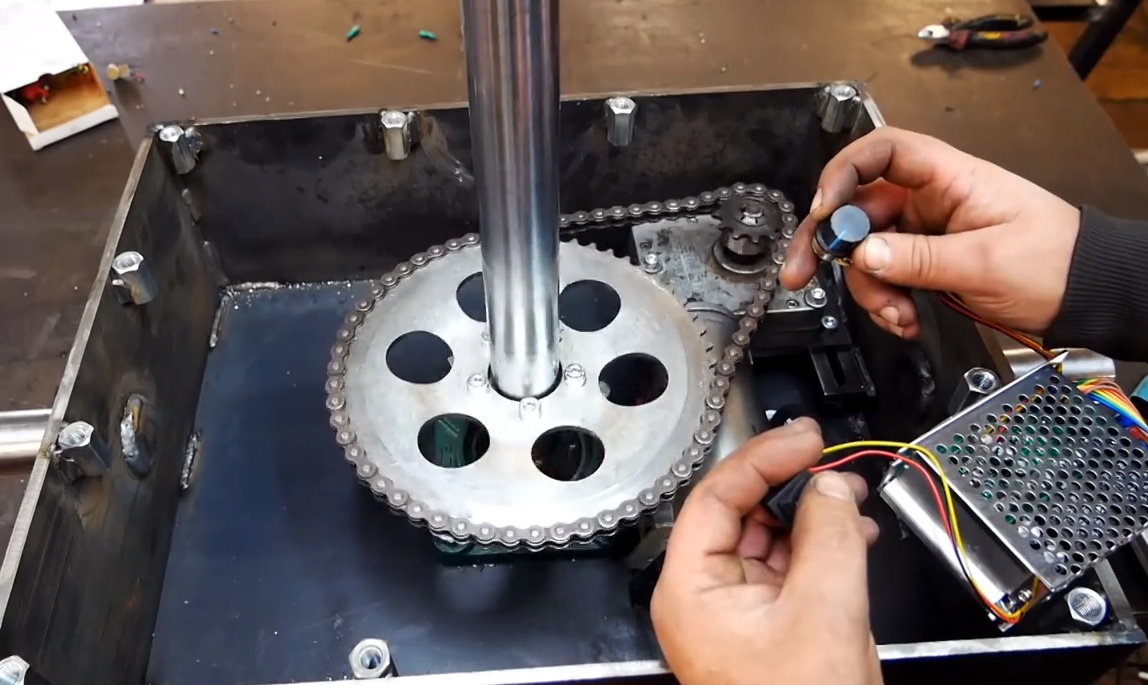
Note the welded standoffs used to hold on the lid.

From a technical standpoint, this is perhaps one of his more straightforward builds. But at the same time, the attention to detail that he puts into even this “simple” design is phenomenal. Nothing is wasted, and cutoff pieces from one section are often used in imaginative ways elsewhere.

[Workshop From Scratch] is truly a master of working with what you have, and this project is a perfect example. We especially like the tilt mechanism, which uses a massive leadscrew spun by a wiper motor salvaged from an Audi A8 B4. It looks like a fair amount of new hardware went into the control electronics, but even still, we have no doubt that the cost of this build is well below the purchase price of a commercial alternative.

Much like his hydraulic lifting table or motorized plasma cutter, not everyone is going to need something this elaborate in their home shop. But his magnetic vise and mobile drill press cart are far more approachable for the home gamer. Of course even if you don’t follow along and build your own versions of his tools, it’s always worth tuning in just to see him work.

source https://hackaday.com/2020/11/20/a-motorized-rotary-shop-table-from-scratch/

Ask Hackaday: What Tools Do You Really Need For A Life On The Road?

How do you dispose of an old hard drive? Inventive stories about heat and flame or industrial shredders will no doubt appear in the comments, but for me I just dismantle them and throw the various parts into the relevant scrap bins at my hackerspace. The magnets end up stuck to a metal door frame, and I’m good to go. So a week or so ago when I had a few ancient drives from the 1990s to deal with, I sat down only to find my set of Torx and Allen drivers was missing. I was back to square one.

What A Missing Tool Tells You About Necessities

Clint Eastwood always seemed to have just what he needed, why can I never manage it! Produzioni Europee Associati, Public domain.

Life deals an odd hand, sometimes. One never expects to find oneself homeless and sofa-surfing, nearly all possessions in a container on a farm somewhere. But here I am, and somewhere in one of those huge blue plastic removal crates is my driver set, alongside the other detritus of an engineer scribe’s existence. It’s all very well to become a digital nomad with laptop and hotspot when it comes to writing, but what has the experience taught me about doing the same as a solderer of fortune when it comes to hardware? My bench takes up several large removal crates and there is little chance of my carrying that much stuff around with me, so what makes the cut? Evidently not the tools for hard drive evisceration, so I had to borrow the set of a hackerspace friend to get the job done.

The practicality of life on the move comes down to how much stuff you can carry with you. Even with friends second to none and the immense privilege that comes with having the resources to get through the experience without destitution, there is a limit to what it is possible for a person to have in their immediate possession. Lonesome drifters in the movies seem to have an astounding variety of just the stuff they need for each escapade lashed to their saddles, but for me there’s no script-writer. So my daypack becomes the focus of my life, and what goes in to it has to be chosen with care. In the chill and damp of a British October and November it’s easy to fill it entirely with just a waterproof jacket and a fuzzy jumper so my first task is to secure the former on the outside of the pack with a cargo net, instantly making the visible jump for observers from one who’s just walked out of an office to one who’s on the move and spends time outdoors. Bad move if you need to blend in, but my choices are few.

Your Life In A Day Pack

Nota Bene: Dont't forget this set in the future! Junkyardsparkle, CC0.
Nota Bene: Dont’t forget this set in the future! Junkyardsparkle, CC0.

Into the pack goes an all-important packet of ginger biscuits, two laptops and their associated wiring, a hefty battery booster pack, and my folding headphones. I’m set for writing, but why two laptops? For years I’ve worked with a powerful semi-paving-slab of a laptop in the office and a super-light Chromebook on the road, and when fate puts me in this position I find myself lumbered with both of them. Lesson learned: should you do this by choice rather than necessity make sure to pick a single  laptop with both portability and power.

At the start of my nomadic existence I carried a soldering iron and a multimeter, screwdrivers and tweezers. I was set for whatever hardware the world would bring me, but somehow what I imagined never came. Another lesson learned: common tools are likely to already be wherever you might need them, in a hackerspace or at the bench of your technically inclined friends. Why carry what you can easily borrow, instead the art lies in selecting the uncommon tools that may not be to hand. And there’s the rub, for you only discover what those are when you don’t have them to hand. So far aside from the driver set I’ve found myself wanting a tape measure when I couldn’t borrow one and missing my Vernier caliper, and while there’s no way I’ll subject my Mitutoyo to my pack there’s definitely a cheap instrument on my shopping list. Meanwhile I’ve hung on to the screwdriver set and left the soldering iron in my storage unit.

Before too long I’ll no doubt be settled again somewhere, but along the way I have parked up in a lot of field entrances on country roads, seen more motorway service stations and fast food drive-thru lanes than I’d care to, learned a few things about life, about other people, about myself, and about which tools are indispensable but surprisingly uncommon. Which of you have had a similar experience, and what were the tools you found yourself needing on the road? Can we arrive at the truly indispensable kit of tools for the wandering hardware hacker, rather than the stuff we think we’ll need? Our comments section is as always open.

Meanwhile may you never find yourself in this position, and if you do may you be fortunate enough to have the peer group and resources to make your way through it. Consider donating to your local food bank and homeless charities, and be sure to lend a hand to friends in need. Some of those who helped me will be reading this, and I thank them.

Header image: Karsten Würth, CC0.

source https://hackaday.com/2020/11/20/ask-hackaday-what-tools-do-you-really-need-for-a-life-on-the-road/

Hackaday Podcast 094: Fake Sun, Hacked Super Mario, Minimum Viable Smart Glasses, and 3D Printers Can’t Do That

Hackaday editors Elliot Williams and Mike Szczys traverse the hackerscape looking for the best the internet had to offer last week. Nintendo has released the new Game & Watch handheld and it’s already been hacked to run custom code. Heading into the darkness of winter, this artificial sun build is one not to miss… and a great way to reuse a junk satellite dish. We’ve found a pair of smartglasses that are just our level of dumb. And Tom Nardi cracks open some consumer electronics to find a familiar single-board computer doing “network security”.

Take a look at the links below if you want to follow along, and as always, tell us what you think about this episode in the comments!

Direct download (~60 MB)

Places to follow Hackaday podcasts:

Episode 094 Show Notes:

New This Week:

Interesting Hacks of the Week:

Quick Hacks:

Can’t-Miss Articles:

source https://hackaday.com/2020/11/20/hackaday-podcast-094-fake-sun-hacked-super-mario-minimum-viable-smart-glasses-and-3d-printers-cant-do-that/

New Part Day: Bouffalo Labs BL602 RISC-V Wi-Fi/Bluetooth SoC

We should all by now be used to microcontrollers with wireless hardware on board, with Espressif or Nordic Labs dominating the hacker scene. There have been several other contenders in this arena over the years that haven’t really caught the attention of our community, usually because of the opacity of their available information.

A new contender should be worth a second look though. The BL602 from Bouffalo Labs is a Wi-Fi- and Bluetooth LE-capable microcontroller with a 32-bit RISC-V derived core. If that doesn’t interest you much, perhaps news that the PINE64 folks are spearheading an effort to reverse engineer it for a fully open-source blob-free wireless implementation might sharpen your attention.

So where can you get your hands on one? Hold your horses, this chip is at an early stage in its gestation. We can see that there are some exciting possibilities in store, but we’re still figuring out the hardware interfaces and other software required to make it work. A community is hard at work reverse engineering it, which leads us back to the PINE64 story we mentioned earlier.

You can find BL602 modules from AliExpress vendors, but the PINE64 folks will offer you a free one if you join their blob reverse engineering effort. Take note though, this offer is for those prepared to show commitment to the project, so don’t spam them in the hope of free stuff if you won’t be helping deliver the goods.

We might see the BL602 gaining an open-source toolchain and internal blobs over the coming months thanks to the efforts of those working on it. Just as the ESP8266 did back in 2014, it’s starting as a black box with a relative scarcity of information. But if this hacking effort pays off, we’ll have a cheap RISC-V Wi-Fi and Bluetooth module with entirely open-source software from the silicon upwards. What a time to be alive!

Thanks [Renze] for the tip.

source https://hackaday.com/2020/11/20/new-part-day-bouffalo-labs-bl602-risc-v-wi-fi-bluetooth-soc/

This Week in Security: SAD DNS, Incident Documentation Done Well, and TCL Responds

One of the big stories from the past few days is the return of DNS cache poisoning. The new attack has been dubbed SADDNS, and the full PDF whitepaper is now available. When you lookup a website’s IP address in a poisoned cache, you get the wrong IP address.

This can send you somewhere malicious, or worse. The paper points out that DNS has suffered a sort of feature creep, picking up more and more responsibilities. The most notable use of DNS that comes to mind is LetsEncrypt using DNS as the mechanism to prove domain ownership, and issue HTTPS certificates.

DNS Cache poisoning is a relatively old attack, dating from 1993. The first iteration of the attack was simple. An attacker that controlled an authoritative DNS server could include extra DNS results, and those extra results would be cached as if they came from an authoritative server. In 1997 it was realized that the known source port combined with a non-random transaction ID made DNS packet spoofing rather trivial. An attacker simply needs to spoof a DNS response with the appropriate txID, at the appropriate time to trick a requester into thinking it’s valid. Without the extra protections of TCP connections, this was an easy task. The response was to randomize the txID in each connection.

I have to take a moment to talk about one of my favorite gotchas in statistics. The Birthday paradox. The chances that two randomly selected people share a birthday is 1 in 365. How many people have to be in a room together to get a 50% chance of two of them sharing a birthday? If you said 182, then you walked into the paradox. The answer is 23. Why? Because we’re not looking for a specific birthday, we’re just looking for a collision between dates. Each non-matching birthday that walks into the room provides another opportunity for the next one to match.

This is the essence of the DNS birthday attack. An attacker would send a large number of DNS requests, and then immediately send a large number of spoofed responses, guessing random txIDs. Because only one collision is needed to get a poisoned cache, the chances of success go up rapidly. The mitigation was to also randomize the DNS source port, so that spoof attempts had to have both the correct source port and txID in the same attempt.

The other major DNS security improvement we have to mention is DNSSEC. DNS Security Extensions is the DNS protocol built on top of public key cryptography. Cache poisoning and DNS spoofing essentially goes away when DNSSEC is implemented. The problem is that so many resolvers, forwarders, and domains don’t yet support DNSSEC. SADDNS specifically targets those resolvers and forwarders.

The real linchpin to SAD DNS is a quirk of DNS ports that allows a port scan to identify the sending port of a given DNS query. That quirk is that when a UDP packet is sent from a given source port, that port is considered open to incoming packets by the OS. Any other port will return an ICMP bounce message, indicating a closed port. This technique, combined with a denial of service attack, gives an attacker enough time to identify the source port and send a flurry of txID guesses. Because they can figure out the port and txID in a two step process, the cache poisoning attack is viable once again.

There is one quick-and-dirty mitigation against this attack, that is easy to implement. Instead of setting your firewall to reject packets by default, set it to drop them by default. It’s possible that this workaround could be overcome, but the mechanism described in this paper does not work if the target DNS resolver/forwarder is set to default drop unsolicited packets.

How To Document a Breach

Capcom of Japan was recently hit with a ransomware attack. How exactly their network was compromised is still unclear, but Capcom is being very clear about what data was compromised, and what data may have been compromised. In fact, their overall response looks like a textbook case of getting it right. They give the types and numbers of records exposed. Additionally, they intentionally don’t keep things like credit card numbers in their database, so those are known not to be compromised.

They give a detailed timeline in section four. As soon as the results of the attack were noticed, they pulled the plug on their servers and went directly into incident response mode. It’s very likely that the attack remained minor due to this quick action. Within two days of the incident, they had an initial statement out, confirming it was an attack. The more detailed report being available two weeks later is reasonably quick as well. If you’re ever in the unenviable position of having to write the public incident summaries for an attack, this might be a good reference, as to how to get it right.

Intel

Intel has dropped 40 security advisories in November, for a total of 95 vulnerabilities disclosed. As noted in the link above, that’s a lot. What strikes me is that over half of those were discovered by Intel employees doing paid security research. Some of the more interesting vulns discovered were a pair of remotely exploitable problems in Intel’s AMT management platform, and a similar problem in Intel Bluetooth products. While it’s great that these bugs are getting fixed, I would love to see a bit more information about what exactly is going on with each of these vulns.

TCL Responds

Remember last week, we talked about the problems in TCL TVs? One of the biggest complaints security researchers had about that issue was the deafening silence from TCL. That silence has been broken, and quite a few questions have been answered. I’ve seen some additional information, where TCL states that TerminalManager is strictly for remote diagnostics, and can only be activated by the end user. The primary vulnerability we discussed, the filesystem being exposed over HTTP, was caused by a seperate app, T-Cast. This application enables streaming from mobile devices, and wasn’t installed on North American TVs. It seemed to be an unintended side-effect of the app.

There may be more to come, as there are several of us digging into TCL TVs and firmware. So far, however, my experience has been that the firmware is relatively well put together. On the model I bought, SELinux is enabled, the root filesystem is mounted read-only, and no SU binary is installed. There are a few oddities, but if anything comes of those, we’ll let you all know at the appropriate time.

Modern Wardialing

Remember War Games? A young Matthew Broderick was just looking for early access to a video game. He decided to dial every phone number in LA, and make note of which ones had computer modems at the other end, so he could find which one belonged to his favorite game developer. I think [Martin Vigo] must have had that in mind when he made a discovery. Many services allow you to trigger a password reset through a cell number. Often times, that process gives away a few digits of the associated number. If you could coordinate a lookup against multiple services, you could recover multiple digits, maybe all of them, from a simple email address.

The second half of that tool is now available: Phonerator. It scrapes Open Source INTelligence (OSINT) sources for information on valid phone numbers, and lets you generate a list of known good numbers from a partial match. “Open Source” here doesn’t refer to source code, but to publically available data. Martin suggests a few clever uses of these tools. One would be a reverse lookup on a stalker, assuming you have an email address that’s associated with their number. The read is interesting, particularly if you’re a telephone geek like many of us are.

Worst Idea of the Week?

And finally, we have the idea that strikes me as the worst idea of the week. In this blog post, [Matthew Green] makes a simple request. He asks Google to release their old DKIM secret keys after they expire, and maybe rotate those keys more often. First, DKIM is the “DomainKeys Identified Mail” system. It’s a simple way to confirm that the claimed sender of an email is the actual sender. In the case of gmail, Google signs each outgoing message with their secret DKIM key, confirming that the message was really sent from the claimed account, and hasn’t been tampered with. The purpose of this signature is to give admins another spam-fighting tool.

So why does Matthew want Google to release those keys? Google DKIM has recently been used to validate some very high-profile email dumps. His argument is that if anyone has access to the signing keys, signatures on dumped emails will no longer be trustworthy. Since they can no longer be proven to be real, email hacks will slow down and cease to be an issue.

Why is this a bad idea? Because it won’t cut down on email hacks, it will just make it impossible to debunk the fake ones. If anything, giving away the signing keys will just encourage fake email dumps. There’s a separate point to be made here about DKIM being useful in the case of law enforcement and prosecution. In this case, it not only confirms validity, but also prevents anyone from tampering with the emails.

[Editor’s note: We’re not all agreed on this. Deniability is often seen as a good thing in crypto algorithms, both because it’s privacy-preserving and prevents the system from being used in these kind of blackmail schemes. If you want to sign your e-mails, there are tons of ways to do so: GPG is the most obvious. But you shouldn’t have to. Users shouldn’t have this fundamental privacy choice made for them, especially with the default mode being the privacy violation. Discuss!]

source https://hackaday.com/2020/11/20/this-week-in-security-sad-dns-incident-documentation-done-well-and-tcl-responds/


3D Printable Cloth Takes Advantage of Defects

Normally, a 3D printer that under extrudes is a bad thing. However, MIT has figured out a way to deliberately mix full extrusions with under extruded layers to print structures that behave more like cloth than normal 3D printed items. The mesh-like structure apparently doesn’t require any modification to a normal 3D printer, just different software to create special code sequences to create the material.

Called DefeXtiles, [Jack Forman] is producing sheets and complex structures that appear woven. The process is known as “blob-stretch” because of the way the plastic makes blobs connected by fine filaments of plastic.

According to the talk by [Jack] (see the second video, below), the technique works with different types of filament and it is possible to print very large items folded up, even on a standard printer. After printing, you simply unfold or unwrap the plastic. For example, by printing a spiral, a 70 meter roll of “fabric” came out of an unremarkable-looking 3D printer. The thickness is under 0.4 mm.

Another example is the full-sized skirts you can see in the paper. They print in a roll form and then expand after printing. Other demonstration objects include a shuttlecock (you know, the thing you use for badminton) and lampshades.

We were hoping to find software or G-code files to demonstrate the technique, but if they were there we missed them. However, it seems like it should be easy enough to create some test files. Let us know if you try.

We’ve seen folding prints before. Fabric like this could transform printing wearables.


source https://hackaday.com/2020/11/20/3d-printable-cloth-takes-advantage-of-defects/

Mushroom Canoe is Rooted in Nature

Mushrooms might be the most contested pizza topping after pineapple, but can you build a boat from pineapples? Probably not, but you can from mushrooms. Mushrooms, or rather their mycelium root systems, can be used for things like packaging, insulation, and furniture, and it could be the next thing in floatation, too. Just ask [Katy Ayers], a Nebraska college student who built an eight-foot canoe molded almost entirely of mycelium.

[Katy] got into mushrooms when she was tasked with researching solutions to climate change. She loves to fish and has always wanted a boat, so when she found out that mycelium are naturally buoyant and waterproof, she decided to try using it as a building material.

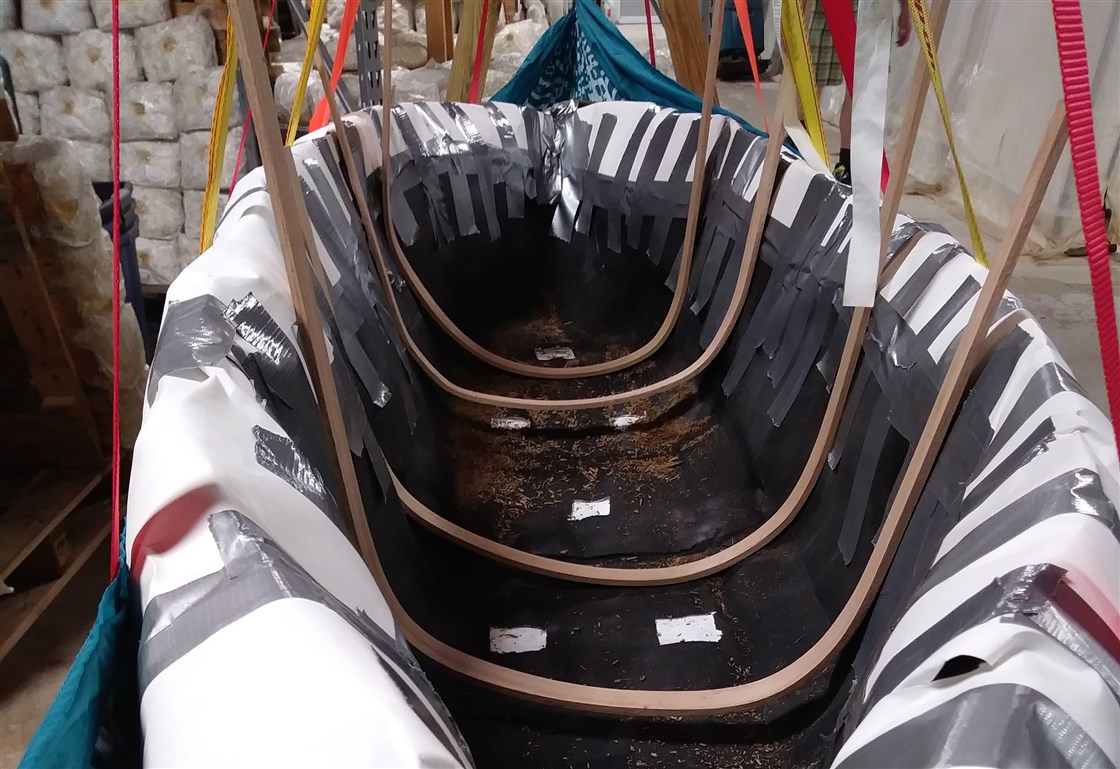
[Katy] floated the idea by the owner of a local mushroom company and they got to work, building a frame suspended in the air by a hammock-like structure. Then they covered the boat’s skeleton with spores and let it proliferate in a hot, humid growing room. Two weeks later, they had a boat made of live mycelium, which means that every time it goes out on the water, it spawns mushrooms. The total cost including tools was around $500. The boat experiment spawned even more mycelium projects. [Katy] has since experimented with making lawn chairs and landscaping bricks from mycelium.

Don’t want to wait to grow your own mycelium boat? You can build one out of stretch wrap, packing tape, and tree branches.

Thanks for the tip, [ykr300]!

Main image by Katy Ayers via NBC News

source https://hackaday.com/2020/11/20/mushroom-canoe-one-ups-climate-change/

Mushroom Canoe is Rooted in Nature

Mushrooms might be the most contested pizza topping after pineapple, but can you build a boat from pineapples? Probably not, but you can from mushrooms. Mushrooms, or rather their mycelium root systems, can be used for things like packaging, insulation, and furniture, and it could be the next thing in floatation, too. Just ask [Katy Ayers], a Nebraska college student who built an eight-foot canoe molded almost entirely of mycelium.

[Katy] got into mushrooms when she was tasked with researching solutions to climate change. She loves to fish and has always wanted a boat, so when she found out that mycelium are naturally buoyant and waterproof, she decided to try using it as a building material.

[Katy] floated the idea by the owner of a local mushroom company and they got to work, building a frame suspended in the air by a hammock-like structure. Then they covered the boat’s skeleton with spores and let it proliferate in a hot, humid growing room. Two weeks later, they had a boat made of live mycelium, which means that every time it goes out on the water, it spawns mushrooms. The total cost including tools was around $500. The boat experiment spawned even more mycelium projects. [Katy] has since experimented with making lawn chairs and landscaping bricks from mycelium.

Don’t want to wait to grow your own mycelium boat? You can build one out of stretch wrap, packing tape, and tree branches.

Thanks for the tip, [ykr300]!

Main image by Katy Ayers via NBC News

source https://hackaday.com/2020/11/20/mushroom-canoe-one-ups-climate-change/

Mushroom Canoe is Rooted in Nature

Mushrooms might be the most contested pizza topping after pineapple, but can you build a boat from pineapples? Probably not, but you can from mushrooms. Mushrooms, or rather their mycelium root systems, can be used for things like packaging, insulation, and furniture, and it could be the next thing in floatation, too. Just ask [Katy Ayers], a Nebraska college student who built an eight-foot canoe molded almost entirely of mycelium.

[Katy] got into mushrooms when she was tasked with researching solutions to climate change. She loves to fish and has always wanted a boat, so when she found out that mycelium are naturally buoyant and waterproof, she decided to try using it as a building material.

[Katy] floated the idea by the owner of a local mushroom company and they got to work, building a frame suspended in the air by a hammock-like structure. Then they covered the boat’s skeleton with spores and let it proliferate in a hot, humid growing room. Two weeks later, they had a boat made of live mycelium, which means that every time it goes out on the water, it spawns mushrooms. The total cost including tools was around $500. The boat experiment spawned even more mycelium projects. [Katy] has since experimented with making lawn chairs and landscaping bricks from mycelium.

Don’t want to wait to grow your own mycelium boat? You can build one out of stretch wrap, packing tape, and tree branches.

Thanks for the tip, [ykr300]!

Main image by Katy Ayers via NBC News

source https://hackaday.com/2020/11/20/mushroom-canoe-one-ups-climate-change/

Circuit Boards You Can Stretch: Liquid Metal Nanomaterials Make a Strange Flex

If you think polyimide-based flexible PCBs are cool, wait until you get a load of what polymerized liquid metal networks can do.

Seems like [CNLohr] has some pretty cool friends, and he recently spent some time with a couple of them who are working with poly LMNs and finding out what they’re good for. Poly LMNs use a liquid metal composed of indium and gallium that can be sprayed onto a substrate through a laser-cut stencil. This results in traces that show the opposite of expected behavior; where most conductors increase in resistance when stretched, pol LMNs stay just as conductive no matter how much they’re stretched.

The video below shows [CNLohr]’s experiments with the stuff. He brought a couple of traditional PCB-based MCU circuits, which interface easily with the poly LMN traces on a thick tape substrate. Once activated by stretching, which forms the networks between the liquid metal globules, the traces act much like copper traces. Attaching SMD components is as simple as sticking them to the tape — no soldering required. The circuits remain impressively stretchy without any apparent effect on their electrical properties — a characteristic that should prove interesting for wearables circuits, biological sensors, and a host of real-world applications.

While poly LMNs aren’t exactly ready for the market yet, they don’t seem terribly difficult to make, requiring little in the way of exotic materials or specialized lab equipment. We’d love to see someone like [Ben Krasnow] pick this up and run with it — it seems right up his alley.

source https://hackaday.com/2020/11/19/circuit-boards-you-can-stretch-liquid-metal-nanomaterials-make-a-strange-flex/

Remoticon Video: Firmware Reverse Engineering Workshop with Asmita Jha

Taking things apart to see how they work is an important part of understanding a system, and that goes for software as much as for hardware. You can get a jump start on your firmware reverse engineering skills with Asmita Jha’s workshop which was presented live at the Hackaday Remoticon. The video has just been published, and is found below along with a bit more on what she covered in her hands-on labs.

Where do you start when poking around a binary file with which you’re unfamiliar? The first part of the two-hour workshop tackles this issue. Asmita takes a systematic approach to figuring out what you’ve got and what methods will have the best chance of success.

The tools needed for static analysis are likely familiar names to you already: Binwalk, John the Ripper, Ghidra, Firmwalker, FACT Tool, and EXPLIoT Firmware Auditor. Three of the four labs use these tools to practice things like extracting firmware binaries to find hardcoded credentials, modifying and repacking binaries, and cracking passwords found inside. There is also an example of dynamic analysis where the hardware architecture for which the firmware is compiled differs from the computer you’re using for reverse engineering. In that case you can use a flavor of Qemu to make sense of it.

Beginning about half-way through the workshop the hands-on labs begin. You can follow along with this using workshop slides and setup instructions found on the workshop page.

source https://hackaday.com/2020/11/19/remoticon-video-firmware-reverse-engineering-workshop-with-asmita-jha/