[Amy Makes Stuff] has long used a pair of diamond honing blocks to freehand sharpen planes, chisels, and all the other dull things around the shop. Although this method works fairly well, the results are often inconsistent without some kind of jig to hold the blade securely as it’s being sharpened. These types of devices are abundant and cheap to buy, but as [Amy] says in the video after the break, then she doesn’t get to machine anything. Boy, do we know that feeling.
[Amy] was able to make this completely out of stuff she had lying around, starting with a block of scrap aluminium that eventually gets cut into the two halves of the jig. The video is full of tips and tricks and it’s really interesting to see [Amy]’s processes up close. Our favorite part has to be that grippy knob that expands and contracts the jig. [Amy] made it by drilling a bunch of holes close to the outside edge of a circle, and then milled away the edge until she had a fully fluted knob. Once she had the jig finished, she upgraded her honing blocks by milling a new home for them out of milky-white high-density polyethylene.
The availability of small and powerful brushless motors has been instrumental in the development of so-called micro-mobility vehicles. But if your commute involves crossing a frozen lake, you might find the options a bit lacking. Fortunately [Simon] from [RCLifeOn] now has a solution for you in the form of motorized ice skates.
[Simon] used 3D printed brackets to mount outrunner brushless motors to the back of a pair of ice-skates. The spinning outer housing of the motor is used as the wheel, with a bunch of studs threaded in it to dig into the ice and provide traction. At first [Simon] tried to use a pair of RC car springs to keep the motor in contact with the ice, but spring force was insufficient for the task, so he ended up rigidly mounting the motors. Getting proper traction on the ice from a standstill was still tricky, so he ended up leaning back to push the motor down, which also had the effect of putting him off balance, limiting the practical acceleration. The most obvious solution for the tracking problem seems to be stronger springs, but we assume he didn’t have any on hand. The batteries are held in a backpack, with cables running down to the skates, and a wireless electric skateboard controller is used for throttle control.
The obvious risk of these skates is of the studded motors inadvertently becoming meat grinders if you fall. It still looks like a fun project, and we wouldn’t mind having a go on those skates.
Getting into e-biking is a great hobby. It can get people on bikes who might otherwise not be physically able to ride, it can speed up commute times, and it can even make hauling lots of stuff possible and easy, not to mention it’s also fun and rewarding. That being said, there are a wide array of conflicting laws around what your e-bike can and can’t do on the road and if you don’t want to run afoul of the rules you may need a programmable device that ensures your e-bike is restricted in the appropriate way.
This build is specifically for Bafang mid drives, which can be up to 1000 W and easily power a bike beyond the speed limit where [Tomblarom] lives. A small microcontroller is housed in a waterproof box on the bike and wired between the motor’s display and controller. A small hall effect sensor and magnet sit by this microcontroller, and if the magnet is removed then the microcontroller reprograms the bike’s controller to limit the speed and also to disable the throttle, another feature that is illegal in some jurisdictions but not others. As an added bonus, the microcontroller also handles brake lights, turn signals, and automatic headlights for the bike as well.
While the project page mentions removing the magnet while getting pulled over to avoid fines and other punishments, that’s on you. We imagine this could still be useful for someone who wants to comply with local laws when riding on the road, but still wants to remove the restrictions when riding on private property or off-road where the wattage and speed restrictions might not apply.
Wind turbines are incredible pieces of technology, able to harvest wind energy and deliver it to the power grid without carbon emissions. Their constant development since the first one came online in 1939 mean that the number of megawatts produced per turbine continues to rise as price per megawatt-hour of wind energy continues to fall. Additionally, they can operate in almost any climate to reliably generate energy almost anywhere in the world from Canada to the North Atlantic to parts beyond. While the cold snap that plowed through the American South recently might seem to contradict this fact, in reality the loss of wind power during this weather event is partially a result of tradeoffs made during the design of these specific wind farms (and, of course, the specifics of how Texas operates its power grid, but that’s outside the scope of this article) rather than a failure of the technology itself.
First, building wind turbines on the scale of megawatts isn’t a one-size-fits-all solution. Purchasing a large turbine from a company like GE, Siemens, or Vestas is a lot like buying a car. A make and model are selected first, and then options are selected for these base models. For example, low but consistent wind speeds demand a larger blade that will rotate at a lower speed whereas areas with higher average wind speeds may be able to get by with smaller and less expensive blades for the same amount of energy production. Another common option for turbines is cold weather packages, which include things like heaters for the control systems, hydraulics, and power electronics, additional insulation in certain areas, and de-icing solutions especially for the turbine blades.
In a location like Texas that rarely sees cold temperatures for very long, it’s understandable that the cold weather packages might be omitted to save money during construction (although some smaller heaters are often included in critical areas to reduce condensation or humidity) but also to save on maintenance as well: every part in a wind turbine has to be maintained. Continuing the car analogy, it’s comparable to someone purchasing a vehicle in a cold climate that didn’t come equipped with air conditioning to save money up front, but also to avoid repair costs when the air conditioning eventually breaks. However, there are other side effects beyond cost to be considered when installing equipment that’s designed to improve a turbine’s operation in cold weather.
Let’s dig into the specifics of how wind turbine equipment is selected for a given wind farm.
Good Design Involves Tradeoffs
Improving a turbine’s ability to operate in cold weather may actually decrease its ability to operate in hot weather, which Texas at least is guaranteed to see during large portions of the year. Everything in a turbine generates heat when operating, from the blade pitching equipment to the gearbox and generator to the power electronics which tie them electrically to the grid. Expelling the waste heat in summer is much more important in these places than preparing them for a few days of cold weather that might not even happen in any given year. Typically this waste heat is expelled by means of radiators and cooling fans, whether they are installed on the gearbox, generator, power converter, or other heat-sensitive equipment, and the settings at which the cooling systems activate (if they exist at all) may not be easy or possible to change.
This brings up another consideration with wind energy in Texas specifically. Wind is plentiful in Texas, so it was among the first places in the US to adopt early versions of grid-scale wind turbines, some of which are still in operation. These turbines are much less configurable than modern versions, and it may not be easy or possible to change the various temperature settings in a turbine. That means that in some cases, cooling fans are active all the time, or the turbines are otherwise permanently configured in a way that makes them ideal for use in hot climates but quickly trip offline in cold weather. Even modern turbines will go offline if the internal temperatures reach a set point well below freezing (typically -30 °C/-22 °F) in order to prevent damage (note that if grid operators are aware of the weather they’ll be able to predict the loss of generation and plan for it), but if cooling systems aren’t configured for the cold, vents are still open, or insulation is lacking, these turbines will not be immune to the effects of the cold either.
Fighiting Ice: Electric Heat and Special Paint; But Not Helicopters
Other aspects of wind turbines that impact their abilities to operate in extreme cold is how they deal with ice, specifically on the turbine blades. Carbon-based electrical heaters on the blades are common way to control ice buildup. 2014 images of the helicopter deicing tests in Sweden shown in the video below went viral during the Texas outage, but this technique is not used in Texas and doesn’t seem to have seen much adoption anywhere due to the expenses involved. (Also considering the need to have a pilot and at least two other workers on-site during icy conditions.) Installing blade heaters caries its own cost and, at least for the time being, may only make economic sense in areas that are expected to deal with cold during a significant portion of the year.
Other options include using thermal cameras to sense ice buildup and shut the turbine down if the ice becomes severe. While all of these methods so far require energy inputs in order to de-ice blades, an innovative product from a wind turbine company called Gamesa is producing paint that naturally prevents ice formation, eliminating the need for expensive energy-intensive deicing solutions.
Another example of a company using paint to try to prevent ice buildup on blades is at a wind farm in Canada where the site has painted some blades black in order to increase the amount of UV light absorbed from the sun, hoping to naturally increase the temperature of the blades without any novel technology or energy-intensive solutions. While this method is not as widespread as other methods, it demonstrates an example of a tradeoff between hot and cold climates: painting blades black in Texas, while there is some evidence that it may reduce bird fatalities, presumably would have major downsides when the long summers rolled around and the blades heated up beyond design tolerances.
Human Resources in Cold Weather
While all of these technological solutions to extreme climates are the subject of any news cycle focused on the downsides of wind energy, one of the most important things about the operation of wind turbines is often glossed over when considering operation outside of their intended climate: the people who maintain them have to also be prepared to live and work in that climate as well. If a turbine trips offline for a routine reason during a snow or ice event, most wind technicians at sites in places like Texas don’t have access to snowplows, snowblowers, or snowmobiles to access the turbines like they might if they were working in northern Quebec. They may not live in areas that regularly plow or salt the roads, making it difficult or unsafe to get to the site or turbines at all. Even if the technicians are doing something simple to improve the turbine’s performance in cold weather, like shutting hatch vents or adding insulation, they still need to get to the turbines.
Ice buildup on turbine blades can be thrown or fall on people and equipment if left unchecked. Via windpowerengineering.com
Further, there are some safety issues with ice buildup on turbines as well, namely that it has to go somewhere when it falls off of the turbines. For that reason, most technicians have strict rules on approaching turbines during ice events to prevent any ice from shedding off of the turbine and onto them or their vehicles. In a cold climate that has de-icing systems, however, this issue can be more controlled and predictable, but in a place like Texas this means that an otherwise fixable turbine might be left offline for a much longer time while technicians wait for safer conditions.
In conclusion, we’d like to note that the recent disaster in Texas was not related to any fundamentals of wind energy itself, but rather to other issues with their isolated power grid and the trend of American infrastructure to be in a general state of disrepair. Wind turbines are perfectly capable of producing energy in some of the most extreme cold environments on the planet, provided they (and their operators) are designed and equipped to handle the climate. In fact, since air density is inversely proportional to temperature, turbines in cold climates can produce more energy for a given wind speed than those in hot climates. We should also give Texas a pat on the back for investing so heavily in wind energy. As of 2019 the state had just shy of 25 GW of wind power capacity, the most by far of any other state, and installed capacity continues to rise rapidly. They have an incredible amount of wind energy available and they have not let it go to waste. But winterizing turbines in hot climates, especially older turbines that aren’t as configurable, is often infeasible both from an economic point-of-view and also because the process of designing any product, whether it’s a small toy or a giant wind farm, requires tradeoffs.
Wind turbines are incredible pieces of technology, able to harvest wind energy and deliver it to the power grid without carbon emissions. Their constant development since the first one came online in 1939 mean that the number of megawatts produced per turbine continues to rise as price per megawatt-hour of wind energy continues to fall. Additionally, they can operate in almost any climate to reliably generate energy almost anywhere in the world from Canada to the North Atlantic to parts beyond. While the cold snap that plowed through the American South recently might seem to contradict this fact, in reality the loss of wind power during this weather event is partially a result of tradeoffs made during the design of these specific wind farms (and, of course, the specifics of how Texas operates its power grid, but that’s outside the scope of this article) rather than a failure of the technology itself.
First, building wind turbines on the scale of megawatts isn’t a one-size-fits-all solution. Purchasing a large turbine from a company like GE, Siemens, or Vestas is a lot like buying a car. A make and model are selected first, and then options are selected for these base models. For example, low but consistent wind speeds demand a larger blade that will rotate at a lower speed whereas areas with higher average wind speeds may be able to get by with smaller and less expensive blades for the same amount of energy production. Another common option for turbines is cold weather packages, which include things like heaters for the control systems, hydraulics, and power electronics, additional insulation in certain areas, and de-icing solutions especially for the turbine blades.
In a location like Texas that rarely sees cold temperatures for very long, it’s understandable that the cold weather packages might be omitted to save money during construction (although some smaller heaters are often included in critical areas to reduce condensation or humidity) but also to save on maintenance as well: every part in a wind turbine has to be maintained. Continuing the car analogy, it’s comparable to someone purchasing a vehicle in a cold climate that didn’t come equipped with air conditioning to save money up front, but also to avoid repair costs when the air conditioning eventually breaks. However, there are other side effects beyond cost to be considered when installing equipment that’s designed to improve a turbine’s operation in cold weather.
Let’s dig into the specifics of how wind turbine equipment is selected for a given wind farm.
Good Design Involves Tradeoffs
Improving a turbine’s ability to operate in cold weather may actually decrease its ability to operate in hot weather, which Texas at least is guaranteed to see during large portions of the year. Everything in a turbine generates heat when operating, from the blade pitching equipment to the gearbox and generator to the power electronics which tie them electrically to the grid. Expelling the waste heat in summer is much more important in these places than preparing them for a few days of cold weather that might not even happen in any given year. Typically this waste heat is expelled by means of radiators and cooling fans, whether they are installed on the gearbox, generator, power converter, or other heat-sensitive equipment, and the settings at which the cooling systems activate (if they exist at all) may not be easy or possible to change.
This brings up another consideration with wind energy in Texas specifically. Wind is plentiful in Texas, so it was among the first places in the US to adopt early versions of grid-scale wind turbines, some of which are still in operation. These turbines are much less configurable than modern versions, and it may not be easy or possible to change the various temperature settings in a turbine. That means that in some cases, cooling fans are active all the time, or the turbines are otherwise permanently configured in a way that makes them ideal for use in hot climates but quickly trip offline in cold weather. Even modern turbines will go offline if the internal temperatures reach a set point well below freezing (typically -30 °C/-22 °F) in order to prevent damage (note that if grid operators are aware of the weather they’ll be able to predict the loss of generation and plan for it), but if cooling systems aren’t configured for the cold, vents are still open, or insulation is lacking, these turbines will not be immune to the effects of the cold either.
Fighiting Ice: Electric Heat and Special Paint; But Not Helicopters
Other aspects of wind turbines that impact their abilities to operate in extreme cold is how they deal with ice, specifically on the turbine blades. Carbon-based electrical heaters on the blades are common way to control ice buildup. 2014 images of the helicopter deicing tests in Sweden shown in the video below went viral during the Texas outage, but this technique is not used in Texas and doesn’t seem to have seen much adoption anywhere due to the expenses involved. (Also considering the need to have a pilot and at least two other workers on-site during icy conditions.) Installing blade heaters caries its own cost and, at least for the time being, may only make economic sense in areas that are expected to deal with cold during a significant portion of the year.
Other options include using thermal cameras to sense ice buildup and shut the turbine down if the ice becomes severe. While all of these methods so far require energy inputs in order to de-ice blades, an innovative product from a wind turbine company called Gamesa is producing paint that naturally prevents ice formation, eliminating the need for expensive energy-intensive deicing solutions.
Another example of a company using paint to try to prevent ice buildup on blades is at a wind farm in Canada where the site has painted some blades black in order to increase the amount of UV light absorbed from the sun, hoping to naturally increase the temperature of the blades without any novel technology or energy-intensive solutions. While this method is not as widespread as other methods, it demonstrates an example of a tradeoff between hot and cold climates: painting blades black in Texas, while there is some evidence that it may reduce bird fatalities, presumably would have major downsides when the long summers rolled around and the blades heated up beyond design tolerances.
Human Resources in Cold Weather
While all of these technological solutions to extreme climates are the subject of any news cycle focused on the downsides of wind energy, one of the most important things about the operation of wind turbines is often glossed over when considering operation outside of their intended climate: the people who maintain them have to also be prepared to live and work in that climate as well. If a turbine trips offline for a routine reason during a snow or ice event, most wind technicians at sites in places like Texas don’t have access to snowplows, snowblowers, or snowmobiles to access the turbines like they might if they were working in northern Quebec. They may not live in areas that regularly plow or salt the roads, making it difficult or unsafe to get to the site or turbines at all. Even if the technicians are doing something simple to improve the turbine’s performance in cold weather, like shutting hatch vents or adding insulation, they still need to get to the turbines.
Ice buildup on turbine blades can be thrown or fall on people and equipment if left unchecked. Via windpowerengineering.com
Further, there are some safety issues with ice buildup on turbines as well, namely that it has to go somewhere when it falls off of the turbines. For that reason, most technicians have strict rules on approaching turbines during ice events to prevent any ice from shedding off of the turbine and onto them or their vehicles. In a cold climate that has de-icing systems, however, this issue can be more controlled and predictable, but in a place like Texas this means that an otherwise fixable turbine might be left offline for a much longer time while technicians wait for safer conditions.
In conclusion, we’d like to note that the recent disaster in Texas was not related to any fundamentals of wind energy itself, but rather to other issues with their isolated power grid and the trend of American infrastructure to be in a general state of disrepair. Wind turbines are perfectly capable of producing energy in some of the most extreme cold environments on the planet, provided they (and their operators) are designed and equipped to handle the climate. In fact, since air density is inversely proportional to temperature, turbines in cold climates can produce more energy for a given wind speed than those in hot climates. We should also give Texas a pat on the back for investing so heavily in wind energy. As of 2019 the state had just shy of 25 GW of wind power capacity, the most by far of any other state, and installed capacity continues to rise rapidly. They have an incredible amount of wind energy available and they have not let it go to waste. But winterizing turbines in hot climates, especially older turbines that aren’t as configurable, is often infeasible both from an economic point-of-view and also because the process of designing any product, whether it’s a small toy or a giant wind farm, requires tradeoffs.
Wind turbines are incredible pieces of technology, able to harvest wind energy and deliver it to the power grid without carbon emissions. Their constant development since the first one came online in 1939 mean that the number of megawatts produced per turbine continues to rise as price per megawatt-hour of wind energy continues to fall. Additionally, they can operate in almost any climate to reliably generate energy almost anywhere in the world from Canada to the North Atlantic to parts beyond. While the cold snap that plowed through the American South recently might seem to contradict this fact, in reality the loss of wind power during this weather event is partially a result of tradeoffs made during the design of these specific wind farms (and, of course, the specifics of how Texas operates its power grid, but that’s outside the scope of this article) rather than a failure of the technology itself.
First, building wind turbines on the scale of megawatts isn’t a one-size-fits-all solution. Purchasing a large turbine from a company like GE, Siemens, or Vestas is a lot like buying a car. A make and model are selected first, and then options are selected for these base models. For example, low but consistent wind speeds demand a larger blade that will rotate at a lower speed whereas areas with higher average wind speeds may be able to get by with smaller and less expensive blades for the same amount of energy production. Another common option for turbines is cold weather packages, which include things like heaters for the control systems, hydraulics, and power electronics, additional insulation in certain areas, and de-icing solutions especially for the turbine blades.
In a location like Texas that rarely sees cold temperatures for very long, it’s understandable that the cold weather packages might be omitted to save money during construction (although some smaller heaters are often included in critical areas to reduce condensation or humidity) but also to save on maintenance as well: every part in a wind turbine has to be maintained. Continuing the car analogy, it’s comparable to someone purchasing a vehicle in a cold climate that didn’t come equipped with air conditioning to save money up front, but also to avoid repair costs when the air conditioning eventually breaks. However, there are other side effects beyond cost to be considered when installing equipment that’s designed to improve a turbine’s operation in cold weather.
Let’s dig into the specifics of how wind turbine equipment is selected for a given wind farm.
Good Design Involves Tradeoffs
Improving a turbine’s ability to operate in cold weather may actually decrease its ability to operate in hot weather, which Texas at least is guaranteed to see during large portions of the year. Everything in a turbine generates heat when operating, from the blade pitching equipment to the gearbox and generator to the power electronics which tie them electrically to the grid. Expelling the waste heat in summer is much more important in these places than preparing them for a few days of cold weather that might not even happen in any given year. Typically this waste heat is expelled by means of radiators and cooling fans, whether they are installed on the gearbox, generator, power converter, or other heat-sensitive equipment, and the settings at which the cooling systems activate (if they exist at all) may not be easy or possible to change.
This brings up another consideration with wind energy in Texas specifically. Wind is plentiful in Texas, so it was among the first places in the US to adopt early versions of grid-scale wind turbines, some of which are still in operation. These turbines are much less configurable than modern versions, and it may not be easy or possible to change the various temperature settings in a turbine. That means that in some cases, cooling fans are active all the time, or the turbines are otherwise permanently configured in a way that makes them ideal for use in hot climates but quickly trip offline in cold weather. Even modern turbines will go offline if the internal temperatures reach a set point well below freezing (typically -30 °C/-22 °F) in order to prevent damage (note that if grid operators are aware of the weather they’ll be able to predict the loss of generation and plan for it), but if cooling systems aren’t configured for the cold, vents are still open, or insulation is lacking, these turbines will not be immune to the effects of the cold either.
Fighiting Ice: Electric Heat and Special Paint; But Not Helicopters
Other aspects of wind turbines that impact their abilities to operate in extreme cold is how they deal with ice, specifically on the turbine blades. Carbon-based electrical heaters on the blades are common way to control ice buildup. 2014 images of the helicopter deicing tests in Sweden shown in the video below went viral during the Texas outage, but this technique is not used in Texas and doesn’t seem to have seen much adoption anywhere due to the expenses involved. (Also considering the need to have a pilot and at least two other workers on-site during icy conditions.) Installing blade heaters caries its own cost and, at least for the time being, may only make economic sense in areas that are expected to deal with cold during a significant portion of the year.
Other options include using thermal cameras to sense ice buildup and shut the turbine down if the ice becomes severe. While all of these methods so far require energy inputs in order to de-ice blades, an innovative product from a wind turbine company called Gamesa is producing paint that naturally prevents ice formation, eliminating the need for expensive energy-intensive deicing solutions.
Another example of a company using paint to try to prevent ice buildup on blades is at a wind farm in Canada where the site has painted some blades black in order to increase the amount of UV light absorbed from the sun, hoping to naturally increase the temperature of the blades without any novel technology or energy-intensive solutions. While this method is not as widespread as other methods, it demonstrates an example of a tradeoff between hot and cold climates: painting blades black in Texas, while there is some evidence that it may reduce bird fatalities, presumably would have major downsides when the long summers rolled around and the blades heated up beyond design tolerances.
Human Resources in Cold Weather
While all of these technological solutions to extreme climates are the subject of any news cycle focused on the downsides of wind energy, one of the most important things about the operation of wind turbines is often glossed over when considering operation outside of their intended climate: the people who maintain them have to also be prepared to live and work in that climate as well. If a turbine trips offline for a routine reason during a snow or ice event, most wind technicians at sites in places like Texas don’t have access to snowplows, snowblowers, or snowmobiles to access the turbines like they might if they were working in northern Quebec. They may not live in areas that regularly plow or salt the roads, making it difficult or unsafe to get to the site or turbines at all. Even if the technicians are doing something simple to improve the turbine’s performance in cold weather, like shutting hatch vents or adding insulation, they still need to get to the turbines.
Ice buildup on turbine blades can be thrown or fall on people and equipment if left unchecked. Via windpowerengineering.com
Further, there are some safety issues with ice buildup on turbines as well, namely that it has to go somewhere when it falls off of the turbines. For that reason, most technicians have strict rules on approaching turbines during ice events to prevent any ice from shedding off of the turbine and onto them or their vehicles. In a cold climate that has de-icing systems, however, this issue can be more controlled and predictable, but in a place like Texas this means that an otherwise fixable turbine might be left offline for a much longer time while technicians wait for safer conditions.
In conclusion, we’d like to note that the recent disaster in Texas was not related to any fundamentals of wind energy itself, but rather to other issues with their isolated power grid and the trend of American infrastructure to be in a general state of disrepair. Wind turbines are perfectly capable of producing energy in some of the most extreme cold environments on the planet, provided they (and their operators) are designed and equipped to handle the climate. In fact, since air density is inversely proportional to temperature, turbines in cold climates can produce more energy for a given wind speed than those in hot climates. We should also give Texas a pat on the back for investing so heavily in wind energy. As of 2019 the state had just shy of 25 GW of wind power capacity, the most by far of any other state, and installed capacity continues to rise rapidly. They have an incredible amount of wind energy available and they have not let it go to waste. But winterizing turbines in hot climates, especially older turbines that aren’t as configurable, is often infeasible both from an economic point-of-view and also because the process of designing any product, whether it’s a small toy or a giant wind farm, requires tradeoffs.
Resin 3D printers have a significant advantage over filament printers in that they are able to print smaller parts with more fine detail. The main downside is that the resin parts aren’t typically as strong or durable as their filament counterparts. For this reason they’re often used more for small models than for working parts, but [Breaking Taps] wanted to try and improve on the strength of these builds buy adding metal to them through electroplating.
Both copper and nickel coatings are used for these test setups, each with different effects to the resin prints. The nickel adds a dramatic amount of stiffness and the copper seems to increase the amount of strain that the resin part can tolerate — although [Breaking Taps] discusses some issues with this result.
While the results of electroplating resin are encouraging, he notes that it is a cumbersome process. It’s a multi-step ordeal to paint the resin with a special paint which helps the metal to adhere, and then electroplate it. It’s also difficult to ensure an even coating of metal on more complex prints than on the simpler samples he uses in this video.
After everything is said and done, however, if a working part needs to be smaller than a filament printer can produce or needs finer detail, this is a pretty handy way of adding more strength or stiffness to these parts. There’s still some investigating to be done, though, as electroplated filament prints are difficult to test with his setup, but it does show promise. Perhaps one day we’ll be able to print with this amount of precision using metal directly rather than coating plastic with it.
Long-time readers may remember one of the occasional Engineering Heroes series that focused on the British engineer, inventor and sometime TV presenter Tim Hunkin, known for his intricate creations, unusual arcade machines, and Secret Life Of Machines TV series’ from the years around 1990. It seems we’re now in for a fresh treat as he’s returning to our screens via YouTube with a new series. The Secret Life Of Components will be his attempt to pass on the accumulated knowledge of a long career that most of us would have given our eyeteeth for.
There will be eight videos in the series which launches on the 4th of March, and judging by the snippets in the preview video below the break he’ll be covering a wide range including springs, adhesives, chains, belts, switches, and much more. His entertaining style and beautifully built working models are guaranteed to make for some very good content while giving a unique view into the workshop of a true master of the craft.
As an appetiser it’s worth reading our profile of Tim Hunkin. It features a visit to his Novelty Automation arcade in London’s Holborn, which should be an essential stop for any travelling Hackaday reader finding themselves in that city.
Long-time readers may remember one of the occasional Engineering Heroes series that focused on the British engineer, inventor and sometime TV presenter Tim Hunkin, known for his intricate creations, unusual arcade machines, and Secret Life Of Machines TV series’ from the years around 1990. It seems we’re now in for a fresh treat as he’s returning to our screens via YouTube with a new series. The Secret Life Of Components will be his attempt to pass on the accumulated knowledge of a long career that most of us would have given our eyeteeth for.
There will be eight videos in the series which launches on the 4th of March, and judging by the snippets in the preview video below the break he’ll be covering a wide range including springs, adhesives, chains, belts, switches, and much more. His entertaining style and beautifully built working models are guaranteed to make for some very good content while giving a unique view into the workshop of a true master of the craft.
As an appetiser it’s worth reading our profile of Tim Hunkin. It features a visit to his Novelty Automation arcade in London’s Holborn, which should be an essential stop for any travelling Hackaday reader finding themselves in that city.
GPS technology is a marvel of the modern world. Not only can we reliably locate positions on the planet with remarkable accuracy and relatively inexpensive hardware, but plenty of non-location-based features of the technology are available for other uses as well. GPS can be used for things like time servers, since the satellites require precise timing in order to triangulate a position, and as a result they can also be used for things like this incredibly accurate frequency reference.
This project is what’s known as a GPSDO, or GPS-disciplined oscillator. Typically they use a normal oscillator, like a crystal, and improve its accuracy by pairing it with the timing signal from a GPS satellite. This one is a standalone model built by [Szabolcs Szigeti] who based the build around an STM32 board. The goal of the project was purely educational, as GPSDOs of various types are widely available, but [Szabolcs] was able to build exactly what he wanted into this one including a custom power supply, simple standalone UI, and no distribution amplifier.
The build goes into a good bit of detail on the design and operation of the device, and all of the PCB schematics and source code are available on the projects GitHub page if you want to build your own. There are plenty of other projects out there that make use of GPS-based time for its high accuracy, too, like this one which ties a GPS time standard directly to a Raspberry Pi.
In an announcement that came as a surprise to few, NASA now says that landing humans on the Moon by 2024 is no longer likely. Acting administrator Steve Jurczyk lays the blame at the feet of Congress, for failing to provide the funds needed for Human Landing Systems development, a critical step needed to meet the aggressive overall timeline. The announcement doesn’t mark the end of the Artemis program; in fact, NASA is continuing to work on a realistic timeline for getting boots back on the lunar surface, and a decision on which of the three submitted proposals for a lunar lander will be further developed should be coming in the next few months. As far as we can see, this is simply an adjustment to the original timeline for a landing, but given the stunning recent success of Perseverance showing just what robots can do, we’d expect pushback from some quarters on the need for human exploration.
The entry-level 3D design market was thrown into considerable turmoil last year when Autodesk changed the licensing terms for its flagship Fusion 360 package. Hobbyists who had been enjoying relatively unfettered access to the powerful suite chafed at the new restrictions, leaving many to threaten to jump ship, apparently without much thought given to the dearth of alternative products. That may be changing now that Dassault Systèmes has announced two new versions of SolidWorks aimed at the maker and student segments. The Makers offer is intended for hobbyists who want to design for benchtop manufacturing methods like 3D-printing. The Students offer is aimed at engineering and design students looking to gain experience with the tools they’ll be expected to have mastered by the time they enter the job market. It looks like the Makers offer will be at least partly contingent on the interest expressed by the community, so you might want to make your feeling know on the subject. If the Makers edition comes to pass in the second half of this year, it will likely target a $99/year price point.
We stumbled upon an interesting YouTube series the other day that stirred the creative juices. We all probably remember the first time we learned about the Mandelbrot set, the fractal number set that looks something like a lumpy kidney bean and continues to do so no matter how far you zoom into it. The image may be complex but the math behind it is simple enough to implement in software that it’s often done as an exercise for CS students and other unfortunates. But implementing a Mandelbrot set generator in logic is possible too, which WildEngineering did in this video series. Rather than implement this as discrete logic gates, he used a neat logic simulator called Digital, which looks like a handy tool to learn all by itself. The Mandelbrot generator concepts are really instructive too, and it sure seems like the next logical step would be to gather the needed 74xx-series chips and start breadboarding. We’d love to give it a whirl ourselves, but won’t be heartbroken if someone beats us to it.
If it sometimes appears that we at Hackaday get a little frustrated with the comments section of the articles we write, rest assured that we know that we have the best readers on the planet, hands down. Where the toxicity of other corners of the Internet is often unbearable, our readers truly do make this a fabulously collaborative environment, on the whole.
In fact, some commenters even go so far as to basically write their own articles in response to one of ours, and when that happens we like to point it out. The article that spawned the effort was Kristina Panos’ excellent “What If I Never Make Version Two?”, a recent piece that dips a toe into the psychology of hacking. Peter Walsh picks up on the theme with his Hackaday.io page entitled “The Psychology of Version Two”, which we really enjoyed. After a brief look at the neurochemistry of happiness, Peter dives into some “brain hacks” to assess the need for a version 2. There are some great tips, and we really enjoyed both the original article and Peter’s response.
In an announcement that came as a surprise to few, NASA now says that landing humans on the Moon by 2024 is no longer likely. Acting administrator Steve Jurczyk lays the blame at the feet of Congress, for failing to provide the funds needed for Human Landing Systems development, a critical step needed to meet the aggressive overall timeline. The announcement doesn’t mark the end of the Artemis program; in fact, NASA is continuing to work on a realistic timeline for getting boots back on the lunar surface, and a decision on which of the three submitted proposals for a lunar lander will be further developed should be coming in the next few months. As far as we can see, this is simply an adjustment to the original timeline for a landing, but given the stunning recent success of Perseverance showing just what robots can do, we’d expect pushback from some quarters on the need for human exploration.
The entry-level 3D design market was thrown into considerable turmoil last year when Autodesk changed the licensing terms for its flagship Fusion 360 package. Hobbyists who had been enjoying relatively unfettered access to the powerful suite chafed at the new restrictions, leaving many to threaten to jump ship, apparently without much thought given to the dearth of alternative products. That may be changing now that Dassault Systèmes has announced two new versions of SolidWorks aimed at the maker and student segments. The Makers offer is intended for hobbyists who want to design for benchtop manufacturing methods like 3D-printing. The Students offer is aimed at engineering and design students looking to gain experience with the tools they’ll be expected to have mastered by the time they enter the job market. It looks like the Makers offer will be at least partly contingent on the interest expressed by the community, so you might want to make your feeling know on the subject. If the Makers edition comes to pass in the second half of this year, it will likely target a $99/year price point.
We stumbled upon an interesting YouTube series the other day that stirred the creative juices. We all probably remember the first time we learned about the Mandelbrot set, the fractal number set that looks something like a lumpy kidney bean and continues to do so no matter how far you zoom into it. The image may be complex but the math behind it is simple enough to implement in software that it’s often done as an exercise for CS students and other unfortunates. But implementing a Mandelbrot set generator in logic is possible too, which WildEngineering did in this video series. Rather than implement this as discrete logic gates, he used a neat logic simulator called Digital, which looks like a handy tool to learn all by itself. The Mandelbrot generator concepts are really instructive too, and it sure seems like the next logical step would be to gather the needed 74xx-series chips and start breadboarding. We’d love to give it a whirl ourselves, but won’t be heartbroken if someone beats us to it.
If it sometimes appears that we at Hackaday get a little frustrated with the comments section of the articles we write, rest assured that we know that we have the best readers on the planet, hands down. Where the toxicity of other corners of the Internet is often unbearable, our readers truly do make this a fabulously collaborative environment, on the whole.
In fact, some commenters even go so far as to basically write their own articles in response to one of ours, and when that happens we like to point it out. The article that spawned the effort was Kristina Panos’ excellent “What If I Never Make Version Two?”, a recent piece that dips a toe into the psychology of hacking. Peter Walsh picks up on the theme with his Hackaday.io page entitled “The Psychology of Version Two”, which we really enjoyed. After a brief look at the neurochemistry of happiness, Peter dives into some “brain hacks” to assess the need for a version 2. There are some great tips, and we really enjoyed both the original article and Peter’s response.
If you want to build cool things these days, you’ve probably had to master surface mount electronics. However, for many people, ball grid array (BGA) is still intimidating. Have a look at [VoltLog’s] video about his techniques for soldering BGA and inspecting that you managed to do it right.
He’s got quite a few tips about things like surface finish and flux selection. It looks easy when he does it. Of course, having a good PCB with good registration markings will help too.
You can’t get a soldering iron under the part, of course. A hot plate provides heat from underneath. A gentle push from a hot air gun will push the solder balls over the melting edge. Even taking the part off the hotplate requires a special technique.
Without seeing the result, how can you know if it was successful? Pros can use an X-ray machine, but you probably don’t have one of those sitting in your shop. [VoltLog] uses a DVM and tests the internal protection diodes that the chip almost certainly has on its pins. However, to do that, you need to put the chip on a bare board. If you were repairing an existing board, the technique wouldn’t be useful since other components on the board would throw the measurements off.
The Game Boy DS Lite was one of Nintendo’s most popular handheld gaming consoles, but unbeknownst to all, it has a hidden feature that could have made it even more popular. Digging through the hardware and firmware of the DS Lite, the [Lost Nintendo History] team discovered the System-on-Chip (SoC) in the Game Boy DS Lite can output a composite video signal.
The SoC can output a 10-bit digital output running at 16.7 MHz, but it is disabled by the stock firmware early in the boot process, so custom firmware was required. It still needs to be converted to an analog signal, so a small adaptor board with a DAC (digital-analog converter) and op-amp is attached to the flex cable of the upper screen. A set of buttons on the board allow you to select which screen is displayed on the TV. The adaptor board is open source, and the Gerbers and schematics are available on GitHub.
The current version of the adaptor board disables the upper screen, but the [Lost Nintendo History] team is considering designing a pass-through board to eliminate this disadvantage. The TV-out mod can also be combined with the popular Macro mod, in which the upper screen is removed to turn it into a Game Boy Advance. The Nintendo DS is a popular hacking subject, and we’ve been covering them for well over a decade.
It would be great if you could create your own filament. On the face of it, it seems easy to do, but as [Thomas Sanladerer] found out when he was a student, there are a lot of details that can bedevil your design. His extruder sort of works, but he wouldn’t suggest duplicating his effort. In fact, he hopes you can learn what not to do if you try to do it yourself.
In all fairness, [Thomas] was a low-budget student and was trying to economize. For example, he tried using a drill to drive the auger. Why not? It looks like a drill bit. But he found out that wasn’t satisfactory and moved to a pair of wiper motors with their built-in gear train.
The wiper motors allowed him to get some ABS filament, but the machine had more troubles. Other lessons learned were to keep the water cooling tank closed so water doesn’t splash out onto electronics, and that it is hard to look at filament with a CCD sensor.
The controller is a simple Arduino. There are three heat zones before the plastic reaches the die. As you might expect, there’s a PID controller to regulate the machine.
[Thomas] says the flow rate was too high, so slowing down the production might have helped. A smaller auger is also on his list of things he’d do differently in hindsight. The melting area needed a heatbreak much like a 3D printer’s hotend to keep hot plastic from creeping towards the cooler part of the tube and clogging.
With his current experience and a bigger budget, we have no doubt he could end up with a workable extruder. As it is, we always enjoy learning from other people’s suboptimal builds. It is a little humbling to show you failed projects on the Internet, but it is a valuable service, indeed.
All this working from home is pretty great, but we have to admit that we miss packing up the Hackaday office and heading for the local coffeehouse once in a while to spend a few hours writing against the buzzing background. One thing we don’t miss about the experience is that you’re never guaranteed a place to sit and spread out. And unless you trust a friendly stranger to keep an eye on your stuff while you’re in the bathroom, you have to take it with you at the risk of losing your table.
If only we could afford one of Nissan’s mobile office pod concept vehicles. We’ve always wanted to pretend we’re doing surveillance and would probably have the thing wrapped with graphics for a fake flower shop or something. That would certainly make it easier to park somewhere and borrow someone’s open Wi-Fi network — maybe even from the coffeehouse parking lot after we hit the drive-thru.
As you’ll see in the extended tour video below, Nissan seem to have thought of everything except restroom facilities. The cab-over-engine design and all-terrain tires would make it easier to drive out into nature and really get away from it all. Once you’ve found the perfect spot, you can open the lift gate for some fresh air, or get some sun while you work by pulling out the motorized unibody-constructed cubicle which includes a built-in Herman Miller Cosm chair. (Evidently the Aeron is old and busted now; we disagree). For some reason, the cubicle is edge-lit, and not in a way that would help you work at the desk. According to the video, it’s based on the Caravan NV350, which looks far more comfortable but not as cool when outfitted as an alternate mobility concept.
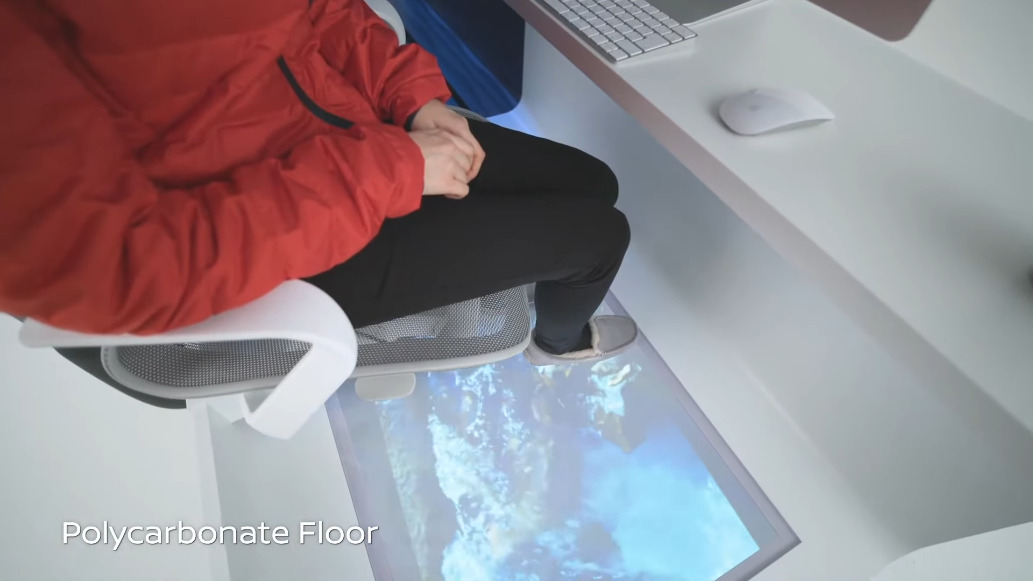
The office pod has some nice amenities like a DC-AC converter so you can run your Keurig or Nespresso, and there’s even a UV-disinfecting lamp in the glove box. The larger windows behind the cab can be electronically shaded so you don’t bake in the sun. Here’s where things get a bit ridiculous: the floor is made of clear polycarbonate in case you want to park lengthwise over a small stream and watch the surviving fish go by underneath your feet. And if you really want to take a break, climb up to the roof deck and stretch out in the chaise lounge beneath the deck umbrella.
All this working from home is pretty great, but we have to admit that we miss packing up the Hackaday office and heading for the local coffeehouse once in a while to spend a few hours writing against the buzzing background. One thing we don’t miss about the experience is that you’re never guaranteed a place to sit and spread out. And unless you trust a friendly stranger to keep an eye on your stuff while you’re in the bathroom, you have to take it with you at the risk of losing your table.
If only we could afford one of Nissan’s mobile office pod concept vehicles. We’ve always wanted to pretend we’re doing surveillance and would probably have the thing wrapped with graphics for a fake flower shop or something. That would certainly make it easier to park somewhere and borrow someone’s open Wi-Fi network — maybe even from the coffeehouse parking lot after we hit the drive-thru.
As you’ll see in the extended tour video below, Nissan seem to have thought of everything except restroom facilities. The cab-over-engine design and all-terrain tires would make it easier to drive out into nature and really get away from it all. Once you’ve found the perfect spot, you can open the lift gate for some fresh air, or get some sun while you work by pulling out the motorized unibody-constructed cubicle which includes a built-in Herman Miller Cosm chair. (Evidently the Aeron is old and busted now; we disagree). For some reason, the cubicle is edge-lit, and not in a way that would help you work at the desk. According to the video, it’s based on the Caravan NV350, which looks far more comfortable but not as cool when outfitted as an alternate mobility concept.
The office pod has some nice amenities like a DC-AC converter so you can run your Keurig or Nespresso, and there’s even a UV-disinfecting lamp in the glove box. The larger windows behind the cab can be electronically shaded so you don’t bake in the sun. Here’s where things get a bit ridiculous: the floor is made of clear polycarbonate in case you want to park lengthwise over a small stream and watch the surviving fish go by underneath your feet. And if you really want to take a break, climb up to the roof deck and stretch out in the chaise lounge beneath the deck umbrella.
We live in a time where our phones have computing power that would have been the envy of NASA a few decades ago. So, in theory, we should be able to simulate just about anything. Thanks to [rhoban], robots you design in OnShape — a popular CAD tool — are now easier to simulate using several common simulation tools.
Electronic circuits are pretty easy to simulate, because we typically draw schematics and circuit simulators can capture those schematics readily. But simulating physics for robotic designs is a bit trickier. Gazebo and Pybullet both can use SDF files or URDF. However, building those files is often a separate process from actual physical design even though you probably did the design using a CAD tool. Even if you don’t use OnShape, you can probably import your preferred format and then bridge to the simulation file format without having to manually recreate your design. You can see the author walk through the process in the video below.
The program does use the OnShape API, so you’ll need a key for that. The example quadruped looks like a cool design. Once you have the design in the right format, you can use multiple tools to work with it from a simulation perspective.
The device is a small, flexible patch that adheres to the skin. So how does it manage to measure blood pressure without causing discomfort? The blood pressure sensor consists of eight customized piezoelectric transducers that bounce ultrasonic waves off the near and far walls of the artery. Then the sensor calculates the time of flight of the resulting echoes to gauge arterial dilation and contraction, which amounts to a blood pressure reading.
This patch also has a chemical sensor that uses a drug called pilocarpine to induce the skin to sweat, and then measures the levels of lactate, caffeine, and alcohol found within. To monitor glucose levels, a mild current stimulates the release of interstitial fluid — the stuff surrounding our cells that’s rife with glucose, salt, fatty acids, and a few minerals. This is how continuous glucose monitoring for diabetes patients works today. You can check out the team’s research paper for more details on the patch and its sensors.
In the future, the engineers are hoping to add even more sensors and develop a wireless version that doesn’t require external power. Either way, it looks much more comfortable and convenient than current methods.
As time has gone by and PCB assembly companies have reached further into the space of affordability for our community, the available types of board have multiplied. No longer are we limited to FR4 with a green solder mask, we can have all colours of the rainbow and a variety of substrates. The folks at BotFactory have taken things a step further with their PCB printer though, by printing a fully-functional PCB on a quarter.
As a base layer the printed five passes of insulation on the coin, before printing the traces. Holes are left in the insulation to create a form of via that connects to the coin. On the board is an ATtiny2313 microcontroller that flashes an LED, and on the reverse side of the coin is a CR2032 cell that’s secured with a set of bolts and washers. You can see it taking shape in the video below the break.
It’s true that an LED flasher isn’t exciting, and that this is a marketing stunt for BotFactory’s printer. But it’s an inventive one, and reminds us that with a bit of ingenuity anything can become a board. We’ve had our share over the years, and instantly springing to mind is this stretchable PCB.
[James Bruton]’s impressive portfolio of robots has always used conventional rigid components, so he decided to take a bit of a detour and try his hand at a soft robot. Using a couple of few inflatable pool noodles for quick prototyping, his experiments quickly showed some of the strengths and weaknesses of soft robots.
Most of the soft robots we see require an external air source to inflate cells in the robot and make the limbs actuate. Taking inspiration from a recent Stanford research project, [James] decided to take an alternative approach, using partially inflated tubes and squeezing them in one section to make the other sections more rigid. He bought a couple of cheap pool noodles and experimented with different methods of turning them into actuators. The approach he settled on was a pair of noodles tied together side by side, and then folded in half by an elastic cord. As one end is squeezed by a servo bellows, the internal pressure overcomes the tension from the elastic cord, and the “elbow” straightens out.
[James] tested various arrangements of these limbs to build a working hexapod robot but to no avail. The simple actuating mechanism was simply too heavy, and could just lift itself slightly. This highlighted a common theme in almost all the soft pneumatic robots we’ve seen: they carry very little weight and are always tethered to an external air supply. The combination of stretchy materials and relatively low pressure compressed air can only handle small loads, at least in Earth gravity and above water.
However, it wasn’t all failure. [James] had success with a gripper design, which is the one area we have seen practical and commercial success with other soft robots. They do work well for gripping delicate and irregularly shaped objects. If you would like to experiment with [James]’s bellow design, it is open source and available on GitHub.
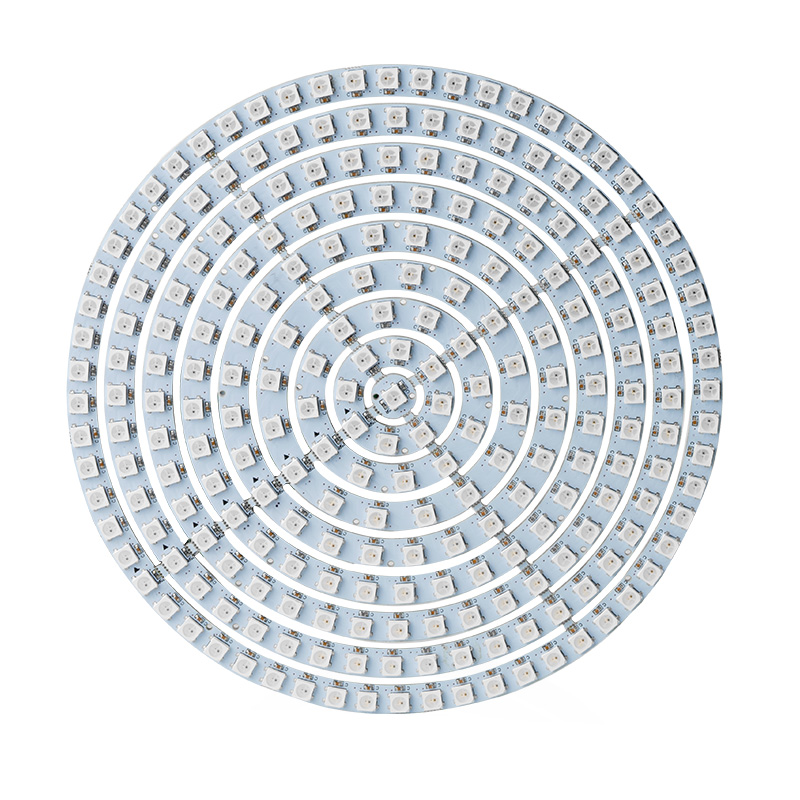
Building a clock of some sorts seems to be a time honored tradition for hackers and LED clocks seem one of the most popular. You can build anything from a seven-segment display to a binary clock or something even more fancy. [Clueless] found a circle of LED rings online and with made an LED version of an analog clock.
The rings aren’t wired together, and it seems like these are designed to be separated, but it’s pretty easy to wire them together in order to have a circle of individually accessible RGB LEDs. Each hand of the clock is a different color and is antialiased to give a smoother look, since the LEDs don’t line up. [Clueless] wanted the second hand to rotate smoothly, so it is updated using the milliseconds as an offset to the second. An ESP8266 runs the code and controls the LEDs getting the time from an NTP server. Occasionally, [Clueless] has the clock display a quick effect, such as a Pac-man or a radar scan animation.
All the files are up on the Github page, including the Blender models for the case, available to build your own and a simple search for “241 LED ring” turns up the LED hardware used. There are plenty of clock projects on the site, like this multicolor LED ring clock and we’re sure that you can find somethinginteresting.
It’s an exciting time in the world of microprocessors, as the long-held promise of devices with open-source RISC-V cores is coming to fruition. Finally we might be about to see open-source from the silicon to the user interface, or so goes the optimistic promise. In fact the real story is considerably more complex than that, and it’s a topic [Andreas Speiss] explores in a video that looks at the issue with a wide lens.
He starts with the basics, looking at the various layers of a computer from the user level down to the instruction set architecture. It’s a watchable primer even for those familiar with the topic, and gives a full background to the emergence of RISC-V. He then takes Espressif’s ESP32-C3 as an example, and breaks down its open-source credentials. The ISA of the processor core is RISC-V with some extensions, but he makes the point that the core hardware itself can still be closed source even though it implements an open-source instruction set. His conclusion is that while a truly open-source RISC-V chip is entirely possible (as demonstrated with a cameo Superconference badge appearance), the importance of the RISC-V ISA is in its likely emergence as a heavyweight counterbalance to ARM’s dominance in the sector. Whether or not he is right can only be proved by time, but we can’t disagree that some competition is healthy.
We had a comment recently from a nasty little troll (gasp! on the Internet!). The claim was that most makers are really just “copiers” because they’re not doing original work, whatever that would mean, but instead just re-making projects that other people have already done. People who print other peoples’ 3D models, or use other peoples’ hardware or software modules are necessarily not being creative. Debunking a cheap troll isn’t enough because, on deeper reflection, I’m guilty of the same generic sentiment; that feeling that copying other people’s work isn’t as worthy as making your own. And I think that’s wrong!
In the 3D printing world in particular, I’m guilty of dismissively classifying projects as “Yoda Heads”. About ten years ago, [chylld] uploaded a clean, high-res model of Yoda to Thingiverse, and everyone printed it out. Heck, my wife still has hers on her desk; and alone this is proof that straight-up copying has worth, because it made a sweet little gift. After a while, Yoda gave way to Baby Groots, and strangely enough we’re back to Yoda again, but it’s Baby Yoda now.
Does filling the world with more Yoda Heads, vomiting toothpaste or not, further creativity? I’d argue it does. It’s actually a moderately difficult print — those spindly little ears present an overhang challenge that’ll definitely help you calibrate your cooling, or force you to learn something about supports. Pushing your limits in 3D printing teaches you about the tool and what possibilities it presents. Mastering a tool is an important step toward using it creatively. And then there’s “riffing”.
Jazz musicians don’t just get up and play improvisational solos that come magically into their heads. They’ve spent hours in the shed, copying the ways that other players have interpreted the classics. Which is to say, they become creative through copying. Transcendental, inspirational, original moments come about through hours and hours of filtering other peoples’ work through your fingers, ears, and lips until it becomes a part of you and eventually bubbles up through your musical sensibility.
The same goes for any “derivative” project. We just covered a tuning-fork-based clock that was a remake of a previous incarnation, but in the process of re-making, it morphed a little bit into something more aesthetically post-apocalyptic. We’ve seen possibly a million word clock builds, but [t0mg]’s version this one is beautifully laser-etched into paint on the back side of glass, and made me think that you could do the same with the coating on the back side of a mirror. Riffing. I could go on for hours.
So maybe it’s not as sexy to re-make someone else’s project, but it can be tremendously valuable. It’s how we learn tools, how we increase our creative vocabulary, and it gives us a chance to explore something cool that someone else has done from the inside out. Copying should be seen as essential skill-building, despite our cultural prejudices against it. Go out and print yourself some Yoda Heads (metaphorically) without shame!
This article is part of the Hackaday.com newsletter, delivered every seven days for each of the last 200+ weeks. It also includes our favorite articles from the last seven days that you can see on the web version of the newsletter.
Want this type of article to hit your inbox every Friday morning? You should sign up!
We had a comment recently from a nasty little troll (gasp! on the Internet!). The claim was that most makers are really just “copiers” because they’re not doing original work, whatever that would mean, but instead just re-making projects that other people have already done. People who print other peoples’ 3D models, or use other peoples’ hardware or software modules are necessarily not being creative. Debunking a cheap troll isn’t enough because, on deeper reflection, I’m guilty of the same generic sentiment; that feeling that copying other people’s work isn’t as worthy as making your own. And I think that’s wrong!
In the 3D printing world in particular, I’m guilty of dismissively classifying projects as “Yoda Heads”. About ten years ago, [chylld] uploaded a clean, high-res model of Yoda to Thingiverse, and everyone printed it out. Heck, my wife still has hers on her desk; and alone this is proof that straight-up copying has worth, because it made a sweet little gift. After a while, Yoda gave way to Baby Groots, and strangely enough we’re back to Yoda again, but it’s Baby Yoda now.
Does filling the world with more Yoda Heads, vomiting toothpaste or not, further creativity? I’d argue it does. It’s actually a moderately difficult print — those spindly little ears present an overhang challenge that’ll definitely help you calibrate your cooling, or force you to learn something about supports. Pushing your limits in 3D printing teaches you about the tool and what possibilities it presents. Mastering a tool is an important step toward using it creatively. And then there’s “riffing”.
Jazz musicians don’t just get up and play improvisational solos that come magically into their heads. They’ve spent hours in the shed, copying the ways that other players have interpreted the classics. Which is to say, they become creative through copying. Transcendental, inspirational, original moments come about through hours and hours of filtering other peoples’ work through your fingers, ears, and lips until it becomes a part of you and eventually bubbles up through your musical sensibility.
The same goes for any “derivative” project. We just covered a tuning-fork-based clock that was a remake of a previous incarnation, but in the process of re-making, it morphed a little bit into something more aesthetically post-apocalyptic. We’ve seen possibly a million word clock builds, but [t0mg]’s version this one is beautifully laser-etched into paint on the back side of glass, and made me think that you could do the same with the coating on the back side of a mirror. Riffing. I could go on for hours.
So maybe it’s not as sexy to re-make someone else’s project, but it can be tremendously valuable. It’s how we learn tools, how we increase our creative vocabulary, and it gives us a chance to explore something cool that someone else has done from the inside out. Copying should be seen as essential skill-building, despite our cultural prejudices against it. Go out and print yourself some Yoda Heads (metaphorically) without shame!
This article is part of the Hackaday.com newsletter, delivered every seven days for each of the last 200+ weeks. It also includes our favorite articles from the last seven days that you can see on the web version of the newsletter.
Want this type of article to hit your inbox every Friday morning? You should sign up!