Making something that has to get into others’ hands involves solving a lot of different problems, many of which have nothing at all to do with actually building the dang things. [Conor Patrick] encountered them when he ran a successful Kickstarter campaign for an open-source USB security key that was not only shipped to backers, but also made available as an ongoing product for sale. There was a lot of manual and tedious work that could have been avoided, and so [Conor] laid out all the things he wishes he had done when first setting up a product line.
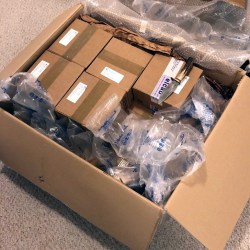
Turning these unprogrammed boards into finished products then shipping them is a big job.
If the whole process is a river, then the more “upstream” an issue is, the bigger its potential impact on everything that comes afterwards. One example is the product itself: the simplest and most easily managed product line is one that has only one product with no variations. That not only minimizes errors but makes supply, production, and shipping more straightforward. Striving for a minimum number of products and variations is also an example of something [Conor] didn’t do. In their crowdfunding campaign they offered the SoloKeys USB device — an implementation of the FIDO2 authentication token — as either USB-A or USB-C. There were also two types of key: NFC-capable (for tapping to a smartphone) and USB only. That is four products so far.
Offering keys in an unlocked state for those who want to tamper makes it eight different products. On top of that, they offered color choices which not only adds complexity to production, but also makes it harder to keep track of what everyone ordered. [Conor] also observed that the Kickstarter platform and back end are really not set up like a store, and it is clunky at best to try to offer (and manage) different products and variations from within it.
Another major point is fulfillment and in [Conor]’s opinion, unless the quantities are small, an order fulfillment company is worth partnering with. He says there are a lot of such companies out there, and it can be very time consuming to find the right one, but it will be nothing compared to the time and effort needed to handle, package, address, and ship several hundreds (or thousands!) of orders personally. His team did their own fulfillment for a total of over 2000 units, and found it a long and tedious process filled with hidden costs and challenges.
There’s good advice and background in [Conor]’s writeup, and this isn’t his first rodeo. He also shared his thoughts on taking electronics from design to production and the more general advice remains the same for it all: be honest and be open. Under-promise and over-deliver, especially when it comes to time estimates.
One thing we sometimes forget in our community is that many of the tecniques and machines that we take for granted are still something close to black magic for many outsiders. Here’s a tip: leave a 3D printer running next time you take a group of visitors round a hackerspace, and watch their reaction as a Benchy slowly emerges from the moving extruder. To us it’s part of the scenery, but to them it’s impossibly futuristic and their minds are blown.
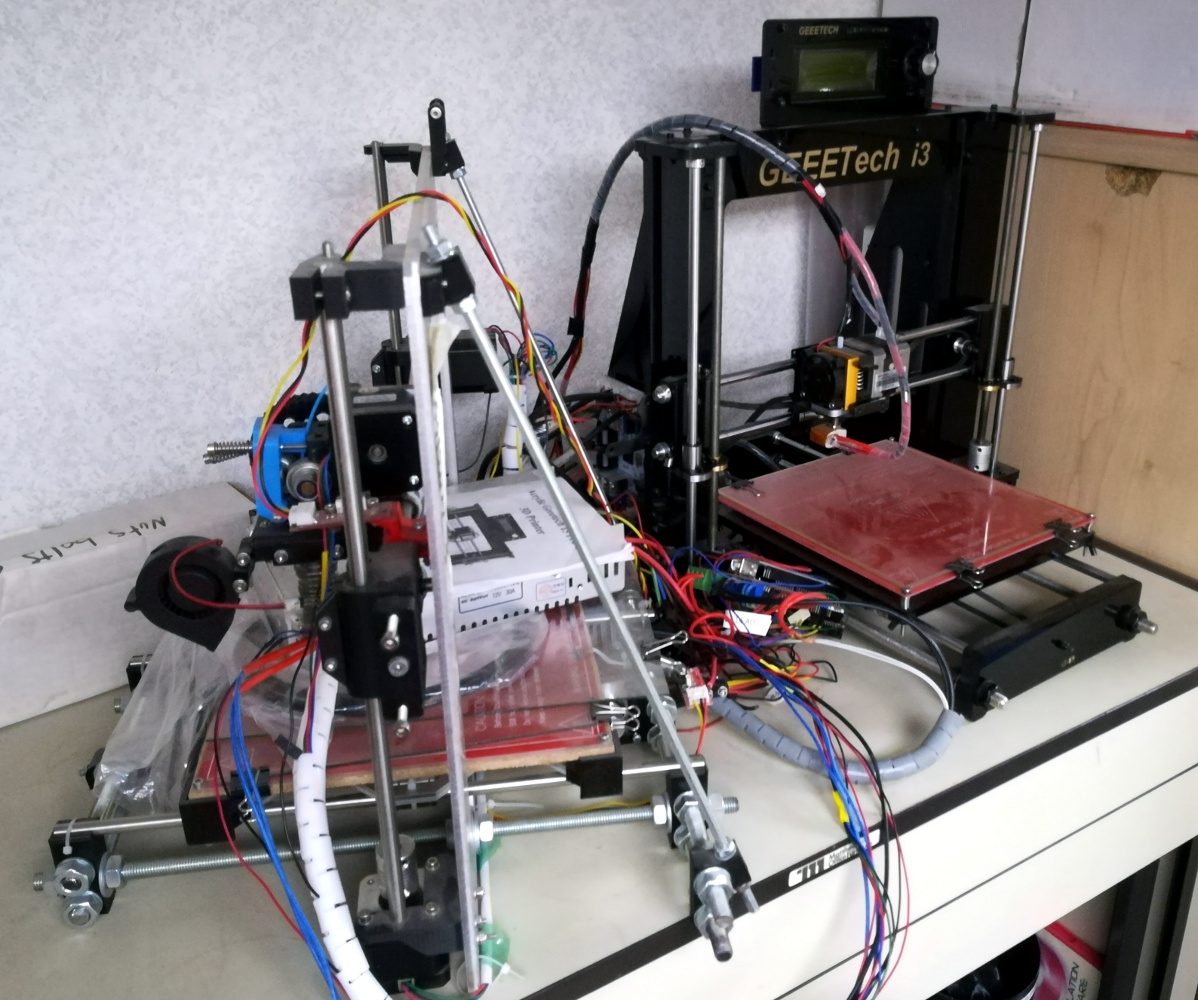
Just because something says it’s a Prusa i3, doesn’t mean it is a Prusa i3.
Nearly 15 years after the dawn of the RepRap project we have seen a huge advancement in the capabilities of affordable 3D printers, and now a relatively low three-figure sum will secure a machine from China that will churn out prints whose quality would amaze those early builders. We’ve reached the point in our community at which many people are on their third or fourth printer, and this has brought with it an unexpected side-effect. Where once a hackerspace might have had a single highly prized 3D printer, now it’s not unusual to find a pile of surplus older printers on a shelf. My hackerspaces both have several, and it’s a sight I’ve frequently seen on my travels around others. Perhaps it’s a sign of a technology maturing when it becomes ewaste, and thus it seems affordable 3D printing has matured.
Printer History Told Through The Medium Of Junk Piles
My hackerspace isn’t the only one with a few spare 3D printers! Ultimaker stash photo: Mendel Mobach
You can tell a lot about a product by how long it remains in use, for example a much higher percentage of Volkswagen Golfs have survived for three decades than have Yugo 55s. Thus a look at these piles of old printers is to look at which models turned out to be the stars and which the lemons. There are several main strands among them, each one representing a different set of failed dreams. First among them are the pioneers, a Makerbot Cupcake or perhaps a RepRap Darwin or Mendel. We even know of one space with a working Cupcake, but these aren’t machines you would use in 2019. Instead they represent the days when 3D printing was still a novelty even to us. If you think of the first machine you saw, perhaps it will be here.
Then there are the surprises, decent workhorses in their day that could still deliver a creditable result but which have simply been bypassed. It was a shock earlier in the year to see a pile of Ultimakers lying idle for instance, but perhaps I needed reminding that it was no longer 2015.
By far the most numerous though are the next group, knock-offs, proving that merely selling something as a Prusa clone does not make it a Prusa. It’s interesting though that not all clones were of low quality, I can think of more than one space still happily using years-old WanHao Duplicators, clones of the Makerbot Replicator.
Finally it’s a constant among hackerspaces that someone will have bought a delta printer and inevitably found it to be problematic. Is it a desire to be different or merely a fondness for printing vases that drives it, but if I had to guess which printer would be gathering dust it would be someone’s delta project.
What Can You Do with all This Junk?
So we’ve exposed a typical hackerspace junk pile as a potted history of failed desktop 3D printing endeavour, but as well as that it’s both a significant problem and an opportunity. A problem because while it has become a matter of ewaste the 3D printers themselves are still perceived as having value — but value that can only be realized if they do something other than sit on a junk pile. An opportunity because they still contain the basis of a CNC machine that is sitting idle.
If we can rid ourselves of the view that an old 3D printer is sacrosanct then we can make something of them, turn them into the basis of something else. We’ve all at times amassed piles of junk before realising that we’ve made a mistake, so there’s no shame in taking a fresh look at that printer pile.
The WanHao Duplicator that’s still one of the workhorse printers at MK Makerspace.
At its most basic, a redundant 3D printer is a pile of parts just waiting to be dismantled. Slides, stepper motors, extrusions, and the associated electronics. It’s questionable whether whatever was the cutting edge in extruders and control boards circa 2012 could find a use in 2019, but the rest should find ready homes in other projects. To dismantle a printer though is perhaps to lose sight of its main event. A ready-made CNC mechanism with generous X, Y, and Z axes and a ready-to-go controller should be something that presents endless possibilities.
Attaching a mini router or an engraving laser to it is something of a done deal, but what else could you do? Make chocolate and fondant extruders with syringes and servos, and print confectionery? Attach an LED for some 3D-light painting? One-off art project or wacky tool, how have you repurposed your disused printer to keep it from gathering dust.
Whatever you think of for your surplus 3D printers, perhaps in all this there’s another story. Our community didn’t invent the 3D printer, but we’ve certainly taken it as our own and run with it. If we’ve reached the point at which they have finally matured, then in part that success belongs to us, to those hackers who have pushed forward their design. We can feel proud of that pile of surplus older printers, because they and the $200 Chinese machine that replaced them represent a 15-year success story from our community. The question is, where will they go in the next 15 years?
[Jason Gin] wanted to reuse the SIM card that came with a ZTE WF721 wireless terminal he got from AT&T, but as he expected, it was locked to the device. Unfortunately, the terminal has no function to change the PIN and none of the defaults he tried seemed to work. The only thing left to do was crack it open and sniff the PIN with a logic analyzer.
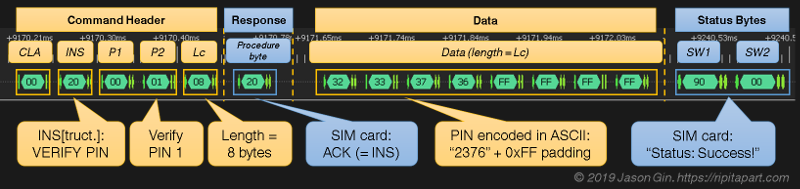
This project is a fantastic example of the kind of reverse engineering you can pull off with even a cheap logic analyzer and a keen eye, but also perfectly illustrates the fact that having physical access to a device largely negates any security measures the manufacturer tries to implement. [Jason] already knew what the SIM unlock command would look like; he just needed to capture the exchange between the WF721 and SIM card, find the correct byte sequence, and look at the bytes directly after it.
Finding the test pads on the rear of the SIM slot, he wired his DSLogic Plus logic analyzer up to the VCC, CLK, RST, and I/O pins, then found a convenient place to attach his ground wire. After a bit of fiddling, he determined the SIM card was being run at 4 MHz, so he needed to configure a baud rate of 250 kbit/s to read the UART messages passing between the devices.
Once he found the bytes that signified successful unlocking, he was able to work his way backwards and determine the unlock command and its PIN code. It turns out the PIN was even being sent over the wire in plain text, though with the way security is often handled these days, we can’t say it surprises us. All [Jason] had to do then was put the SIM in his phone and punch in the sniffed PIN when prompted.
Could [Jason] have just run out to the store and picked up a prepaid SIM instead of cracking open this wireless terminal and sniffing its communications with a logic analyzer? Of course. But where’s the fun in that?
We’re suckers for the Fallout aesthetic, so anything with a post-apocalyptic vibe is sure to get our attention. With a mid-century look, Nixie tubes, a brushed metal faceplate, and just a touch of radioactivity, this quantum random number generator pushes a lot of design buttons, and it pushes them hard.
Charmingly named “Chernobyl Dice”, this little gadget comes to us from [Nathan Griffith], and appears to be one of those “Why not?” builds we love so much. The heart of any random number generator is a source of entropy, for which [Nathan] chose to use six slightly radioactive uranium glass marbles. Those feature prominently in the front panel of the device, occasionally made to fluoresce with a few UV LEDs just because it looks cool. A Geiger tube inside the case is used to look for decay events from the marbles every millisecond. After some adjustment for the bias toward zeroes due to the relative rarity of decay events, the accumulated bits are displayed on eight Nixies. The box can be set to generate a stream of random numbers up to 31 bits long and send it over a USB port, or make random throws of a die with a settable number of sides. And when it’s not doing random stuff, it can just be a cool Nixie clock.
There are lots of ways to generate the entropy needed for truly random number generation, from a wall of lava lamps to bubbles in a fish tank. They’ve all got style, but something about this one just works.
When [gdarchen] wanted to read some NFC tags, he went through several iterations. First, he tried an Electron application, and then a client-server architecture. But his final iteration was to make a standalone reader with an Arduino and use WebUSB to connect to the application on the PC.
This sounds easy, but there were quite a few tricks required to make it work. He had to hack the board to get the NFC reader’s interrupt connected correctly because he was using a Leonardo board. But the biggest problem was enabling WebUSB support. There’s a library, but you have to change over your Arduino to use USB 2.1. It turns out that’s not hard, but there’s a caveat: Once you make this change you will need the WebUSB library in all your programs or Windows will refuse to recognize the Arduino and you won’t be able to easily reprogram it.
Once you fix those things, the rest is pretty easy. The PC side uses node.js. If you back up a level in the GitHub repository, you can see the earlier non-Arduino versions of the code, as well.
If you want to understand all the logic that went into the design, the author also included a slide show that discusses the three versions and their pros and cons. He did mention that he wanted a short-range solution so barcodes and QR codes were out. He also decided against RFID but didn’t really say why.
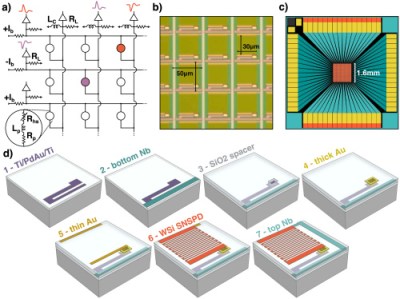
There may soon be breakthroughs in the search for dark matter. A new publication in Optics Expressreveals a camera consisting of superconducting nanowires capable of detecting single photons, a useful feature for detecting light at the furthest ends of the infrared band. The high-performance camera, developed by the National Institute of Standards and Technology (NIST), boasts some of the best performing photon counters in the world in terms of speed, efficiency, and color detection. The detectors also have some of the lowest dark count rates of any photon sensor, resisting false signals from noise.
The size of the detectors comes out to 1.6mm on each side, packed with 1024 sensors for high resolution imagery and fabricated from silicon wafers cut into chips. The nanowires are made from tungsten and silicon alloy with leads made from superconducting niobium.
In order to prevent the sensors from overheating, a readout architecture was used based on a previous demonstration on a smaller camera with 64 sensors adding data from rows and columns. The research has been in collaboration with the National Aeronautics and Space Administration (NASA), which seeks to include the camera in the Origins Space Telescope project.
The eventual goal is to use the arrays to analyze chemical compositions of planets outside of our solar system. By observing the absorption spectra of light passing through an exoplanet’s atmosphere, information can be gathered on the elements in the atmosphere. Currently, large-area single-photon counting detector arrays don’t exist for measuring the mid- to far-infrared signatures, the spectrum range for elements that may indicate signs of life. While fabrication success is high, the efficiency of the detectors remains quite low, although there are plans to extend the current project into an even bigger camera with millions of sensors.
In addition to searching for chemical life on other planets, future applications may include recording measurements to confirm the existence of dark matter.
It’s the season to be surrounded by greeting cards of all shapes and sizes from friends old and new. News of their families and achievements, reminders that they exist, and a pile of cards to deal with sometime in January. Wouldn’t it be great if you could send something with a little more substance, something your friends would remember, maybe even hang on to?
[Brian Brocken]’s 3D-printed Da Vinci catapult kit may not fill that niche for everyone, but we can guarantee it will be a talking point. The Da Vinci catapult design uses a pair of springs similar to an archer’s bow, to unwind a pair of ropes and thus turn the shaft upon which the catapult shaft itself is fitted. All these components are mounted in a single piece with sprues similar to an injection moulded model kit, allowing the whole to easily be posted in an envelope.
The parts are all available to print separately among the files on the Thingiverse page for those with no need to mail them. For the casual spectator he’s made a YouTube video that we’ve placed below the break, detailing the design and build process as well as showing the device in use.
Pixelated RPGs are pretty standard in games like Legend of Zelda and Pokemon, but have you ever seen anything like ASCIICKER? It’s a full-color three-dimensional world rendered with ASCII art and playable in your browser.
For the time being, the game exists as an experiment. There’s no storyline or goals other than exploring the world, although you can meet up with (or follow) others exploring the game — although all of the sprites look the same, so it may be difficult to have interactions. The game was created by [Gumix] and built entirely in JavaScript without using any other game engines.
All of the previous iterations have also been published online and are accessible by adding X1 up to X13 to the end of the URL. With game development beginning in 2017, it has since been through a considerable amount of change. There’s an entire subreddit dedicated to the game with regular updates from the creator on the development of an open-source dev tool for building new levels and features for the environment. The current engine is capable of rendering objects as thin as fences as well as reflections in bodies of water.
Flight shaming is the hot new thing where people who take more than a handful of trips on an airplane per year are ridiculed for the environmental impact of their travels. It’s one strategy for making flying more sustainable, but it’s simply not viable for ultimately reducing the carbon impact that the airline industries have on the environment.
Electric planes are an interesting place to look for answers. Though carbon-free long haul travel is possible, it’s not a reality for most situations in which people travel today. Current battery technology can’t get anywhere near the energy density of fossil fuels and larger batteries aren’t an option since every pound matters when designing aircraft.
Even with land travel and electric grids improving in their use of renewables and electric power, aviation tends to be difficult to power with anything other than hydrocarbons. Student engineers in the AeroDelft program in the Netherlands have created Project Phoenix to develop an aircraft powered by a liquid hydrogen fuel cell, producing a primary emission of water vapor. So it is an electric plane, but leverages the energy density of hydrocarbons to get around the battery weight problem.
While the project may seem like an enormous reach peppered with potential safety hazards, redundant safety features are used such as sensors and vents in case of a hydrogen leakage, as well as an electric battery in case of failure. Hydrogen produced three times more energy per unit than kerosene, but is six times the volume in gas form and requires cumbersome compression tanks.
Even though hydrogen fuel only produces water vapor as a byproduct, it can still cause greenhouse effects if it is released too high and creates clouds. The team is exploring storage tanks for slow release of the water vapor at more optimal altitudes. On top of that, most hydrogen is produced using steam methane reforming (SMR), creating up to 150g of greenhouse gases per kWh, and electrolysis tends to be more costly and rarely carbon neutral. Alternatives such as solar power, biofuels, and electric power are looking to make headwind as well, but the technology is still far from perfected.
While it’s difficult to predict the success of the project so early on, the idea of reducing risk in hydrogen fuels may not be limited to a handful of companies for very long.
Good morning everyone, and what a lovely start to the new year it is, because it’s your birthday! Happy birthday, it’s your 50th! What’s that you say, you aren’t 50 today? (Looks…) That’s what all these internet databases say, because you’ve spent the last decade or so putting 1970-01-01 as your birth date into every online form that doesn’t really need to know it!
It’s been a staple for a subset of our community for years, to put the UNIX epoch, January 1st 1970, into web forms as a birth date. There are even rumours that some sites now won’t accept that date as a birthday, such is the volume of false entries they have with that date. It’s worth taking a minute though to consider UNIX time, some of its history and how its storage has changed over the years.
Don’t Use Up That 32 Bit Int Too Quickly
How do you turn a 1960s minicomputer into a clock? Digital pdp8f.jpg: Simon Claessen [CC BY-SA 3.0]
Most readers will be familiar with the UNIX timestamp that the date command will return on UNIX-like operating systems. It’s an integer value representing the number of whole seconds that have elapsed since January 1st 1970, and it’s easy enough to write a little script that scrolls it up the screen so you can watch it increment second by second. But the interesting things about it are that the epoch date preceded its inception by several years, and the earliest UNIX versions used a rather different timing system.
We’re used to generating any clock signal we please using any of a huge number of available clock chips. If we need an odd frequency, there will be a PLL chip somewhere that can do it. In the early 1970s though the designers of the DEC minicomputers used by those primordial UNIX developers did not have that luxury, as complex clock generation would have required costly extra logic chips. The earliest UNIX time was thus measured in terms of the American mains power frequency, 60ths of a second with an epoch at the start of 1971. Since a 32 bit number at that rate would have meant a very short time before roll-over it was decided to use seconds instead with an epoch at the start of the decade. The latest distributions might have switched to using a 64-bit integer because the original 32-bit one would roll over in 2038, but otherwise the timing scheme remains unchanged.
Face It, We’re All Growing Older One Second At A Time
The 50-year anniversary, whether real or assumed, hides another impact of that early UNIX. For our youngest readers it’s possible that the start of the 1970s now represents as remote a date as possible, but for many adults it has still been possible to cling to the notion that it’s not too long ago even if we weren’t personally around to see it. The five-decade mark is a definitive point that puts it firmly in the historical, and should remind us that UNIX is no longer the relative new kid it might have been when we first used it.
You can still get away with claiming it for a fake birthday (at least for a a few more decades) perhaps it’s time to reflect that much of the technology we like to think of as cutting-edge and exciting is in fact now mature and middle-aged. It’s likely we’ll be still measuring time in some way from the same UNIX epoch in a century’s time, and by then how shall we express a fake birthday?
The Urantia Book dates back to some point between 1924 and 1955. It emerged in Chicago, IL, and no one who is still alive knows who wrote it. In the book, Urantia is the Earth. The book talks about God, Jesus, the meaning of life, science, and philosophy. In this telling, however, Jesus is born via traditional conception, not immaculate conception, and he did not perform the miracles mentioned in the Bible.
The book was brought to public attention by two doctors, husband and wife William and Lena Sadler, who said a neighbor told them her husband was falling into very weird and deep sleeps. The man would also frequently speak what he claimed were messages from some other being. He eventually began to write these messages down as opposed to speaking them aloud, which is how the book came to be. The man’s identity was never revealed, as William Sadler said the “revelators [authors] do not want any human being—any human name — ever to be associated” with the book. Some believe that the book is a hoax.
I N THE MINDS of the mortals of Urantia—that being the name of your world—there exists great confusion respecting the meaning of such terms as God, divinity, and deity. Human beings are still more confused and uncertain about the relationships of the divine personalities designated by these numerous appellations. Because of this conceptual poverty associated with so much ideational confusion, I have been directed to formulate this introductory statement in explanation of the meanings which should be attached to certain word symbols as they may be hereinafter used in those papers which the Orvonton corps of truth revealers have been authorized to translate into the English language of Urantia. It is exceedingly difficult to present enlarged concepts and advanced truth, in our endeavor to expand cosmic consciousness and enhance spiritual perception, when we are restricted to the use of a circumscribed language of the realm. But our mandate admonishes us to make every effort to convey our meanings by using the word symbols of the English tongue. We have been instructed to introduce new terms only when the concept to be portrayed finds no terminology in English which can be employed to convey such a new concept partially or even with more or less distortion of meaning. In the hope of facilitating comprehension and of preventing confusion on the part of every mortal who may peruse these papers, we deem it wise to present in this initial statement an outline of the meanings to be attached to numerous English words which are to be employed in designation of Deity and certain associated concepts of the things, meanings, and values of universal reality. But in order to formulate this Foreword of definitions and limitations of terminology, it is necessary to anticipate the usage of these terms in the subsequent presentations. This Foreword is not, therefore, a finished statement within itself; it is only a definitive guide designed to assist those who shall read the accompanying papers dealing with Deity and the universe of universes which have been formulated by an Orvonton commission sent to Urantia for this purpose. Your world, Urantia, is one of many similar inhabited planets which comprise the local universe of Nebadon. This universe, together with similar creations, makes up the superuniverse of Orvonton, from whose capital, Uversa, our commission hails. Orvonton is one of the seven evolutionary superuniverses of time and space which circle the neverbeginning, never-ending creation of divine perfection—the central universe of Havona. At the heart of this eternal and central universe is the stationary Isle of Paradise, the geographic center of infinity and the dwelling place of the eternal God. The seven evolving superuniverses in association with the central and divine universe, we commonly refer to as the grand universe; these are the now organized and inhabited creations. They are all a part of the master universe, which also embraces the uninhabited but mobilizing universes of outer space.
Popol Vuh is a written text dating back to the mid-1500s, and its name translates to “Book of the People.” It is written in the Mayan language K’iche’ and discusses the creation of humans and animals. Two prominent characters are the Hero Twins, Hunahpu and Xbalanque, who ultimately become the sun and the moon. The book was found by a priest in Guatemala in the 1700s.
According to its creation myth, there was only sky and sea until the creators formed the Earth. Their first creatures were animals, then mud men, then wooden men, which did not work out so well. However, they eventually made four men out of corn. Later, while the men slept, the gods created women. The entire creation story can be heard in the video above.
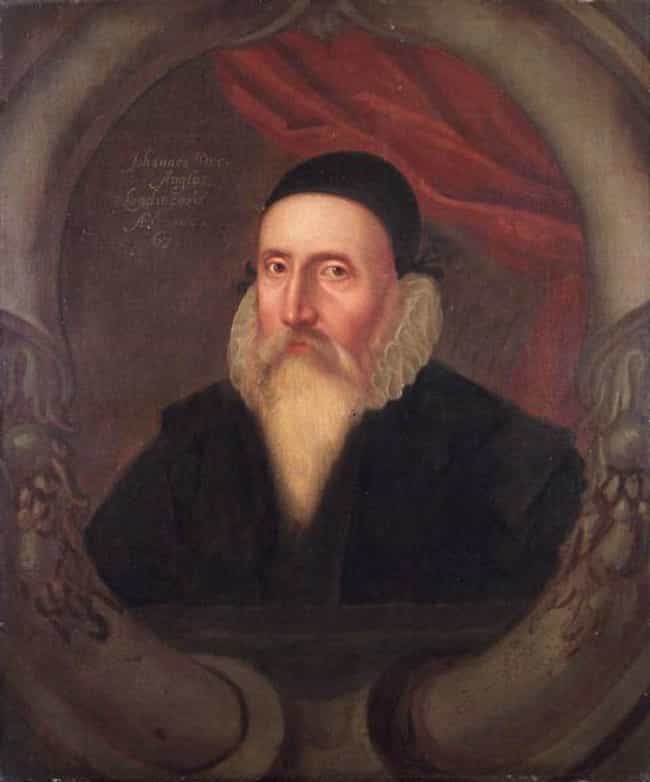
The Book of Soyga, also known as Aldaraia, is a book about magic. It is written in Latin and talks of demons, astrology, spells, and angels. Scholar John Dee, who was an advisor to Queen Elizabeth I, had a copy of the book in the 16th century, but it was lost after his passing. However, two copies of the book were found later: one in the British Library and the other in the Bodleian Library.
Dee was unable to figure out several tables contained in the book, and once attempted to talk to angels for help figuring the book out via Edward Kelley, a medium who purported to channel them.
The Voynich Manuscript was purchased by Polish antique books dealer Wilfrid Voynich in 1912. It is a roughly 250-page book written in some kind of code that no one has ever been able to crack. It is believed to date back to the 15th century and is rife with illustrations of various herbs, animals, people, astrology, and maps.
Some believe the book may have been medicinal in nature. The book currently resides at Yale University’s Beinecke Rare Book and Manuscript Library.