
Monthly Archives: August 2020
What does a computer mouse see?
What does a computer mouse see?
Cheap And Effective Mosquito Trap Looks Like A Disco
Words cannot quite articulate the collective loathing humankind has for mosquitoes, and rightfully so! These parasite peddling, blood sucking little critters are responsible for a great deal of human suffering. Mosquito-borne diseases such as malaria still account for a significant proportion of human mortality, especially in under-developed parts of the world . So it’s no wonder that people try to reduce their numbers; see this latest $40 mosquito trap by [jacobsk]. (Video, embedded below.)
The idea is critically simple, opening up the potential for widespread deployment. The base and body of the trap are made out of three five-gallon buckets with a mini desk fan sandwiched in between, providing suction into the main trap bin. An opening is cut in the top bucket as a point of entry, and an old school incandescent blacklight is mounted in the centre, with just enough IR and UV output to entice these little vermin, who will definitely regret mistaking it for a black-light rave.
[jacobsk] also does a very good job of showing every step of its construction in his videos. Whilst this solution is purposefully low tech, check out this admittedly overcooked way of killing mosquitoes, with a laser turret.
source https://hackaday.com/2020/08/03/cheap-and-effective-mosquito-trap-looks-like-a-disco/
BFF for a tennis player
Sound That Makes Dog Tilt Head Left & Right (GUARANTEED )
Making a Nightstand with Hidden Drawer & Epoxy Inlay
A New Adventure – Minecraft Skyblock Let’s Play | Part 1
my boyfriend comes home from basic training
The HyperCube

Polyhedra
So I saw a video on the Rhombic Icosahedron made by Adam Savage and the Numberphile.
I thought I may try my hand at it and hunted for the relevant angles.
Found this site that has cardboard cutouts with the relevant measurements and layouts to assemble.
Pop around and have a look, most can be done with cardboard, though i want mine as an infinity box.
ANTHONY JAMES : ABSOLUTE ZERO
Infinity Dodecahedron DIY 1/2 How to
Pinephone Gets Thermal Imaging Backpack
When you buy a mass-market mobile phone, you’re making the decision to trust a long list of companies with your private data. While it’s difficult for any one consumer to fully audit even a single piece of consumer technology, there have been efforts to solve this problem to a degree. The Pinephone is one such example, with a focus on openness and allowing users to have full control over the hardware. [Martijn Braam] is a proud owner of such a device, and took advantage of this attitude to add a thermal imager to the handset.
The build is not a difficult one, thanks to the expansion-friendly nature of the Pinephone hardware. The rear of the phone sports six pogo pins carrying an I2C bus as well as power. [Martin] started by modifying the back cover of the phone with contacts to interface with the pogo pins. With this done, the MLX90640 thermal imager was attached to the case with double-sided tape and wired up to the interface.
While the 32×24 output from the sensor isn’t going to help you build cutting edge heat-seeking missiles, it’s an affordable sensor with good performance for low-end thermal imaging tasks. We’ve featured teardowns of thermal imaging hardware before, too.
source https://hackaday.com/2020/08/03/pinephone-gets-thermal-imaging-backpack/
See the Science Behind VR Display Design, and What Makes a Problem Important
VR headsets are more and more common, but they aren’t perfect devices. That meant [Douglas Lanman] had a choice of problems to address when he joined Facebook Reality Labs several years ago. Right from the start, he perceived an issue no one seemed to be working on: the fact that the closer an object in VR is to one’s face, the less “real” it seems. There are several reasons for this, but the general way it presents is that the closer a virtual object is to the viewer, the more blurred and out of focus it appears to be. [Douglas] talks all about it and related issues in a great presentation from earlier this year (YouTube video) at the Electronic Imaging Symposium that sums up the state of the art for VR display technology while giving a peek at the kind of hard scientific work that goes into identifying and solving new problems.
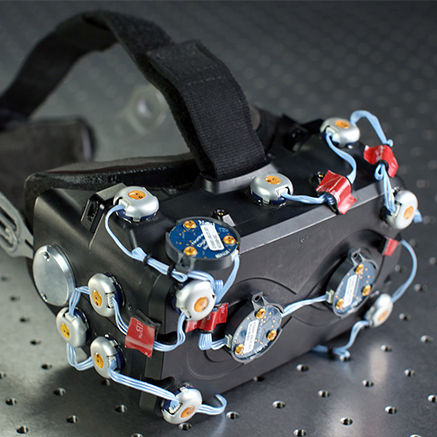
[Douglas] chose to address seemingly-minor aspects of how the human eye and brain perceive objects and infer depth, and did so for two reasons: one was that no good solutions existed for it, and the other was that it was important because these cues play a large role in close-range VR interactions. Things within touching or throwing distance are a sweet spot for interactive VR content, and the state of the art wasn’t really delivering what human eyes and brain were expecting to see. This led to years of work on designing and testing varifocal and multi-focal displays which, among other things, were capable of presenting images in a variety of realistic focal planes instead of a single flat one. Not only that, but since the human eye expects things that are not in the correct focal plane to appear blurred (which is itself a depth cue), simulating that accurately was part of things, too.
The entire talk is packed full of interesting details and prototypes. If you have any interest in VR imaging and headset design and have a spare hour, watch it in the video embedded below.
Things have certainly come a long way since mobile phone-based VR headsets, and displays aren’t the only thing getting all the attention. Cameras have needed their own tweaks in order to deliver the most to the VR and AR landscape.
Red Fox is very excited to see her best friend !
15grams – Pieces Of You (Official Lyric Video)
Electrochemistry at Home
A few years ago, I needed a teeny, tiny potentiostat for my biosensor research. I found a ton of cool example projects on Hackaday and on HardwareX, but they didn’t quite fulfill exactly what I needed. As any of you would do in this type of situation, I decided to build my own device.
Now, we’ve talked about potentiostats before. These are the same devices used in commercial glucometers, so they are widely applicable to a number of biosensing applications. In my internet perusing, I stumbled upon a cool chip from Texas Instruments called the LMP91000 that initially appeared to do all the hard work for me. Unfortunately, there were a few features of the LMP91000 that were a bit limiting and didn’t quite give me the range of flexibility I required for my research. You see, electrochemistry works by biasing a set of electrodes at a given potential and subsequently driving a chemical reaction. The electron transfer is measured by the sensing electrode and converted to a voltage using a transimpedance amplifier (TIA). Commercial potentiostats can have voltage bias generators with microVolt resolution, but I only needed about ~1 mV or so. The problem was, the LMP91000 has a resolution of ~66 mV on a 3.3 V supply, mandating that I augment the LMP991000 with an external digital-to-analog converter (DAC) as others had done.
However, changing the internal reference of the LMP91000 with the DAC confounded the voltage measurements from the TIA, since the TIA is also referenced to the same internal zero as the voltage bias generator. This seemed like a problem other DIY solutions I came across should have mentioned, but I didn’t quite find any other papers describing this problem. After punching myself a little, I thought that maybe it was a bit more obvious to everyone else except me. It can be like that sometimes. Oh well, it was a somewhat easy fix that ended up making my little potentiostat even more capable than I had originally imagined.
I could have made a complete custom potentiostat circuit like a few other examples I stumbled upon, but the integrated aspect of the LMP91000 was a bit too much to pass up. My design needed to be as small as possible since I would eventually like to integrate the device into a wearable. I was using a SAMD21 microcontroller with a built-in DAC, therefore remedying the problem was a bit more convenient than I originally thought since I didn’t need an additional chip in my design.
I am definitely pretty happy with the results. My potentiostat, called KickStat, is about the size of a US quarter dollar with a ton of empty space that could be easily trimmed on my next board revision. I imagine this could be used as a subsystem in any number of larger designs like a glucometer, cellphone, or maybe even a smartwatch.
Check out all the open-source files on my research lab’s GitHub page. I hope my experience will be of assistance to the hacker community. Definitely a fun build and I hope you all get as much kick out of it as I did.
source https://hackaday.com/2020/08/02/electrochemistry-at-home/
칭다오에서 가장 시원했던 보면서 하는 귀청소 – ASMR
literally the most ANNOYING ENTITLED PARENTS you will see today
Minecraft: A New Beginning – 1.16 Survival Let’s play | Ep 1
Folding@Home And Rosetta, For ARM
Most readers will be aware of the various distributed computing projects that provide supercomputer-level resources to researchers by farming out the computing tasks across a multitude of distributed CPUs and GPUs. The best known of these are probably Folding@Home and Rosetta, which have both this year been performing sterling service in the quest to understand the mechanisms of the SARS COVID-19 virus. So far these two platforms have remained available nearly exclusively for Intel-derived architectures, leaving the vast number of ARM-based devices out in the cold. It’s something the commercial distributed-computing-on-your-phone company Neocortix have addressed, as they have successfully produced ARM64 clients for both platforms that will be incorporated into the official clients in due course.
So it seems that mundane devices such as mobile phones and the more capable Raspberry Pi boards will now be able to fold proteins like a boss, and the overall efforts to deliver computational research will receive a welcome boost. But will there be any other benefits? It’s a Received Opinion that ARM chips are more power-efficient than their Intel-derived cousins, but will this deliver more energy-efficient distributed computing? The answer is “probably”, but the jury’s out on that one as computationally intensive tasks are said to erode the advantage significantly.
Folding@Home was catapulted by the influx of COVID-19 volunteers into first place as the world’s largest supercomputer earlier this year, and we’re pleased to say that Hackaday readers have played their part in that story. As this is being written the July 2020 stats show our team ranked at #39 worldwide, having racked up 14,005,664,882 points across 824,842 work units. Well done everybody, and we look forward to your ARM phones and other devices boosting that figure. If you haven’t done so yet, download the client and join us..
Via HPCwire. Thanks to our colleague [Sophi] for the tip.
source https://hackaday.com/2020/08/02/foldinghome-and-rosetta-for-arm/