
Monthly Archives: August 2020
Dealing With People Who Think The Rest Of Us Owe Them Something – 04/26/2011
So I made pickaxes RIDICULOUSLY LONG… (ft. Bandi) [Datapack]
Official Arduboy Upgrade Module Nears Competition
We’ve been big fans of the Arduboy since [Kevin Bates] showed off the first prototype back in 2014. It’s a fantastic platform for making and playing simple games, but there’s certainly room for improvement. One of the most obvious usability issues has always been that the hardware can only hold one game at a time. But thanks to the development of an official add-on, the Arduboy will soon have enough onboard storage to hold hundreds of games
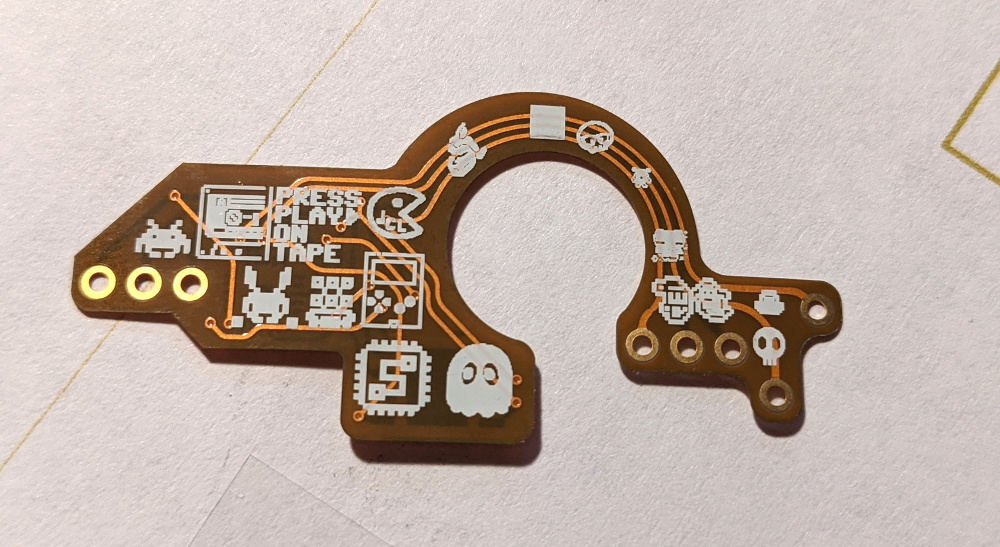
The upgrade takes the form of a small flexible PCB that gets soldered to existing test points on the Arduboy. Equipped with a W25Q128 flash chip, the retrofit board provides an additional 16 MB of flash storage to the handheld’s ATmega32u4 microcontroller; enough to hold essentially every game and program ever written for the platform at once.
Of course, wiring an SPI flash chip to the handheld’s MCU is only half the battle. The system also needs to have its bootloader replaced with one that’s aware of this expanded storage. To that end, the upgrade board also contains an ATtiny85 that’s there to handle this process without the need for an external programmer. While this is a luxury the average Hackaday reader could probably do without, it’s a smart move for an upgrade intended for a wider audience.
The upgrade board is currently available for pre-order, but those who know their way around a soldering iron and a USBasp can upgrade their own hardware right now by following along with the technical discussion between [Kevin] and the community in the “Project Falcon” forum. In fact, the particularly astute reader may notice that this official upgrade has its roots in the community-developed Arduboy cartridge we covered last year.
source https://hackaday.com/2020/08/04/official-arduboy-upgrade-module-nears-competition/
LIKE A BOSS COMPILATION #252 AMAZING Videos #ЛайкЭбосс
I secretly got a PUNCH 1,000 BOW in Minecraft Bedwars…
POUR COFFEE ON THOSE YOU DISAGREE WITH SJW FAILS AND CRINGE #73
Dealing With Annoying Neighbors
MenoPlay Through the Pain of Menopause
Menopause, that fireworks finale of fertility, is like a second puberty that works in reverse. At least, that’s what we hear. Along with mood swings and acne, there are new joys like hot flashes that make you want to jump naked into the nearest snowdrift, or at least put your head in the freezer for a while. Sounds great; can’t wait.
The biggest problem with menopause is that it gives suffers pause when it comes to getting help. This is natural, they think. There’s nothing I can do but ride it out. Those who do seek relief are likely to find expensive products that only treat single symptoms. This dearth of solutions inspired [Moinak Ghosh] to create one system to rule them all, a wearable with a suite of sensors that’s designed to take the pause out of menopause.
MenoPlay will take temperature readings at the neck and pelvis and switch on a Peltier module worn on the back of the neck when it senses a hot flash in progress. Exercise is a natural defense against hormonal imbalance, but step counters are too easy to cheat or ignore. The MenoPlay system will model the user’s movements using 9DoF accelerometers and suggest exercises that fill in the gaps.
We particularly like the automation aspect of this wearable. After decades of manually tracking menstrual cycles and everything that implies, the idea of so much useful biological data being collected automatically and fed over BLE to a NodeRed application sounds wonderful.
Hot flashes may not feel useful internally, but would do a fine job of powering the right kind of flashlight.




source https://hackaday.com/2020/08/04/menoplay-through-the-pain-of-menopause/
Long Term Bushcraft Shelter Build – Stage Three (Final)
LIKE A BOSS COMPILATION #130 AMAZING Videos 9 MINUTES #ЛайкЭбосс #stayhome
Unbricking a $2,000 Exercise Bike with a Raspberry Pi Zero and Bluetooth Hacks
Really, how did we get the point in this world where an exercise bike can be bricked? Such was the pickle that [ptx2] was in when their $2,000 bike by Flywheel Home Sports was left without the essential feature of participating in virtual rides after Peloton bought the company. The solution? Reverse engineer the bike to get it working with another online cycling simulator.

We have to admit we weren’t aware of the array of choices that the virtual biking markets offers. [ptx2] went with Zwift, which like most of these platforms, lets you pilot a smart bike through virtual landscapes along with the avatars of hundreds of other virtual riders. A little Bluetooth snooping with Bluetility let [ptx2] identify the bytes in the Flywheel bike’s packets encoding both the rider’s cadence and the power exerted, which Zwift would need, along with the current resistance setting of the magnetic brake.
Integration into Zwift was a matter of emulating one of the smart bikes already supported by the program. This required some hacking on the Cycling Power Service, a Bluetooth service that Zwift uses to talk to the bike. The final configuration has a Raspberry Pi Zero W between the Flywheel bike and the Zwift app, and has logged about 2,000 miles of daily use. It still needs a motor to control the resistance along the virtual hills and valleys, but that’s a job for another day.
Hats off to [ptx2] for salvaging a $2,000 bike for the price of a Pi and some quality hacking time, and for sticking it to The Man a bit. We have to say that most bike hacks we see around here have to do with making less work for the rider, not more. This project was a refreshing change.
[Featured images: Zwift, Flywheel Sports]
[via r/gadgets]
When your neighbors party too loud, Fight Back
Strengthen the Hut after 6 months of Survival, Wilderness Alone, Episode 31
How to Build a REAL Igloo
Alpha – A 3D printed robot
Don’t Let Endianness Flip You Around
Most of the processor architectures which we come into contact with today are little-endian systems, meaning that they store and address bytes in a least-significant byte (LSB) order. Unlike in the past, when big-endian architectures, including the Motorola 68000 and PowerPC, were more common, one can often just assume that all of the binary data one reads from files and via communication protocols are in little-endian order. This will often work fine.
The problem comes with for example image formats that use big-endian formatted integers, including TIFF and PNG. When dealing directly with protocols in so-called ‘network order’, one also deals with big-endian data. Trying to use these formats and protocol data verbatim on a little-endian system will obviously not work.
Fortunately, it is very easy to swap the endianness of any data which we handle.
Keeping Order
If bits can be packed in either order, it makes sense to tag the data with a marker up front. For instance, in TIFF (Tagged Image File Format) images, the first two bytes of the file indicate the byte order: if they read ‘II’ (from ‘Intel’) the file is in little-endian (LE) format, if they read ‘MM’ (from ‘Motorola’) then the data is in big-endian (BE) format. Since Unicode text can also be multi-byte in the case of UTF-16 and UTF-32, its endianness can optionally be encoded using the byte order mark (BOM) at the beginning of the file.
Although one could argue the need to care about endianness in most code, it bears reminding that many processor architecture in use today are in fact not LE, but bi-endian (BiE), allowing them to operate in either LE or BE mode. These architectures include ARM, SPARC, MIPS and derivatives like RISC-V, SuperH, and PowerPC. On these systems, one can’t just assume that it’s running in LE mode. Even more fun is that some of these architectures allow for endianness to be changed per process, without restarting the system.
Case Study: Dealing with Endianness
Recently I implemented a simple service discovery protocol (NyanSD) that uses a binary protocol. In order to make it work regardless of the endianness of the host system, I used another project of mine called ‘ByteBauble‘, that contains a few functions to easily convert between endiannesses. This utility was originally written for the NymphMQTT MQTT library, to also allow it work on any system.
The use of ByteBauble’s endianness features is fairly straightforward. First one has to create an instance of the ByteBauble class, after which it can be used for example to compose a binary (NyanSD) message header:
ByteBauble bb;
BBEndianness he = bb.getHostEndian();
std::string msg = "NYANSD";
uint16_t len = 0;
uint8_t type = (uint8_t) NYSD_MESSAGE_TYPE_BROADCAST;
After the message body has been defined, the length of the message (len) is the only part of the message header that is more than a single byte. As the NyanSD protocol is defined as being little-endian, we must ensure that it is always written to the byte stream in LE order:
len = bb.toGlobal(len, he);
msg += std::string((char*) &len, 2);
The global (target) endianness is set in ByteBauble as little-endian by default. The toGlobal() template method takes the variable to convert and its current endianness, here of the host. The resulting value can then be appended to the message, as demonstrated. If the input endianness and output endianness differ, the value is converted, otherwise no action is taken.
The other way around while reading from a byte stream is very similar, with the known endianness of the byte stream being used together with the toHost() template method of ByteBauble to ensure that we are getting the intended value instead of the inverted value.
Converting Between Endiannesses
Fortunately, processor architectures don’t simply leave us hanging with these endianness modes. Most of them also come with convenient hardware features to perform the byte swapping operation required when converting between LE and BE or vice versa. Although one could use the required assembly calls depending on the processor architecture, it is more convenient to use the compiler intrinsics.
This is also how ByteBauble’s byte swapping routines are implemented. Currently it targets the GCC and MSVC intrinsics. For GCC the basic procedure looks as follows:
std::size_t bytesize = sizeof(in);
if (bytesize == 2) {
	return __builtin_bswap16(in);
}
else if (bytesize == 4) {
	return __builtin_bswap32(in);
}
else if (bytesize == 8) {
	return __builtin_bswap64(in);
}
As we can see in the above code, the first step is to determine how many bytes we are dealing with, following by calling the appropriate intrinsic. The compiler intrinsic’s implementation depends on what the target architecture offers in terms of hardware features for this process. Worst case, it can be implemented in pure software using an in-place reverse algorithm.
Determining Host Endianness
As we saw earlier, in order to properly convert between host and target endianness, we need to know what the former’s endianness is to know whether any conversion is needed at all. Here we run into the issue that there is rarely any readily available OS function or such which we can call to obtain this information.
Fortunately it is very easy to figure out the host (or process) endianness, as demonstrated in ByteBauble:
uint16_t bytes = 1;
if (*((uint8_t*) &bytes) == 1) {
	std::cout << "Detected Host Little Endian." << std::endl;
	hostEndian = BB_LE;
}
else {
	std::cout << "Detected Host Big Endian." << std::endl;
	hostEndian = BB_BE;
}
The idea behind this check is a simple experiment. Since we need to know where the MSB and LSB are located in a multi-byte variable, we create a new two-byte uint16_t variable, set the LSB’s first bit high and then proceed to check the value of the first byte. If this first byte has a value of 1, we know it is the LSB and that we are working in a little-endian environment. If however the first byte is 0, we know that it is the MSB and thus that this is a big-endian environment.
The nice thing about this approach is that it does not rely on any assumptions such as the checking of the host architecture, but directly checks what happens to multi-byte operations.
Wrapping Up
We will likely never see the end of having to deal with these differences in byte order. This both due to the legacy of existing file formats and processor architectures, as well as due to the fact that some operations are more efficient when performed in big-endian order (like those commonly encountered for networking equipment).
Fortunately, as we saw in this article, dealing with differing endianness is far from complicated. The first step is to always be aware of which endianness one is dealing with in the byte stream to be processed or written. The second step is to effectively use the host endianness with readily available functions provided by compiler intrinsics or libraries wrapping those.
With those simple steps, endianness is merely a mild annoyance instead of a detail to be ignored until something catches on fire.
source https://hackaday.com/2020/08/04/dont-let-endianness-flip-you-around/
Oddly Satisfying Video – Cleaning Edition to get sleepy 3
I Created A Shark-Proof Battle Ship in Raft: The First Chapter
The Hum
Most people find this website because they are disturbed by an unusual unidentified low-frequency sound that scientists now call the Worldwide Hum. The classic description is that The Hum sounds like a car or truck engine idling outside your home or down the block. Some people describe it as a low rumbling or droning sound. It is typically perceived louder at night than during the day, and louder indoors than outdoors. The sound can usually be masked by background noise, such as a fan or keeping the radio on. We estimate that 2-4% of the global population can experience this phenomenon under certain conditions.
The typical characteristics of the World Hum are that it follows sufferers wherever they go, and that other people in the same place and time cannot hear it. This may be a type of otoacoustic phenomenon generated internally in the brain and auditory organs, through mechanisms which are not yet fully understood, but for which this project tries to find answers and possible remedies.
Another group of sufferers have exceptionally sensitive hearing (hyperacusis) and pick up actual environmental noises, which other people either cannot hear or are not bothered by. We try to provide the reasoning tools for distinguishing between these two types. For the latter there might not be a universal remedy, since each case has a different source, which may or may not be possible to remove or silence.
This website documents and maps the self-reported data from people around the world who can hear The Hum, and also provides a serious and disciplined forum for scientific investigations and commentary. This is a volunteer, non-profit effort. Fund raising barely covers the costs of web hosting and basic equipment.
This is not a place for pseudoscience or conspiracy theories. There are no discussions here regarding so-called “Targeted Individuals” or microwave weapons. There are many other websites and forums for those interested in such things.
Dr. MacPherson can be reached at glen.macpherson@gmail.com. Due to the large volume of emails received, not everybody will receive a timely or full reply.