
Monthly Archives: July 2020
Rob Bailey & The Hustle Standard 💪 Best Workout Songs, Motivation Music Mix, Gym Music 2017
A LIGHT THAT NEVER COMES
Shell Shocked (feat. Kill The Noise & Madsonik) (From “Teenage Mutant Ninja Turtles”)
MY DAD OWNS THIS PLACE ! YOU ALL WILL BE FIRED ! Today You Learn one Lesson | r/IDontWorkHereLady
Make Your Own Microdot
If you spent your youth watching James Bond or similar movies on rainy Saturday afternoons, then you may be familiar with a microdot as a top-secret piece of spy equipment, usually revealed as having been found attached to a seemingly innocuous possession of one of the bad guy’s henchmen, which when blown up on the screen delivers the cryptic yet vital clue to the location of the Evil Lair. Not something you give much thought in 2020 you might think, but that’s reckoning without [Sister HxA], who has worked out how to make them herself and detailed the process in a Twitter thread.
A microdot is a tiny scrap of photographic film, containing the image of some secret document or other, the idea being that it is small enough to conceal on something else. The example she gives is hiding it underneath a postage stamp. Because of their origins in clandestine work there is frustratingly little info on how to produce them, but she found a set of British instructions. Photographing a sheet such that its image occupies a small portion of her negative she makes a postage-stamp-sized one, and with care photographing that she manages to produce another of only a few millimetres in size. The smaller one isn’t very legible, but it’s still a fascinating process.
While we’re shopping at Q branch, how about an air-gun pen worthy of James Bond?
source https://hackaday.com/2020/07/03/make-your-own-microdot/
Fluffy Meets Arnold Schwarzenegger | Gabriel Iglesias
Transformation dress
Watch Conway’s Game of Life Flutter Across a Flip-Dot Display
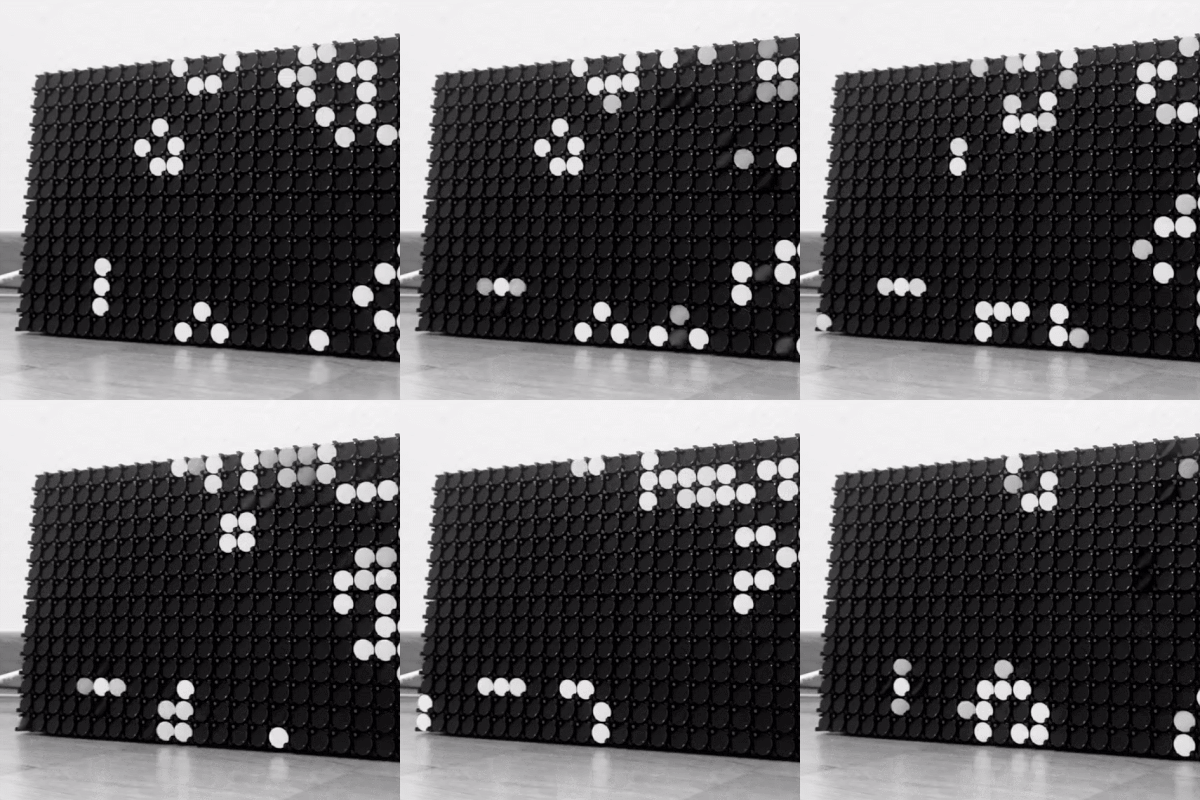 Like many of us, [John Whittington] was saddened with the news that John Horton Conway passed away a little earlier this year, and in honor of his work, he added the Game of Life to a flip-dot display that he has been working on. The physicality of an electromechanical display seems particularly fitting for cellular automata.
Like what you see? If you’re curious about what makes it all tick, the display shown is an Alfa-Zeta XY5 28×14 but [John] is currently working on building them into a much larger 256 x 56 display. GitHub hosts the flip-dot simulator and driver software [John] is using, and the Game of Life functions are here.
If you’re new to the Game of Life and are not really sure what you’re looking at, [Elliot Williams] tells you all you need to know in his writeup celebrating its profound impact and lasting legacy. Watch the flip-dot display in action in the video embedded below.
source https://hackaday.com/2020/07/02/watch-conways-game-of-life-flutter-across-a-flip-dot-display/
Last Of Me (Arknights Soundtrack)
Beast Mode | Russ, G-Eazy, Logic Hype Music Mix
Watch Conway’s Game of Life Flutter Across a Flip-Dot Display
Like many of us, [John Whittington] was saddened with the news that John Horton Conway passed away a little earlier this year, and in honor of his work, he added the Game of Life to a flip-dot display that he has been working on. The physicality of an electromechanical display seems particularly fitting for cellular automata.
Like what you see? If you’re curious about what makes it all tick, the display shown is an Alfa-Zeta XY5 28×14 but [John] is currently working on building them into a much larger 256 x 56 display. GitHub hosts the flip-dot simulator and driver software [John] is using, and the Game of Life functions are here.
If you’re new to the Game of Life and are not really sure what you’re looking at, [Elliot Williams] tells you all you need to know in his writeup celebrating its profound impact and lasting legacy. Watch the flip-dot display in action in the video embedded below.
source https://hackaday.com/2020/07/02/watch-conways-game-of-life-flutter-across-a-flip-dot-display/
Watch Conway’s Game of Life Flutter Across a Flip-Dot Display
Like many of us, [John Whittington] was saddened with the news that John Horton Conway passed away a little earlier this year, and in honor of his work, he added the Game of Life to a flip-dot display that he has been working on. The physicality of an electromechanical display seems particularly fitting for cellular automata.
Like what you see? If you’re curious about what makes it all tick, the display shown is an Alfa-Zeta XY5 28×14 but [John] is currently working on building them into a much larger 256 x 56 display. GitHub hosts the flip-dot simulator and driver software [John] is using, and the Game of Life functions are here.
If you’re new to the Game of Life and are not really sure what you’re looking at, [Elliot Williams] tells you all you need to know in his writeup celebrating its profound impact and lasting legacy. Watch the flip-dot display in action in the video embedded below.
source https://hackaday.com/2020/07/02/watch-conways-game-of-life-flutter-across-a-flip-dot-display/
Space Engineers Funny Moments – WorstPremadeEver
JUST WAIT FOR IT! MOST AMAZING AND FAILS MOMENTS COMPILATIONS #14
Plus size new mesh see through striped batch printed slim fit stretch dress(No lining) SKU A28771
Creation Is More Logical Than Evolution – Atheist Experience 490
Easy, Secure HTTPS With an ESP8266
Security has always been an issue with IoT devices. Off the shelf devices often have terrible security while DIY solutions can be complicated, needing recompilation every time a website’s fingerprint changes. [Johannes] wrote in to let us know he’s been working on a way to make HTTPS requests easier to do on ESP devices.
The normal ways to do HTTPS with an ESP8266 is to either use Fingerprints, or to use client.setInsecure(). Fingerprints require the user to know exactly which pages the ESP will connect to and extract the Fingerprints from each of those websites. Since the fingerprints change yearly, this means the fingerprint will have to be re-extracted and the code recompiled each time a fingerprint changes. The use of client.setInsecure() is, obviously, insecure. This may not be an issue for your project, but it might be for others.
[Johannes’] solution is to extract the trusted root certificates and store them in PROGMEM. This allows access to any web page, but the root certificates do expire as well. As opposed to the fingerprints, though, they expire after 20 years, rather than every year, so the program can run for a long time before needing recompilation. This solution also doesn’t require any manual steps – the build process runs a script that grabs the certificates and stores them as files that can be uploaded to the SPIFFS to be used during HTTPS requests.
He’s come up with a fairly straightforward way to have your IoT device connect to whichever web page you want, without having to recompile every once in a while. Hopefully, this will lead to better security for your IoT devices. Take a look at his previous work in this area.
source https://hackaday.com/2020/07/02/easy-secure-https-with-an-esp8266/
Custom Packet Sniffer Is A Great Way To Learn CAN
Whilst swapping out the stereo in his car for a more modern Android based solution, [Aaron] noticed that it only utilised a single CAN differential pair to communicate with the car as opposed to a whole bundle of wires employing analogue signalling. This is no surprise, as modern cars invariably use the CAN bus to establish communication between various peripherals and sensors.
In a series of videos, [Aaron] details how he used this opportunity to explore some of the nitty-gritty of CAN communication. In Part 1 he designs a cheap, custom CAN bus sniffer using an Arduino, a MCP2515 CAN controller and a CAN bus driver IC, demonstrating how this relatively simple hardware arrangement could be used along with open source software to decode some real CAN bus traffic. Part 2 of his series revolves around duping his Android stereo into various operational modes by sending the correct CAN packets.
These videos are a great way to learn some of the basic considerations associated with the various abstraction layers typically attributed to CAN. Once you’ve covered these, you can do some pretty interesting stuff, such as these dubious devices pulling a man-in-the-middle attack on your odometer! In the meantime, we would love to see a Part 3 on CAN hardware message filtering and masks [Aaron]!
source https://hackaday.com/2020/07/02/custom-packet-sniffer-is-a-great-way-to-learn-can/
NEW Building Apocalypse Survival Bunkers Under My House | Mr. Prepper Bunker Builder Tycoon Gameplay
Asterix In Britain (1986) HD, 16:9
POLICE FOUND A METH LAB IN MY NEIGHBORS HOUSE, KIDS WERE PUT INTO FOSTER CARE! – r/NeighborsFromHell
r/EntitledParents – KAREN TRIES TO FORCE HER SON INTO MY APARTMENT! GETS SHUT DOWN…
NEW TMT MERCH

New Trade Mark Tattoo Merchandise in stock. Contact us on 0313038713, info@trademarktattoos.com for prices or come by the shop to see our range of T-shirts, Caps & Patches.
An Off-The-Grid Instant Messaging Plattform
Having an open-source communication device that is independent of any network and works without fees sounds like a hacker’s dream come true. Well, this is exactly what [bobricius]’ is aiming at with his Armawatch and Armachat devices.
Recently, [bobricius] built a LoRa based instant messaging device named Armachat. The gadget is controlled by a SAMD21 MCU with native USB and includes a QWERTY keyboard and an LCD display. Communication is based on an RFM95 LoRa transceiver which can reach a range of up to 2 km under ideal conditions. [bobricius] is a wiz when it comes to PCB design and one thing that makes his projects look so good is how he often uses PCBs as enclosures.
Armachat came in two form factors a large desktop and a smaller pocket version. The new Armawatch is another downsized version that perfectly fits on your arm by using a smaller display and keyboard. [bobricius] also did a lot of work on the firmware which now features a message delivery confirmation and the possibility to automatically resend undelivered messages. Future improvements will include message encryption, a store-and-forward function, and GPS position parsing. [bobricius] is also working on completing his portfolio of communicators with a credit-card-sized version.
LoRa is the go-to technology for off-the-grid communication devices and there are already other ongoing projects for using it to construct a mesh network.


source https://hackaday.com/2020/07/02/an-off-the-grid-instant-messaging-plattform/