Building a Giant Meta-Clock Made of Smaller Clocks

Have any last-minute projects you finished just before the end of the decade? To help pass the time, [Erich Styger] decided to build a meta digital clock made up of 24 individual analog clocks, the perfect item to help welcome in the new year. The stepper clock is controlled by a network of LPC microcontrollers, displaying the time and room temperature, as well as several aesthetically pleasing loading animations.

Each clock operates from a 5 V USB power bank drawing less than 2 A for the full 24-clock setup. The meta-clock resides in a laser cut enclosure, with 3D printed hands telling the time. While having one board per clock would be easier to implement, [Erich] decided to use one board per four clocks arranged in rows to save on costs. The arrangement fixes the distance between clocks, though [Erich] also made the clock size slightly smaller to compensate.
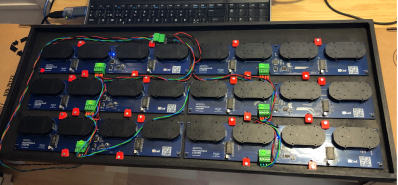
The ‘stepper’ part of the stepper clock uses a 360 degree version of the VID28 stepper motor to reduce the height of the design and the cost of the project. Apart from the X12.017 driver silently driving the motors, the stepper motors also conveniently only need a ‘direction’ and ‘step’ pin, reducing the pin count needed for the microcontroller. Neodymium magnets and hall effect sensors are used for tracking the position of the hands as the clocks move, with the magnets embedded into the clock hands.

As for communication, rather than use the common I2C protocol, the more robust RS-485 was selected. A master coordinates all of the clocks using the bus, providing a command line interface. The master is also able to communicate with the host PC over USB to maintain RTC time.

During the software development phase, [Erich] made use of the SEGGER J-Link EDU mini CLI for keeping track of information about the driver and each individual stepper motor. The software controlling the motors is written in C, with boards running FreeRTOS. The stepping is handled with a timer interrupt, but because the LPC845 doesn’t have enough timer channels, all of the functionality is done within a single channel. This results in plenty of interrupt handlers, flags, and callbacks across the code, which makes for some good fun.

Speaking of clocks, check out some of our other past clock hacks, including this mini-VFD clock and this fun LED matrix clock (it lets you play Tetris!)

source https://hackaday.com/2020/01/01/building-a-giant-meta-clock-made-of-smaller-clocks/
PoE Powers Christmas Lights, But Opens Up So Much More

Addressable LEDs are a staple of homemade Christmas decorations in our community, as is microprocessor control of those LEDs. So at first sight [Glen Akins]’ LED decorated Christmas tree looks pretty enough, but isn’t particularly unusual. But after reading his write-up you’ll discover there’s far more to the project than meets the eye, and learn a lot about the technologies behind it that has relevance far beyond a festive light show.

The decoration is powered exclusively from power-over-Ethernet, with a PIC microcontroller translating Art-Net DMX-over-Ethernet packets into commands for the LED string. The control board is designed from the ground up and includes all the PoE circuitry, and the write-up  gives a very thorough introduction to this power source that takes the reader way beyond regarding PoE as simply another off-the-shelf black box. Along the way we see all his code, as well as learn a few interesting tidbits such as the use of a pre-programmed EEPROM containing a unique MAC address.

So if your house has CAT5 wiring and you want an extra dimension to your festive splendour, you’ve officially got a whole year to build your own version. He’s featured here before, with his buzzer to break the Caps Lock habit.

source https://hackaday.com/2019/12/31/poe-powers-christmas-lights-but-opens-up-so-much-more/

Flip Phones Are Making a Comeback

If you’re the kind of person who hates this new generation of smartphone users and longs for a nostalgic past, you’re not far from the new target demographic for many commercial phone manufacturers. Major phone companies like Motorola and Huawei have been developing foldable versions of conventional smartphone designs, intended to be more versatile while maintaining the same functionality as their less flexible counterparts.

It’s certainly gimmicky, but phones like the Samsung Galaxy Fold, the Motorola Razr, and the Huawei MateX are elegant from an engineering perspective. Developing a seamless interface experience, maximizing surface area for functionality, and maintaining the same nostalgic flip phone aesthetic while making use of familiar smartphone features isn’t an easy design process.

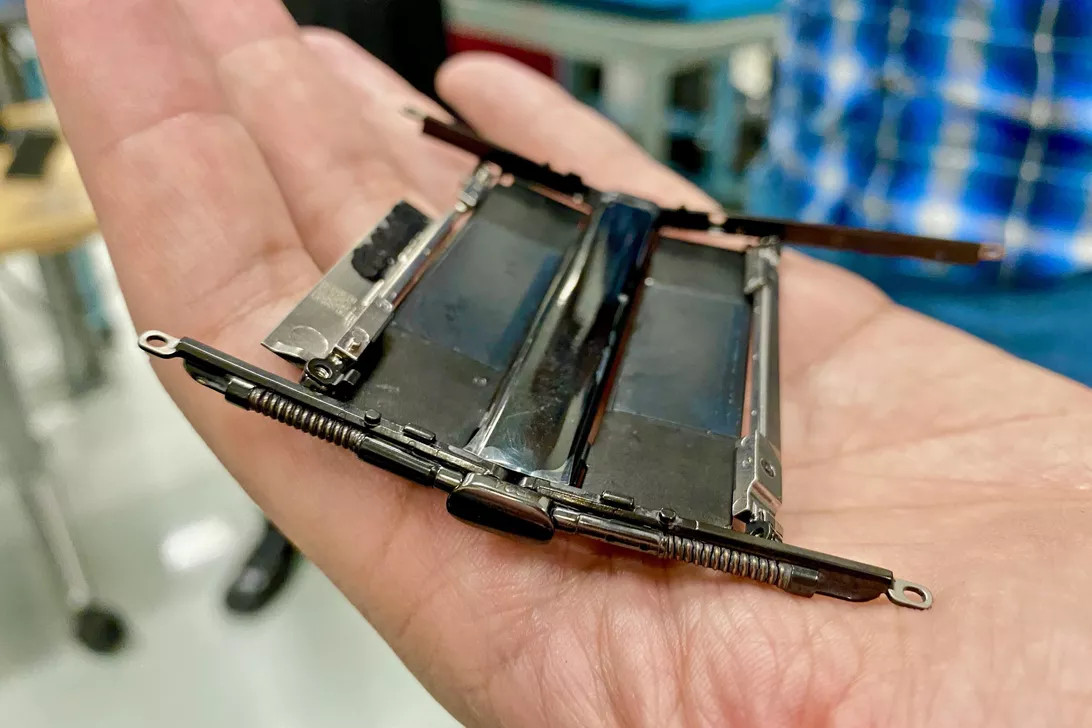
Motorola RAZR hinge shown by CNET’s Patrick Holland during a tour of their labs.

For the Razr, a hinge system that takes up about a third of the phone’s internal space allows the OLED display to have no noticeable binder line. Rather than curving like a piece of paper, it forms a teardrop shape that prevents the screen from creasing and being damaged. Springs and pistons below the surface move small places underneath where the user will be tapping – folded in, the plates slide away. It’s an interesting effect, although as you can see in the banner image, it doesn’t quite achieve optically flat perfection.

In order to ensure that the screen doesn’t overheat as it bends, it is made up of microlayers sandwiched together. To balance weight, the circuits and battery is split into two, operating on each half of the device, an unusual design choice for smartphones. Placement of the array of radios and antennas is also a challenge since they can’t be too close to each other or the processor, which can interfere with signal transmission.

Other devices like the Royale Flexpai are more so proof-of-concepts making use of flexible screens and batteries, rather than capturing the aesthetics of a flip phone generation — but who doesn’t want their smartphone to unfold into a tablet when needed? The future of smartphone technology is looking interesting, and we’ll be sure to see even more iterations of flexible displays in the near future.

source https://hackaday.com/2019/12/31/flip-phones-are-making-a-comeback/

Macro Photography With Industrial Lenses

Line scan cameras are advanced devices used for process inspection tasks in industrial applications. Used to monitor the quality of silicon wafers and other high-accuracy tasks, they’re often outfitted with top-quality optics that are highly specialised. [Peter] was able to get his hands on a lens for a line-scan camera, and decided to put it to work on some macro photography instead.

Macro image taken with the hacked lens.

Judging by the specs found online, this is a fairly serious piece of kit. It easily competes with top-shelf commercial optics, which is what piqued [Peter]’s interest in the part. Being such a specialised piece of hardware, you can’t just cruise over to eBay for an off-the-shelf adapter. Instead, a long chain of parts were used to affix this lens to a Sony AIII DSLR, converting from threaded fittings to a Nikon mount and then finally to Sony NEX mount.

Further work involved fitting an aperture into the chain to get the lens as close as possible to telecentric. This improves the lens’s performance for certain tasks, and makes focus stacking macro shots more readily achievable – something we’ve seen [Peter] tinker with before.

You never know what you might find when sorting through surplus industrial gear, could could score some high-performance hardware if you know where to look. It’s always great to see a cheap find become a useful instrument in the hacker toolbox!

source https://hackaday.com/2019/12/31/macro-photography-with-industrial-lenses/