
Yearly Archives: 2019
How to Host a website in Google Drive with custom Domain
Building a semi-permanent Shelter from natural materials only
EcubMaker – 4in1 Multi Tool 3D Printer – Unbox & Setup
Digital Wellbeing


Digital Wellbeing, see a complete picture of your digital habits and disconnect when you want to.
Get a daily view of your digital habits:
• How frequently you use different apps
• How many notifications you receive
• How often you check your phone or unlock your device
Disconnect when you want to:
• Daily app timers let you set limits for how much you use apps.
• Wind Down reminds you to switch off at night, setting a schedule to fade your screen to Grayscale while Do Not Disturb silences notifications for a good night’s sleep.
• Focus mode lets you pause distracting apps with a single tap so you can better focus your time. You can also set a schedule to turn on Focus mode automatically and reduce distractions while you’re at work, school, or home.
Get started:
• Look for Digital Wellbeing in your phone’s Settings menu
ADDITIONAL INFORMATION
Updated – December 10, 2019
Size – 6.5M
Installs – 1+
Current Version – 1.0.283573418
Content Rating – Rated for 3+
Offered By – Google LLC
Developer – Visit website
digital-wellbeing-help@google.com
1600 Amphitheatre Parkway, Mountain View
How to make ● a Vacuum Chamber ( for under $30 ! ) #youtubevids
Street Epistemology: LDS Missionaries Meet Atheist (Book of Mormon) #youtubevids
Dwarf Fortress – The Greatest Game We’ve Never Played #youtubevids
How Far is Too Far? | The Age of A.I. #youtubevids
Learn Python – Full Course for Beginners [Tutorial] #youtubevids
Tkinter Course – Create Graphic User Interfaces in Python Tutorial #youtubevids
DIY Mini Lab Bench Power Supply (With Switchable DC and AC Input) #youtubevids

Anya Chalotra
Top 20
 Unlock with Patreon
DIY Bluetooth Boombox Speaker With Music Reactive Led Light #youtubevids
Globes by Mova
- MOVA Globes utilizes solar cell technology to rotate silently on its own with any ambient indoor light or indirect sunlight, no batteries or wires required. Non-toxic fluids rest between the inner and outer acrylic shells for low-friction environment
- Measures 4.5 inches in diameter, fitting in the palm of your hand; slightly larger than a softball. After base assembly, measures approximately 7 inches in height and weighs 4 pounds
- Globe comes with easy-to-assemble 3-pronged acrylic stand and user manual, all in secure foam packaging
- Unique gift item for home decorators, tech geeks, world travelers, astronomy enthusiasts, educators, corporation gifts and the person who already has everything. Globe’s silent movement reflects the steady rotation of the earth while sparking conversation and wonder for anyone who comes across its path
Laser Welding With A Tattoo Removal Gun
Dating as far back as the early 1960’s, researchers were zapping tattoo inks with laser light was an effective way to remove the markings from human skin. At the time it was prohibitively expensive. But the desire to have an undo-button for badge choices is strong, and thus the tattoo removal gun was born.
These days you can pick up one of these zappy, burn-y wonders for far less than a flagship cellphone put their high-power-output to alternative use. [Andrew] recently discovered that these devices can be readily repurposed into a laser welding tool with just a bit of work under the hood.
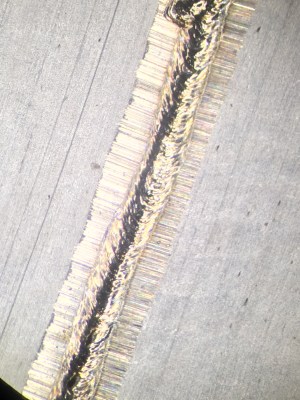 He first came across the technology via videos from [styropyro], whose work we’ve featured before. The tattoo removal gun features a YAG laser, which is pulsed to create a high power density. In initial testing, the pulses were too short and of too high intensity to effectively weld with; instead, the pulses simply cratered the metal.
After delving in further, [Andrew] discovered that by removing the Q-switch optical component, the pulses from the laser could be lengthened. This reduces the power density, and allows the tool to weld various materials even on its lower power settings. Success was found welding steel, titanium, and other materials, though attempts to weld copper and silver faced little success. Test pieces included razor blades and small screws, which could easily be welded with the tool. Results of the razor blade welding is spectacular, with a high-quality welding bead achieved by taping the laser to a CNC mill for precise movement.
It could prove to be a useful tool for those experimenting with complex projects involving bonding metals at very fine scales. If you’re pursuing something exotic yourself, we want to hear about it!
source https://hackaday.com/2019/12/25/laser-welding-with-a-tattoo-removal-gun/
AMAZING Physics Toys That You Will LOVE! #youtubevids
r/IDOWORKHERELADY | Oh, You’re good friends with the Boss. It’s Weird because I’m the Owner. #youtubevids
Why Don’t You Have the Conviction to Take a Stand on God? | Corey – USA | Atheist Experience 22.39 #youtubevids
