Prusa Dares You to Break Their Latest Printer

Two months after its surprise reveal at the 2019 East Coast RepRap Festival, the Prusa Mini has started shipping out to the first wave of early adopters. True to form, with the hardware now officially released to the public, the company has begun the process of releasing the design as open source. In their GitHub repository, owners can already find the KiCad files for the new “Buddy” control board and STLs for the machine’s printable parts.

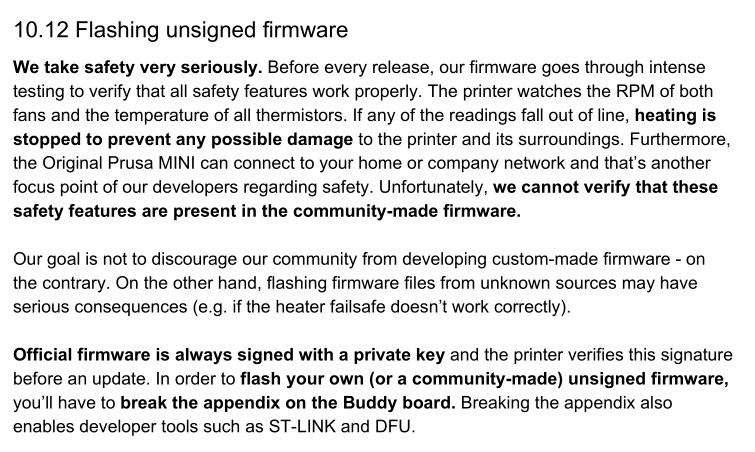
But even so, not everyone feels that Prusa Research has made the Mini as “open” as its predecessors. Some concerned owners have pointed out that according to the documentation for the Buddy board, they’ll need to physically snap off a section of the PCB so they can flash custom firmware images via Device Firmware Upgrade (DFU) mode. Once this piece of the board has been broken off, which the documentation refers to as the Appendix, Prusa Research will no longer honor any warranty claims for the electronic components of the printer.
For the hardcore tinkerers out there, this news may come as something of a shock. Previous Prusa printers have enjoyed a fairly active firmware development community, and indeed, features that started out as user-developed modifications eventually made their way into the official upstream firmware. What’s more, certain hardware modifications require firmware tweaks to complete.

Prusa Research explains their stance by saying that there’s no way the company can verify the safety of community developed firmware builds. If thermal runaway protections have been disabled or otherwise compromised, the results could be disastrous. We’ve already seen it happen with other printers, so it’s hard to fault them for being cautious here. The company is also quick to point out that the installation of an unofficial firmware has always invalidated the printer’s warranty; physically breaking the board on the Mini is simply meant as a way to ensure the user understands they’re about to leave the beaten path.

How much support is a manufacturer obligated to provide to a user who’s modified their hardware? It’s of course an issue we’ve covered many times before. But here the situation is rather unique, as the user is being told they have to literally break a piece off of their device to unlock certain advanced functionality. If Prusa wanted to prevent users from running alternate firmware entirely they could have done so (or at least tried to), but instead they’ve created a scenario that forces the prospective tinkerer to either back down or fully commit.

So how did Prusa integrate this unusual feature into their brand new 32-bit control board? Perhaps more importantly, how is this going to impact those who want to hack their printers? Let’s find out.

A Tale of Two Grounds

Looking at pictures of the assembled Buddy board, it’s not immediately obvious how the so-called Appendix works. It’s just a small piece of the PCB with no components on either side, there aren’t even any obvious traces running through it. But with a quick look at those aforementioned KiCad design files, we can put the pieces together.
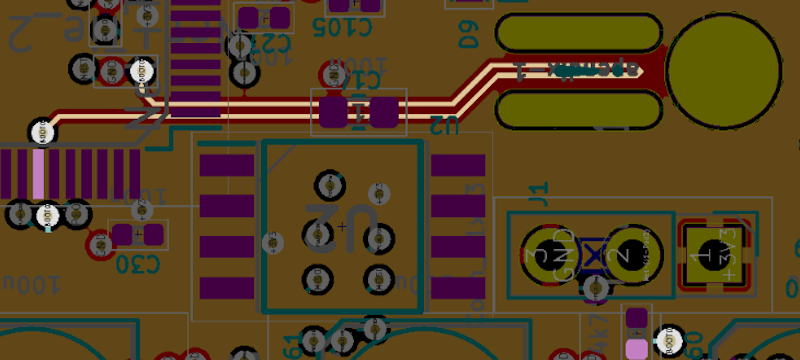
As we can see, there’s a trace on one of the internal copper layers that loops through the Appendix. One side is connected to ground, and the other to the BOOT0 pin on the STM32F407VGT6 MCU. Consulting the datasheet for the chip, we can see that holding BOOT0 low like this disables DFU mode. So that explains why it has to go.

But the documentation says that to enable DFU mode you need to bring the BOOT0 pin high, and breaking the Appendix only leaves it floating. That’s where the second trace comes in. This one runs from BOOT0 to the center pin of a nearby three pin header. With pins for ground and 3.3 V on either side, a jumper can be used to switch BOOT0 between low and high. The Appendix is essentially a “safety” that prevents this jumper from having any effect.
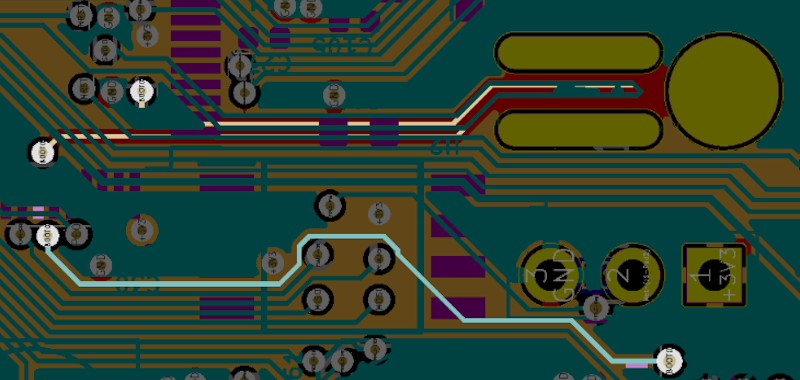
The attentive reader may be wondering what would happen if you moved the jumper over to 3.3 V with the Appendix intact. It looks like Prusa considered this possibility, as the circuit diagram actually shows a 4.7K resistor between the header and BOOT0 pin to avoid a dead short.

Prusa Developer Program

While we’re certainly approaching the point where the average 3D printer owner is no different than the sort of person who owns a drill press or a table saw, a good chunk of them still spend as much time tweaking and modifying their machine as they do actually printing with it. So it’s little surprise that the possibility of firmware hacking being off the table has lead to some backlash.

But if there’s anyone who understands the desire to hack, modify, and improve 3D printers, it’s Josef Průša. The very real dangers of unchecked firmware modification forced him to act, as much to protect his customers as his brand, but he’s made it clear that the intent was never to block the more technically inclined users from getting their hands dirty.

In a recent blog post, Josef explained the company’s plan to introduce a “Developer Program” that is aimed specifically at those who want to get involved in unofficial firmware development:

Also, we plan to launch a community developer program in the upcoming months. You’ll get extra resources from us and in case you break something during development, you will get new parts (no matter whether you broke the “appendix” on the mainboard). We’ll publish more information soon, so stay tuned!

Such a program sounds like it would address essentially all of the concerns currently being voiced by users, though undoubtedly some will resent needing to register themselves as “developers” if all they want to do is modify a few lines of code in their printer’s firmware. It’s also unclear if a cost will be associated with this program, but it’s somewhat difficult to believe that the company will completely foot the bill for expanded customer support and access to replacement parts.

The End-Hacker License Agreement

Hacker-friendly companies like Prusa Research are in a difficult position. On one hand, they don’t want to do anything that prevents more technical users from modifying their products. But at the same time, it’s unreasonable to expect a manufacturer to replace hardware that was damaged while the user was performing unsanctioned modifications. As hackers, we need to acknowledge that there’s a certain level of personal responsibility that comes with the territory.

At the end of the day, the introduction of the Appendix should be seen as a net positive for the hacking community. It provides a clear line in the sand for anyone who wants to explore their hardware, and ensures both parties clearly understand the paradigm shift that happens when the user decides to take matters into their own hands. The fact that it even exists shows the hardware was not designed to restrict the user’s rights, but rather to acknowledge and respect them.

With any luck, the next time a manufacturer does something like this they’ll put “REMOVE BEFORE HACK” right on the silkscreen.

source https://hackaday.com/2019/12/16/prusa-dares-you-to-break-their-latest-printer/

Weird World of Microwaves Hack Chat

Join us on Wednesday, December 18 at noon Pacific for the Weird World of Microwaves Hack Chat with Shahriar Shahramian! We’ve been following him on The Signal Path for years and are excited to pick his brain on what is often considered one of the dark arts of electronics.

No matter how much you learn about electronics, there always seems to be another door to open. You think you know a thing or two once you learn about basic circuits, and then you discover RF circuits. Things start to get a little strange there, and stranger still as the wavelengths decrease and you start getting into the microwave bands. That’s where you see feed lines become waveguides, PCB traces act as components, and antennas that look more like musical instruments.

Shahriar is no stranger to this land. He’s been studying millimeter-wave systems for decades, and his day job is researching millimeter-wave ASICs for Nokia Bell Labs in New Jersey, the birthplace of the transistor. In his spare time, Shahriar runs The Signal Path, a popular blog and YouTube channel where he dives tear-downs, explanations, and repairs of incredibly sophisticated and often outrageously expensive equipment.

We’ll be sitting down with Shahriar this week for the last Hack Chat of 2019 with a peek inside his weird, wonderful world of microwaves. Join us with your questions about RF systems, microwaves in the communication industry, and perhaps even how he manages to find the gear featured on his channel.

join-hack-chatOur Hack Chats are live community events in the Hackaday.io Hack Chat group messaging. This week we’ll be sitting down on Wednesday, December 18 at 12:00 PM Pacific time. If time zones have got you down, we have a handy time zone converter.

Click that speech bubble to the right, and you’ll be taken directly to the Hack Chat group on Hackaday.io. You don’t have to wait until Wednesday; join whenever you want and you can see what the community is talking about.

source https://hackaday.com/2019/12/16/weird-world-of-microwaves-hack-chat/

Sleek, Sophisticated Skittle Sorter

Sorting candy by color is a classic problem that has its roots in the contract riders of rock stars who were just trying to make sure that more important contractual obligations were not being overlooked by concert venues. Through the years, candy sorting has become a classic problem for hobbyists to solve in various ways. After a false start a few years back, [little french kev] was compelled to dust off those plans and make the most compact sorter possible.

This minimalist beauty uses an Arduino Nano and RGB sensor to assess the color. At the top, a small servo rotates an arm inside the hopper that both shakes the Skittles and sets them up single file before the sensor. Another small servo spins the tube rack around to catch the rainbow. There’s an RGB LED in the base that bathes the tube from below in light that matches the Skittles. Check out the series of gifs on [little french kev]’s personal project site that show how each part works, and then watch the build video after the break.

Did you know you can roll your own color sensor from an RGB LED and a photocell? If you don’t think candy is so dandy, you could always color-sort your LEGO.

source https://hackaday.com/2019/12/16/sleek-sophisticated-skittle-sorter/

Mikayla Deysel

Mikayla

Tiktok

Kaynova – Mikayla is a content creator on tiktok and other platforms. Keep an eye out, there’s more to come…

@19_kaynova_98

♡Birthday: 11/12/1998♡

♡Let your past make you BETTER not BITTER♡

The Hornsdale Power Reserve And What It Means For Grid Battery Storage

Renewable energy has long been touted as a major requirement in the fight to stave off the world’s growing climate emergency. Governments have been slow to act, but prices continue to come down and the case for renewables grows stronger by the day.

However, renewables have always struggled around the issue of availability. Solar power only works when the sun is shining, and wind generators only when the wind is blowing. The obvious solution is to create some kind of large, grid-connected battery to store excess energy in off-peak periods, and use it to prop up the grid when renewable outputs are low. These days, that’s actually a viable idea, as South Australia proved in 2017.

Building The World’s Largest Lithium-Ion Battery

The blackout was caused by storms taking down transmission lines, but the politics of the day laid the blame at renewable energy’s door. Credit: ABC News

On the 28th of September, 2016, the state of South Australia faced an unprecedented storm. Wind gusts exceeded 120 km/h, and pouring rains threatened to flood low-lying areas. Amid the chaos, major transmission lines and interconnectors were damaged, and the entire grid went down. 1.7 million people were suddenly without power.

Thankfully, in the hours following, civilization remained standing. Emergency crews were able to bring the grid back to life relatively quickly, with most parts of the state up and running within 24 hours. Despite this, the incident was quickly used as a political football, with the reigning pro-coal Federal Government placing the blame squarely on the state’s heavy use of renewable energy. This was provably false, but spawned a greater discussion about improving grid resilience and the use of grid storage for when solar and wind generation is impractical.

Despite the hype and bluster, or perhaps because of it, the battery was built in record time. Credit: The Lead SA

The polava drew the attention of Elon Musk, who threw down the gauntlet. A battery-based storage solution installed within 100 days of contract signature — or it’s free. Further billionaires weighed in, and the State Government set the project in motion. Construction actually began prior to the contract being signed on September 29th, 2017, with the battery finished 55 days later, technically well ahead of schedule. Some decried it as a PR stunt, but the Hornsdale Power Reserve now sports the world’s largest lithium-ion battery, connected right up to the grid.

Taking Advantage of a Fast and Ready Resource

The battery as installed features 129 MWh of storage, using Samsung 21700 lithium-ion cells, similar to those in the Tesla Model 3. Capable of a maximum discharge rate of 100MW, at full tilt the battery can operate for a little over an hour. However, in day to day operation, the battery is not used in such a way. Instead, the battery is contracted to operate in several different ways to suit the needs of the grid.

Three hours of output at 30 MW (or 90 MWh of capacity) is set aside for load shifting. This is where excess renewable energy is stored in the battery when not needed by the grid. This power is then later sold on the market during peak times when electricity prices are higher.

Next to this, 70MW of output is reserved for maintenance of grid stability. Power grids require careful management of their many connected generators, in order to make sure that the voltage and frequency of the grid remain in acceptable bounds. This is achieved through maintaining a balance between the supply and demand of electricity across the entire grid. Sudden changes in either supply or demand require quick reactions from attached generators in order to avoid major excursions that can risk taking the grid offline, or lead to rolling blackouts. Commonly, this happens when a major generator such as a coal plant has a fault, or when a soap opera ends in England and thousands of households all switch on the kettle at the same time. This is referred to as Frequency Control and Ancilliary Services (FCAS) in the local market, and is typically handled by gas-powered generators, which can respond on timescales of seconds to minutes.

A graph of the Loy Yang incident in December 2018, showing the Hornsdale Power Reserve’s quick response time to the frequency excursion. Credit: Renew Economy

The Hornsdale battery, however, is capable of much faster response times. On December 14th, 2017, the Loy Yang A coal generator tripped, causing the sudden loss of 560 MW of generation from the grid. Upon the main frequency dropping to 49.8 Hz, in mere milliseconds, the Hornsdale installation delivered 7.3 MW to the grid to prop up the frequency over a period of several minutes, while other infrastructure was brought online. This fast-discharge capability has allowed the battery to beat other generators to the punch. This has brought the battery’s owners, Nueon, significant profits from the provision of FCAS services to the grid, taking 55% of the market from existing operators. There have been complaints that the existing billing system is not actually fast enough to properly compensate the battery’s owners for its output, as the system was originally designed around conventional generation which is slower to respond.

Looking To The Future

The success of the project has proven that battery storage at a grid scale is now practical and, more importantly, profitable. The Hornsdale Power Reserve was built at a cost of just $50 million, and despite their initial mockery of the state project, the Federal Liberal government have confirmed funding for the expansion of the project. The battery will be upgraded to deliver up to 150 MW, with capacity expanding to 193.5 MWh. This will allow the battery more capacity to respond in the case of adverse events, as well as improve the profitability of load shifting operations. There will also be trials of “digital inertia” technology, where the battery’s inverters will be designed to replicate the mechanical inertia of large synchronous generators, further stabilizing the grid.

Other lithium-ion battery projects are cropping up worldwide, too. Plans for a New York plant are underway, aiming for a 316 MW output and a massive 2,528 MWh of capacity, allowing the battery to run for extended periods. California is also looking to host a pair of installations, with a 400 MW project in Long Beach and a 300 MW project in Moss Landing.

With the cost of lithium-ion batteries continuing to come down thanks to economies of scale and the electric car revolution, it’s likely that yet more projects will come to fruition. Where there is profit to be made in the load shifting of renewable energy, along with a need for highly responsive grid stabilization services, grid storage batteries make a strong business case.

source https://hackaday.com/2019/12/16/the-hornsdale-power-reserve-and-what-it-means-for-grid-battery-storage/

wickr logo

Wickr

Wickr Pro Is Your Secure Team Collaboration Space

Fully encrypted. Enterprise-ready. Private. Set up in minutes and invite your team to join your private Wickr Network.

Control and protect your most critical communications. Wickr’s end-to-end encrypted platform offers features like: Voice & Video Calls, File transfer, SSO and MDM integration, Bots, full administrative controls and a whole lot more.

download app store
download play store
download desktop

me app icon

Wickr Me

Sign-up, download the app, and invite your contacts in minutes. It’s that easy. Take control of your critical communications and personal data. Always anonymous, fully-encrypted and ephemeral. Join millions of users worldwide

pro app icon

Wickr Pro

Sign-up, invite your team with the convenient Network Dashboard, and download the app to get your own secure and private Wickr network in minutes. Take control of your most critical communications and data exchanges. On multiple networks? No problem, Wickr has cross-network communications with other Wickr Pro and Wickr Me users. It’s that easy.

Dashboard Dongle Teardown Reveals Hardware Needed to Bust Miles

Progress and the proliferation of computers in automotive applications have almost made the shade tree mechanic a relic of the past. Few people brave the engine compartment of any car made after 1999 or so, and fewer still dive into the space behind the dashboard. More’s the pity, because someone may be trying to turn back the odometer with one of these nefarious controller area network (CAN bus) dongles.

Sold through the usual outlets and marketed as “CAN bus filters,” [Big Clive] got a hold of one removed from a 2015 Mercedes E-Class sedan, where a mechanic had found it installed between the instrument cluster and the OEM wiring harness. When the dongle was removed, the odometer instantly added 40,000 kilometers to its total, betraying someone’s dishonesty.

[Big Clive]’s subsequent teardown of the unit showed that remarkably little is needed to spoof a CAN bus odometer. The board has little more than an STM32F microcontroller, a pair of CAN bus transceiver chips, and some support circuitry like voltage regulators. Attached to a wiring harness that passes through most of the lines from the instrument cluster unmolested while picking off the CAN bus lines, the device can trick the dashboard display into showing whatever number it wants. The really interesting bit would be the code, into which [Clive] does not delve. That’s a pity, but as he points out, it’s likely the designers set the lock bit on the microcontroller to cover their tracks. There’s no honor among thieves.

We found this plunge into the dark recesses of the automotive world fascinating, and [Big Clive]’s tutelage top-notch as always. If you need to get up to speed on CAN bus basics, check out [Eric Evenchick]’s series on automotive network hacking.

[rasz_pl] sent us a tip on this one. Thanks!

source https://hackaday.com/2019/12/16/dashboard-dongle-teardown-reveals-hardware-needed-to-bust-miles/

Nintendo Switch Doubles as Network Switch

Coming straight to you from the “Department of Redundant Redundancies” comes this clever hack that turns a Switch into a switch. More specifically, a network switch. Not even a half bad one either, judging by the speed tests [Cynthia Revström] performed after setting it all up. We wouldn’t advise you dump your existing network gear in favor of a repurposed game system, but perhaps in a pinch…

Despite what you might be thinking, there’s no hardware modifications at work here. This is a fully functional Nintendo Switch that’s just had two USB to Ethernet adapters plugged into it. The secret ingredient is the addition of some Penguin Power, up and running on Nintendo’s latest and greatest thanks to a project called switchroot.

With Linux running on the system, all [Cynthia] had to do was make sure that the USB to Ethernet adapters were supported, and fiddle around with the brctl and ip commands to configure a bridge between the interfaces to get the packets moving. Putting the Switch between the main network and a test computer showed it had a throughput of just over 90 Mbps, which is about all that could be expected from the USB-connected network interfaces.

From here it wouldn’t have taken much more effort to get the system working as a wireless router and providing services like DHCP and NAT to clients. But since Nintendo didn’t see fit to call it the Router, that would’ve offered minimal meme value. There’s always next generation.

Seeing the Nintendo Switch do a surprisingly good job running as an Ethernet switch is even more surprising given the fact that it struggles to function with accessories that are actually intended for it. Though to be fair, the migration to USB-C has been a little rockier than most of us would have hoped.

source https://hackaday.com/2019/12/16/nintendo-switch-doubles-as-network-switch/

Old Christmas Tree Gets a New Spin

A couple of Christmases ago, [Nick] got tired of trying to evenly decorate his giant fake tree and built an MDF lazy Susan to make it easy as eggnog. But what’s the point of balanced decorations if one side of the tree will always face the wall? This year, [Nick] is giving himself the gift of a new project and motorizing the lazy Susan so the tree slowly rotates.

The saintly [Nick] decided to do this completely out of the junk box, except for all the WS2811 RGB LEDs on order that he hopes to synchronize with the tree’s movement. He started by designing a gear in OpenSCAD to fit the OD of the bearing, a task made much simpler thanks to the open-source gear libraries spinning around out there.

It was hard to get slow, smooth movement from the NEMA-23 he had on hand, but instead of giving up and buying a different motor, he designed a gear system to make it work. Our favorite part has to be the DIY slip ring [Nick] made from a phono connector to get around the problem of powering a rotating thing. This is a work in progress, so there are no videos just yet. You can watch [Nick]’s Twitter for updates.

[Nick] didn’t specify why he chose to use WS2811s, but they have gotten pretty cheap. Did you know you can drive them with VGA?

Via Adafruit’s CircuitPython newsletter

source https://hackaday.com/2019/12/15/old-christmas-tree-gets-a-new-spin/

A Modern Take On A Piece Of Old Test Equipment

The HP 11947A is something of a footnote in the back catalogue of Hewlett Packard test equipment. An attenuator and limiter with a bandwidth in the megahertz rather than the gigahertz. It’s possible that few laboratories have much use for one in 2019, but it does have one useful property: a full set of schematics and technical documentation. [James Wilson] chose the device as the subject of a clone using surface mount devices.

The result is very satisfyingly within spec, and he’s run a battery of tests to prove it. As he says, the HP design is a good one to start with.   As a device containing only passive components and with a maximum frequency in the VHF range this is a project that makes a very good design exercise for anyone interested in RF work or even who wishes to learn a bit of RF layout. At these frequencies there are still a significant number of layout factors that can affect performance, but the effect of conductor length and  stray capacitance is less than the much higher frequencies typically used by wireless-enabled microcontrollers.

source https://hackaday.com/2019/12/15/a-modern-take-on-a-piece-of-old-test-equipment/

Hackaday Links: December 15, 2019

When you’re right, you’re right. Back in January, we predicted that exoskeletons were about to break out as a mainstream product, and gave several examples of prototypes poised to become products. So it was with interest that we read about Sarcos Robotics and their new Guardian XO, a cyber suit aimed at those doing heavy lifting tasks. The wearable, full-body exoskeleton is supposed to amplify the wearer’s effort 20-fold, making a 200-pound load feel like lifting 10 pounds. It runs untethered for two hours on hot-swappable battery packs, and will be offered for lease to civilian heavy industries and the military for $100,000 a year. Honestly, it seems like you could hire a fair number of meat-robots for that sum, but still, it’s an interesting technology and a promising development.

Aficionados of 3D printing know all too well the limitations of the technology. While we’ve come a long way with things like a print in place, multiple materials, embedded electronics, and even direct 3D printing of complex mechanisms like electric motors, there’s been a long-standing obstacle to turning the 3D printer into the replicators of the Star Trek universe: batteries. But even that barrier is falling, and a new paper shows just how far we’ve come to printing batteries right into our designs. Using an off-the-shelf Prusa Mk 3 and specially formulated lithium iron phosphate/PLA and silicon dioxide/PLA filaments, the group was able to print working batteries in one shot. It’s exciting news because previous 3D-printed batteries required special printers or laborious post-processing steps. We’ll be watching for developments here.

Speaking of laboratory work, anyone who has been around labs is probably familiar with LabVIEW, the de facto standard for programming data capture and automation applications in the laboratory setting. The graphical programming language makes it easy to throw together a quick interface, and many lab-rats regret not having the expensive, proprietary environment available for their after-hours hacking. That might no longer be true, though, with special LabVIEW licensing for non-commercial users. It looks like there are two levels: LabVIEW Home Edition and a Community Edition of LabVIEW, which is currently in Beta. Either way, it’s good news for LabVIEW fans.

Friend of Hackaday Eric Strebel released a video the other day that we just had to comment on. It has nothing to do with electronics – unless you’re into circuit sculpture, that is. In the first of a two-part series, Eric covers the basics of modeling with brass and copper, using both wire and tubing. He has some great tips, like work-hardening and straightening copper wire by stretching it, and the miniature roll bender seen at 7:40 looks like something that could easily be 3D-printed. We recently did a Hack Chat on circuit sculpture with Mohit Bhoite, and saw his Supercon talk on the subject, so this video really got the creative juices flowing.

If you’re local to the Elkhorn, Wisconsin area, consider stopping by the Elkhorn Mini Maker Faire on February 15 and 15. Elkhorn looks like it has a nice central location between Milwaukee and Madison, and doesn’t appear too far from Chicago either, which is probably why they drew 1,200 people to the inaugural Faire last year. They’re looking to get that up to 2,000 people this year and over 150 booths, so if you’ve got something hackish to show off, check it out. The organizers have even set up a Hackaday.io event page to coordinate with the Hackaday community, so drop them a line and see what you can do to pitch in.

And finally, this one has us scratching our head. Activist group Extinction Rebellion (XR) has claimed they’ve “decommissioned” thousands of electric scooters in French cities. Why they’ve done this is the puzzler; they claim that the scooters-for-hire are an “ecological disaster” due to the resources needed to produce them compared to their short lifespan. We haven’t done the math. What is interesting, though, is the mode of decommissioning: XR operatives simply defaced the QR code on the scooters, rendering them un-rentable with the vendor’s smartphone app. Scooter companies might want to look into alternative rental methods if this keeps up.

source https://hackaday.com/2019/12/15/hackaday-links-december-15-2019/

A LED Cube Designed for Easy Assembly

LED cubes are mesmerizing and fun, but they’re usually a pain to build. Not so with [burkethos]’s cleanly designed cube. 

Many cubes are put together in an elaborate sculptural style. Traditionally the leads of the LEDs are artistically bent and then hours are spent laboring over the future rainbow Borg cube. This build is more reminiscent of a motherboard or back plane design. The LEDs are surface mount units re-flowed onto a rake shaped PCB. At the base of each “rake” there’s a right angle male header. This is then soldered to base board which creates a reliable mechanical bond.

There are some downsides to this approach. For example, the PCBs occlude the LEDs at some viewing angles. However, this can be mitigated with careful placement in the room, or in one variation, mounting the cube at a different orientation so the rakes are horizontal rather than vertical.

Regardless, we appreciate this new take on an old project and can definitely see it having a more universal appeal than the kits that require a couple weeks of afternoons to finish.

source https://hackaday.com/2019/12/15/a-led-cube-designed-for-easy-assembly/